
I bought a generator in April. Dual-fuel portable, runs on propane so you don't have to keep gasoline in the garage. I spent three weeks on it. Compared wattage and runtime and noise levels, read forums where people argued about inverter versus conventional, watched a guy on YouTube test six models in his driveway in Phoenix. I was thorough. I was careful. I did the work the way you do work when the work is the only part you can control, and when the thoroughness is also a way of not saying out loud what the purchase means.
My husband asked if something had happened. Meaning had I read something, seen something. I said no. He said okay. He didn't ask again.
I've been trying to figure out what to call that purchase. The generator is just a machine. I'm trying to name the thing that made me buy it. The shift that made me a person who buys a generator for no particular emergency, who does three weeks of research for a machine she hopes she won't need but is pretty sure she will.
People offer words for this. I've been testing them.
Grief is the first one. Climate grief. You hear it a lot. I pulled out the hydrangeas in March. My mother-in-law gave them to us when we moved in, and they'd been struggling for two summers. I'd been watering them the way you visit someone in the hospital, bringing what you have, knowing it's not enough. Pulling them out was grief. I'll give it that. But I put in lantana and salvia and black-eyed Susan, plants that can handle the heat, that don't need much water, and the feeling I had standing in the yard afterward wasn't about what was gone. It was about what I'd chosen instead. The new plants looked fine. They'd probably do well. The feeling was in the choosing, in the calculation that went into it. Grief is about what's missing. I was standing there with dirty hands, already thinking about drip irrigation. Whatever this is, it has too much to do to sit with what's gone.
Resignation is the next one people try. You've given up.
I haven't given up. I bought a generator. I replanted the yard. I planned my daughter's summer around cooling and hydration and indoor hours between noon and four. Morning swim, afternoon library. She'd rather be at the pool all day, but the library is air-conditioned and free and open until five. My mother planned my summers around sunscreen and bug spray, and it was casual, almost an afterthought. Mine is structural. I've built a schedule around a climate. I don't know what that is, but it's not giving up.
A Pew survey from this spring found that 62 percent of Americans now believe countries won't do enough to avoid the worst effects of climate change. Among Democrats it's 69 percent, up from 51 four years ago. I read that and felt something I can only describe as the relief of hearing someone cough in a room you thought was empty. Not happy. Just less alone in it.
Sixty-two percent. That number is still moving. People are still crossing over, and they're crossing in the same direction.
My friend calls what I'm doing pragmatic. She means it kindly. She's still signing petitions, sharing articles, talking about what we need to demand. I don't disagree with any of it. I just also don't do it anymore, and she's noticed. Pragmatism sounds clean, though. Sensible. Like you've run the numbers and you're acting on them. But pragmatism doesn't account for the thing that happened at Target last week. I was buying a second box fan for my daughter's room and another woman was doing the same thing and we looked at each other and neither of us said anything. Pragmatism doesn't have that woman's face. Whatever passed between us in that aisle, pragmatism doesn't have a word for it.
The APA found that 52 percent of parents say climate change is affecting their mental health. One-third of American adults worry about it weekly. I don't know if what I do counts as worrying. Worrying is what you do when you don't know what to do. I know what to do. I'm doing it. The feeling lives in the doing-it-without-expecting-it-to-be-enough.
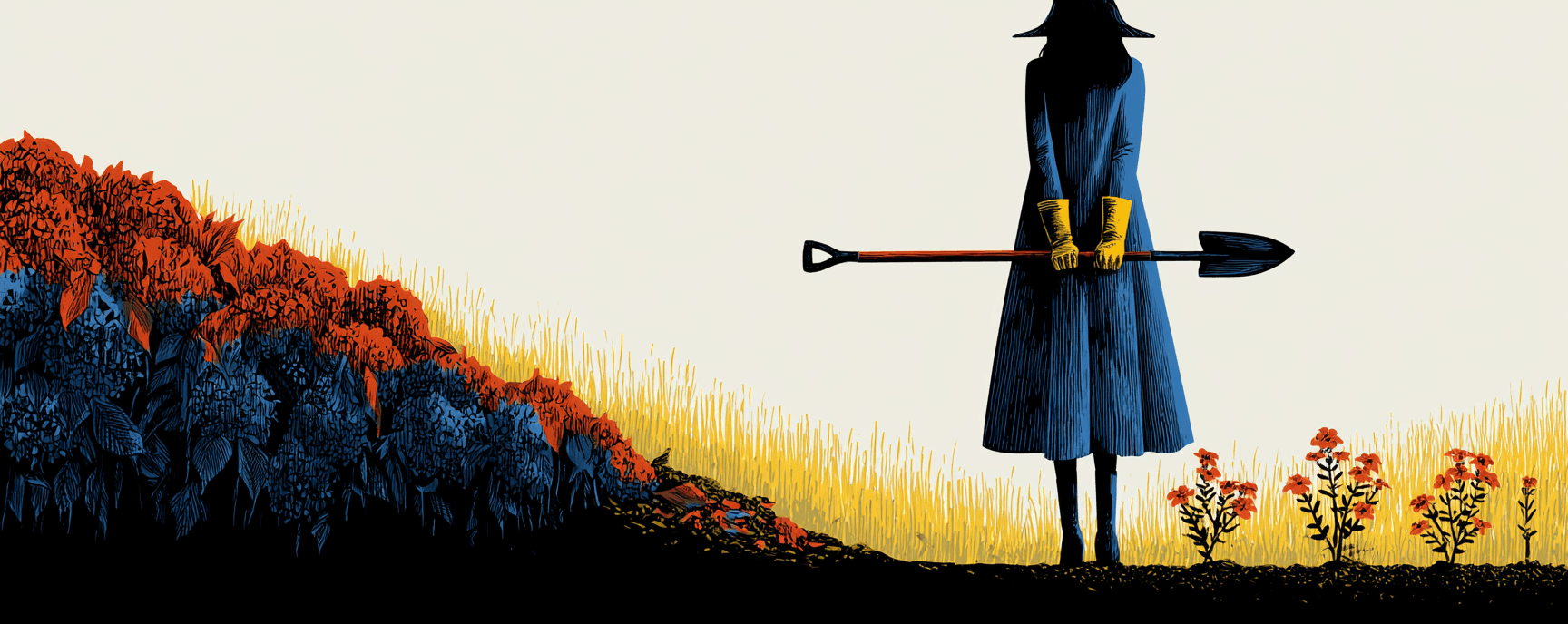
There are clinical words. An Australian philosopher coined "solastalgia" for the homesickness you feel while you're still home, when the place you live becomes unfamiliar while you're standing in it. That one gets close when I look at the yard. The lantana is fine. It's even pretty. But the yard is not the yard I moved into, and I'm the one who changed it, and I changed it because I was paying attention. I made my home unfamiliar to myself on purpose. Solastalgia gets at the yard. But I'm the one who held the shovel. I did it with a plan and a credit card at the nursery. Whatever you call the person holding the shovel, that's a different word.
There's eco-anxiety. Pre-traumatic stress. I've read about these too. Pre-traumatic. Pre. But two-thirds of registered voters told Yale and George Mason researchers this spring that climate change is already raising their utility bills. Sixty-one percent said the same about groceries. When I sat down in January and looked at what we'd spent on electricity last summer, what I felt wasn't anxiety. It was arithmetic. I knew what the numbers would look like. I was just adding them up.
Here's the thing the Pew data showed that I keep coming back to: the share of Americans who believe climate change is mostly caused by human activity has barely moved in a decade. Around 50 percent since 2016. The people who believe the science stopped expecting the science to lead to action. That's the part that moved.
The knowing and the expecting came apart. That's the crossing I'm trying to name. What I believe hasn't changed. What I expect believing to accomplish has.
I can feel it in how I read the news now. A report comes out. I read it. The numbers are what I thought they'd be, or worse. And nothing moves inside me, because the knowing was already there. The part that used to convert knowing into expecting someone to do something about it, that conversion just stopped. I don't remember the day. I remember noticing it was gone, the way you notice a sound has stopped only after the silence has been there a while.
My husband hasn't crossed. He still talks about policy and elections and what might happen if the right people get into the right offices. I don't argue. I don't even disagree. I just also bought a generator. We're in the same house and on different sides of something that doesn't have a word, and because it doesn't have a word we can't quite talk about it. He sees a system where collective action is still the mechanism. I've started building a smaller one inside our house. The generator is in the garage. The petitions are on his laptop. We eat dinner.
The Pew survey asked people about eco-friendly behaviors. Ninety-five percent say they turn off the lights. About half limit their water use. But when you look at why, most people do these things for financial reasons, not environmental ones. The environmental motivation trails behind. I think about that gap. From the outside it all looks the same. Nobody asks why.
Friday is Juneteenth. The holiday exists because of a gap. The Emancipation Proclamation was January 1863. The news reached Galveston in June 1865. Two and a half years between something becoming true and the truth arriving where people lived.
I think about gaps like that now. The gap between the science being settled and the action following. Between knowing your hydrangeas are dying and pulling them out. Between buying a generator and being able to tell your husband what it means.
There's a version of this where I land on a word. Where I test all the available terms and then, in the last section, arrive at the right one, and the reader feels the click, and we both feel something like relief.
I don't have that word.
What I have is the paying attention. The watching. The quiet, constant work of noticing what's changing and calculating what to do about it, day after day, while making breakfast and packing lunches and checking the weather. It doesn't feel like anything most of the time. It just runs underneath everything else, this low-grade orientation toward conditions, and it's so steady that I forget it's there until someone asks why I bought a generator and I can't explain it in a sentence.
I have a generator in the garage and lantana in the yard and a daughter who thinks morning swim and afternoon library is just what summer looks like. She's six. She'll grow up thinking this is normal, which it will be, for her. The adaptation will be invisible because it's all she's known.
Making it normal for someone who won't remember it was ever different. I don't know what to call that. I'm doing it either way.
The lantana is blooming. It looks fine out there.
-
The cooling program closed: New York's federally funded HEAP Cooling Assistance benefit shut down on June 5, earlier than any previous year, leaving thousands without access to free air conditioners before summer officially started.
-
Heat kills quietly, not dramatically: NYC's heat mortality report, released two days ago, found that roughly 80 percent of heat-related deaths happen on hot but not extreme days, between 82 and 94 degrees, when no emergency is declared.
-
The racial burden compounds: A Harvard study of 73 million older Americans published in The Lancet Planetary Health found that the increase in heat wave mortality was nearly three times higher for Black individuals than for white individuals.
-
The vocabulary keeps growing: Australian philosopher Glenn Albrecht, who coined solastalgia, has expanded his psychoterratic typology to catalog dozens of earth-mind emotional states, though the specific posture of domestic adaptation without collective hope remains unnamed.