
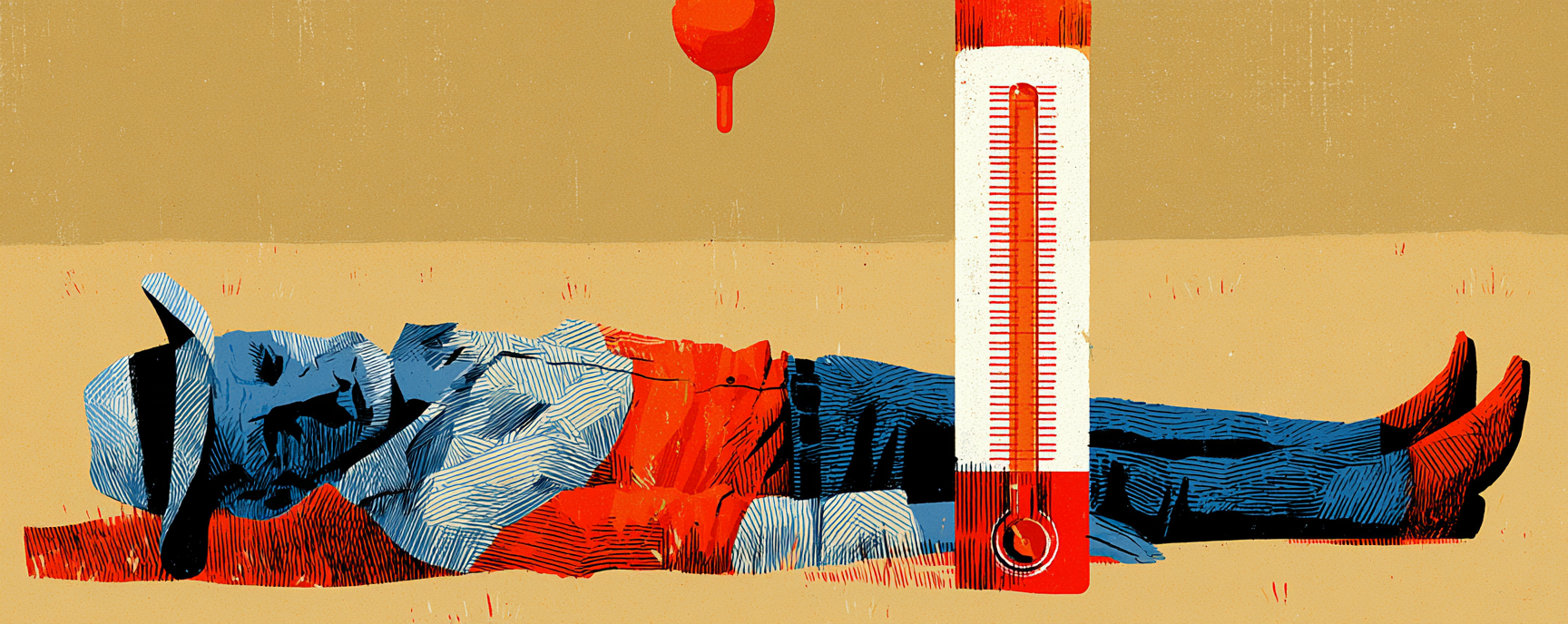
Your body runs a cooling system. It is elegant, old, and has exactly one trick: move blood to the skin, push heat across the gradient between your 37°C core and the cooler air outside, sweat, let evaporation do the rest. The system requires a gradient. When the gradient closes, the system doesn't downshift or adapt. It fails. Core temperature rises. Organs cook.
Every heat warning system in the United States measures the air. Temperature, humidity, wet-bulb, heat index, deviation from local climatological norms. The instruments point outward. They answer the question how hot is it out there. Whether someone lives or dies depends on how hot is it in here, inside the body, where the gradient either exists or has collapsed.
On July 20, 2023, in Yuma, Arizona, a 25-year-old farmworker named Dario Mendoza died of heat stroke after walking away from his worksite and collapsing. He was harvesting fruit. The air temperature reached 116°F. It was at least the ninth consecutive day above 110. He collapsed before 10 a.m. He was a father of two.
The structural failure is worth tracing: because the humidity in Yuma that day was low, the heat index would have registered lower than the actual air temperature. The primary public metric for communicating heat danger was designed for humid conditions. In the arid climate where Mendoza was working, it understated risk by construction. The number on the screen said something less alarming than the thermometer, and neither number described what was happening inside his body, where blood was rushing to the skin and finding no cooler air to dump its heat into, where sweat was evaporating fast but not fast enough to overcome a twelve-hour thermal debt that had been compounding for over a week of nights that never cooled down.
Three studies published in early 2026, from different disciplines and different continents, have converged on the same finding. The instruments are measuring the wrong variable. The threshold that has anchored climate risk assessment for fifteen years was never empirically tested on a human being. And the actual physiological limits, now that someone has finally measured them, fall well below the line the world has been using.
The number nobody checked
The canonical threshold for human survivability in heat has been, since 2010, a wet-bulb temperature of 35°C. Wet-bulb temperature accounts for heat and humidity by measuring how much a thermometer cools when wrapped in a wet cloth. At 35°C wet-bulb, the reasoning goes, sweat cannot evaporate, skin cannot cool below core temperature, and the body's thermal regulation fails.
This number comes from a 2010 paper by Steven Sherwood and Matthew Huber in PNAS. The argument was derived from first principles: core temperature at 37°C, skin needing to stay below roughly 35°C to maintain the outward gradient, therefore 35°C wet-bulb as the absolute wall. The paper was elegant. It was cited in IPCC reports. It became, in the way useful numbers do, a piece of policy furniture. People stopped looking at it and started building on top of it.
Sherwood and Huber included a caveat. They wrote that 35°C was an upper bound and that a lower, more realistic limit probably existed. They didn't specify what it was.
The caveat went nowhere. The number went everywhere. For twelve years, nobody put a human being in a controlled environment and measured where the body actually fails.
Somebody checked
In 2022, researchers at Penn State did exactly that. Young, healthy adults performed basic daily activities in controlled heat chambers while the team tracked the precise point at which the body could no longer shed heat as fast as it produced it. The moment is not dramatic from outside. Inside, it is the moment the gradient reverses: skin temperature climbs past 35°C, the core begins absorbing heat from the environment instead of dumping it, and the slow accumulation toward organ failure begins. Across every experimental condition, the critical wet-bulb temperature fell significantly below 35°C. In humid environments, the limit averaged around 31°C. In hot, dry environments, it dropped to 25–28°C.
"There is likely not a single cutoff limit."
The threshold depends on who you are, how old you are, what you're doing, and whether the air is wet or dry.
The HEAT-Lim model, developed by researchers at the University of Sydney and Arizona State University, built on this empirical foundation. Sherwood and Huber derived a number from physics. HEAT-Lim models what the body is actually doing: how fast the heart is pushing blood to the skin, how much sweat the glands are producing and whether evaporation can keep pace, how much heat the muscles generate at a given workload, whether shade changes the radiation load enough to buy the system time. It generates four population-specific threshold lines. Older people in direct sun hit the wall first. Then younger people in sun. Then older people in shade. Then younger people in shade. The distance between the first line and the last can span ten degrees or more.
A 25-year-old doing physical labor in direct desert sun maps onto one of those lines. The model can now say, with physiological specificity, what the atmospheric metrics could not: at what point the conditions in Yuma on July 20, 2023, became unsurvivable for a body doing that work in that exposure.
In March 2026, Sarah Perkins-Kirkpatrick and collaborators applied HEAT-Lim to six real heat events where mass casualties had been documented: Mecca in June 2024, Bangkok in April 2024, Phoenix in July 2023, Mount Isa in January 2019, Larkana in May 2015, Seville in August 2003. Non-survivable conditions occurred during every event. All fell below the 35°C wet-bulb threshold. The range across events spanned from roughly 24°C to 34.6°C wet-bulb.
Across six lethal heat events, physiologically non-survivable conditions occurred at wet-bulb temperatures spanning 24.1°C to 34.6°C — all below the canonical 35°C threshold. The limit is population-dependent, not universal.
The Phoenix July 2023 event registered a wet-bulb temperature of approximately 24°C. By the old threshold, that's eleven degrees of margin. By the HEAT-Lim model, it was already lethal for older adults in direct sun.
"Non-survivable conditions are occurring during present-day heat events. If it's already happening now, then what does a future that is two or three degrees warmer hold?"
— Sarah Perkins-Kirkpatrick
HEAT-Lim is young. First published in 2023, the Perkins-Kirkpatrick study is its first large-scale application to historical events, and it has not been validated against a prospective dataset. There is a defensible argument for keeping a physics-based upper bound like 35°C as policy guidance: it's simpler, universal, doesn't require population-specific inputs. But that argument assumes the physics-based number errs on the side of caution. It doesn't. It errs in the direction of telling people they have eleven degrees of margin when they have none. A 2023 review in Environmental Research Letters noted that the original derivation rests on assumptions that cut in both directions, some tending to lower the fatal threshold and some to raise it. What is beyond dispute: every empirical measurement of actual human heat tolerance falls below the canonical 35°C. The disagreement is about where the corrected thresholds should sit.
The emergency department already had the data
Two weeks before the Perkins-Kirkpatrick paper appeared, a study published March 20, 2026, in JAMA Network Open arrived at a version of the same finding from inside hospital walls. Researchers at NYU Grossman School of Medicine analyzed emergency department records for patients 65 and older at two New York City EDs, matching each visit to heat index data from the LaGuardia Airport monitoring station.
New York City triggers heat advisories when the heat index hits 95°F for two consecutive days, or 100°F on any single day. At one ED, serving a climate-vulnerable population that was predominantly from underserved minority racial and ethnic groups and more reliant on Medicaid, the risk of heat-associated emergency visits began rising at a heat index of 66°F, with amplified risk at 90°F. Five degrees below the city's advisory trigger. What arrives at that ED looks like confusion, rapid heart rate, a body that has stopped sweating because it has run out of the capacity to sweat. The researchers estimated that a warning system activated at 90°F could have prevented approximately 116 ED visits during the study period.
At the second ED, serving a whiter, more privately insured population, researchers found no significant association between heat and emergency visits at all.
Same city. Same heat. The threshold turned out to be a property of the population. Who has air conditioning, who has housing that holds heat, who works outside, who can afford to stay home. Black New Yorkers and low-income New Yorkers are less likely to own or use AC during hot weather because of the cost. The body that fails first is the body with the least infrastructure between it and the sky.
The mortality data tells the same story at a different scale. New York City's own 2026 Heat Mortality Report found that heat-exacerbated death risk was observed starting at a maximum temperature of 82°F. Because there are far more days between 82°F and 94°F than days above 95°F, those moderate hot days contributed more total heat-exacerbated deaths than the extreme ones. The bulk of the killing happens below the warning line, in the long plateau of merely hot days that don't trigger any institutional response.
The farmers showed up first in the data
A third study, published in Scientific Reports in February 2026, analyzed twenty years of health records in Taiwan against daily maximum temperatures. Significant associations between heat and health emergencies, spanning cardiovascular, respiratory, renal, and diabetic disease, all appeared at thresholds below current warning levels. Each disease category had its own onset temperature. People with hypertension, hyperglycemia, or hyperlipidemia were more vulnerable still.
Among occupational groups, farmers carried the highest relative risk of cardiovascular emergencies during high-heat days. The people doing the most physical work in the most direct sun, with the least institutional protection, showed up first in the data. The Taiwan study used daily maximum air temperature, not wet-bulb, not heat index. Different metric, different continent, same conclusion: the warning line is drawn above where the damage begins.
Arizona, where Dario Mendoza died harvesting fruit in 2023, had no enforceable heat-safety regulations for outdoor workers until a voluntary executive order in December 2025. His death is what Arizona Rep. Mariana Sandoval cited as the catalyst for investigating heat protections in the state. The evidence that the threshold was wrong already lived inside the systems that responded to the harm: hospital intake records, coroner reports, OSHA incident logs. Generated continuously. Never assembled as an indictment of the threshold itself, because no institution funds research that attributes deaths to its own trigger point.
Five metrics, no shared instrument
These three studies converged on the same conclusion using three different metrics. Perkins-Kirkpatrick used wet-bulb temperature. The JAMA study used heat index. The Scientific Reports study used daily maximum air temperature. The National Weather Service in Phoenix uses HeatRisk, a composite index calibrated to local climatological deviation. OSHA's proposed (and stalled) permanent heat standard uses heat index at 80°F and 90°F tiers. Occupational health researchers prefer wet-bulb globe temperature, which incorporates solar radiation and wind. None of these are interchangeable. They measure different physical quantities, weight different variables, and produce numbers that cannot be directly compared.
A clinician reading the JAMA study, an emergency manager watching the NWS forecast, and a farm supervisor checking OSHA guidance are operating from different instruments pointed at different parts of the same problem. All three 2026 studies converge on the same demand: measure the body. But reforming the warning system requires first agreeing on what to measure, and that agreement does not exist.
The Phoenix case makes the fragmentation sharpest. HeatRisk triggers on deviation from local norms, which means a 112°F day in a city where 110°F is climatologically normal may not generate a warning, even though the HEAT-Lim model shows it is physiologically lethal for exposed older adults. The NWS itself acknowledges that heat-associated deaths in Arizona occur at temperatures in the mid-80s. The knowledge that the thresholds are wrong already lives inside the system. There is no mechanism to act on it.
What correction looks like at this speed
OSHA's enforcement program for heat hazards was renewed in April 2026 for five years, covering 55 high-hazard industries. Inspections continue. The permanent heat illness prevention rule, which would establish enforceable employer obligations, remains stalled with no finalization date. More than a dozen Republican senators have urged the Labor Department to abandon the proposal entirely, arguing that:
"Protecting workers from a common and easily understandable workplace hazard does not require a prescriptive rule."
The proposed rule's triggers were themselves atmospheric rather than physiological. Even the standard that didn't pass was measuring the air.
Seven states with OSHA-approved plans have their own heat illness prevention standards. Arizona is not among them.
The Perkins-Kirkpatrick paper's most important contribution may be the least dramatic: it demonstrates that a physiological model can be applied to real-world conditions using existing climate data. The infrastructure to measure the atmosphere already exists. What these three studies show, independently and from different directions, is that the measurement has to move from the air to the body. It has to capture what the atmosphere does to the specific person standing in it.
The scientific community has not settled on where the corrected thresholds should sit, partly because the whole point is that a single number cannot represent the range of human vulnerability. An older person in sun and a younger person in shade face limits separated by ten degrees or more. A Medicaid-reliant population in the Bronx and a privately insured population in Manhattan face the same heat index and radically different outcomes. A farmworker in Yuma and an office worker in Scottsdale inhabit the same forecast and entirely different risk profiles. The threshold turns out to be a property of the body, shaped by age, health, labor, housing, wealth, and whether anyone with authority over your working conditions has read the data.
The morning Dario Mendoza collapsed in a Yuma field, the atmosphere was being measured. The instruments were functioning. The numbers were accurate descriptions of the air. They did not describe what was happening inside his body, where the gradient between core and skin had closed, where the cooling system that keeps a person alive in heat had reached a limit that no forecast, no advisory, no metric in any agency's toolkit was designed to detect.
The thermometer worked fine. It was pointed at the wrong thing.
-
Heat erodes cognition daily: A May 2026 pilot study in Environmental Research Communications found that thermal discomfort at typically experienced warm temperatures, not just extremes, measurably impairs everyday cognitive performance.
-
Nights that never cool: A March 2026 paper in Nature Sustainability projects that warming nighttime temperatures will erode global sleep quality at scale, with downstream effects on childhood cognitive development and long-term economic productivity.
-
Wildfire smoke's invisible layer: A Stony Brook University-led study in Science Advances found that wildfire smoke significantly raises ground-level ozone, an invisible respiratory and cardiovascular hazard that prior research had largely overlooked in favor of particulate matter.
-
Black heat death disparity: New York City's own 2026 Heat Mortality Report found that Black New Yorkers die from heat stress at twice the rate of white New Yorkers, driven largely by disparities in air conditioning access and housing quality.