

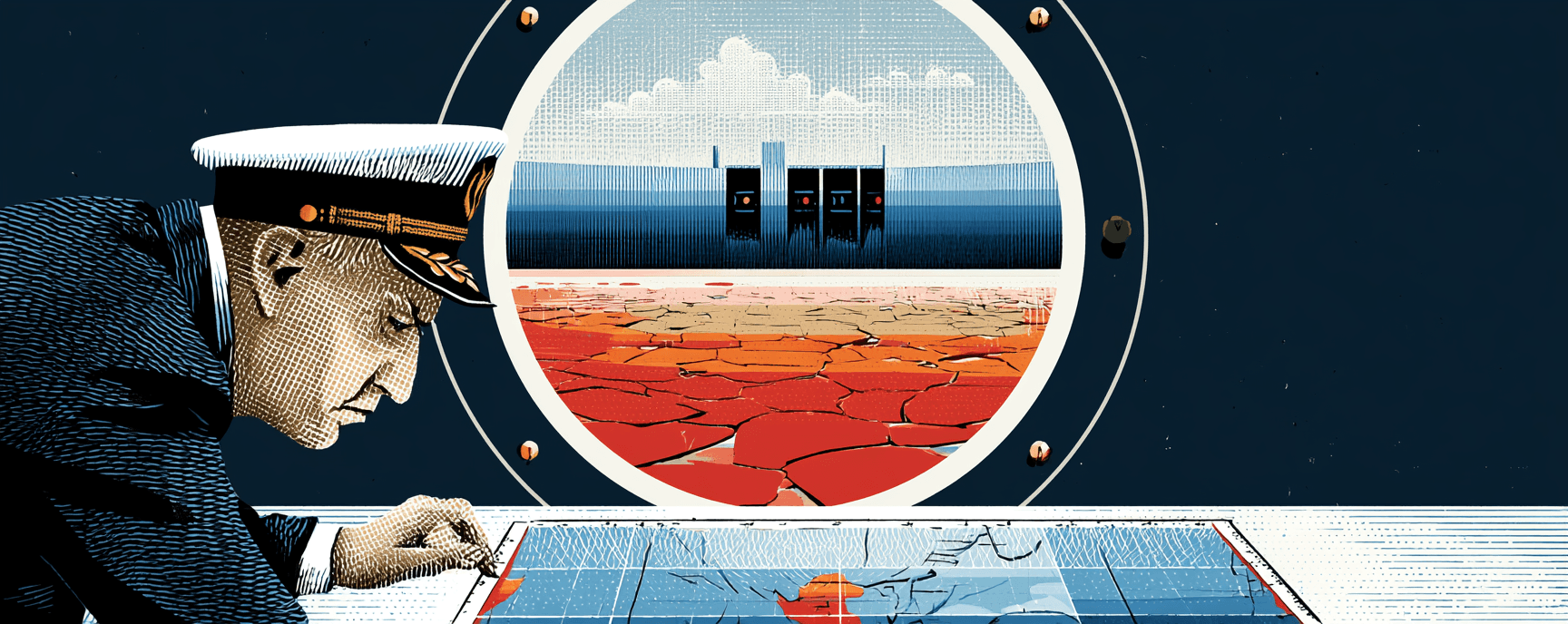
I spent five years on cargo ships, and one thing you learn at sea is the difference between a chart and a channel. The chart shows the surveyed depth from whenever the survey was done. The channel is what's actually under the keel right now, this minute, with this tide and this silt load and whatever else has shifted since the last survey. A competent officer knows the chart is a starting point. The trouble comes when the institution treats the chart as the territory.
Katie Rogers's title at the Western Electricity Coordinating Council is manager of reliability assessment. Her job, in the formal sense, is to help produce the seasonal assessments that tell regulators, utilities, and the public whether the Western grid has enough generation to meet demand. Those assessments follow a standardized methodology. They run scenarios. They compute reserve margins. They flag risks by category: drought, heat, wildfire, demand growth.
Her actual work this summer has outrun the categories. Rogers has been collaborating with hydrologists at Pacific Northwest National Laboratory and the National Laboratory of the Rockies, building computer models that essentially turn Hoover Dam off and watch what happens to the grid. Different weather scenarios, different demand levels, different generation mixes. Can large-scale battery storage offset the loss of Hoover's ramping capability? Is a spring heat wave more dangerous than a summer spike? These models allow her team to test compound failures that the standard reliability assessment was never designed to evaluate.
"We do those 'what if' scenarios," Rogers told Circle of Blue in May, "and your question is spot on — can the other areas of the grid compensate for what may be lost? And we don't necessarily have answers to those questions, but those are the exact" questions that need asking.
The fact that WECC's own manager of reliability assessment is building tools outside the standard reliability assessment process, in real time, during the season those tools are meant to evaluate, tells you where the institutional architecture stands. She's checking the depth under the keel because she knows when the chart was last surveyed.
What the river is doing while the assessment is being written
Water flowing into Lake Powell in May was 18 percent of the 30-year average. The June forecast: 7 percent. The full water year projection sits at 33 percent of average, among the lowest since Glen Canyon Dam began operating in 1964. The period from 2000 to the present is the driest quarter-century since the dam was built, and at some point you stop calling a quarter-century of drought a deviation from normal and start calling it the new normal.
The Bureau of Reclamation is already draining Flaming Gorge Reservoir upstream, releasing between 660,000 and one million acre-feet to keep Powell above the elevation where its turbines stop working. Flaming Gorge, as of June 3, was at 77 percent of live storage and falling. The emergency response to one reservoir's crisis is creating the conditions for the next one.
Downstream, Lake Mead is expected to drop below 1,035 feet within the next twelve months. Below that elevation, twelve of Hoover's seventeen turbines cannot operate. According to Power Magazine, citing FERC, up to 4,500 MW of Colorado River hydropower could be affected as soon as August 2026, including Hoover's full 2,000 MW capacity.
The operational rules governing releases from Powell and Mead expire December 31, 2026. Replacement rules haven't been finalized. The Bureau's June study was forced to model future operations using the same expiring guidelines, and noted, with the kind of understatement that government agencies deploy when the situation has outrun the available euphemisms, that current conditions are "a clear reminder that the Colorado River remains vulnerable and that updated operational tools are essential for long-term stability."
None of this is secret. The data is public, the trend lines are public, the officials are speaking on the record. And the formal reliability assessment for the Western Interconnection this summer concludes that the grid is adequate under normal conditions.
The word that does all the work
NERC, the North American Electric Reliability Corporation, publishes a summer reliability assessment every May. It is the closest thing the grid has to a seasonal physical. The 2026 assessment runs 173 pages. It is thorough, data-rich, and institutionally honest about individual risk categories. It flags drought and demand growth and hydropower decline and wildfire and the Pacific Northwest, where 55 percent of generation comes from hydro and the April 1 snowpack was at 52 percent of normal. Correlated failure across those categories — drought and heat and demand and import loss arriving together — falls outside the methodology.
The definition of "elevated risk" in NERC's framework: resources are expected to be adequate under typical summer conditions, but could fall short during a worse-than-forecast heat wave, an unexpected loss of generation, or unusually low renewable output.
That word "or." It is doing all the structural work. The assessment evaluates each stress independently against historical probability distributions. Drought reducing hydro generation is one scenario. A heat wave spiking demand is another. Low wind or solar output is a third. The probabilistic metrics are computed per assessment area, using historical baselines submitted by the areas themselves.
The architecture assumes that when one area is stressed, it can import power from its neighbors. That works when drought hits one basin while another has surplus, when heat domes park over one region while the rest stays mild. Drought currently covers 62 percent of the continental U.S. and is expected to expand.
NERC's framework evaluates drought, heat, demand growth, and import shortfalls as independent scenarios joined by "or." Summer 2026 presents them simultaneously across 62 percent of the continental United States.
WECC's own summer outlook acknowledges this, speaking "in general terms" about drought, extreme heat, wildfire, and diminished hydropower output. Those risks, it says, "individually or in concert, influence electricity availability and demand." The planning framework handles the first half of that phrase. The second half is what Rogers is building ad hoc tools to evaluate, because the standard process cannot pose the question.
Everything arriving at once
Start with the imports. Canadian hydropower has been a structural backstop for the Western grid for decades. BC Hydro, the main entity trading power into the U.S. Northwest through Bonneville Power Administration, reported record drought in 2023. By 2024, Canadian hydro imports to the U.S. had fallen 31 percent to 18 terawatt-hours, roughly half the long-term average. The decline continued through 2025. What had been a reliable surplus flowing south became, for the first time in decades, a roughly balanced trade. The safety margin that planning models assumed was there quietly stopped being true.
Now add the demand. Aggregate peak demand across all NERC assessment areas increased by over 11 gigawatts from the previous summer's projections, exceeding the already-historic 10 GW rise that preceded summer 2025. In the WECC Northwest subregion, peak demand is projected to grow 4.6 percent over last summer while anticipated resources show only a 1.5 percent increase in energy availability. Demand growing three times faster than supply, in the most hydro-dependent subregion in the country, in one of the worst drought years on record.
The forecasting itself has become unstable. Multiple assessment areas revised their load projections downward because data centers and large industrial loads are interconnecting more slowly than requested. But aggregate demand still went up. Nobody knows which forecast to plan against.
"The system is changing faster than the infrastructure needed to support it. We are in a period here where future electricity supply has never been more uncertain."
— John Moura, NERC director of reliability assessments
Each of these risks, taken alone, is the kind of thing the assessment framework handles competently. Drought in one basin. A demand spike in one region. An import shortfall from one trading partner. The framework was built for a world where these problems take turns. What it confronts this summer is a world where they show up together, and the methodology has no conjunction for "and."
The rational system
I want to be precise about what I'm saying here. The people running these assessments are clear-eyed about the gap. Moura, in the same breath as announcing improved conditions in some areas, cautioned that "the improved conditions we're seeing shouldn't be interpreted as saying that overall reliability risk is declining." Mark Olson, NERC's manager of reliability assessments, said the Northwest is "in the crosshairs" of converging trends. Brian D'Agostino of San Diego Gas and Electric said it directly at a WECC webinar in May: "We have to not just look at that one initial risk. We have to start looking at what happens when we combine two or three of these simultaneously and how do we prepare for that as a region."
The fact that D'Agostino had to say this at a reliability forum in 2026 tells you everything about where the institutional architecture stands. The standard assessment doesn't combine two or three risks simultaneously. Rogers is doing exactly that, with national laboratory partners, because the standard process has no mechanism for the question.
So why hasn't the framework been updated? The reasons are structural. NERC is a consensus-based standards organization. Each assessment area submits its own baseline data, its own demand forecasts, its own resource projections. The methodology aggregates these submissions. Changing the framework to model correlated, wide-area failures would require acknowledging that the historical baselines underlying every area's submission no longer describe reality. That acknowledgment carries regulatory and financial consequences that nobody in the consensus process has an incentive to trigger. The methodology determines what can be seen before any analyst opens a spreadsheet.
The institution is telling the truth about conditions that no longer exist.
The widening window
Moura identified one more gap worth attention: "There is trending higher risk in shoulder periods than in the summer peak conditions, and I think that's really a reflection of how we're using electricity and the types of resources that are being provided to us."
The summer reliability assessment was built to evaluate peak risk in the traditional July-August window. But the early arrival of extreme heat in March 2026 showed what happens when high demand overlaps with spring maintenance outages. Generators are offline for scheduled work. Snowpack-fed hydro is transitioning between seasons. Solar output hasn't reached summer intensity. The risk window is widening at both ends, and the assessment's peak-risk frame hasn't caught up. The months that used to be gaps between the dangerous seasons have become dangerous themselves, and the planning tools haven't adjusted.
Meanwhile, the physical cliff edges closer. Glen Canyon Dam approaches minimum power pool. Lake Mead approaches the elevation where Hoover loses most of its turbines. The Bureau drains one upstream reservoir to keep another above its operational floor. The rules governing all of this expire in six months, and the replacement rules aren't finished.
NERC's assessment says the Western grid faces elevated risk this summer. Elevated risk, in the framework's own definition, means adequate under normal conditions but potentially short under stress. The definition treats the stresses as alternatives. The Colorado River is delivering them together.
Rogers and her colleagues at WECC are building the models to see what happens when the stresses arrive simultaneously. They are doing this work because it needs doing and because the standard process cannot do it. Whether the answers come before August is genuinely uncertain. Rogers, asked about the scale of the grid's exposure if Hoover's capacity drops, answered with the precision of someone who measures reliability for a living: "How large? That remains to be seen."
-
NERC's large-load alert: In May 2026, NERC issued a Level 3 essential actions alert after data centers suddenly disconnecting from the grid caused frequency and voltage stability events in both the Eastern and Texas interconnections, adding a new category of unpredictable stress to an already strained system.
-
Northwest demand doubling forecast: The Northwest Power and Conservation Council projects that regional electricity demand could double by 2046, driven by data centers, EVs, building electrification, and chip manufacturing, tripling the growth rate predicted just three years ago.
-
Federal climate data cuts: The Trump administration has curtailed development and distribution of climate risk data that grid operators rely on daily, and researchers at the Union of Concerned Scientists warn these cuts to NOAA and the National Weather Service will compound the harms from extreme weather and prolonged outages.
-
Transformer bottleneck underneath: Over 55 percent of U.S. large power transformers are past design life, and lead times for replacements have stretched to as long as four years with prices up 60 to 80 percent since 2020, meaning the grid's physical fabric cannot be repaired at the speed it is degrading.