

The Cook County Medical Examiner's office had 222 refrigerated bays. On a normal day, about seventeen bodies came in. These numbers represented a system calibrated to the pace at which a large American city typically produced death, and nobody thought much about the calibration because it worked. Adequacy, when it holds, is invisible.
The heat index in Chicago hit 119°F on July 13, 1995. By the time the CDC tallied the aftermath, 465 deaths in Cook County had been certified as heat-related during July 11–27. The distance between those two facts, between the meteorological event and the institutional count, is where the story lives. The heat did not announce what it was doing. The city had to learn to see it, and the learning cost hundreds of lives.
July 12–13
Chicago's temperatures began climbing on July 12. The week before had been unremarkable. The CDC's certified heat-death count for July 4–10 was zero. Maximum daily readings during July 12–16 ranged from 93°F to 104°F, high but not unprecedented for a midwestern summer. The humidity made the heat lethal, the wet suffocating density of it, and the fact that nighttime temperatures refused to drop. The city could not cool. Buildings that had absorbed heat all day radiated it back through the night, and by morning the cycle started again from a higher baseline.
On July 13, the worst day by meteorological measures, the certified heat-death count had not yet begun to climb. People were dying in their apartments with the windows shut. But the Medical Examiner's criteria, in use since 1978, required a core body temperature of at least 105°F, substantial environmental evidence of heat contribution, or decomposition without another evident cause when the person was last seen alive during the heat-wave period. The CDC later confirmed these criteria. They were rigorous. They were defensible. They also meant the count lagged the killing by roughly two days.
On the most dangerous day, the institutional evidence of catastrophe had not materialized. The recording system was working exactly as designed, and the design assumed a pace of death the city had never exceeded.
The Cascade
By Friday, July 14, the lag began closing. The Medical Examiner's office recorded 49 certified heat deaths. Paramedics could not keep pace with emergency calls. Eric Klinenberg's research documents that twenty-three hospitals, concentrated on the South and Southwest Sides, went on bypass status, closing their emergency rooms to new patients. At one point, eighteen were simultaneously refusing admissions. No monitoring system existed to track which ERs were open. Ambulance crews drove from hospital to hospital, searching for a bed that would take their patient.
The power grid buckled under record energy demand. Some grids failed outright, leaving 49,000 households without electricity. The CDC would later identify air conditioning as the single most important protective factor against heat death. Losing power during a heat emergency meant losing the thing most likely to keep you alive. Meanwhile, more than 3,000 fire hydrants were opened across the city, and neighborhoods that had already lost electricity lost water pressure too.
Each failure loaded the next system. No air conditioning drove more people into emergency medical response. Overwhelmed dispatch stretched wait times. Hospitals on bypass forced longer transport distances, and without a monitoring system, crews couldn't find the open ER. The failures fed each other, each one increasing the weight on whatever came next, and none of the downstream systems had been engineered to absorb that transferred load.
Then came July 15. One hundred and sixty-two certified heat deaths in a single day.
Where It Became Visible
Heat death is quiet. There are no collapsed structures, no floodwaters in living rooms, no tornado paths visible from the air. A person dies alone in an apartment. The death is individual, interior, contained. It does not produce footage.
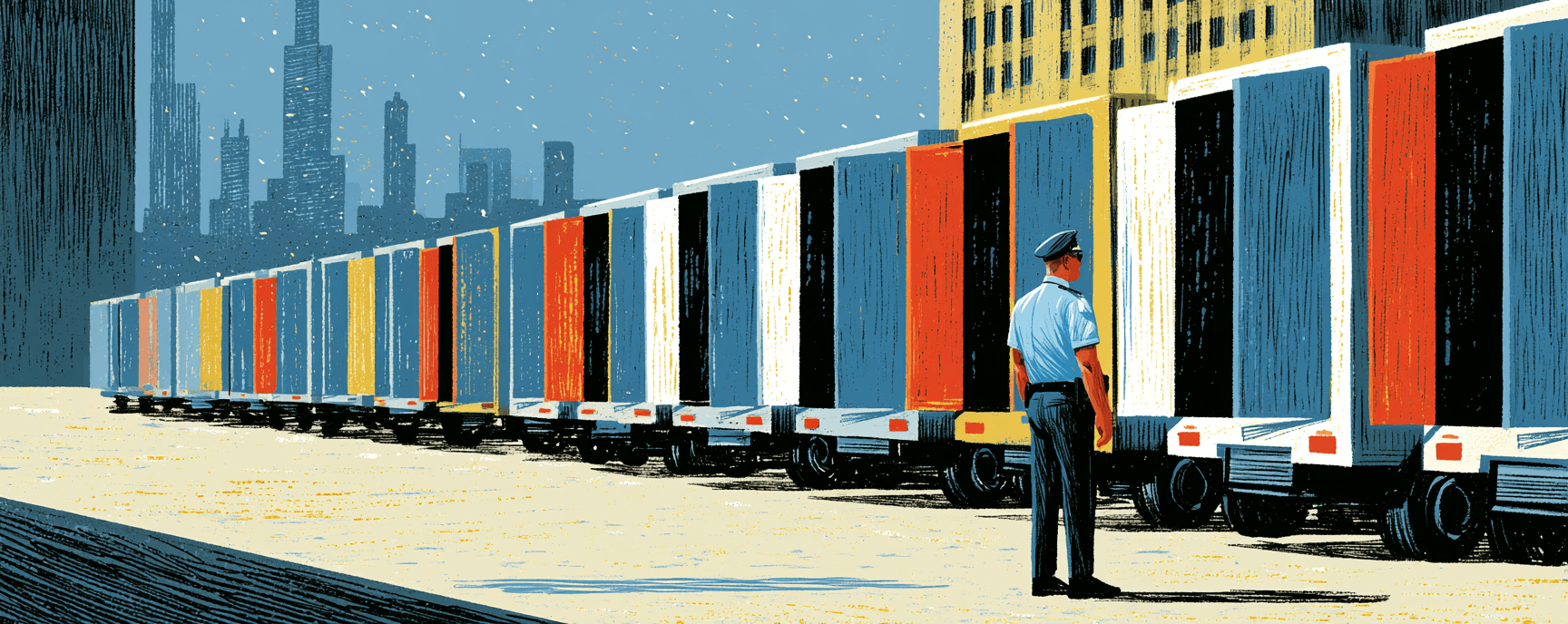
The place where the crisis broke through into public sight was the morgue. By Saturday, July 15, all 222 refrigerated bays were full. The office that normally received seventeen bodies a day had been overwhelmed by a volume exceeding its capacity by hundreds. A fleet of refrigerated trucks was brought in and parked outside the building to store the dead. Police officers delivering bodies waited up to three hours for a morgue worker to receive them.
The trucks were one rupture in the city's capacity to absorb what was happening without anyone noticing. The Chicago Tribune's daily reporting was another. As the newspaper published its mounting death counts through that week, the accumulating toll became a public fact before City Hall was ready to acknowledge its scale. The numbers, aggregated and printed, did what individual deaths could not: they made the pattern visible. A person dying alone in an apartment is a private event. Four hundred and sixty-five such events, counted and published, constitute a disaster.
Heat kills this way. The deaths accumulate one by one, each one explicable on its own terms: an elderly person with a heart condition, a resident who didn't have air conditioning, someone who was already sick. Taken individually, each death fits within the normal range of what a city processes. Taken together, they are a mass casualty event. But the recording system processes them individually. The aggregation happens later, at the Medical Examiner's office, in the count, in the newspaper. And by the time the count is large enough to be undeniable, the people are already dead.
City Hall
Mayor Richard M. Daley declared an official emergency on Saturday, July 15, after hundreds of bodies had already arrived at the county morgue. The declaration came two days after the heat index peaked and on the same day the certified death count reached its highest single-day total.
Daley challenged the framing of the mortality numbers publicly. He warned reporters not to "blow it out of proportion," arguing that not everyone who died over "the last eight or nine days" could be claimed as a heat death. He was not entirely wrong on the epidemiological point. The CDC's own editorial note on the 1995 data acknowledged that medical-examiner surveillance has selection-bias limitations and that the absence of a uniform national heat-death definition caused substantial variation across jurisdictions. Klinenberg argues that Daley's skepticism shaped the public debate over whether the heat deaths were "really real," though that is Klinenberg's interpretation of the political dynamics.
Total deaths in Chicago during July 13–21 reached 1,177, an 85 percent increase over the 637 deaths during the same period in 1994.
Whether the certified heat-death figure was 465 or some other number, the excess mortality was massive. The argument over the precise count became the ground on which a different argument was fought: whether the city's existing systems had failed, which would demand institutional change, or whether the weather had simply been unusually severe, which would not.
The Window
Heat waves end. The temperatures dropped. The trucks were emptied. The hospitals came off bypass. The morgue returned to its normal pace of seventeen bodies a day.
In the aftermath, there was a narrow period when the memory of those trucks, those numbers, that week was recent enough to create political space for building something new. Chicago constructed institutional machinery that had not previously existed: an Extreme Weather Operations Plan with specific, operational components. Cooling centers activated by temperature thresholds. Free bus transportation to reach them. Phone banks calling elderly residents. Police officers and city workers going door to door to check on seniors living alone. Outreach lists identifying residents most likely to be at risk.
Each component maps to a specific failure from July 1995. Cooling centers addressed the absence of accessible air conditioning. Free transportation addressed the inability to reach relief. Phone outreach addressed isolation. The door-to-door checks addressed the fact that people had been dying without anyone knowing until the body arrived at the morgue. The Extreme Weather Operations Plan was a precise negative image of the old machinery's breaking points.
The protective value of air conditioning, of human contact, of accessible cooling spaces had been understood before July 1995. The vulnerability of elderly residents living alone was documented. The science of heat mortality existed, and the city had not acted on any of it. The Medical Examiner's count, disputed as it was, produced that visibility. So did the 85 percent mortality spike. So did the refrigerated trucks, parked on a public street because a government building had run out of room for the dead. The plan was built in the brief window when the political cost of doing nothing exceeded the cost of building something new. Every component in it was an admission, written in operational design, of exactly what had gone wrong.
-
The plan's current test: Chicago's post-1995 Extreme Weather Operations Plan is facing renewed pressure this summer as consecutive high-heat days test whether the institutional machinery built thirty-one years ago still matches the scale of current risk.
-
Certified versus excess deaths: The CDC's later summary reported 485 heat-related deaths and 739 excess deaths from the 1995 event, and the gap between those two numbers reflects an unresolved national problem: the United States still lacks a uniform heat-death definition across jurisdictions.
-
Protection systems that erase their own evidence: The Miami Conservancy District, built after the 1913 Dayton flood, now protects 47,000 properties across five counties while struggling with flat assessment revenues since 2012 and aging infrastructure, a pattern in which successful adaptation erodes the public urgency needed to maintain it.
-
When codes meet enforcement: IBHS's 2024 Rating the States report evaluates eighteen coastal states on building-code adoption, enforcement, training, and contractor licensing, finding that written standards matter far less than the institutional capacity to implement them.