
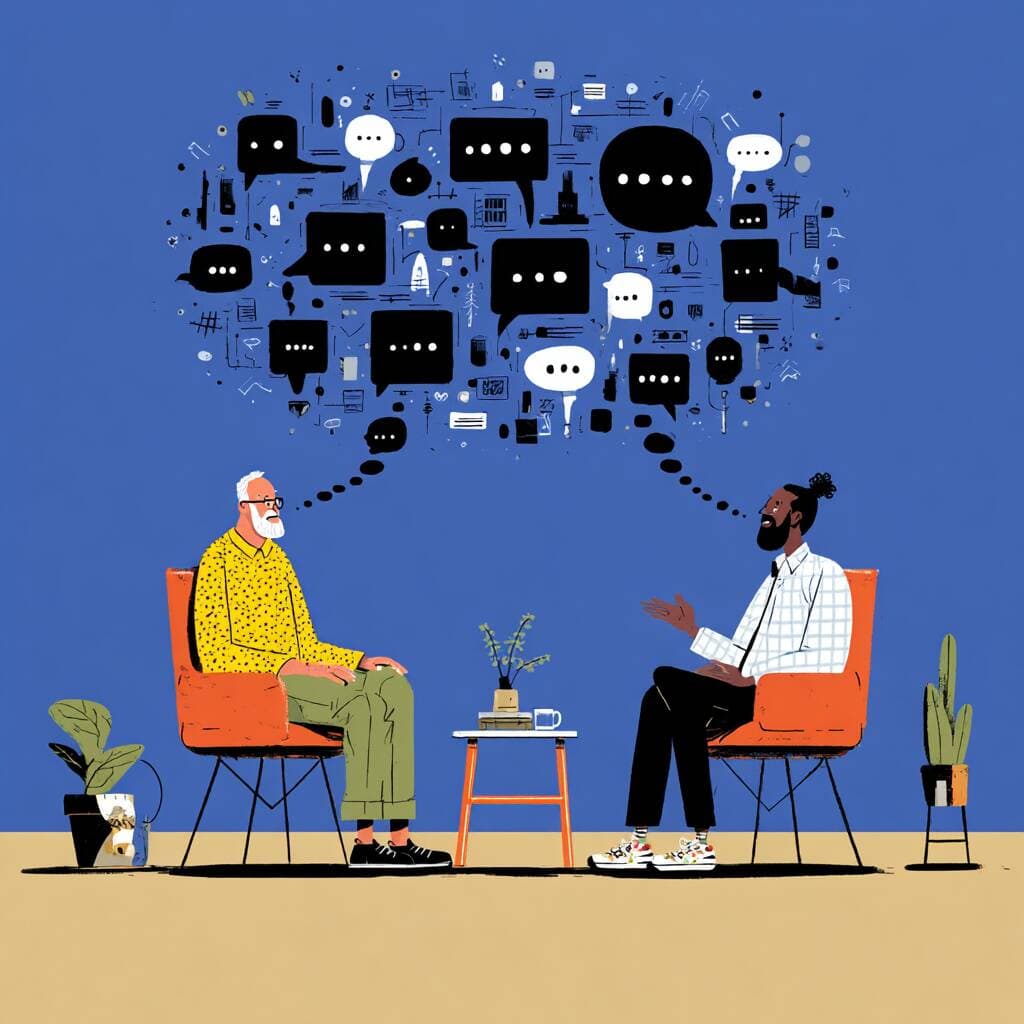
Future Tense is The Docket's speculative fiction section. The following interview takes place in a version of the 2030s that hasn't happened yet, but the temperatures, regulations, and working conditions it draws from are documented realities of the mid-2020s, extended forward by a few degrees and a few years. Marco Espinoza is a fictional character. His schedule is not.
We meet Marco Espinoza at a Denny's in west Phoenix at 10:40 a.m. on a Thursday in late June. He's been awake since 1:15. He finished his route ninety minutes ago. He orders a short stack and a water, no coffee ("I'm done with caffeine by like, four a.m."), and keeps his sunglasses on the table between us like a tool he'll need again shortly. Which he will. The parking lot outside is already shimmering. His delivery van, branded with a logistics company's cheerful arrow logo, sits in the only shaded spot, engine off.
He's 31. He delivers packages for a DSP, a delivery service partner contracted with one of the major carriers. He's been on the pre-dawn dispatch for four years. His wife, Ana, works days at a dental office in Tempe. They have two kids: Sofía, 7, and Mateo, 4.
You started your route at what time this morning?
Marco: Two-fifty. Dispatch was two-forty but I was already loaded. I like to be rolling by two-fifty because if you wait until three you lose time. Not a lot, but you feel it by six. By six it's already ninety-four, ninety-five, and the van takes about twenty minutes to cool down once the sun's actually hitting it. So you want those minutes back.
What does 2:50 a.m. feel like in Phoenix in June?
Marco: Warm. People think it's cool at night here but it's not. You step outside and it's eighty-eight, ninety, and the ground is still hot from yesterday. Not hot like you'd burn yourself, but you feel it through your shoes. The air is thick. Still. Nothing's moving. You can smell the asphalt. It's not the worst part of the day, obviously, but it's not relief either. It's like the city is holding its breath.
Walk me through the rest of the morning.
Marco: I run the route. Residential mostly, some commercial. Maybe a hundred and sixty stops, depends on the day. The good thing about pre-dawn is nobody's out. No traffic, no dogs. Well, fewer dogs. I can move. The back of the van is fine at three a.m., maybe eighty-five in there. By five-thirty it's climbing. By seven, if I'm not almost done, the cargo area is somewhere you don't want to spend time. The packages are warm to the touch. I had a candle delivery last week that was just... soup. By like six-fifteen.
I try to be done by eight. Eight-thirty latest. Then I drive back, drop the van, get in my car. Home by nine, nine-fifteen. Sofía's already at school. Mateo's at Ana's mom's. The house is empty and the AC is set to seventy-four because we keep it there during the day now. We used to do seventy-two but. You know. The bill.
What happens when you get home?
Marco: I eat. Whatever Ana left or whatever I make. Eggs usually. Then I shower. Then I have this window, nine-thirty to about one-forty-five, where I'm awake and home and nobody else is. That's when I do stuff. Laundry, dishes, the HVAC coursework I'm doing online. I pick up Mateo at noon from Ana's mom's. We hang out for a bit. He naps, which is great because I need to start winding down too. Sofía gets out at two-fifty and Ana's mom picks her up, or sometimes I do if I'm still up. But I need to be asleep by two. Two-thirty at the latest.
And your alarm goes off at?
Marco: One-fifteen. Yeah.
So your sleep window is roughly 2 p.m. to 1 a.m.
Marco: That's the idea. In practice it's more like two-thirty to midnight, maybe twelve-thirty. You don't just fall asleep at two. The house is alive. Mateo's up, or Ana gets home at four-thirty and she's making dinner, and I can hear everything. We have the blackout curtains, we have the white noise machine. I take melatonin sometimes. But my body knows it's two p.m.1 The sun is right there behind the curtain. You can feel it.
How long did it take you to adjust to this schedule?
Marco: You don't.
You don't adjust?
Marco: I mean, you get used to it. That's different. My body never adjusted. The first year I thought I'd adapt, like people say you adapt. Night shift workers adapt. But there's research, I looked it up, your circadian rhythm doesn't actually shift all the way.2 You're always a little off. I get maybe five, five and a half hours on a work night. On my days off I sleep normal hours and then I feel worse on Monday because I switched back and forth. My body doesn't know what day it is. It barely knows what year it is.
What does Ana think about all this?
Marco: (pause) She thinks it's temporary. She's thought it's temporary for four years. And she's not wrong, the HVAC thing is real, I'm working on it. But right now this pays better than anything else I can get without the certification, and we need the insurance through her job, so. It works. It's just that we don't eat dinner together. She eats with the kids at five-thirty. I eat at one a.m. Sometimes she leaves me a plate and I eat it standing up in the kitchen in the dark and I think, okay. (laughs) This is a structure. This is technically a life.
The weekends are better. I try to stay up until eight or nine on Friday so we can do something Saturday like normal people. But by Saturday afternoon I'm wrecked. Ana calls it my "Sunday face." Like I look haunted.
Tell me about the heat program at your DSP.
Marco: We have one. It's a binder. We did the training when I started, and then again last year when they updated it because OSHA updated their emphasis thing.3 It says drink water, take breaks, know the signs of heat exhaustion. Which, yeah. I do know the signs. I've seen a guy go down. Not on my team but at the station. They called an ambulance. He was back the next week.
The thing is, the break policy says I can take a fifteen-minute cool-down break if I feel symptoms. But the app still expects me to hit my stops. Nobody says "don't take the break." They just... the metrics are the metrics. If I take three fifteen-minute breaks, that's forty-five minutes, and now I'm finishing at nine instead of eight, and the van is twenty degrees hotter, and what was the point of starting at three?
The engine-off rule. Is that still a thing?
Marco: EOC. Yeah. Technically I'm supposed to kill the engine at every stop. In practice my manager told us last summer, just leave it running if you need the AC. But that's him. That's not policy. If someone from corporate audits the telematics data, that's on him, or on me. I genuinely don't know which.4 It's one of those things where everyone knows the rule doesn't work in July but nobody wants to be the person who officially says so. So you get this little conspiracy of common sense, and it holds until it doesn't.
You mentioned you're studying for an HVAC certification.
Marco: Yeah. Twelve more months, maybe. If I can stay awake for the classes.
Is that the plan? Get out of delivery?
Marco: That's the plan. I mean (gestures at the window, at the heat) there's not going to be less demand for HVAC in Phoenix. That's the one thing I'm sure about.
Last question. What do you tell people when they ask what you do?
Marco: I say I'm a delivery driver. They say oh, like Amazon? And I say yeah, basically. And then they don't ask anything else. Which is fine. What am I going to say? I live on a different clock than you. I eat breakfast at one a.m. I know what the road smells like at three in the morning in June.
My kid drew a picture of me last month and I'm asleep in it. I'm in bed and everyone else in the picture is standing up. That's not a complaint. That's just what the picture looks like.
Marco puts his sunglasses on and picks up the check. It's 11:15 a.m. He has two and a half hours before he needs to be unconscious. Outside, the parking lot asphalt is already soft enough to mark with a heel. He notices me noticing. "Give it three hours," he says. "You won't want to stand on it." He says this the way someone in Seattle might mention rain.
Footnotes
-
Night shift workers average approximately 5.4 hours of sleep per workday, accumulating a sleep debt of roughly 3 hours daily, according to research on hospital shift workers. See: NCBI/PMC, "Immune disruptions and night shift work in hospital healthcare professionals," https://www.ncbi.nlm.nih.gov/pmc/articles/PMC9509137/ ↩
-
Research confirms that permanent night shift workers show persistent circadian disruption; the body's internal clock does not fully adapt to inverted schedules. See: Boivin, Boudreau, Kosmadopoulos, "Disturbance of the Circadian System in Shift Work and Its Health Impact," Journal of Biological Rhythms, 2022, https://journals.sagepub.com/doi/10.1177/07487304211064218 ↩
-
OSHA's original Heat National Emphasis Program expired April 8, 2026, and was replaced with a revised NEP targeting 55 high-risk industries including delivery and logistics. The proposed federal heat standard remains unfinalised with no target date. See: Beveridge & Diamond, "OSHA Refines Heat Enforcement Strategy While Federal Heat Rule Remains Pending," April 23, 2026, https://www.bdlaw.com/publications/osha-refines-heat-enforcement-strategy-while-federal-heat-rule-remains-pending/ ↩
-
Amazon's Engine Off Compliance policy requires drivers to shut off engines during delivery stops, cutting AC. Voluntary exceptions exist as company policy, not law, and can be inconsistently enforced. See: KHOU, "Amazon delivery drivers suffering in the heat leads to changes in policy," https://www.khou.com/article/news/local/amazon-hot-drivers-policy/285-995ab709-95f2-41ec-ae40-0b5ae6f3469c ↩