
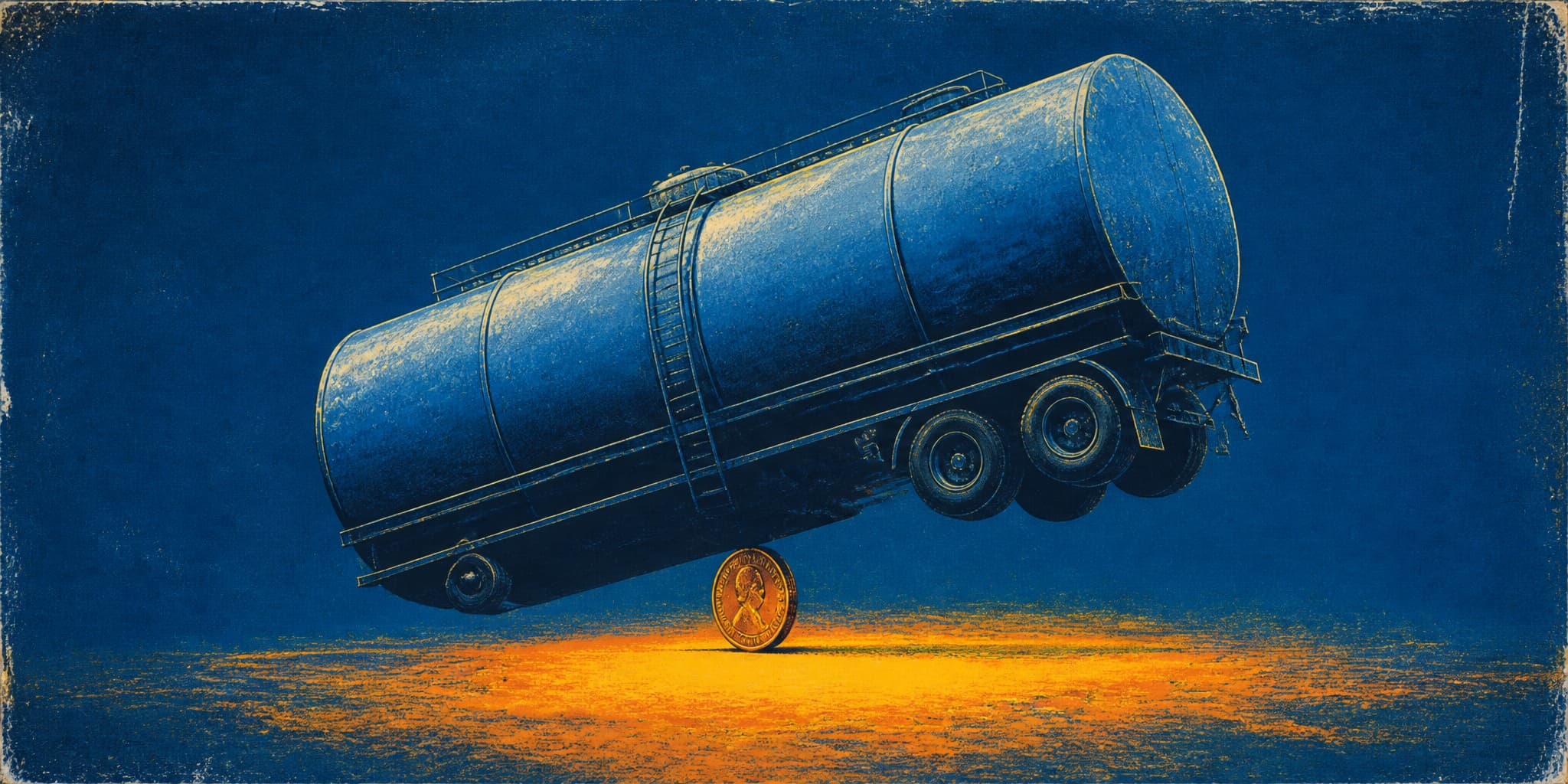
Scott Snyder loaded a 6,500-gallon tanker and two smaller vehicles one day in mid-July and started hauling water to his cattle outside Montrose, Colorado. He made eight trips over nine hours, in heat that AP's Brittany Peterson described as sweltering. What he moved that day would keep 800 cow-calf pairs going for a day, maybe two.
Mex & Sons is a multigenerational ranch based on Wright's Mesa near Norwood, in San Miguel County, high country between Telluride and Montrose. The Colorado Sun described the operation in 2024 at about 1,000 pairs: cattle summered on Lone Cone and other mountain pastures, alfalfa grown near Norwood for winter feed, calves trucked out in fall. The family had leased a 560-acre state parcel for roughly 40 years and owned additional land in western San Miguel County.
By July 2026 the herd was down to 800 pairs. Scott and his brother Monte had shrunk it. How many pairs went, when, and at what price isn't public. What's visible is the direction. Fewer breeding pairs means fewer calves next spring, less income next fall, and a narrower set of choices the winter after that. Sold breeding capacity doesn't come back when the rain does.
The water comes from a neighbor's reservoir. AP reported that a nearby landowner charges the Snyders to refill. That's the extent of what's public: paid access, unspecified rate, no documented contract, no guaranteed volume or duration. The arrangement works until the reservoir runs low or the neighbor stops selling, and no published source establishes where either limit sits.
AP documented Scott, Monte, and three vehicles on that July day but didn't report how many other family members were working, whether anyone is hired, or what happens when someone can't haul. An operation this size doesn't pause while the water truck runs: cattle on mountain pastures still need checking, equipment breaks, fences go down, and whatever alfalfa is growing in a drought year still has to be managed. Nine hours of hauling competes with all of it, and the labor doing both is family. Scott's cousin Mark Ragsdale runs his own 45-pair operation near Norwood while holding a second job as the state water commissioner, hauling water to his cattle before and after his government shift. AP reported the dual role about Ragsdale specifically, not the Snyder brothers.
The hauling is physical work repeated in conditions that wear on a body, and AP captured one day of it. The drought has been running for months. If Snyder is injured or sick, nothing in the reporting shows who takes over the tanker. ELAP has no category for the person doing the driving.
What the formula measures
USDA's Emergency Assistance for Livestock, Honeybees and Farm-raised Fish program, known as ELAP, reimburses water hauling at a national rate of $0.11 per gallon. The agency then applies a payment factor to the calculated eligible amount: 60 percent for most producers, 90 percent for qualifying beginning, socially disadvantaged, limited-resource, or veteran producers.
Run the arithmetic on a single full tanker load and you get about $429. That number is illustrative, not a Snyder payment. AP didn't say the tanker was full every trip, the other two vehicles had different capacities, and eligibility depends on documented gallons and livestock counts. Reimbursement is also capped at 150 calendar days.
$0.11 per gallon, capped at 150 days. Fuel, vehicle wear, labor, and the cost of the water itself are excluded.
Fuel isn't covered. Neither is tire wear, vehicle depreciation, or the nine hours that produced one or two days of water. The program substitutes a per-gallon rate for the actual cost of moving water. And if the neighbor's charge covers the water itself rather than its transportation, USDA's own guidance indicates that cost falls outside the program entirely.
The application deadline for 2026 losses is March 1, 2027. USDA publishes no median processing time. Whether Mex & Sons has filed isn't public. Whenever the payment arrives, it will settle against expenses already incurred: fuel already burned, hours already spent, hay already bought at whatever price Snyder could find.
What the hay costs
The most recent USDA Colorado hay report before this writing, covering the week ending August 14, recorded one confirmed bulk trade in the Mountains and Northwest Colorado region: 50 tons of fair-quality grass hay at $300 per ton. The Southwest section, closer to Norwood, had no confirmed bulk trade at all.
One trade doesn't establish a market. In April, Mesa County rancher Janie VanWinkle told KJCT she was seeing $180 to $300 per ton and expected prices to climb as drought cut production. AP didn't disclose what Snyder pays for hay, how much he's buying, or where it comes from.
I reported earlier this year from Hotchkiss, a couple of counties north, where Robbie LeValley sold roughly a fifth of her breeding herd and started buying hay after irrigation water ended two months early. The same $300-per-ton figure turned up in the same thin USDA report. What her situation made plain is that none of these decisions can be made one at a time. Sell cattle and you need less hay but lose next year's calves. Buy hay and you keep the herd but spend cash you may not get back. Fallow ground so a neighbor on the same ditch has water and you lose feed while keeping a relationship you depend on. The arithmetic gets redone constantly, and hauling water nine hours a day is one more term in it.
What September looks like
As of August 20, Bureau of Reclamation data showed Blue Mesa Reservoir, the largest in Colorado, at about 24 percent of capacity. Lake Powell held about 22 percent. Nearly 95 percent of the Intermountain West was in drought.
Each of the things holding the operation together has its own trajectory into fall. The neighbor's reservoir has been supplying hauling runs through a summer with no documented inflow; its level when hauling started isn't public, and neither is its volume now. VanWinkle's April expectation that hay would push past $300 a ton has had five more months to come true, in a region where USDA's reporters are confirming one or two trades a week. The ELAP deadline sits in March 2027, with no published processing timeline after that, which means a reimbursement calculated at eleven cents a gallon arrives on the program's schedule rather than the ranch's.
The body that hauled in July will haul in August and September. Cattle that got through summer on trucked water will need winter feed from a market drought has been thinning since spring. The herd could be cut again, but every sale is permanent; breeding stock sold this fall won't produce calves in 2028.
Which of those gives out first isn't something the reporting can answer. Snyder is running the calculation daily against a season with no end date.
Companion pieces.
