

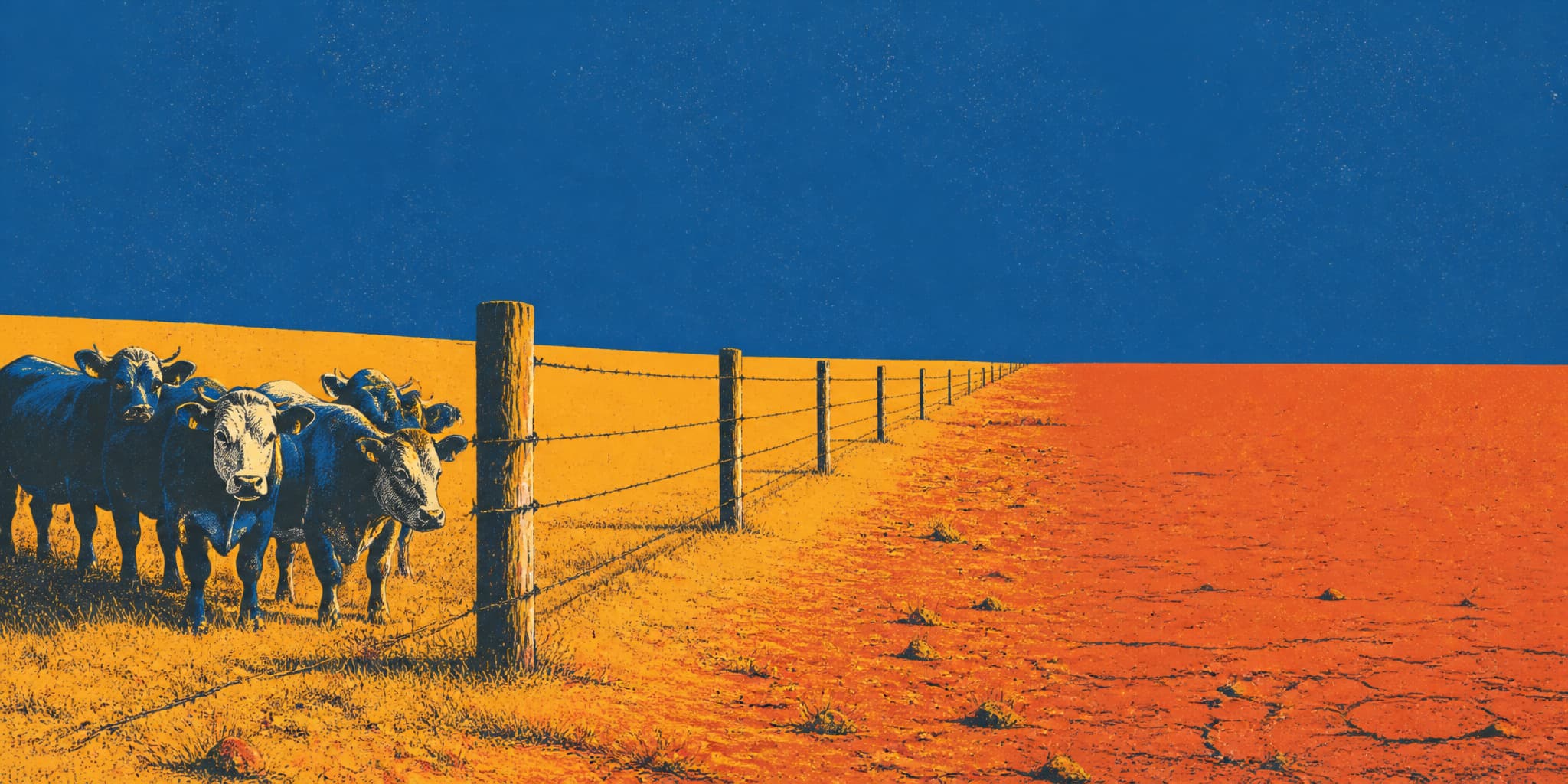
Robbie LeValley sold roughly a fifth of her breeding herd this summer. On a cow-calf operation, where the whole business is keeping mother cows and selling their calves, that decision follows you for years — each cow you sell takes with her every calf she would have raised. CSU Extension economist Jenny Beiermann put the tradeoff in terms any rancher already understands: selling breeding animals is like drawing down a retirement account. When conditions improve and you go to replace them, they cost more than what you were paid.
The extension guidance that circulates in years like this one comes down to a single line:
"The most expensive drought decision is the one that is made too late."
LeValley's ranch sits near Hotchkiss, in western Colorado's North Fork Valley, where the Smith Fork River feeds a canal system that has watered hay ground and pasture on the mesas above the valley since before Thomas LeValley homesteaded the land around 1910. In an ordinary year, snowmelt held in Crawford Reservoir carries the ranch through the growing season, and by July the irrigated mesas are the greenest thing in sight, hay and pasture standing against the brown hills around them. This year the water ran out two months early and the fields went brown behind it. LeValley — who spent 23 years as a CSU Extension livestock specialist before becoming Delta County administrator, and who therefore knows the drought playbook as well as anyone in the valley — started buying hay.
What the hay costs
The closest USDA benchmark for western Colorado hay, fair grass in medium-square bales, shows $300 per ton in late July 2026 against $150 per ton the previous July. LeValley told Reuters her own costs had tripled, which probably reflects the type of hay she buys, the bale size, or how far it has to travel to reach her. Other western Colorado producers told Colorado Public Radio their prices had more than doubled. Both USDA reports rest on thin confirmed trades — 200 tons in one, 25 in the other — so the numbers are rough, but the direction isn't in question. Montrose, the nearest climate station, recorded its warmest 30-day stretch on record. Hay yields came in short and the quality came in low, which is the combination that moves prices fastest.
The cattle sale, at least, went into a strong beef market, so ranchers forced to sell this summer aren't compounding a drought loss with a bad price. What a good sale price doesn't fix is the shape of the year underneath it. LeValley is spending more to feed fewer animals. The cows she sold won't calve next spring, so the herd stays smaller, the feed bill stays larger, and the distance between what the ranch produces and what it costs to run keeps widening until the water comes back.
Who governs the water
Colorado irrigation runs on a rule older than the state itself: whoever filed a claim on the water first gets served first, and in a short year the newer claims simply go dry. The Grandview Canal delivers roughly 14,200 acre-feet a year to about 4,500 acres of hay and pasture, drawing partly from the Smith Fork's live flow and partly from storage in Crawford Reservoir.
Mark LeValley has served as president of both the Grandview Canal company and the Crawford Clipper Ditch company. The family doesn't just take water from the system; it helps run it. That means Robbie and Mark know the mechanics from the inside, including the way the mechanics stop mattering. When the reservoir empties and the river drops below what the senior rights holders are entitled to, no order from a regulator is required to end the season. Reuters' phrasing was exact: the snowmelt irrigation water "ran out." There was nothing left in the ditch.
This has happened to them before. In 2012, LeValley described conditions that rhyme with this year's to KUNC — runoff arriving early and leaving early, hay yields down, feed being trucked in from as far away as Canada. Reuters counts 2010 as another. Each time, the ranch took the loss, rebuilt the herd and waited for the snowpack to return, and each time that bet was the right one. The harder question in 2026 is whether the gaps between these years are closing — whether the seasons when the water holds through August are on their way to becoming the exception. Lake Powell recorded inflows at 12 percent of the historical average in June, which is one month's reading and not a forecast, but it sits inside a documented long decline in western snowpack. The LeValleys' water comes from Gunnison basin tributaries, not from the Colorado River mainstem. The warming that shrinks the big river shrinks the small ones on the same schedule.
116 years of choosing to stay
The LeValleys have been adapting for decades, and the kind of capital they've put into it only makes sense if you believe the place will outlast you. By 2017 the ranch had converted about a third of its irrigated ground to center-pivot sprinklers, replacing flood irrigation that loses water to evaporation and runoff. They laid 17 miles of pipeline with livestock tanks on their federal grazing allotment so cattle could drink without being trailed back to a single creek.
In the 1990s they went in with five other ranches on Homestead Natural Meats, a cooperative with its own USDA-inspected processing plant about 25 miles from the ranch. The six families were running roughly 2,000 cattle between them as of 2023. Ship your animals to a distant corporate packer and you take the price you're given and hand the rest of the animal's value to somebody else's supply chain. A plant you own lets the families cut, brand and sell their own beef. It also needs a dependable supply of cattle from the ranches around it, which is the part that doesn't appear in any drought assessment: it took six families several decades to build, and it can't be reassembled once the ranches feeding it start converting to something else.
These arrangements rarely make it into state and federal conversations about western water, which tend to be conducted in acre-feet between agencies. The investments assume somebody will be there to use them. Ross LeValley, the most recently documented of Robbie and Mark's sons, has been working alongside the cattle and the ground that four generations shaped ahead of him. A family profile quotes Robbie calling the work they do together on the range "pretty special."
"We are benefit," LeValley told Reuters this summer. "We are not the problem."
She was answering a framing she's heard for years, the one that files agricultural water use under obstacles to urban and industrial supply. It leaves out what a ranch holds in place — open ground, wildlife habitat, a local meat supply chain — none of which comes back once the land is sold and subdivided. The argument carries a particular weight coming from someone who has just sold a fifth of her herd to keep the rest fed.
The public record doesn't say what Robbie and Mark told their sons after this summer's sale, whether Ross has revised his own plans, or whether the family has ever named a threshold — a number of consecutive bad years, a hay price, a herd size — past which the operation stops adding up. What it does hold is 116 years of a family choosing to stay, and a season that made staying cost more than any in at least a decade. The sprinklers stretch the water, the cooperative keeps more of the value at home, and the pipeline keeps cattle drinking on federal range. None of it produces snowpack, which is what everything else depends on.