

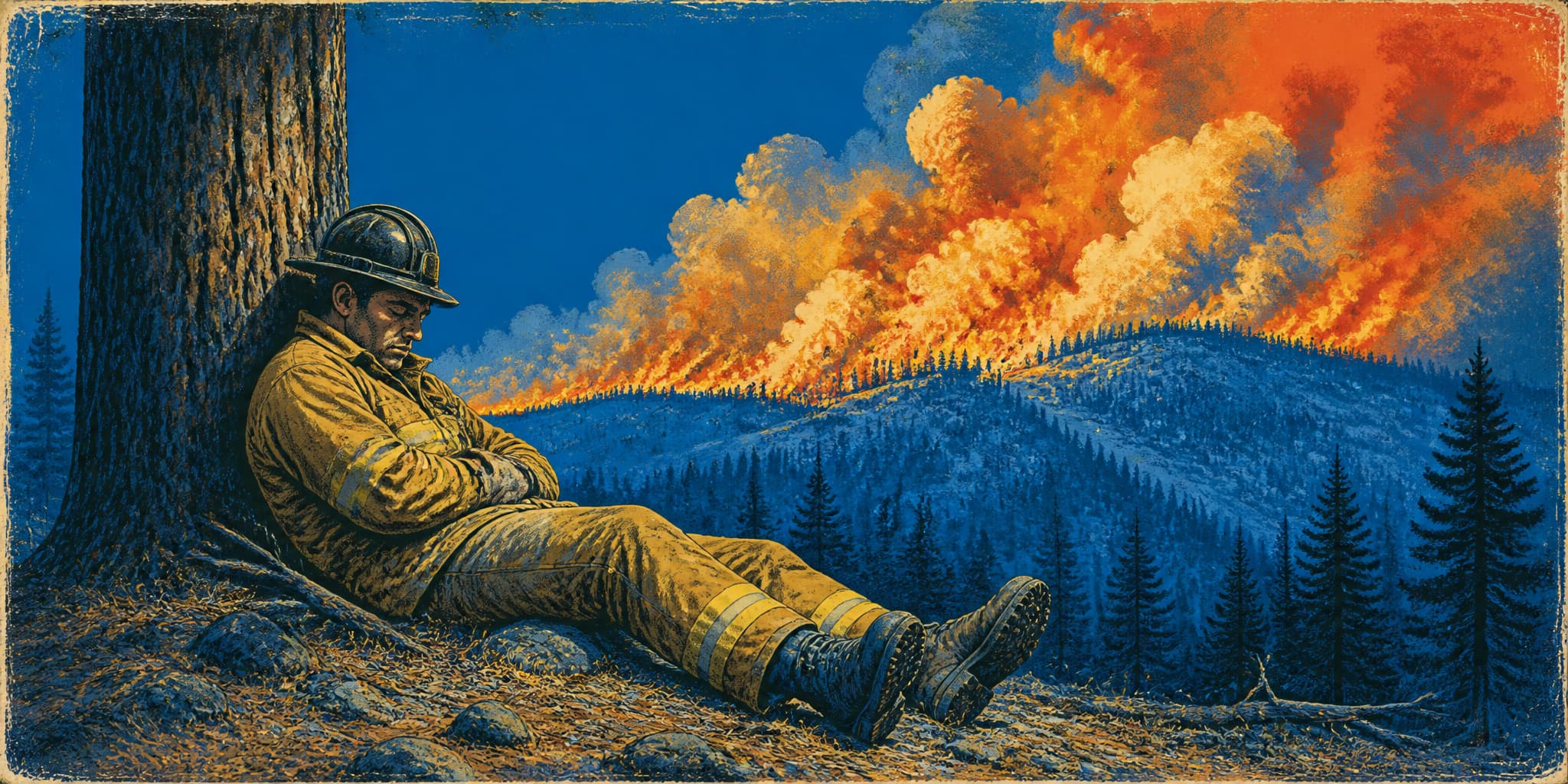
A study published last month in Communications Earth & Environment identifies fire-weather waves — sustained stretches where hot, dry, and windy conditions overlap. Across global forested regions from 1979 to 2024, these waves occupied 4% of days but coincided with 26% of burned area and roughly half of the most intense fires. They are becoming more frequent.
The U.S. is living inside one now. Early August brought the highest national alert level: 102 uncontained large fires, over 29,000 personnel deployed, international crews supplementing from Australia and New Zealand, military aircraft staged in Oregon and California. Some new ignitions may get no initial-attack response — the brief window when a fire is still small enough to catch.
Every system downstream assumes the danger will break. Wildland crews rotate on 14-day assignments. EPA guidance frames cleaner-air shelters as "short periods (hours) of respite." Jasper, Alberta, stayed evacuated for 24 days last summer. The wave pattern raises a practical question for anyone in fire country: what happens to crew fatigue, shelter air quality, and evacuation timelines when dangerous conditions persist for weeks instead of days?
Crew rotation limits: After a 14-day assignment, minimum 7-day gap before redeployment. Shifts over 16 hours require pre-approval from incident command.
Overnight recovery disappearing: A 2026 Science Advances study found potential burning hours rose roughly 36% over 1975–2024 as nighttime humidity recovery weakened — the cooling window crews historically use to regroup and build containment lines.
Season running ahead: National system hit Level 4 by late June. Historical June average is Level 2.
Shelter filtration under sustained smoke: In 24 Alberta university buildings, 71% exceeded daily fine-particle standards during smoke events despite upgraded filters. Portable air cleaners dropped from 90% to 45–70% effectiveness under continuous infiltration (NIST, 2025).
Evacuation durations, 2024: Jasper, Alberta — 24 days. Lake Fire, California — approximately 15 days. Standard household emergency kits assume 72 hours.