
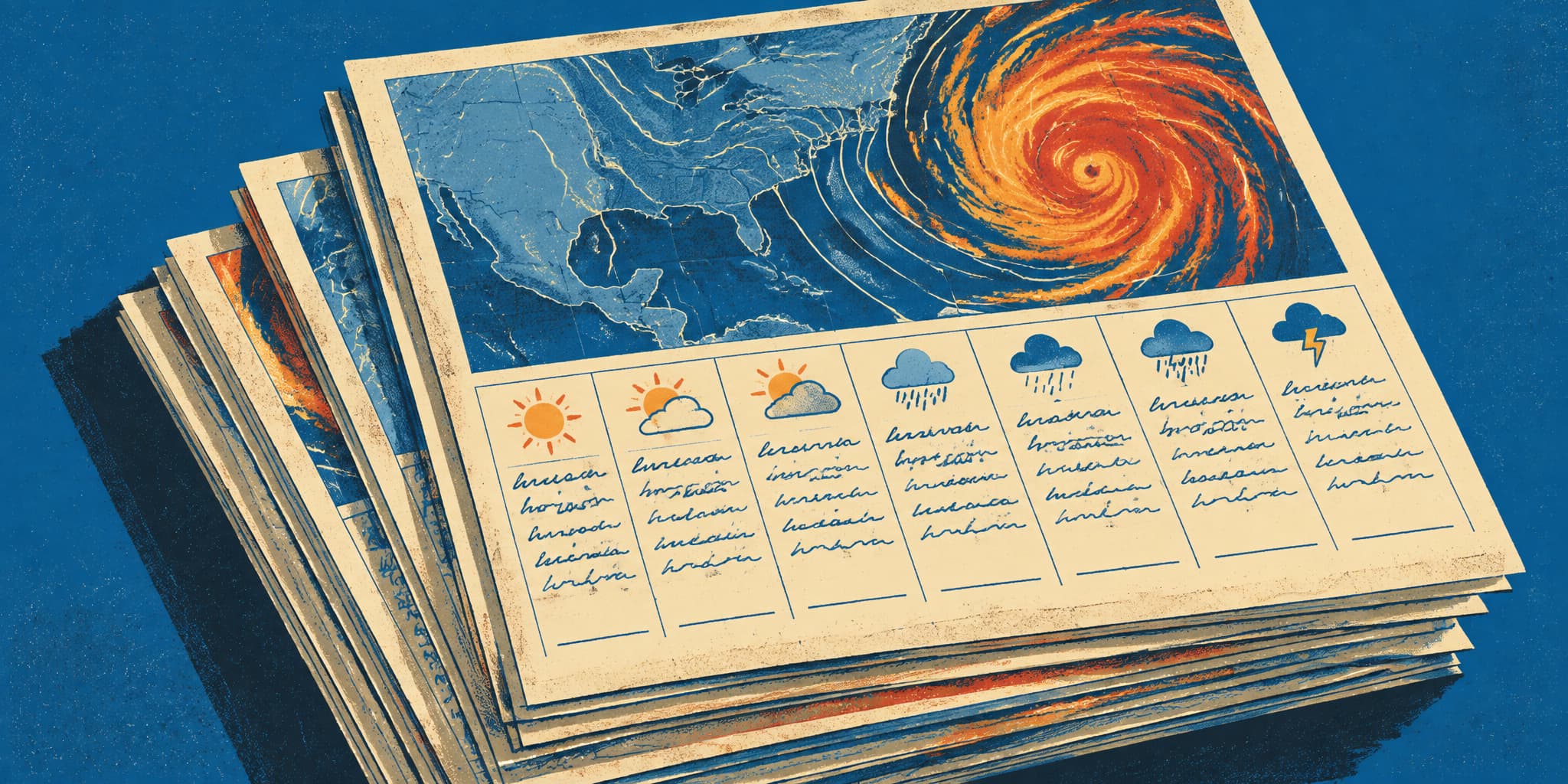
In 1930 a senior Weather Bureau meteorologist named Alfred J. Henry published a government pamphlet describing how his agency handled tornadoes. He called the approach, without any visible embarrassment, a "policy of silence."
He wasn't owning up to anything. He was describing procedure. The federal agency responsible for telling Americans about dangerous weather had maintained, for decades, a written prohibition against the word tornado in public forecasts. The ban had been issued, reissued, printed in the station regulations, and folded into personnel evaluations. By the time Henry got around to naming it, 695 people had died in a single afternoon without any warning at all, and the policy had outlived them. An outfit that existed for no purpose other than telling people what the weather was going to do had concluded that one particular kind of weather was too frightening to mention.
A Program That Worked, Briefly
In the early 1880s an Army Signal Corps officer named John Park Finley assembled a network of more than two thousand volunteer observers and used their reports to issue experimental tornado predictions. The forecasts were crude. He divided the country east of the Rockies into large regions and predicted either tornado or no tornado. A modern statistical reconstruction found that forecasting "no tornado" every single day would have been correct 98.2 percent of the time, which is the baseline he was working against. The same analysis found he had real skill at flagging the days when tornadoes were more likely. He was doing something, even if he couldn't tell you which town to leave.
In 1885 Chief Signal Officer William B. Hazen's office authorized a special warning when reports suggested violent local storms were developing, and instructed forecasters not to use the word tornado. The permitted phrase was "violent local storms." That is the first documented substitution: you could acknowledge the thing so long as you called it something calmer.
Hazen died in January 1887. His successor, Adolphus W. Greely, pulled Finley off tornado work and shut the prediction program down. The 1887 annual report explained why:
"The harm done by such a prediction would eventually be greater than that which results from the tornado itself."
That is the United States government on the record: being told about the tornado is worse than the tornado.
The argument wasn't stupid on its face. A tornado covers a sliver of any county. Warn an entire region and nearly everyone you warn will never be touched, and the fear and disruption spread across all those untouched people — cellars, closed shops, rumor — might in aggregate exceed the damage along one narrow track. The reasoning required you to believe that unnecessary alarm was a measurable cost and that no warning at all was an acceptable alternative. It also required netting the people in the path against the people who would be frightened for nothing, and arithmetically the path always loses.
Finley's program was tangled up in a fight over whether weather forecasting should stay under the Army or move to civilian hands, and some historians treat its termination as partly a casualty of that. But the vocabulary rule outlasted the fight. Whoever was in charge, the word stayed banned.
How You Make Silence Routine
When forecasting passed to the civilian Weather Bureau in 1890, the new agency took the ban along and tightened it. Instruction No. 61, dated August 2, 1897, established three tiers. An ordinary forecast official who believed conditions favored destructive local storms was to say "severe thunderstorms." The stronger formula, "conditions are favorable for severe (or destructive) local storms," could be issued only by the chief of the bureau in Washington or a designated substitute. And every forecast was to be examined under the chief's personal direction and rated for accuracy and for compliance with the instruction.
The rating is the part that did the work. It turned the prohibition into a question of how a man was supervised and graded. Nobody had to be fired for saying tornado — and the record doesn't show that anyone was — because the word couldn't survive the review. A forecaster who used it would have been corrected the way a shipping clerk gets corrected for using the wrong form number. A paperwork matter.
The flat rule, "Forecasts of tornadoes are prohibited," appears in the bureau's station regulations in 1905, and again in the 1915 and 1934 editions.
I've written before about how San Francisco decided to call its 1906 catastrophe a fire rather than an earthquake, and how that choice of word determined which losses the institutions would act on. The tornado ban runs on the same principle, a dangerous thing made administratively visible only under a milder name, with one difference worth marking. San Francisco's renaming was informal and commercial, pushed along by insurance and real estate. The Weather Bureau's was a written directive out of Washington, enforced through the review process and reprinted in the station regulations across three decades and counting.
What the Approved Language Sounded Like
On the morning of May 27, 1896, the bureau's St. Louis office issued a forecast saying "conditions are favorable for severe local storms." That afternoon a tornado killed 255 people in St. Louis and East St. Louis. The forecast had used the strongest language the rules permitted. It described the conditions and did not name what the conditions produce. Whether anyone who read it understood they ought to get below ground, the record doesn't say.
Forecasts reached the public through newspapers and bulletins posted at local offices. For a farmer in rural Missouri or Illinois the morning paper, if it came at all, carried the day's language, and when a storm went up that afternoon there was no mechanism to update it. I spent five years on cargo ships, and the only thing that ever mattered about a weather report was whether you could do something with it: change course, secure the deck, or go back to what you were doing. A sentence about conditions being favorable for severe local storms doesn't tell anybody to do anything. The distance between what forecasters were permitted to say and what a person could act on was at least as wide as the distance between "severe local storms" and tornado.
By 1930 even the stronger formula was gone. Henry explained that it caused "fear and unrest" among a large population when only a few would actually be struck. What forecasters had left was "severe thunderstorms" or "severe local storms," phrases covering everything from a hard rain to the most violent atmospheric event on the continent, with nothing in them to help anybody tell the difference.
March 18, 1925
The morning forecast called for "rains and strong shifting winds." Other bureau products predicted afternoon thunderstorms across Indiana, Illinois, and Kentucky. The word tornado did not appear. Neither did the permitted euphemism, "destructive local storms."
What came was a tornado that crossed southeastern Missouri, southern Illinois, and southwestern Indiana along a damage path traditionally reported as 219 miles. It killed 695 people, 234 of them in Murphysboro, Illinois, and injured more than two thousand. It remains the deadliest single tornado in American records. Investigators reported afterward that rural residents generally had about five minutes between first sighting the cloud and the storm's arrival, and that many of them took it for an ordinary severe thunderstorm.
No observed-tornado warning was relayed ahead along the path after touchdown. The bureau had neither the communications nor the organized spotter networks that would have made relaying possible, and its twice-daily surface observations, seven in the morning and seven at night, were useless for tracking a fast afternoon storm.
The bureau's response was to investigate the tornado. Two officials, Clarence J. Root and William E. Barron, spent seven days driving the Illinois and Indiana damage path, documenting its course, speed, width, damage, casualties, and what witnesses had seen. Henry published a meteorological analysis in the Monthly Weather Review. The work was thorough. It examined the storm in considerable detail.
Nothing in the published record shows anyone examining the policy that guaranteed no warning went out ahead of it. No internal review of the word ban surfaces, no congressional inquiry, no order from Washington reconsidering the prohibition. The agency studied the storm and did not study itself.
Why the Policy Outlived the Catastrophe
The men who kept the ban in place weren't fools, and they weren't working with our instruments or our data. They had a set of arguments that propped each other up, each one partly true, and together sufficient to justify doing nothing.
The geographic mismatch was real. In 1925 a forecaster could identify broad areas where severe weather was more likely and could not say where inside those areas a tornado would come down. The gap between the territory you'd have to warn and the territory that would actually be struck was enormous. Cleveland Abbe, an earlier bureau official, argued in 1899 that a tornado could form, die, or slip between widely spaced reporting stations before any telegraph operator could pass along an observation. He went further, arguing that tornado destruction was so complete that even an accurate warning might offer little material protection.
The false-alarm problem was real enough to serve. Officials cited reports of people running for storm cellars whenever an ordinary thunderstorm came up and treated that as proof that tornado language produced fear out of all proportion. The institutional worry was credibility. Warn and be wrong often enough and people quit listening; once they quit listening the warnings are worthless; therefore don't warn until you can be sure.
The technical limits were genuine. No radar, no upper-air network worth the name, no organized spotters, no quick chain from observer to forecaster to public. A French meteorologist had published a method in 1914 for using telegraph reports to anticipate squall zones favorable to tornadoes several hours out, and the Weather Bureau did not develop it. The proposal concerned regional conditional alerts, not "a tornado will hit your town at 3:15" but "the next several hours look dangerous across this part of the state." That much was scientifically conceivable. The bureau chose not to pursue it.
The whole arrangement held together by running in a circle: the limits justified not trying, not trying meant the technique never improved, and the unimproved technique confirmed the limits. Underneath sat the 1887 premise, which nobody had revisited. The warning is the danger. Better to say nothing than to say something imprecise and frighten people who turn out not to need it. The ones who did need it were always going to be outnumbered.
Henry, writing in 1930, allowed that some people in and around the institution still considered the policy of silence "debatable." He did not propose anything to put in its place.
Twenty-Seven Years to Say the Word
The ban reportedly began to give way in 1938, when the bureau permitted the word tornado in warnings about storms already observed or bearing down while continuing to prohibit it in forecasts of conditions to come. You could name the thing once it was already killing people. You could not name the conditions that made it before it arrived. The documentary trail here is thin; none of the historians reviewed for this piece reproduces the directive.
What moved the bureau was a war. Military installations, airfields, ammunition plants, and training camps concentrated people and property in places where even imperfect storm information had obvious value. The military built spotter networks, paid for upper-air research, and created a class of users who wanted tornado forecasts and had the standing to insist on them.
The 1948 forecast at Tinker Air Force Base, when Air Force officers Ernest Fawbush and Robert Miller successfully predicted a tornado at their own base, was a military forecast for a military installation. What it broke was the intellectual premise holding the ban up, the claim that the thing could not be done.
In May 1949 an Amarillo meteorologist named Henry Winburn went on the radio to warn residents that a tornado was coming. Six people died. A newspaper went after the bureau. An investigation followed and concluded that Winburn had acted appropriately, and he collected commendations from the bureau chief and from the secretary of commerce.
Then came the memo. On July 12, 1950, Weather Bureau chief Francis W. Reichelderfer sent a circular letter to all first-order stations objecting to officials who had been telling reporters that tornadoes could not be predicted, that the bureau did not forecast them, or that employees were forbidden to do so. He called those statements misleading and damaging. His official formulation:
"There is no regulation or order against the forecasting of tornadoes."
Sixty-five years of written prohibitions, printed in the station regulations, reviewed and graded through the personnel system, and the chief's method of ending the ban was to announce that it had never existed. The regulations are still there. The man in charge read all of it and said there was no regulation.
The last step came in 1952. Tornadoes on March 5 killed people who had gotten no warning while military bases in the same region had gotten one, and the public anger that followed forced the bureau's hand. On March 17, 1952, a temporary severe-weather unit issued the first centralized public tornado forecast bulletin, naming the possibility of tornadoes in eastern Texas and southeastern Oklahoma. On May 21 the bureau made the unit permanent, the institutional ancestor of today's Storm Prediction Center. That was sixty-seven years after the word was first prohibited, twenty-seven years after the catastrophe that should have ended the prohibition, and four years after two Air Force officers proved the premise of impossibility wrong.
What the Record Shows
The theory behind the ban was coherent and self-reinforcing. Everything it required of the agency was inaction, and every argument for keeping it doubled as an argument against effort and against the risk of being publicly wrong. An agency can be publicly wrong and get better at the work. This one stayed quiet, and on one March afternoon in 1925 the quiet cost 695 lives in three states.
An institution can have the right mission and competent people, take a catastrophic demonstration that its own policy is killing the people it exists to protect, investigate that catastrophe with real professional care, document the path and the casualties and the meteorology, and never once look at the policy. The Weather Bureau studied the Tri-State Tornado closely. Then it went another twenty-seven years without saying the word.
- Chicago's banned word equivalent: After the 1995 heat wave killed hundreds, Chicago built a warning and cooling-center system — but recent reporting finds advocates still questioning whether overnight cooling, transportation, and accessible information reach isolated residents during heat emergencies.
- When the forecast existed but couldn't travel: The Weather Bureau's communication constraints in 1925 — twice-daily observations, no spotter networks, no rapid relay — have a present-day echo in communities where flood-risk maps exist but two legitimate mapping systems disagree about which properties face danger, leaving households to reconcile the gap themselves.
- San Francisco's parallel vocabulary choice: The tornado ban shares a structure with San Francisco's post-1906 decision to call its catastrophe a fire rather than an earthquake, a renaming that determined which losses and building rules became institutionally actionable for decades afterward.
- Florida's post-Andrew code system: Hurricane Andrew's 1992 destruction exposed not missing engineering knowledge but a fragmented system for translating that knowledge into consistent local practice, leading to a statewide building code whose ninth edition is in development for 2026 — adaptation as an ongoing revision process rather than a one-time fix.