
"Rains and strong shifting winds." That was the whole of what the Weather Bureau had to say about Illinois on March 18, 1925, the afternoon a tornado killed 234 people in Murphysboro. Over the century since, the country got a great deal better at saying what was coming. It did not get better at it evenly, and it did not get better at it for everything.
The first warnings and their customers
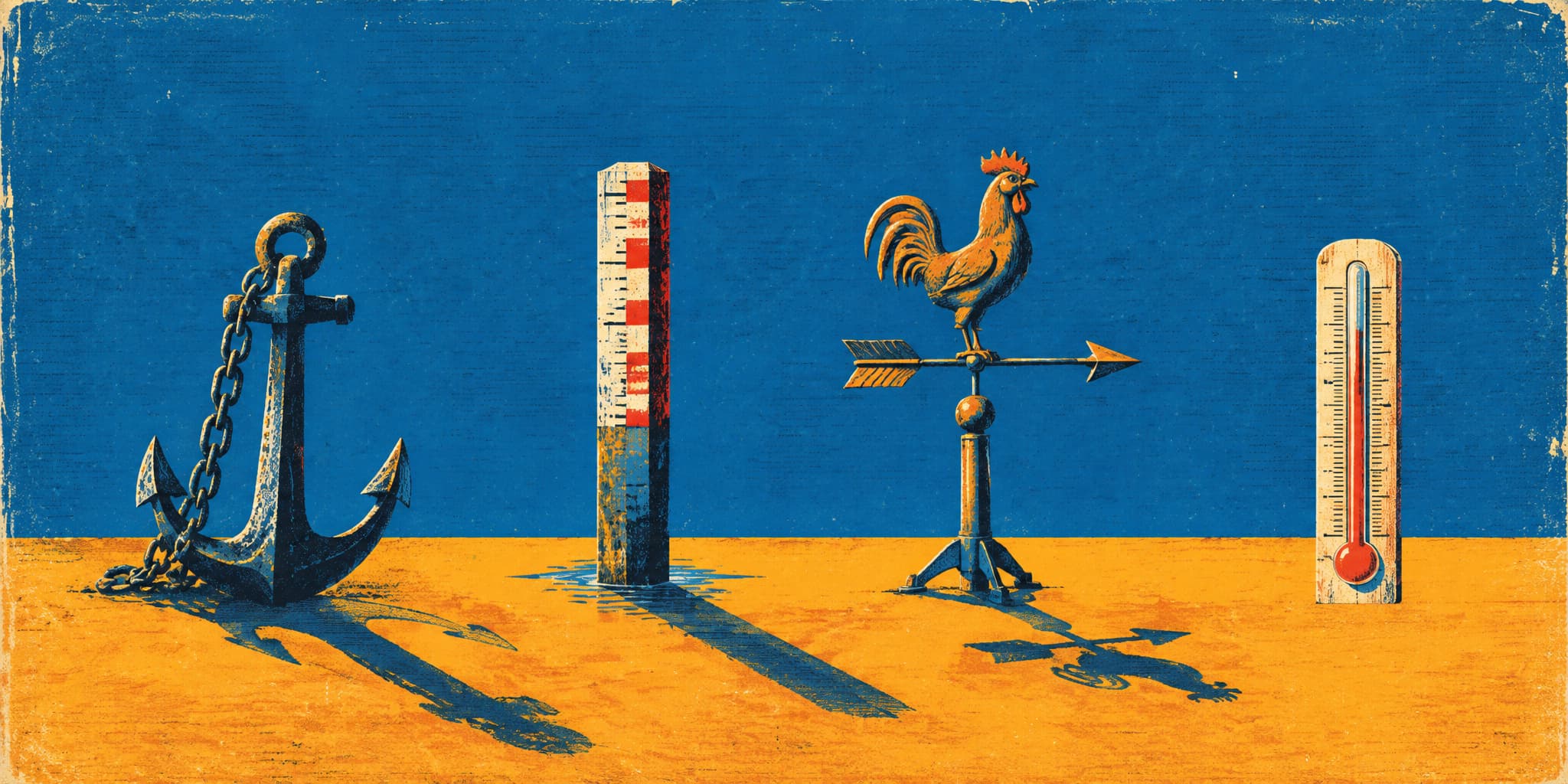
The federal weather service was set up in 1870 to collect observations by telegraph and give storm notice on the Great Lakes and the coasts. Its first customers were shipping and commerce. River-flood warnings were running by 1891. A hurricane warning network followed in 1898. Fire-weather forecasts started in 1912. Public tornado forecasting began in 1952. Air-pollution-potential advisories came in 1960. These were different orders of commitment: observing networks, forecast services, formal products, public indices. Each had a constituency with money on the line.
The hazards that got the early service had a few things in common. You could see them coming, more or less. They moved across a map in ways instruments could follow. Each could be reduced to a number crossing a line, a river stage or a wind speed or a storm's position. And each of them wrecked property in a concentrated way that somebody with a balance sheet noticed.
Heat
Heat kills more Americans in an ordinary year than tornadoes, hurricanes, or floods. It has for a long time. Formal heat warning infrastructure arrived decades after severe storm warnings were routine.
There was no single national moment when heat warnings began. The NWS adopted the heat index for operational use in 1979, and national heat product guidance followed in 1984. Those were tools and procedures. They were not a public warning system of the kind that already existed for severe thunderstorms.
The warning systems themselves grew up locally, unevenly, and usually after people had died. St. Louis had run a heat survival program since 1981. Philadelphia built an interagency heat watch and warning system in 1994, tying a health commissioner's alert level to NWS heat warnings, which put the health authority and the weather authority into the same conversation for the first time.
Then Chicago, 1995. I wrote about that one in "The Morgue That Broke the Frame": the medical examiner's office buried, the argument over certified heat deaths versus excess mortality, hundreds of people dying alone in apartments and becoming a single recognizable event only because the morgue ran out of room. Afterward, the NWS Chicago office and the city agencies worked out heat criteria based on local impact.
"After Chicago" did not mean everywhere at once. A 2013 survey of all 122 NWS forecast offices found 55 offices using national-directive criteria and 60 using locally developed ones, with the mix of watches, warnings, and advisories varying office to office. The same survey found that of nineteen identified health-impact heat waves in California, only six had an accompanying NWS heat advisory or warning. The meteorological threshold and the observed health damage did not always agree.
The NWS started using HeatRisk experimentally in the West in 2014 and took it national in 2024. In June 2025 the Fairbanks and Juneau offices issued formal Heat Advisories for the first time, having relied until then on Special Weather Statements. The Anchorage office added the product in 2026. A hundred and one years after Murphysboro, the country was still adding places to the list.
Why some hazards waited
I spent a good stretch of years writing about job sites, union disputes, and industrial accidents, and what that work teaches you is that whether a hazard gets attended to depends much less on how many people it kills than on who it kills and whether anybody with standing is watching.
A tornado leaves a photograph, a hurricane shows up on a satellite loop, a flood leaves a waterline on the parlor wall. Heat leaves nothing to look at. It doesn't take down buildings. It kills people one at a time, indoors, and the deaths get written up as medical events: heart failure and kidney failure and respiratory collapse rather than weather casualties. Chicago in 1995 became visible because the morgue ran out of space and the medical examiner started counting.
Measurement was part of it too. The heat index gave heat a number in 1979, but turning that number into a statement about health required local calibration that varied with climate, housing stock, who lived in the housing, and what the local health system could absorb. A heat index of 105 in Phoenix and a heat index of 105 in Seattle are not the same danger, because the people, the buildings, and what everybody is accustomed to are different.
And heat's dead were disproportionately old, poor, alone, and without political weight of any kind. Their dying cost no business anything, and nobody went to Washington about it.
The compound problem
All of this assumed dangers would arrive one at a time, in categories matching the institutions built to warn about them.
NWS offices issue heat products. Air quality alerts originate with state or local air agencies. The NWS may pass them along but does not write them, and the NWS directive on air quality products says so plainly. When extreme heat and wildfire smoke show up together, which they increasingly do, the warnings come out of different agencies, through different channels, on different criteria.
A peer-reviewed California study covering 2006 through 2019 found that simultaneous exposure to extreme heat and wildfire smoke was associated with increased cardiorespiratory hospitalizations, and that the joint effect exceeded the sum of the separate heat and smoke effects. The two together did more damage than the two apart would lead you to expect.
The advice conflicts, as well. EPA guidance notes that closing windows and doors keeps smoke out but can drive indoor heat up in a building without adequate cooling. NIOSH says a respirator can add physiological strain to physical work in hot conditions. What you do about the one hazard makes the other one worse. The WMO's 2024 handbook says warning systems ought to identify compound triggers and put multiple hazards into the warning message. That is an international design standard. It is not a description of how American systems presently work.
The gap that persists
In 1925 the observation and forecast system did not produce a location-specific tornado warning for Murphysboro because it could not. The people who died were inside the distance between what the institution could see and what the weather could do.
A century of building closed a lot of those distances. Tornado warnings exist. Hurricane tracking is very good. Flood forecasting has its own hydrologists and its own river forecast centers. Those are real achievements, made by people who understood what unwarned danger costs.
But what got built was shaped by which dangers looked like dangers to the builders: the visible ones, the fast ones, the measurable ones, the ones demanded by customers with economic and political weight. Heat, being slow and invisible and fatal mostly to people without standing, waited decades. Compound risks now sit in a similar position, overlapping hazards whose combined effect runs past the sum of the parts, whose protective actions contradict each other, whose warnings come from separate agencies that don't answer to each other.
The national documents I was able to review do not identify a general NWS heat-and-smoke warning category. That is a statement about what's in the current authoritative documents, not proof that no local agency anywhere has worked one out. But the absence fits the pattern of the rest of the century, and Murphysboro's own numbers still don't agree.