
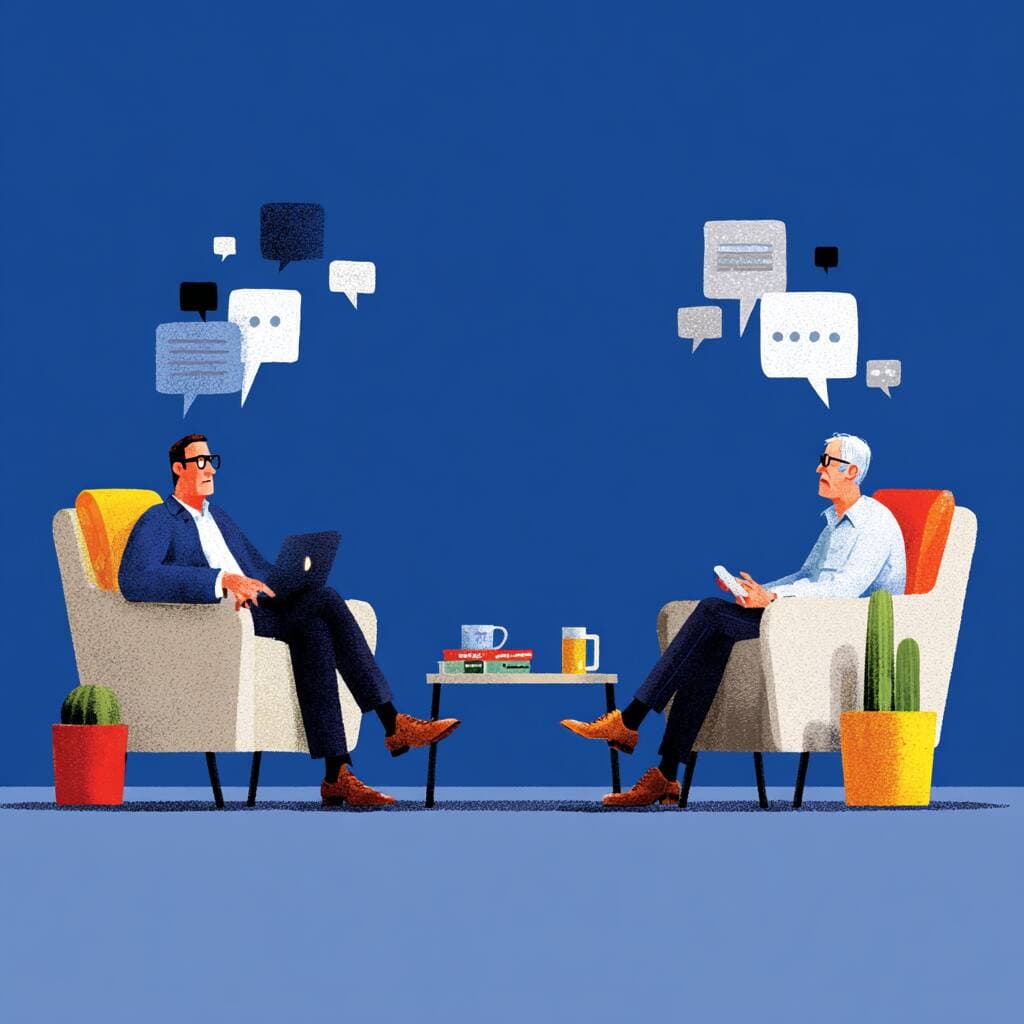
Future Tense is The Docket's speculative fiction section, exploring plausible near-futures through invented characters and scenarios. This interview takes place in 2038.
Kit Bracewell's office occupies a converted exam room on the third floor of a former dermatology clinic in Houston's Montrose neighborhood. The frosted glass partition in the waiting area is original. Behind it, where patients once sat in paper gowns, there's a display table with sample go-boxes, labeled and color-coded, one sized for a child's backpack. A whiteboard on the wall shows a household essential-functions matrix filled out for a family that doesn't exist. The handwriting is very neat.
Bracewell, 46, spent twelve years as a business continuity consultant at a major professional services firm, designing disaster-recovery plans for hospital networks and energy companies. In 2035, after her third consecutive year helping corporate clients maintain operations through hurricane seasons that kept starting in May, she began getting calls from friends. Not about their organizations. About their households.1
She founded Bracewell Continuity the following January. The firm now employs four planners and serves roughly 120 households across the Houston metro, with a growing client base in Austin and San Antonio. Her marketing materials carry the tagline: Your household is an organization. We plan it like one.
When I arrived at two in the afternoon, the building's backup power had just cycled on for the load-management window. Bracewell didn't mention it. The lights didn't flicker. On her desk, next to a stack of intake worksheets, sat a laminated card the size of a playing card. The kind, I'd later learn, she gives to children.
How do you explain this work to someone encountering it for the first time?
Kit: Twelve years in business continuity, you're really asking one question: if something disrupts this organization, what has to keep running, and who makes that happen? That's the whole discipline. I just brought the question home.
A household has essential functions. Shelter, thermal safety, medication management, food, child logistics, income continuity, communication with the outside world. Most families run all of that on institutional knowledge that lives in one person's head. My job is to make it legible. Write it down. Build in redundancy.
Very boring. Very important.
Walk me through what happens when you first sit down with a family.
Kit: The intake is a worksheet. Deliberately boring-looking. I want it to feel administrative, not therapeutic, because the therapeutic part arrives on its own. You don't have to invite it.
I list every essential function the household performs and ask three questions: Who does this? Who else knows how to do this? And who could take it over if that person were unavailable for seventy-two hours?
That third column is where it gets quiet in the room. I call it the backup-designation column, and in maybe seventy percent of the households I work with, it's mostly empty on one side of the table.2 One person holds the insurance account numbers, the prescription refill schedule, the school's emergency-contact protocol, the generator startup sequence, the go-box location, the water shutoff. I could keep going. In continuity planning we call that a single point of failure. It means if that node goes down, if that person is hospitalized or traveling or incapacitated, the household doesn't have a degraded mode. It has a collapse.
I don't name who it is. The worksheet names it. I just ask the questions and write down the answers, and by the third page the room has a different temperature. One partner is usually looking at the other. The other one is looking at the worksheet.
I had a client where the husband said, "I didn't realize she was the entire operating system." And I said, "That's why we're here. We're building you a backup." He laughed. She didn't.
Does that moment change anything between them?
Kit: That's not in my scope of work.
You also work with children in the household. What does that look like?
Kit: Children are household members with assignable roles. I know how that sounds. But the research is fairly clear that children who understand their function in an emergency perform better and report less helplessness afterward.3 So yes, I give them roles. Age-appropriate. A seven-year-old can know where the go-box is and what's in it. A ten-year-old can run the communication tree. Primary contacts, secondary contacts, the out-of-area coordinator, the rally point if cell service is down. I use laminated role cards. Color-coded. They fit in a backpack pocket.
I did a follow-up with a family in Katy last spring, and their eleven-year-old walked me through the entire household communication tree from memory. She was very precise. Knew all of it. Every contact, every fallback.
Her mother pulled me aside afterward and asked if I thought it was healthy. Knowing all that at eleven.
I said what I believe, which is that competence is protective. That's what the literature says.
(She pauses.)
But I did think about the question later. I think about it sometimes.
You use the phrase "contingency operations" a lot in your materials. What does that mean applied to a family?
Kit: OK, so in business continuity, contingency operations means you've activated your backup plan. You're functional but not at full capacity. The key assumption, and this is important, is that it's temporary. You're in contingency mode until you restore normal operations.
What I see in a lot of my client households is families that have been in contingency operations for... I mean, years? They wouldn't use that language. They'd say "how things are now." The generator isn't a backup power source; it's just how they get through July and August. The water delivery isn't emergency provisioning; it's a monthly subscription. The kids don't go outside between eleven and four, and nobody frames that as a restriction anymore. It's the schedule.4
In a corporate engagement, if a client told me they'd been running on their backup plan for three years, I'd say: your contingency plan has become your primary plan, which means your actual resilience is zero. You've consumed your margin. You have no fallback left.
I say essentially the same thing to families, just more gently. I say, "Let's establish what your baseline operations actually are today, and build your contingency plan from there." Which means acknowledging that what they thought was temporary has become permanent.
That's a hard conversation. People don't love that conversation.
What's the deliverable? What do you actually leave behind when you're done?
Kit: A binder. I know. A binder. Very 2019. But the binder works because it's physical, it lives in the house, it doesn't require connectivity. Essential-functions matrix, communication tree, evacuation routes with fuel-range calculations, succession assignments for who takes over what if the primary holder is out. Recovery time objectives. Maintenance calendar. Filter replacements, battery expirations, medication rotation dates. Annual plan-review date.
It's a solid document. My clients who maintain it have better outcomes. That's measurable.
What it doesn't have, and I've gone back and forth on this, is anything about capacity. How depleted the household actually is. Whether they can execute the plan during the third event in a season when they haven't fully recovered from the second.5
The plan assumes a household with the energy to implement it. I build the plan. I don't build the energy.
Do you have a continuity plan for your own household?
Kit: Of course. Binder in the hallway closet. My husband knows where everything is. My daughter can run the communication tree.
(A long pause.)
I will say I update it more often than I tell my clients to update theirs. I'll leave it at that.
Footnotes
-
The household continuity planner is a speculative role, but it has a real precursor: Family Emergency Preparedness Planning Consultants (FEPPCs) already operate in the Pacific Northwest, conducting intake surveys and resource assessments for household disaster readiness. The professional vocabulary Bracewell uses — "essential functions," "single point of failure," "recovery time objectives" — derives from business continuity planning, a well-established corporate discipline. FEMA's own continuity guidance already instructs agencies to include household-level family support plans alongside organizational continuity plans. https://www.preparednw.com/what-is-a-family-emergency-preparedness-planning-consultant-feppc/ ↩
-
Research on cognitive household labor documents a pronounced gender asymmetry: in a study of 2,133 partnered heterosexual U.S. parents, 63% of women reported being the primary household organizer, with women's employment reducing their physical labor but not their cognitive burden. In disaster contexts specifically, women disproportionately perform what researchers have described as the "paper flood" — claims filing, aid registration, replacement shopping, and administrative recovery work. https://journals.sagepub.com/doi/10.1177/23780231251384527 ↩
-
Research on children's disaster preparedness finds that awareness and preparation improve response outcomes, but the emotional strain of potential disaster events — even without direct exposure — can produce somatic complaints and anxiety in young people. Prevalence estimates for climate anxiety in children and adolescents range from 18% to 90%, reflecting inconsistent measurement rather than uncertain concern. https://pmc.ncbi.nlm.nih.gov/articles/PMC13380480/ ↩
-
Qualitative research in communities experiencing repeated disasters documents what residents describe as "survival mode" — cumulative emotional exhaustion characterized by persistent anxiety, hypervigilance, and limited capacity for self-care. Successive disasters create chronic psychological strain while simultaneously limiting access to care. https://pmc.ncbi.nlm.nih.gov/articles/PMC13048403/ ↩
-
This observation reflects a finding from disaster-resilience research: maintaining all household routines and obligations through successive hazards can consume the slack — rest, restocking, maintenance — needed for the next event. A household may appear resilient while becoming progressively less able to recover. https://www.deloitte.com/us/en/insights/topics/environmental-social-governance/climate-resilient-households.html ↩