
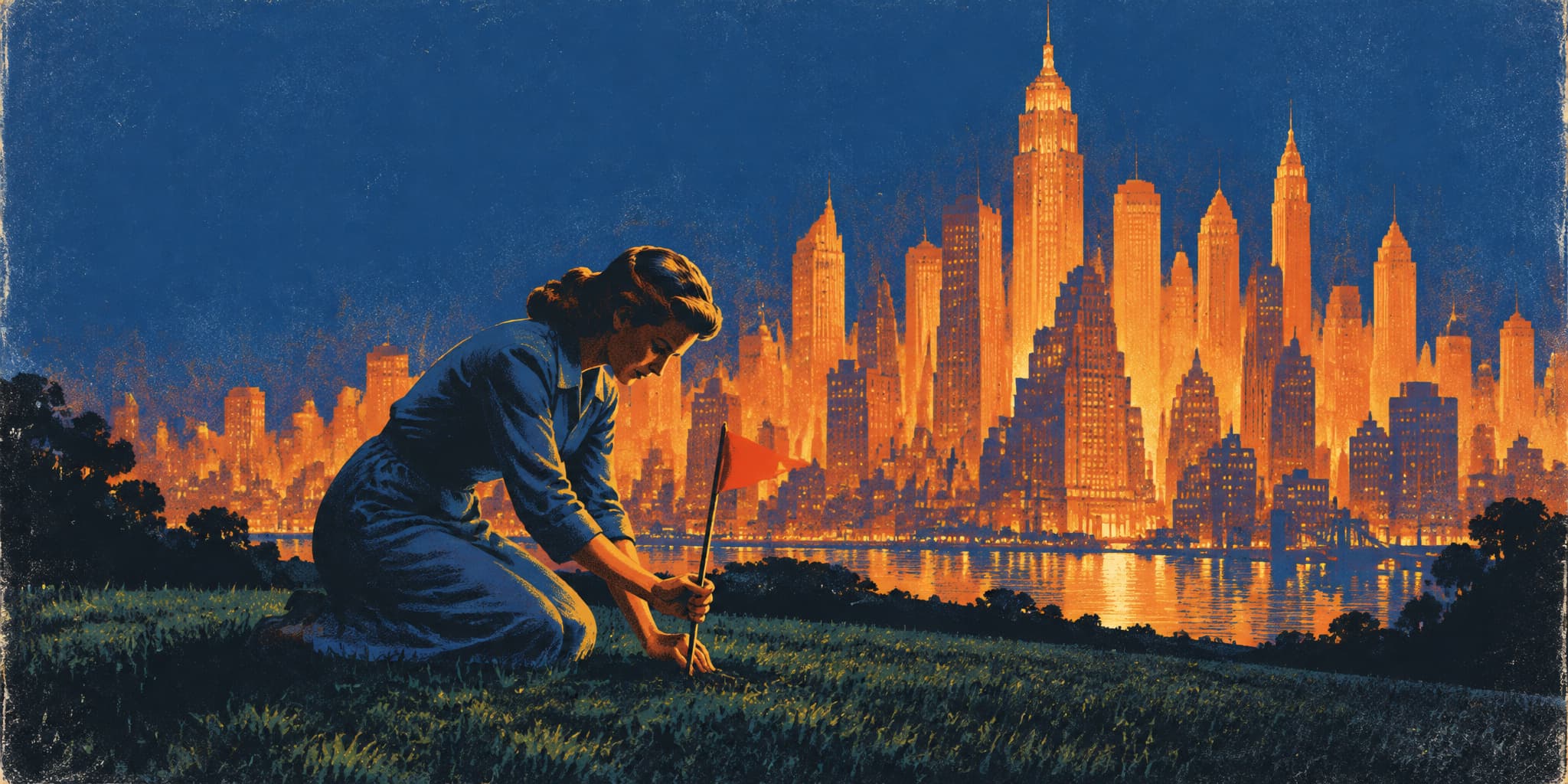
Maren drove the surveyor's flag into the east lawn at 4:17 and wrapped the top with reflective tape so the crew could find it in the dark. This was where the Aldridge girl would stand when civil twilight hit the skyline, seventy-one hours from now. The turf was pushing yesterday's heat back through her boot soles. She checked the monitor on her belt. Eighty-seven degrees at four in the morning. She added it to the column of overnight lows she'd been keeping since the forecast moved on Wednesday.
Tomás was twenty yards south with a lumen meter, mapping the throw from the park's fixtures against the rig she'd specced for the ceremony. "Bleed from the trail lamps past the second row," he said, not looking up. "You want a clean twilight read on the skyline, I have to bag everything south of the promenade."
"Bag or gel?"
"Bag. Color temp's wrong for a gel fix. They're 4000. We're at 2700 going to natural. Anything I put over them makes it worse."
She walked over and looked east. The skyline was a flat cutout against navy, that Houston pre-dawn color where the moisture catches whatever light the city throws up and spreads it until it has no source. In two hours the first color would come behind the buildings. Half an hour after that the sun would clear them and the ceremony space would go from designed light to full solar load in about six minutes.
She had a window. Six-fifteen to seven-twelve, Saturday morning, if the forecast held.
"Bag them," she said. "And pull the quote on the second cooling unit. If we're running thirty minutes early I need the crew trailer cold before the truck gets here."
Tomás made a note. He'd been her crew lead for three years, since the company was her, a rented box truck, and a spreadsheet she couldn't look at without her hands going cold. He didn't ask why she'd moved the ceremony. He'd read the same forecast.
She walked the route the guests would take from the parking structure to the lawn. Two hundred yards of paved trail, then a transition to turf. At this hour the concrete was warm through her soles but not punishing. By Saturday she'd have cooling stations at the fifty-yard mark and the hundred: chilled water, electrolyte packets, a misting fan that in this humidity accomplished almost nothing thermodynamically and a great deal otherwise. Evaporative cooling was a desert technology. Houston needed compressors moving actual heat, and the compressors sat at the end of the walk, in the guest tent, running since two. You gave people the gesture on the way in so the real thing landed harder when they sat down.
She'd learned that from a groomsman who went gray and wobbly on the Ship Channel walk-in during her second year. He'd been fine. IV fluids, half an hour in the medical van. The client's insurance adjuster called before the man's color came back. That was when she wrote her first crew heat plan and started treating the walk-in as part of the production.
The bayou moved below the promenade, black water smearing the trail lights. Something splashed. The vegetation along the bank was nothing like what she remembered from coming here on the Fourth with her mother, sitting on a mowed slope. The native plantings from the post-Harvey redesign had gone feral in ways the landscape architects never drew. Sotol and muhly grass creeping upslope. The bald cypresses along the water enormous now. The park had been built to flood and recover and it had flooded and recovered so many times that it had turned into something nobody specified.
She liked it better than any other hour she had. The city belonged to her and the crews and the possums and the bats under the Waugh Drive bridge half a mile west, thousands of them shifting and chittering in the dark. The air smelled like river mud, warm concrete, and jasmine that had no business growing where the turf used to reach.
She'd texted Aldridge at three-thirty, before she left the apartment. Weather's giving us a better window thirty minutes earlier. Light will be extraordinary. Sending updated renderings today — need your coordinator to confirm by noon.
His reply came while she was pacing the guest route. Sophie wants to know if earlier changes the music. Also — Dad needs shade. He's 78 and won't ask for help but he needs it.
Quartet adjusts easily. Your dad gets covered AC seating twenty yards from the ceremony. I'll have someone walk him.
When she talked to Aldridge properly she would show him the light studies and explain that thirty minutes earlier put the ceremony in deep blue twilight, the skyline coming up behind his daughter like something being revealed rather than something already there. She would explain that this was more beautiful, which it was, and that the photographs would be better, which they would. She would not mention the wet-bulb globe temperature that voided the heat clause in his event insurance if it touched 89 at the Lake Houston station between four and eight in the morning.
She also wasn't going to mention that her business partner had spent Tuesday pitching their investors on leaving.
Her mother arrived at noon with a Suburban full of flat-packed moving boxes and a brisket from Rudy's.
Maren was in the apartment with the blinds sealed and the AC at sixty-eight, working through vendor confirmations. The middle of the day was for screens and spreadsheets and phone calls that couldn't survive outside. She'd built her whole schedule around the dead center of it the way her mother's generation built theirs around nine to five.
"I brought boxes," her mother said, putting the brisket on the counter.
"I see that."
"You don't have to use them."
"Then why bring them."
Her mother opened the paper without answering. Smoke and fat and black pepper filled the apartment.
"Twenty-six of them," her mother said. "I also brought the good knife because yours are terrible. Eat. You've been up since three."
"Four."
"That isn't better."
They ate at the kitchen table while the windows showed a city bleached white by a sun that wouldn't be tolerable for another seven hours. Her mother talked about the neighbors, about Maren's cousin who'd moved to Boise in March.
"They shifted the farmers market to five AM," her mother said. "In San Antonio. June first. The vendors couldn't set up in daylight anymore."
Maren looked at her.
"I'm not making a point. I'm telling you what happened." Her mother put her fork down. "The Garcias closed the nursery. Forty years. Linda said the stock was dying on the trucks between the grower and the shop. She couldn't get the window short enough."
"That's retail."
"I know what it is."
She picked up her fork again. The boxes stood flat against the hallway wall.
"Your father used to check everything before he'd let you outside," her mother said, watching Maren glance at the forecast on her phone. "Temperature, UV, the ozone alerts."
"Dad checked whether it was going to rain."
"Dad checked everything."
Maren put the phone face down. Her mother cut another slice of brisket with the efficiency of a woman who had fed a family through thirty Texas summers and was not going to stop feeding people because the one across the table was thirty-seven and running a company.
She called Suki at nine, from the balcony. Ninety-one. The western sky was purple and orange where the sun had gone down an hour before, and the city was hauling itself out of its daytime coma. Headlights on the freeway. People on the sidewalks. The restaurants on Westheimer opening their patios for the evening window, eight-thirty to eleven if you had fans and shade and your guests didn't mind sweating into their cocktails, which they didn't, because they lived here and this was when you went out.
"You sent the deck," Maren said.
"I sent the deck."
"Without telling me."
"Rosen's fund closes in October. If we're pitching, it's now."
"I'm producing a wedding on Saturday."
"A wedding you just moved thirty minutes earlier because the atmosphere won't let you hold it when you planned."
"That's called operations. That's the work."
"You moved a two-hundred-person ceremony around a number on an insurance contract. Rosen's going to ask what happens the year the number doesn't leave you a window."
Maren watched a pack of runners go by below, reflective vests catching the streetlights. Nine PM runners, a whole population of them now, people who'd moved their lives to the edges of the day and found something there.
"We grew forty percent last year."
"In a city that lost eleven percent of its population."
"Which means less competition and more clients who need somebody who can actually work here. Every firm that leaves is one that can't produce a Houston event. I'm not competing with Denver."
Suki was quiet. Maren could hear her breathing, could picture her in the apartment she'd taken in June, by a window where the outside air was sixty-five and dry and you could leave the door open at night like that was a thing people still did.
"Rosen loved it," Suki said. "She wants to meet Tuesday."
"After the wedding I have a debrief, breakdown, crew recovery, the Petersen anniversary Thursday, and then the Juneteenth build in Third Ward. Forty vendors and a stage on a parking lot that's going to read a hundred and forty on the surface by two, which means decking down by dawn or nobody can stand on it."
"You could train someone to run Houston."
"To do what. To know every permit officer and every cooling vendor and every florist who can hold cut arrangements above ninety. To know the Tinsley lawn runs fourteen degrees hotter than Mecom because of what's under the drainage, and that the Sabine garage throws a shadow that buys you twenty minutes on the south approach if you time the processional right."
"That's exactly my point. You've made yourself the only person who can do this, in the one place where doing it gets harder every year."
"Anyone can throw a party in good weather."
She hung up. Not angry. Finished. She stayed out on the balcony until the reading dropped below ninety, which took forty minutes.
Saturday, 2:47 AM. East lawn, Eleanor Tinsley Park. The cooling trailer's compressor hummed against the bayou and the distant port. Tomás had power to the whole site by three. Two crew were pulling the light rig off the truck and two were inside the trailer with cold water, twelve minutes into a twenty-minute rotation she'd written into the operations manual after the Ship Channel groomsman and revised four times since, each time tightening the intervals because the numbers kept moving. Somebody had taped the threshold chart to the trailer door under a strip of gaff that read DO NOT ARGUE WITH THE NUMBER.
Her meter said eighty-one. Eight degrees of margin, and the sun wouldn't clear the skyline for four hours. She rolled her neck and it popped loud enough that Tomás looked over. Quartet at five-fifteen. Florist at five-thirty, arrangements held in the refrigerated van until the last possible minute, because cut flowers above ninety were a countdown she couldn't negotiate with. Aldridge had signed off on six. He'd seemed pleased once he saw the renderings. His daughter in deep blue, the skyline going dark to copper behind her, his father in a cool chair twenty yards off, walked to his seat by someone who understood he wasn't going to ask.
The boxes were still in her hallway. Suki's meeting with Rosen was Tuesday. Saturday afternoon's forecast showed a heat index of a hundred and twelve, which would be on every screen in the country by noon, so that by the time the wedding photos went around — two hundred people on a bayou at dawn, the city surfacing behind them — people would be asking how anyone still lived here.
She checked the flag's angle to the skyline and moved it two degrees east. Her fingers were clumsy with the tape and she had to wrap it twice. Then she walked down to the fifty-yard station, where the cooling unit had to sit so the mist wouldn't drift into the ceremony space and spot the dresses. She'd run the wind. She'd checked it twice yesterday. She checked it again.
The jasmine was blooming along the bayou, weeks past when it used to finish. She could smell it over the compressor exhaust. It smelled incredible.
- Heat is merging events: A 2026 Nature Communications study using hourly North American simulations found that in hotter southern cities, individual heatwaves begin to merge into events exceeding a month at 2°C of warming, compressing the recovery intervals that outdoor workers and event producers depend on.
- Nights losing their firebreak: A Science Advances study of roughly 9,000 North American fires found that annual potential burning hours increased about 36% over five decades, part of a broader pattern in which nighttime is becoming less reliable as a period of relief across multiple hazards.
- AC present but not cooling: Maricopa County's 2025 heat report found that among indoor heat deaths, an air-conditioning unit was present in 94% of cases but nonfunctioning in 72% of those, a reminder that the presence of cooling infrastructure and the delivery of cooling are different findings.
- Moving but not saying why: A 2026 review of U.S. internal climate-related migration research found that household moves rarely have a single climate cause, with employment, housing cost, family ties, and the possibility of return all interacting with perceived hazard in ways that resist clean labeling.