
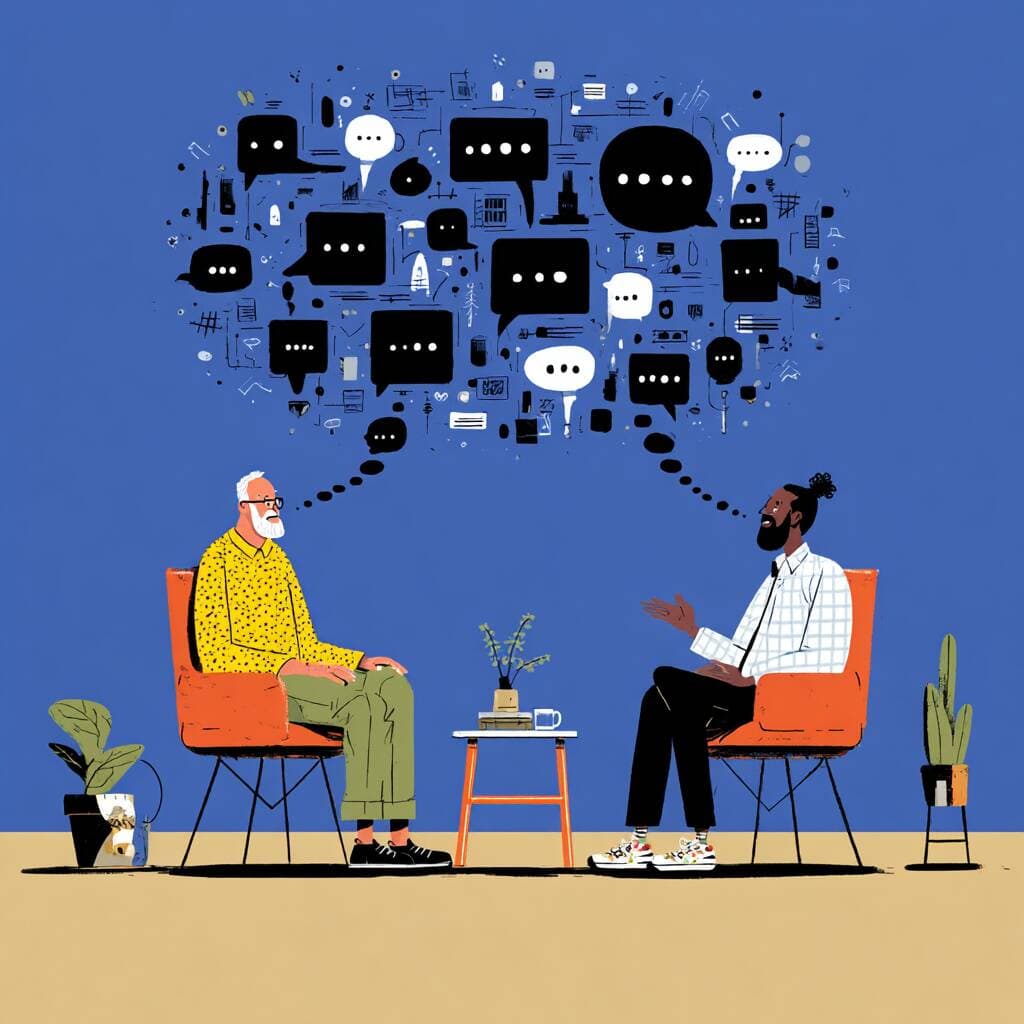
Editor's note: Dr. Patience Okafor-Whitfield is a fictional pediatrician practicing in Sacramento, California. We constructed this interview to give voice to a pattern that exists across many practices but belongs to no single practitioner. Everything she describes is drawn from published clinical research, documented practitioner accounts, and public health records. Her exam room is imaginary. The children she's describing are not.
Sacramento in late September used to be the exhale. The Central Valley heat finally loosening, the school year finding its groove. But for several years running, September has also meant smoke. The city sits in a topographic bowl that traps wildfire particulate drifting down from the Sierra Nevada foothills, and the overlap of residual heat and early fire season creates what one state health official called "the double bind": too hot inside, too smoky outside.
Dr. Patience Okafor-Whitfield has run a pediatric practice in Sacramento's Arden-Arcade neighborhood for fourteen years. Her patient panel spans the area's full economic range, from families in new-build subdivisions to families in older apartment complexes with no central air. We spoke during what she called "the weird calm week" between the end of August's heat advisories and whatever October's fire season would bring.
You've described something shifting in your practice over the past several years. When did you first register it as a pattern?
Patience: The waiting room. Not the exam room. Around 2021, 2022, I started noticing that during smoke weeks, the kids coming in weren't just sick in the usual ways. The respiratory stuff I expected. More rescue inhaler refills, more "is this asthma or is this a cold" visits. Fine. But I was also seeing kids who were just... off. Cranky in a way that didn't match the complaint. Tired. Not sleeping well. And the parents looked like that too. Worn down in a specific way I couldn't name yet.
It took me an embarrassingly long time to connect it to what was happening outside the window.
What does "off" look like in the exam room?
Patience: A four-year-old comes in for a well visit, and the parent mentions, almost as an aside, that he's been hitting his sister more. Or a seven-year-old whose teacher flagged concentration problems that started in August and haven't resolved. The clinical literature now documents this clearly: heat exposure is associated with increased externalizing behaviors in children and can directly impair cognition, memory, problem-solving, the works.1 But sitting across from a parent, it just looks like a difficult phase. The visit gets coded as a behavioral concern. The heat never makes it into the record.
Because there's no code for it?
Patience: There's no box. I can note environmental factors, sure, but the structure of a pediatric visit is complaint, assessment, plan. If a kid is irritable and not sleeping, I'm screening for anxiety, depression, family stressors. I am not routinely asking, "Is your apartment air-conditioned? What was the temperature in your child's bedroom last night?" And I should be. The AAP updated their climate guidance in 2024 telling us to do exactly that.2 But the visit is fifteen minutes, and I have fourteen other things to screen for. Something has to lose, and right now the weather is losing.
You mentioned two different age groups showing up differently. Can you walk through that?
Patience: This is the thing that made me feel like I was seeing two faces of the same coin. The little ones, under eight or so, they show up with their bodies. Headaches, stomach aches, sleep disruption, behavioral regression. They can't articulate "I'm stressed because we haven't gone to the park in three weeks." They just act it out. A Montana pediatrician, Dr. Lori Byron, put it perfectly: "Kids don't understand why the world suddenly isn't stable or why they can't do what was planned."3 That lands in my exam room as a tantrum or a tummy ache.
The teenagers are completely different. They come in and tell you. I have a fourteen-year-old who told me she doesn't see the point of studying for the future because she's read enough to know what's coming. And the research is clear that some level of eco-anxiety is a normal, even adaptive response to a genuinely stressful reality.1 But it's also not nothing. I'm sitting there trying to calibrate between "this is healthy concern" and "this is functionally impairing her," and I have no diagnostic framework for that calibration. I'm improvising. Fourteen years of training and I'm improvising.
How do you hear about the daily routines families have adopted? The AQI checking, the decisions about outdoor time?
Patience: Indirectly. Almost always indirectly. A parent will say, "We've been inside a lot this summer," and if I ask one more question, the whole thing spills out. They're checking air quality every morning before deciding if the kids can play outside. Something as basic as going to the park has become a health calculation.3 But they don't lead with that. They lead with "she's been watching too much TV" or "he's not sleeping." The AQI check has become so routine they don't think to mention it. Like asking a fish to describe the water. Except the water is 107 degrees and has a particulate count.
What's the hardest part of seeing this from your position?
Patience: [long pause]
I see it across sixty, seventy families. I can feel the pattern forming. But my tools are one kid, one visit, one plan. I can't prescribe a city a cooling infrastructure. I can't write a referral for "your school doesn't have air conditioning." The research shows classrooms in under-resourced schools reaching 110 degrees, teachers turning off lights and using quiet time because students are too sluggish and irritable to learn.4 Those kids come to me afterward, and I'm treating the downstream.
I keep using this image with colleagues: I'm mopping the floor with the faucet running.
Do parents ask you directly about climate and their kids?
Patience: More and more. And it's a fundamentally different kind of question than I was trained for. Nobody's asking "does my child have strep." They're asking, "Should I be worried about what the smoke is doing to her brain?" And I have to sit with that, because we do have evidence that wildfire smoke reduces children's academic performance even beyond the days schools close.3 We do have evidence that air pollution exposure during development is associated with cognitive and behavioral effects.1 But I cannot tell this parent what that means for her child, specifically. I can see the population-level signal. I cannot translate it into an individual prognosis. They need me to, and I can't.
That gap between what the science knows and what a parent needs to hear at 3 p.m. on a Tuesday? I live in that gap now.
What would change if you could redesign your own practice around what you're seeing?
Patience: I'd want a weather column in every chart. Just the AQI and the temperature on the day of the visit. That's it. Because right now, a smoke-related asthma exacerbation becomes "asthma exacerbation." A heat-stressed kid becomes "behavioral concern." The environmental cause falls out of the record, then it falls out of the data, then it falls out of the policy conversation.1
We're building a clinical record of a climate-changed childhood with the climate edited out.
That's what haunts me. We're documenting the symptoms meticulously and erasing the cause.
Last question. What do you wish you could say to parents that you can't say in a fifteen-minute visit?
Patience: That what they're feeling isn't neurotic. That checking the air quality before letting your kid outside isn't helicopter parenting. It's a rational response to actual conditions. And that the fact that they're exhausted by it is also rational. I see the fatigue across so many families. They've absorbed a whole new category of daily labor, monitoring, deciding, adjusting, and nobody told them it was coming. Nobody's helping them carry it.
I wish I could tell them they're not imagining it. Because they're not.
Footnotes
-
Milazzo, S., Clarke, C., Moon, C., Sheffield, P., "The Impact of Climate Change on Pediatric Mental and Behavioral Health," Pediatric Clinics of North America, 73(3):541–554, 2026. https://pmc.ncbi.nlm.nih.gov/articles/PMC13541096/ ↩ ↩2 ↩3 ↩4
-
Ahdoot, S. et al., "Climate Change and Children's Health: Building a Healthy Future for Every Child," American Academy of Pediatrics policy statement, Pediatrics 153(3), March 2024. https://publications.aap.org/pediatrics/article/153/3/e2023065505/196648/ ↩
-
Hossain, M., "How Wildfire Smoke Is Reshaping Childhood," Inside Climate News, July 28, 2026. https://insideclimatenews.org/news/28072026/wildfire-smoke-children-health/ ↩ ↩2 ↩3
-
U.S. Government Accountability Office, report on school facility conditions, 2024–2025. Referenced via The Docket's prior reporting on school infrastructure and extreme heat. ↩