
I check two apps before I go outside in the morning. Weather first. I've been reading weather since I started flying small planes in my twenties, and the phone just replaced the briefing room. The second one's newer. AirNow, the EPA's fire and smoke map. I put it on there in the summer of 2023, after wildfire smoke from Canada came down over Kansas City and the air quality people said to stay inside. I'd been planning to mow. My throat burned on the way to the truck and I turned around and went back in.
I kept the app. It sits on the home screen next to the weather. I don't remember deciding to keep it. It just stayed.
Five or six years ago there was only the one. Check the weather for work, look out the window, go outside. The windows would've been open all night and the house smelled like the neighborhood. Cut grass, somebody's grill from the night before, diesel off the highway when the wind came from the south.
The window unit in the bedroom lasted eleven years. A 10,000-BTU Frigidaire, loud enough I could hear it cycle from the kitchen, dripping condensation onto the sill in a way I never got fully solved. On the worst nights it held the room around seventy-eight, which was fine. I'd shut the bedroom door to keep the cool in, and the rest of the house stayed hot, and that was summer.
In July of 2022 it started cycling off every couple of minutes and kicking back on with a sound like somebody hitting sheet metal. Third night of that, I called an HVAC company.
The guy said the compressor was done. He also said that for about what a comparable window unit would run me installed, I ought to look at central air. Evergy had a rebate, a few hundred back on a qualifying system. I looked at the numbers and the quote and told him to go ahead.
It went in on a Wednesday. The house got quiet in a way I wasn't expecting. Nothing rattling in the bedroom window. No shutting doors to hold cool air in one room. I walked around that first evening noticing it. The hallway was cool. So was the kitchen, and the living room where I'd been running a box fan for years. I unplugged the fan and put it in the garage. It's still out there.
Summer means the house stays shut now. Windows closed, doors closed, the system running steady from May into September. The neighborhood sounds I used to get through the screens, somebody's radio, a mower two houses down, I don't hear those anymore. That came from a compressor going out and a contractor mentioning a rebate.
The basement turned into the evening room slowly. Basements run cooler in this part of the country. Concrete walls, below grade, stays in the low seventies when it's ninety-five upstairs. That's just what they do. But I used to go down there for laundry or to find a tool, not to sit. The light was bad. There was a folding chair by the workbench and a bare bulb on a pull chain.
Around 2021 I started taking a book down after dinner on the bad nights. Then a lamp out of the spare bedroom. Then a better chair. Then an extension cord so I could charge my phone. By August of 2023, when Evergy was putting out statements about the grid handling the load, that's where I spent most evenings from late May through September. Come home from work, eat something, go down with a book. The living room upstairs, the couch and the TV and the windows I used to open, I'd walk through it on my way to the stairs.
I didn't decide any of that. I went where the cool was.
I'm not a gardener. There were things growing when I bought the place and I kept them going the way you keep a yard. Mow, water, pull what's obviously dead. Hostas along the north side where it stays shady. Daylilies in a bed by the driveway. A row of something purple along the back fence that I never learned the name of. The previous owner had put all of it in, and it looked good, and I watered it when it needed watering and otherwise left it alone.
The purple things went first. 2020, maybe 2021. I watered them, probably not enough and probably at the wrong time of day. They browned out and didn't come back. The daylilies hung on longer but went thin. Fewer blooms every year, leaves crisping at the tips by August. I'd stand out there with the hose in the evening and it felt like I was slowing something down rather than fixing it.
By 2023 I'd pulled most of what had died and put down mulch and some low ground cover the garden center recommended. Sedum, and something else I've already forgotten the name of. The guy said they'd take the heat and wouldn't need much water. I said that sounded right.
The USDA updated its plant hardiness zone map that same year. Kansas City moved from zone 6a to 6b. What that map measures is the average coldest night of the year, and ours came up about five degrees from the old baseline. It doesn't say anything about July, which is when the daylilies looked worst. But the garden center had a flyer about it by the register, and I read it while I was paying for the sedum, and I stood there a minute looking at where the new lines fell before I put it back.
The Muellers across the street had an ash in the front yard, forty years old at least. Big tree. It shaded half their yard and part of the street in the afternoon. It came down in the spring of 2024. Emerald ash borer, they said, which has been working through this part of the country for years.
What went in where it stood was a patio cover. Metal frame, fabric canopy, set over the stretch of driveway where they park the second car. It shades about what the tree shaded. It went up in an afternoon.
Their kids are in elementary school. In August of 2023, during that same heat stretch, Kansas City schools sent students home early because the cooling in some buildings couldn't keep up. Different schools let out at different times. 10:50, 11:50, 12:45. Jen Mueller told me about it standing in her driveway. She'd gotten the text at work and had to rearrange pickup and figure out the rest of the afternoon. She told it as a logistics problem, which it was. The next summer she mentioned they'd checked whether the school had fixed the AC. It had, she said. Mostly. She said mostly the way you'd say probably.
The smoke kept coming back.
The first time, summer of 2021, seemed like a one-off. Fires a thousand miles northwest putting particulate into the air over the Kansas City metro. I figured it was weather being weird. Then it happened again in 2023. Then 2024, when the regional air quality council said the metro had some of the worst readings in the country. By the summer of 2025, when another advisory went out, I was checking the app the way I'd check for rain.
I fly for a living. I've been reading weather my whole career. Ceilings, visibility, wind, where the storms build over eastern Kansas in July. Smoke days don't look like anything I trained on. The light is wrong. The horizon goes away, but not the way it goes in fog. The first few times I stood on the porch and tried to read it the way I'd read an approach chart for a field I'd never flown into. Now I look at the number and decide whether I'm going out.
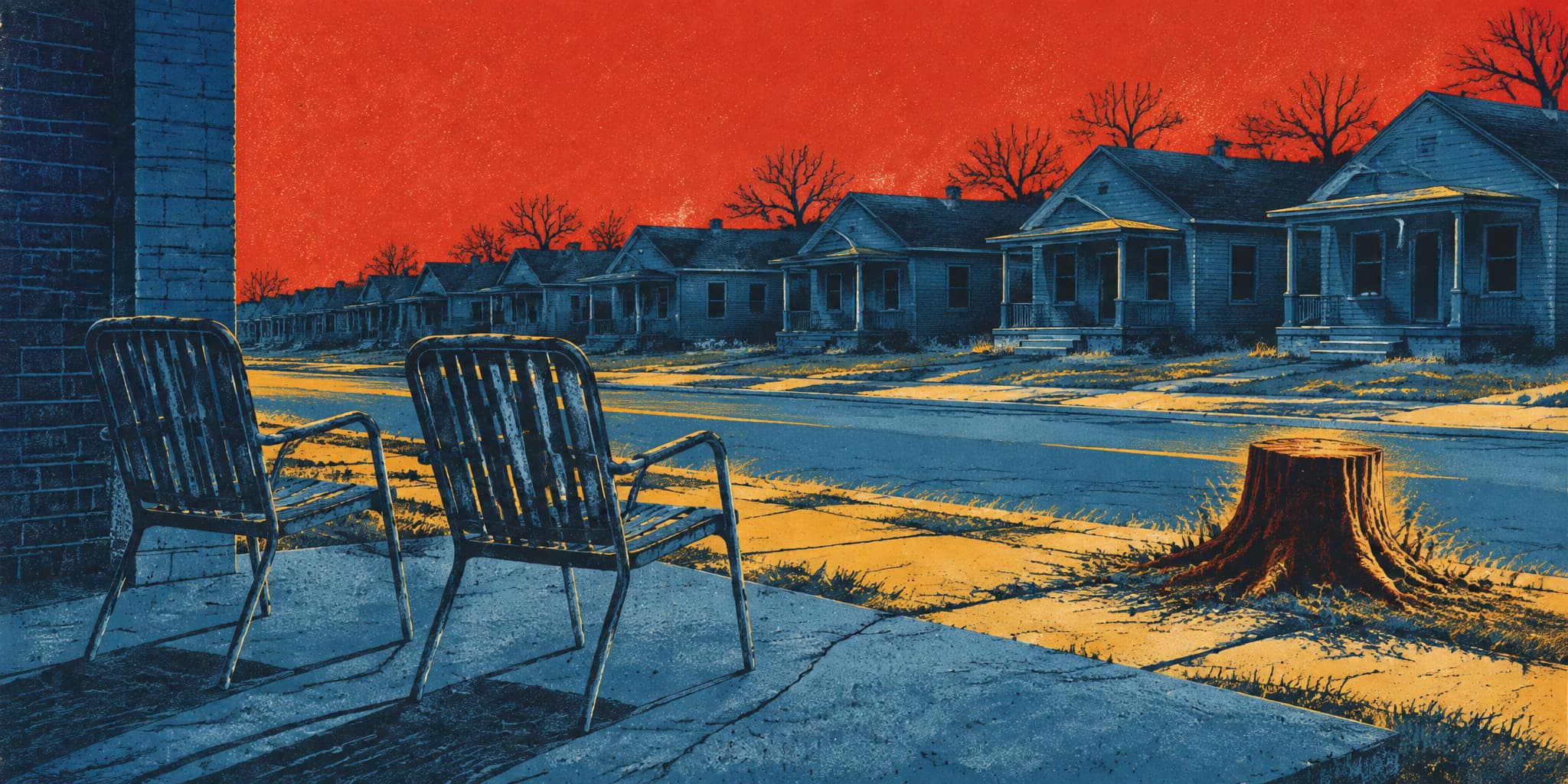
The porch used to be where the summer evenings went. Small concrete slab, two metal chairs, a view of the street and the Muellers' ash catching the last of the light. I'd sit out there with coffee after dinner and watch the block do its evening. Somebody walking a dog. The Hendersons three doors down running a sprinkler that threw a slow arc across the sidewalk. You could hear people talking on other porches without making out the words, just the rhythm of it.
I don't know when I stopped. It wasn't one evening. Some nights it was ninety-two at eight o'clock and the concrete still held the day and sitting out there was work. Some nights the air was bad and I'd look at the number and go back in. Some nights the house was shut and cool and opening the front door felt like letting go of something I was paying for. After the central air went in, the porch turned into the part you cross between the cool house and the hot yard.
The block got quieter those evenings. I noticed it late, the way you notice a sound that stops. Fewer people on their steps after dinner. The Hendersons sold last year and the new people don't water the front at all. The Muellers' patio cover faces the driveway instead of the street. Bad weeks in August, everybody goes car to door.
The two chairs are still out there. I sat in one last October, after the first cool front came through, and the evening felt the way summer evenings used to feel. I stayed out an hour. I could hear somebody's TV through an open window down the block. It had been a while since I'd heard that.
I was in the basement the other night, reading under the lamp I carried down three years ago, the air running steady upstairs, and I tried to remember what the house sounded like when I bought it. The window unit rattling in the bedroom. The screens open. The porch door propped with a boot because the spring was too strong.
I don't know that I decided on any of it. Something broke or died or the air went bad, and I handled it that week, and then that was how the house worked.
I figure there'll be another one. There always is with a house.
- Schools closing for heat: A GAO survey estimated that one in five public-school districts canceled at least one day because of a facility emergency in 2024–25, with classroom temperature among the most frequent causes — but the report doesn't track what parents did with the afternoon.
- Cooling laws, three versions: New York, Houston, and Washington, D.C., all passed cooling protections in 2026, but each one protects something different — a bedroom temperature, equipment capability, or an eviction calendar — and each assigns operating costs differently.
- Insurance premiums in wind-prone areas: GAO found that while average U.S. homeowners-insurance premiums roughly tracked inflation from 2019 through 2024, premiums in high-wind southern coastal areas rose 25% or more, a shift that can quietly reshape where and how people maintain a house.
- The land after a buyout: A peer-reviewed study of sixteen Austin neighborhoods found that post-buyout open space doesn't stay socially empty — remaining neighbors, municipal land managers, and people without permanent housing all occupy the gap left behind.