
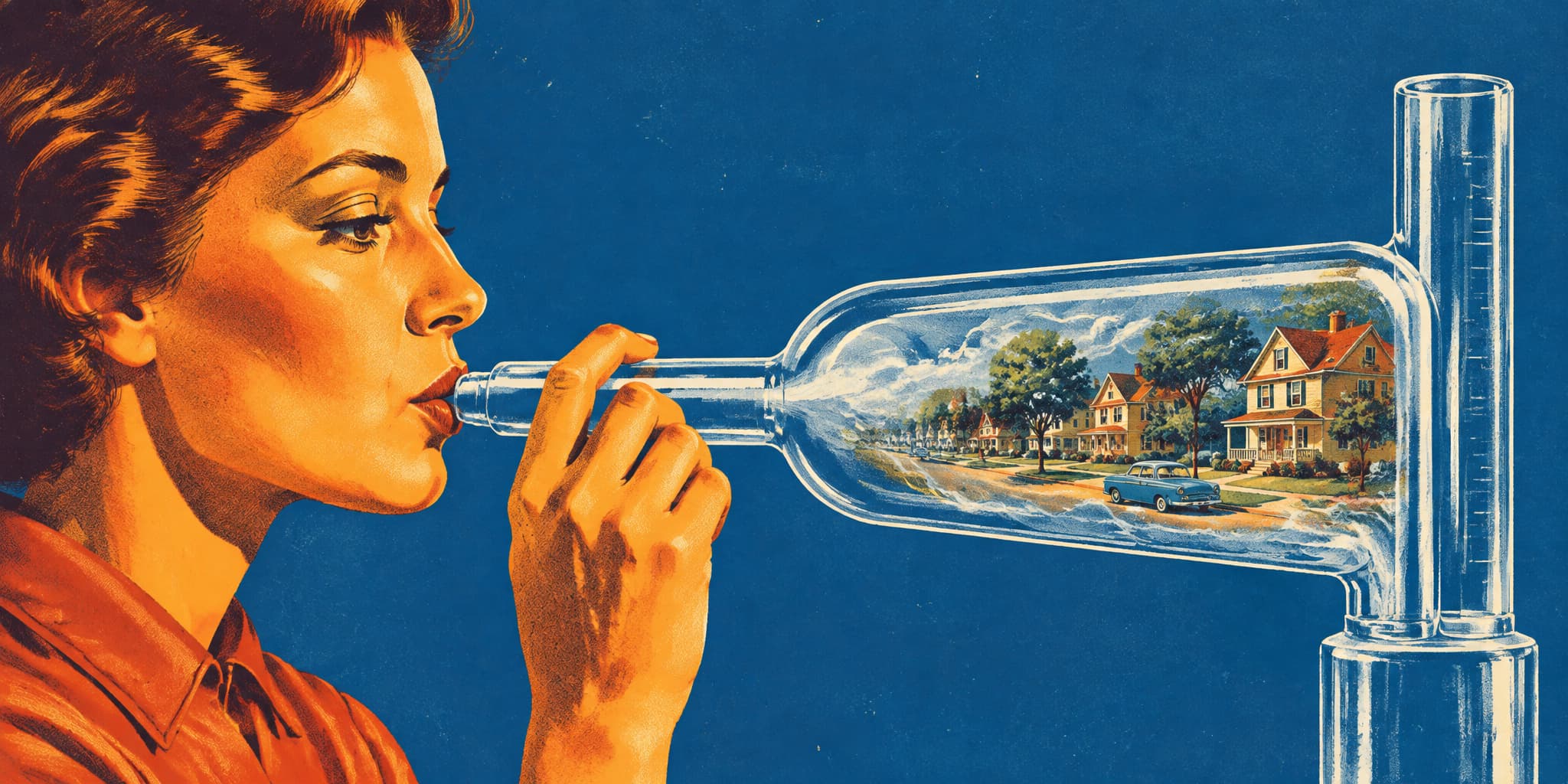
Amy Jackson, 52, came in to give a urine sample and blow into a spirometer, the machine that measures how much air a person can push out and how fast. That was what the Maui Wildfire Exposure Study asked of people: a fire had burned through her town, and researchers wanted to know what it had left inside the bodies of the people who lived there. During the visit, as STAT reported, a physician noticed that the equipment wasn't registering her hemoglobin. She was sent to emergency care. The reading came back at 2.2, a level at which blood is barely carrying oxygen. The diagnosis was pernicious anemia, an autoimmune condition that keeps the body from absorbing vitamin B12. Nobody has established it as fire-related. But the study visit caught it, and there's no indication anything else was going to.
Pernicious anemia has no known connection to wildfire. The visit that found it belongs to a study built around a different question: what a fire leaves inside the people who live through it when the thing that burns is a town.
The chemistry of a burned town
On August 8, 2023, fire moved through Lahaina. The fuel was vinyl siding and synthetic insulation, cars with manganese in their steel and metals in their batteries, flame-retardant plastics in couches and televisions, treated lumber, and canec — a building board pressed from sugarcane fiber, common in older Hawaiian houses and historically treated with arsenical compounds. In places the soil carried its own chemical history. Hawai'i's sugar plantations used arsenical herbicides for decades, leaving residues near former operations, though the most site-specific sampling around Lahaina's former Pioneer Mill found localized elevated areas rather than contamination across the town.
Most coverage of wildfire treats smoke as a single substance. Forest fire smoke is dangerous on its own terms: fine particulate matter, carbon monoxide, volatile organic compounds, all well-documented respiratory hazards. But the fuel is mostly biomass. When fire moves through a developed area, the fuel list is the one the National Academies catalogued in a 2022 report on fires at the edge of development: structures, vehicles, electronics, plastics, textiles, coatings, treated wood, roofing, whatever is stored under the sink. What comes off the fire reflects that inventory.
A 2026 study of LA fire emissions measured the gap at a sampling site in Pasadena. Polycyclic aromatic hydrocarbons — combustion byproducts, several of them carcinogens — ran roughly ten times higher in fine particulate matter than either recent Los Angeles background or biomass-only wildfire smoke. Non-crustal metals, the ones that come from manufactured things rather than dirt, were enriched by as much as 30-fold over urban background and up to 1,000-fold over biomass-fire aerosols, concentrated in particles smaller than 100 nanometers, small enough to travel deep into the lungs. The researchers also detected 28 of 40 targeted PFAS, the fluorinated compounds used in stain- and water-resistant coatings, in sampled ash.
One site, one fire. Those numbers can't be transferred to Lahaina. But the pattern holds across the emerging literature: burning manufactured materials puts metals and synthetic chemicals into the air at concentrations biomass fires don't approach.
A smoke plume is mostly an inhalation problem, and it moves on when the wind shifts or the fire goes out. A burned town leaves a debris field of ash, dust, and contaminated soil, lying on the ground where people used to live and where they come back. Wind lifts it. Cars going down a street lift it. So does sweeping. A study of homes near the 2021 Marshall Fire in Boulder County, Colorado, found that fire-affected dust indoors could be resuspended by ordinary household activity, cleaning included. The exposure doesn't end when the air monitors read clean, and some of it is generated by the work of cleaning up.
What the bodies showed
The study published in PNAS went looking for that mixture not in soil or air but in people. Biomonitoring measures what's circulating inside a body. Researchers collected urine from roughly 1,400 people who had lived through the Lahaina fire, six to 18 months after August 2023, long after the smoke cleared and the monitors came down.
Antimony came back at nearly 40 times the national reference level, which is the concentration typical of the general U.S. population. Manganese, barium, and arsenic were elevated too.
Antimony is a metal most people have never heard of. It's widely used in plastics as a partner to brominated flame retardants and as a catalyst in making polyester, which puts it in textiles, electronics, rubber, foam. When those things burn, the antimony moves into what's left behind. Manganese is in steel, batteries, and pigments, which means it's in every car and most appliances on a residential block. Barium turns up in paint, ceramics, glass, electronics, brake pads. The Hawai'i Department of Health confirmed that antimony and arsenic were among the substances elevated in Lahaina's ash, which ties the materials that burned to the debris that stayed.
The Maui Wildfire Exposure Study, known as MauiWES, is among the earliest large-scale efforts to pair resident biomonitoring with lung testing after a fire that burned through a developed area. Its researchers are careful about what they can and can't claim. The design measures what's in a person's body on the day of sampling. It doesn't trace a given metal reading back to a particular burned building or car. There's no pre-fire baseline, so the study can't show that the fire caused every elevated reading; diet, occupation, and local geology also put these metals into people. What the researchers can say is that the fire burned materials known to contain these metals, that the metals were elevated in Lahaina ash, and that the same metals were elevated in participants' urine. The chain is plausible. For any individual person, it isn't proven.
The health association is firmer. Across three different statistical approaches to estimating the combined effect of several metals at once, participants carrying a higher total metal burden had greater odds of abnormal spirometry. Reduced airflow, in a life, looks like getting winded on a flight of stairs, running out of breath partway through a shift, stopping to gather yourself during exertion that used to be unremarkable. For someone working housekeeping or a kitchen line, the biggest employers in Lahaina before the fire, that's a question about the paycheck.
The timing raises something the data can't settle. Metals showing up in urine six to 18 months after a fire could mean the body is still holding what it absorbed while the town burned, or it could mean people are still coming into contact with contaminated material where they live now. A single urine sample taken at one moment can't separate the two. What it does establish is that the exposure hadn't resolved. Whatever the route, these metals were still moving through people long after the fire was out.
The study that became a clinic
Before anything burned, Lahaina had almost no specialist medical care.
The 2025 physician workforce assessment for Hawai'i put Maui County at 1.8 full-time-equivalent adult lung specialists against a modeled need of 7.7, a shortfall of nearly 77 percent. For pediatric lung medicine, the report found no supply at all. A 2022 county health survey found 48 percent of providers reporting specialist waits longer than a month, and 70 percent of community respondents naming the shortage of doctors as a barrier to getting care. The island's only acute-care hospital, Maui Memorial Medical Center in Wailuku, sits about an hour's drive from Lahaina. Anything more complicated than Maui Memorial can handle means a flight to O'ahu.
So the MauiWES team loaded spirometers, blood-draw equipment, and exam supplies onto flights from O'ahu and set up a temporary clinic at Lahaina Comprehensive Health Center. By STAT's account, the clinic days ran somewhere between a research site and a field hospital: lung-function testing, physical exams, and sample collection all going at once inside a community health center that was never built for that volume or that complexity. Volunteer physicians read results on site. Nursing students from University of Hawai'i Maui College helped with exams and with getting participants connected to follow-up. A partnership with Kaiser Permanente cut the share of uninsured participants roughly in half.
Sixty percent of participants told researchers that the study appointment was their first health check since the fire.
A study designed to find out what a fire had left in people's bodies was also, for most of the people who walked through the door, the only medical appointment available. By the time of STAT's July 2026 report, more than 800 participants had gone on to see a health care provider and more than 300 had obtained mental health counseling. The University of Hawai'i reported more than 4,000 study appointments or screenings involving more than 2,500 Maui residents. The same operation generating the first substantial dataset on post-urban-fire contamination in residents was doing medical screening the island's health system had no capacity to absorb.
Being both things at once changes the research. A study that functions as a clinic draws participants who need care, which shapes who enrolls and what the data look like. It also carries obligations a purely observational design wouldn't. A hemoglobin of 2.2 is not something anyone records and follows up on later.
What public sources don't show is how the metal results reached individual participants. People received printed health summaries and access to a secure results portal organized around blood pressure, body mass index, lung function, and blood chemistry. Whether anyone walked a participant through their own antimony or arsenic number, what comparison ranges came with it, whether a toxicologist was part of that conversation: none of that is in the public record. For a study that found antimony at 40 times the national reference, this isn't a procedural footnote. A person holding that number has to decide something about their house, their job, their kids. The number lands differently depending on whether someone sat down and explained it.
Who carries this
Before the fire, about 12,700 people lived in the Lahaina census-designated place. Census data show that nearly a third were foreign-born, 38 percent identified as Asian, 8.5 percent as Native Hawaiian or Pacific Islander. One in five said they didn't speak English very well. Almost half of occupied homes were rentals, well above the rate for Maui County as a whole. Thirty-five percent of the workforce was employed in accommodation, food service, entertainment, or recreation. The state's rapid needs assessment, surveying 228 fire-affected households, found 32 percent identifying at least partly as Filipino, 21 percent as Native Hawaiian, 17 percent as Hispanic or Latino. Forty-one percent reported that their health had gotten worse. Twelve percent said they couldn't get medical care they needed.
Those numbers describe the conditions the contamination landed in. A renter can't decide to remediate a unit; that decision belongs to whoever owns it. And in a housing market as tight as Maui's, the alternative to a unit that might be contaminated is frequently no unit. When one in five adults doesn't speak English well, a biomonitoring result or a referral letter arrives in a language that isn't the one the recipient thinks about their body in. When the work is hourly and physical, going to the appointment that doubles as your only medical visit costs a shift, and impaired lung function makes the shifts you do work harder to get through.
Nothing to compare it to
After the 2018 Camp Fire destroyed Paradise, California, published research measured metals in post-fire stormwater and tested household tap water: environmental contamination, not what was inside anybody. After the Marshall Fire, researchers sampled indoor dust and surveyed residents about symptoms. Neither study paired biomonitoring with lung testing.
UCLA's Los Angeles Wildfire Exposure Study is now enrolling residents affected by the January 2025 fires for blood and urine collection and lung-function testing. Harvard's LA Fire HEALTH study is designed to follow people for ten years. Neither has published resident biomonitoring results yet.
So the Maui data sit by themselves. Nobody knows whether the antimony levels in Lahaina participants will resemble what turns up in Los Angeles, or what Paradise would have shown if anyone had looked. Biomonitoring is expensive, logistically awkward, and requires an institutional commitment that disaster timelines don't naturally accommodate. The towns that burned earliest have the least information about what happened to the people in them. Without that earlier work, the Maui findings can't be placed in a trend. They're a first measurement.
NIOSH, the federal workplace-safety research agency, did collect blood and urine from Maui first responders in September 2023 and reported no discernible exposure pattern, but the investigators emphasized that samples collected weeks after exposure can miss chemicals the body clears quickly. The population, the analytes, the exposure setting, and the timing were all different from MauiWES.
Living with a number
The study establishes that participants had elevated urinary metals and that the metal mixture was associated with impaired lung function. But the fire isn't established as the cause of every elevation. Source materials are plausible, not traced to any individual's reading. And the design measures what's in a body at the time of sampling without determining whether that reflects a single acute exposure the body held onto or repeated contact with contaminated material in the place people returned to.
Those limits shape what needs to come next. The Los Angeles cohorts, when they publish, will supply the first comparison. Following MauiWES participants over time, some of whom have moved away from the contamination zone and some of whom haven't, could help separate retention from ongoing exposure. Pairing environmental sampling with biomonitoring could start closing the distance between what's in the ground and what's in the body.
The uncertainty isn't only scientific. A participant who learns that their antimony is 40 times the national reference has a number and not much else. The published association with impaired lung function is a population-level finding. It doesn't tell one person whether their shortness of breath will worsen, hold steady, or resolve.
More than 2,500 Maui residents are in that position now. They have a measurement, and no one can yet tell them what it means for their health. The paper is out, the data are in PNAS, the field is paying attention, and the people who gave the samples are back at work, still looking for housing, raising kids in a town under reconstruction, carrying metals whose long-term significance the researchers who found them are still working to understand.
More towns are going to burn this way. Maui has numbers because a team put equipment on a plane and set up in a community health center while the exposure was still measurable. Paradise doesn't have them because nobody did that. Whether the next town does is a question about who shows up, and how fast.
-
Los Angeles cohort results: UCLA's Los Angeles Wildfire Exposure Study and Harvard's ten-year LA Fire HEALTH study are both enrolling residents affected by the January 2025 fires for blood, urine, and lung-function testing, and their first published biomonitoring data will provide the earliest comparison point for the Maui findings.
-
Wildfire smoke's per-unit toll: A 20-state hospitalization study found that wildfire-specific fine particulate matter was associated with 10 to 16 percent higher cardiopulmonary hospitalization risk per microgram than non-wildfire PM2.5, though non-wildfire sources still dominated total exposure in most places studied.
-
Flash drought and fire spread: A U.S. study found that fires following rapid soil-moisture depletion showed roughly 1.3 to 1.8 times faster early spread than fires without flash drought, suggesting that how quickly fine fuels dry may matter more to fire behavior than whether a region carries a longstanding drought designation.
-
Indoor dust as reservoir: After the 2021 Marshall Fire in Colorado, researchers found that fire-affected settled dust could be resuspended indoors by ordinary cleaning and human movement, illustrating how a burned built environment continues generating inhalation exposure long after outdoor air monitors return to normal.
