Fiction. Angus, Scotland. August 2054.
Isa had the front off her ghost train by four o'clock on the last day.
The front is the painted part. Skeletons, a bat with one wing, GHOST TRAIN in green letters with drips coming off the bottom. It comes apart in eight boards. They go flat in the back of the lorry with moving blankets between them, and Isa likes them loaded before the dew comes down. So the last people to ride the ghost train that summer walked up a ramp to a gray plywood box with two doors in it.
Nobody seemed to mind. Two kids asked where the skeletons went. Kenny, who takes the money, told them the skeletons had gone home early.
This was Tam Haldane's field, between the road and the river. The fair has stood on it the last week of August for longer than anybody on the crew can remember, and some of them are old. I've done eleven of them. I'm the electrician. I'm not show folk, which you have to be born into. The rest of us are flatties, and Isa uses the word on me when she wants something done faster.
Isa holds the ground. She pays Tam for the field, runs the ghost train herself, and rents out the spots to everybody else: the Waltzer, the Orbiter, the chip van, the hook-a-duck, the darts. Some of those families have parked in the same twenty feet of grass for forty years. You could find their spots in the dark by the bald patches where the diesel generators sat, back when every ride ran its own. Nothing much has grown there since.
Along the bottom of the field, where it slopes to the river, somebody had put in a line of wooden stakes since last year. Orange tops. They ran from the hedge to the alders in a long curve that didn't follow anything I could see. Tam hadn't mentioned them when we came in on Wednesday. Isa hadn't asked.
The Waltzer used to stand down at that end. This year Isa put it up by the gate and sent the hook-a-duck and the darts to the bottom instead. They're light and they travel on trailers, and you can drag a trailer out of nearly anything. The low end had been wet since Thursday night, when the rain came the way it comes now in summer, two hours of it all at once and then stars. By Sunday the grass was dry on top and soft underneath. You could stand on it and feel it give a little.
Most of the evening the fair runs off two trailers of batteries. There's a generator too, burning vegetable diesel, and it starts on its own when the rides pull more than the batteries want to give. Mostly that's the Waltzer and the Orbiter spinning up together. On a slow Thursday you can go an hour without hearing it. On a last night you hear it plenty.
I walk the boards once an hour. There are six of them around the field, steel boxes where the power gets split out to each ride and stall. I open each one, read the meters, and hold the back of my hand near the connections, because a connection going bad gets warm before it shows up on any meter. Then I walk the rubber ramps where the cables cross the paths and kick them straight, because people kick them crooked. That's about the whole job while the fair's open, and it isn't much. The real work is the first day and the last.
So on a last night I mostly watch.
Around eight the light went long and orange across the field and the bulbs on the rides started to count for something. By half nine they were the only light there was. The chip van had a line twenty deep. Margaret gave me chips and cheese and wouldn't take my money, which she does on last nights only, and I ate them sitting on an empty cable reel behind the Orbiter, where you can see the Waltzer.
The Waltzer is little round cars that spin on a platform that rolls up and over a hump. The lads ride the platform while it's moving and spin the cars by hand. Callum has been doing it since he was fourteen. He can tell from how a car of girls is screaming whether they want it faster or want off, and mostly he was giving them faster. The generator came on. A phone flew out of one of the cars and landed in the grass by the ticket booth. Kenny walked over, picked it up, and held it in the air until a boy came running.
An old man at the hook-a-duck got a winner on his first duck and then took about four minutes picking a prize. He looked at every shelf. He took a blue rabbit and carried it off under his arm like a loaf of bread.
After nine the wind dropped and the midges came up off the low end in clouds. Dawn, who runs the hook-a-duck, had a net over her hat by twenty past and was taking coins through it.
Tam came up from the farmhouse about then, the way he does on the last night. He bought chips. He stood at the Waltzer rail and watched it go round for a while. Then he took a torch and walked down past the hook-a-duck in the near dark and stood at the stakes. I watched the light go along the line of them, one to the next, out toward the alders, and then come back. Then he went home.
At ten Isa rang the bell at the ticket booth, same as every night. No last ride, no speech. The rides ran out what they had on and stopped. Kenny and two of Callum's crew walked the field in a slow line toward the gate, and the last of the public drifted out ahead of them, some of them still eating.
The council license says the generator is off by half past ten. I shut the rides down, then the engine. It ran on a minute cooling and quit, and you could hear the river.
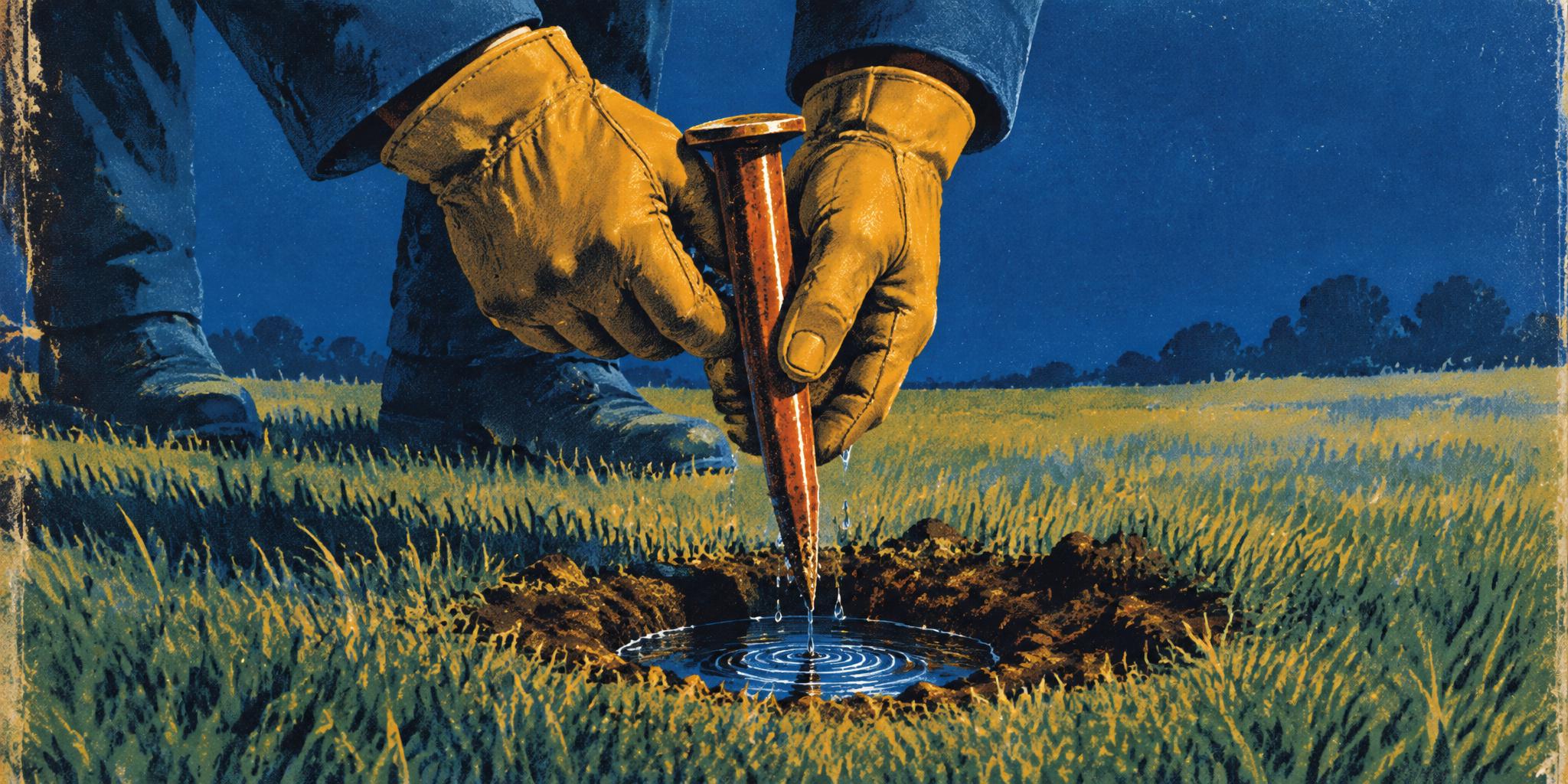
The trailers the families sleep in have their own batteries, so the windows stayed lit. I walked the field with a headlamp looking at what I'd be taking up in the morning. Every earth spike has a yellow tag on it so I can find it in the grass. An earth spike is a copper rod hammered into the ground, so that if something goes wrong in a ride, the electricity has somewhere to go besides into a person. I counted fourteen. There are always fourteen. I count them anyway.
Isa was sitting outside her trailer in a camp chair with a mug of tea.
"Tam was down at the stakes," I said.
"I saw him."
I waited. She drank some tea.
"They're putting the bank back to the trees," she said.
The bank is the flood bank, a long wall of piled earth that keeps the river off Tam's fields. Back to the trees meant the bottom of this field would end up on the river's side of it.
"When?"
"He doesn't know. He says ask him in the spring."
Isa has her rights to this ground under the Showmen's Guild rules, because she's opened here in her own name every year. Among show folk that means it's hers, and nobody would try to take it off her. That counts for a lot. None of it means Tam has to rent her the field, and she knows that better than I do. Every January she writes to him asking for the last week of August, and every January he writes back and says yes.
We used to stand at Montrose in July, on the links by the sea. That one ended with a letter from the council. Isa kept the letter.
"Eight o'clock," she said. "Nothing moves before eight. Tam has neighbors."
"I'll be up at six."
"I know you will."
The sun came up behind the alders a little before six. Everything was wet and the midges were thick at the low end, the air not moving at all. I made coffee and drank it standing on my step.
Electrical work is quiet, so I start before the trucks.
The first thing on any pull-down, which is what they call packing up, is working out what still needs power. That morning it was three things. The chip van was doing bacon rolls for the crew until nine. The Waltzer runs its hoist off my board to lift the cars onto its truck, and Callum doesn't like waiting on me. And the work lights, which on an August morning don't matter. In October they'd be the whole thing.
So the stalls went first.
At each board I switch off whatever's running, then the breakers, then the main switch. I put my padlock through the handle so nobody can turn it back on, and the key goes in my shirt pocket. I'm the only one with keys. I hang a tag on the lock with my name and the time.
Then I prove it dead. The tester has two probes on leads. Before I use it I touch it to a little box called a proving unit, which puts out a voltage I know, so I know the tester works. Then I test every wire against every other wire. Then I put the tester back on the proving unit, to make sure it didn't quit halfway through and tell me everything was safe when it wasn't. It's about four minutes a board. I've watched younger electricians skip that second check. I don't say anything. I just do mine a bit slower when they're watching.
Then the wires come off. The live ones first, then the neutral. The earth wire comes off last, because until everything else is disconnected it's the thing protecting you if you got something wrong.
At eight exactly the first engine started.
Everybody has one job on a pull-down and does it every time. Callum's brother-in-law does the Waltzer cars. Margaret and her son do the chip van and nothing else, and they're gone by ten. Dawn and Kenny pack the hook-a-duck in an order I've never seen change. Ducks into crates, crates into the trailer, then the prizes, then the canopy, then the counter. Anybody could do anybody else's job, but I've never seen it happen.
The ghost train lorry couldn't get out the top way with the Waltzer trucks loading at the gate, so it had to go round by the low end. Callum's crew laid sheets of plywood in front of the wheels and walked them forward. They'd take the sheet from behind the back wheels, carry it round, and drop it in front. The lorry crept out a sheet at a time with Kenny walking backward ahead of it, one hand up. Nobody reverses on that field if they can help it, and when they have to, Kenny walks them back.
I took up cable. The main runs are black rubber, thick as a wrist, and they go onto the reels by hand. I wipe each length with a rag as it comes in and run my glove along it feeling for cuts in the outside. A nick I miss here turns up some wet night in another field with people standing on it. At the gate the cable ran through a pipe buried under the track. I pulled the cable and then dug up the pipe, because you don't leave anything under somebody else's ground. At the low end the cable had sunk an inch into the grass in four days, and I lifted it out with my fingers, a foot at a time.
The Waltzer was finished by eleven. I unlocked that board last, after Callum told me the hoist was off and the cars were chained, and I did the whole thing over. Off, lock, prove, test, prove, wires, earth.
The spikes come out after everything else. Most of them came up with a twist and a pull. The one at the low end, where the hook-a-duck had stood, had gone into clay that stayed wet all week, and it held. I worked it back and forth for ten minutes, a little further each way, until it came up with the sound of a boot coming out of mud.
Fourteen tags in my pocket. Fourteen spikes in the box.
Isa and Tam walked the field together at three. She had photographs on her phone from the day we came in, the field the way it looked before us, and they held the phone up and compared.
There were ruts by the gate where the Waltzer lorry turned, and a flat patch where the Orbiter stood. Callum's crew went over them with garden forks, lifting the turf where it had packed down, then raked it, and Isa scattered grass seed out of a sack she carries every year for this.
At the low end there were wheel marks where the ghost train lorry had slipped off the plywood.
"No point seeding the bottom," Tam said.
Isa handed the sack to Callum, and Callum seeded the bottom.
Tam watched him do it and didn't say anything else about it. He said the rest looked fine. They shook hands, the way they do every year.
The last thing I do on any ground is walk it once with nothing in my hands. I found two cable ties, a hair band where the chip van had been, and a twenty-pence piece under where the ticket booth stood. The hole from the stubborn spike had already filled with water, a little cup of it. I pushed the turf over with my boot and stood on it.
Tam was at the gate with his dog, waiting to shut it behind me.
"January," he said.
"That's Isa," I said.
"I know who writes," he said.
He shut the gate. In the mirror I could see him walking back down the field toward the river, the dog out ahead of him, toward the stakes.
We were due at Cupar on Thursday. The keys were back on the ring. I'd be up at six.
-
Who holds the ground: The Competition and Markets Authority's 2017 consultation on Showmen's Guild commitments explains how a showman's established position at a recurring fair differs from any right to the land itself.
-
Handing the field back: South Ayrshire's 2026 letting particulars for Ayr's Low Green show how a £2,500 reinstatement bond works on a real Scottish funfair ground, with damage measured against the grass's condition before the fair arrived.
-
Moving the flood bank: Scotland's River Nith restoration case study describes embankments set farther back from the river near New Cumnock, the kind of change that would put the bottom of a field on the river's side.
-
Batteries beside the generator: IET temporary-power specialist James Eade's update on temporary power systems explains how transportable batteries let event generators run harder for shorter stretches instead of idling all evening.
