
Two Septembers after the remnants of Hurricane Helene tore through Western North Carolina, the flood has become, among other things, a filing problem. Buncombe County Special Collections conceived Come Hell or High Water soon after the storm but held off on asking for submissions until early 2025. Staff didn't want to press people for documentation in the raw stretch after a trauma.1 By July 2026, the county said the project had gathered more than 1,000 accounts (stories, songs, zines, emails, screenshots) and had moved into a maintenance phase while still accepting some submissions.2
Somewhere in that pile sits the signature artifact of a modern disaster: the group chat. In 2024, the neighborhood text thread was the infrastructure. It served as dispatch center and wellness check. It was also where people typed things at 2 a.m. that they would never say out loud. A screenshot of that thread preserves your own story, plus slivers of thirty other people's. So who gets to hand that to a library?
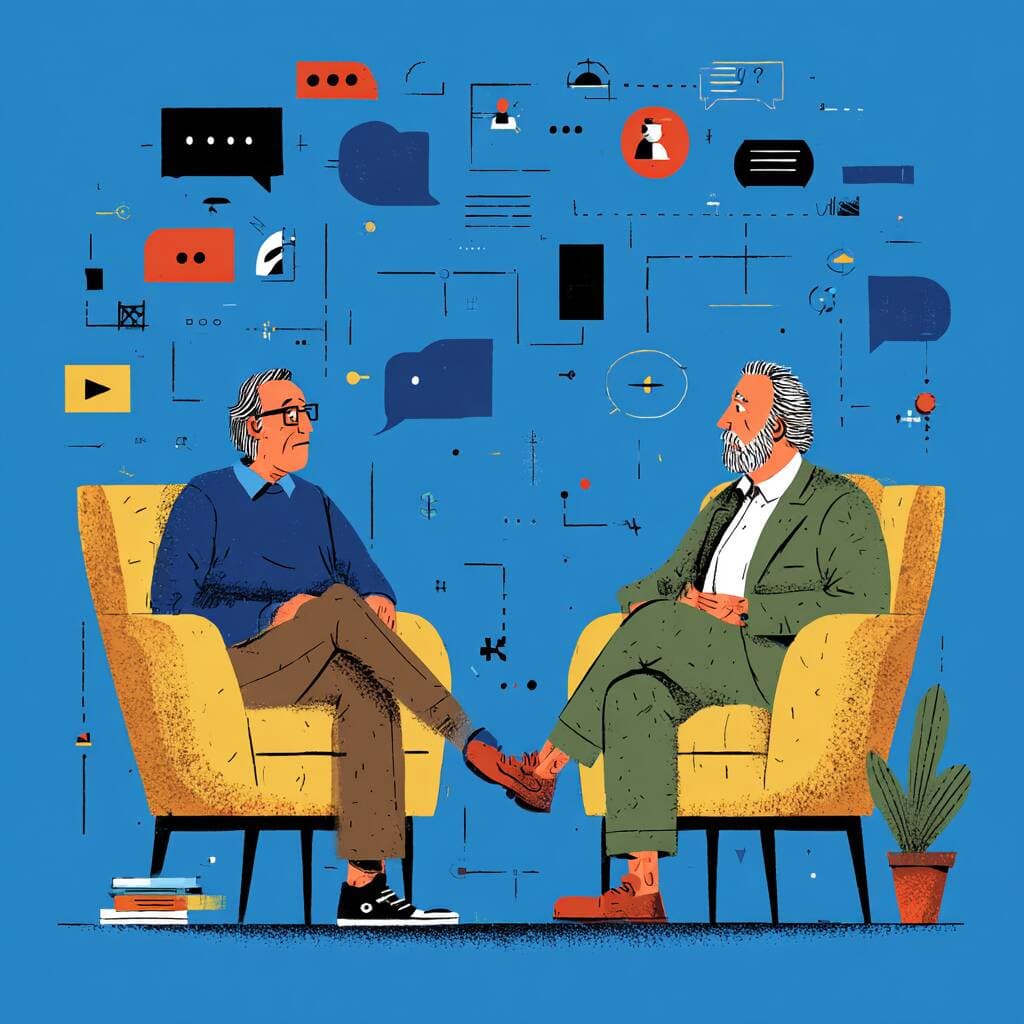
To think it through, we sat down with Prudence "Pru" Overcash, 67, a retired church secretary who captained a Methodist prayer chain for three decades and now volunteers at an intake desk.
Pru does not exist. We invented her. She has asked that this fact be entered in her descriptive metadata, spelled correctly, with standardized subject terms. The archive documents she cites are real and footnoted below. Her desk, her opinions, and every encounter she describes are imagined, and no real contributor stands behind any of them.
In our imagined meeting room, she arrives with a cardigan, a jar of starlight mints, and a label maker she calls "the Deacon." She has the poker face of a woman who has heard every confession a church office can produce and repeated none of them, except to God and, once, to her sister.
You ran a prayer chain for thirty-one years. Professionally speaking, you've been circulating other people's worst moments for decades. How is this different?
Pru: Well. That's rude, and it's fair. [laughs] The prayer chain was a phone tree. Somebody's husband had a biopsy, you called four ladies, they each called four more, and by supper the whole church knew. About a third of them knew it wrong. One year a gallbladder became a heart transplant by Wednesday night service.
But the chain had one mercy. It evaporated. Nobody wrote it down. Here, the writing down is the entire point. Somebody's 2 a.m. is going to be sitting in an acid-free box in 2090, and I'm the lady at the front door taking its coat.
What actually crosses your table?
Pru: Everything. Pictures of the river running where the road used to be. The collection has Michael Hatch's storm version of "Jolene" and a video of a heron fishing in the receding water.1 I love that heron. Nobody had power, and that bird was having the best week of its life.
The form asks when something was written or recorded.3 That sounds fussy until you see how much of what comes in was made afterward. A poem from last spring has had time to comb its hair. A text sent the night of hasn't.
And then there are the screenshots. [She closes her eyes for a moment.] Lord, the screenshots.
Talk to me about the group chats.
Pru: All right. Disclaimer first. This one's made up. I'm made up. It's made up all the way down. But it's the kind of thing I'd lose sleep over, if I slept.
A woman brings in a thread called "Riverbend Rd Check-Ins." Forty-some neighbors. Night one is all business: who's got a chainsaw, whose culvert's gone. Then at 2:14 a.m., somebody types in all caps that she can't reach her daddy, could anybody please, anybody. Four hours later he turns up at the fire station eating Vienna sausages. Happy ending. But 2:14 is still sitting right there in the screenshot, in capital letters, for good.
The woman who brought it is proud of that chat, and she should be. It saved people. It's her memory. And 2:14 is somebody else's worst minute, and nobody asked her.
Now. The terms say you have to have created what you send, with exceptions for permission and fair use and so on, and that it can't violate privacy or confidentiality law.4 Fair use is the legal doctrine that sometimes lets you use somebody else's work without asking, and as far as I can tell it's how copyright lawyers pay for their lake houses. The Copyright Office will tell you that owning a copy of something isn't the same as owning the copyright.5 So having that screenshot on your phone doesn't make the neighbor's words yours. And privacy is a separate animal from copyright altogether.6
I am not a lawyer. I'm a retired church secretary with a label maker. I cannot rule on fair use at a folding table.
What I can do is notice. The archivists' code of ethics talks about protecting the people documented in collections who had no voice in how the records were made or used.7 That's 2:14, exactly.
She was typing to forty neighbors in the dark. History wasn't on the thread.
So what do you do with it?
Pru: Flag it and walk it up the hall. [She mimes carrying something hot.] What happens up the hall, I can't fully tell you. How they handle an objection from somebody who's in a contribution but didn't donate it isn't spelled out in anything public I've seen. I'd like to know too. I'm a volunteer. I find things out the way the prayer chain did, which is eventually and about a third wrong.
The archive lets contributors request privacy, including a restriction for a set number of years.8 Does that solve it?
Pru: It's an answer. You know an unspoken prayer request? Somebody raises a hand in church and says "unspoken," and the whole room prays for a thing nobody names.
A restriction is an archival unspoken. It says this happened, it's being kept, and the answer for now is not yet.
But read two sentences in the terms side by side. You grant permission to preserve and share your material in perpetuity. Meanwhile, they're not obligated to preserve it forever.4 So "forever" runs in one direction and "maybe" runs in the other. [pause] I don't think that's sinister. The terms point to their collection and deaccession policies, and deaccession is librarian for "we let it go." I just want people reading both halves before they sign. I made my nephew do the same thing with his truck loan.
And there are questions I can't answer. Does a restriction hide the title? The description? The dot on the map? Who's watching the calendar in 2049, and what happens if the person who asked for it has died? The oral history people warn that subpoenas or public records requests can make some restrictions unenforceable.9 I'm not saying that happens here. I'm saying "locked for twenty-five years" is a promise made by people who won't all be around to keep it. I outlasted four pastors at First Methodist. Not one of them left me a list of what he'd promised anybody.
Every restriction also thins the record. The archive's own FAQ says earlier flood records mostly reflect people who could afford to keep things.8 Where does that leave you?
Pru: [long exhale] That's the one I go back and forth on. Usually around 3 a.m., which I realize is on theme.
Say the folks in the mobile home parks all decide "not yet." Then in fifty years somebody writes Helene's history from the people with dry attics. Again. But you can't make somebody's worst night public so a historian feels better about her sample size.
The archivists say restrictions should be transparent, with the reasons and the length written down.7 I like that. A labeled gap beats an invisible one. That's the best I've got, and I'm not sure it's good enough.
Have you submitted anything yourself?
Pru: Not yet.
Why not?
Pru: I'm still deciding who's in it.
The collection also has a quieter route, the screenshot scrapbooks. How do those work?
Pru: My favorite thing going. You pick up to twenty-four screenshots, number the filenames in order (in order, I cannot stress this enough), send them to the Friends of Buncombe County Special Collections, and they print you a little book.10 You can keep it, donate it, or add the screenshots to the digital archive.
People hear "archive" and picture the internet. It can be a lot smaller than that. Some memories want a coffee table, a box of tissues, and your sister. That's the whole audience, and it's plenty.
What's the actual job, underneath the paperwork?
Pru: Description, mostly. Katherine Cutshall, who manages Special Collections, has said she values people explaining what they were thinking, not just where the camera was.1 "Taken from porch" tells you nothing. "Taken from porch because I figured it was the last picture of the barn" is a document. [She pats the Deacon.] That one I'd label twice.
The rest of it is not deciding things that aren't mine to decide. I can tell somebody they can publish under "Anonymous," though the archive still gets their name and email.3 I can show them the option that says "Publish my contribution on the web" and make sure they know what it means before they click. I can tell them they're allowed to ask for a delay. I can't tell them what's right. Thirty-one years in a church office, and that was always the pastor's department.
And if a friend asked you? Off the record, so to speak.
Pru: As a friend? Before you hand over the group chat, text 2:14. She might say, "Lord, put it in, I want people to know how scared we were." She might say no. Either way, she's had a say. Then figure out whether that chat belongs on the internet or on the coffee table. Those are different afterlives.
She feeds a strip through the Deacon, peels the backing, and presses the label to the edge of the table. It reads: NOT YET.
Footnotes
-
Katie Myers, BPR/Grist via WFAE, March 6, 2025, "'Come Hell Or High Water.' New archival, oral history project gathers WNC Helene stories." https://www.wfae.org/2025-03-06/come-hell-or-high-water-new-archival-oral-history-project-gathers-wnc-helene-stories ↩ ↩2 ↩3
-
Buncombe County, July 8, 2026, "Special Collections Team Nets Prestigious Awards for Come Hell or High Water Project." https://www.buncombenc.gov/m/newsflash/Home/Detail/1046 ↩
-
Come Hell or High Water, Contribute (personal-account form). https://helenehistory.omeka.net/contribution ↩ ↩2
-
Come Hell or High Water, Contribution Terms and Conditions. https://helenehistory.omeka.net/contribution/terms ↩ ↩2
-
U.S. Copyright Office, Circular 1: Copyright Basics. https://www.copyright.gov/circs/circ01.pdf ↩
-
Library of Congress, "Using Items from the Library's Website: Understanding Copyright." https://www.loc.gov/legal/security-copyright-and-privacy/understanding-copyright/ ↩
-
Society of American Archivists, Core Values Statement and Code of Ethics. https://www2.archivists.org/statements/saa-core-values-statement-and-code-of-ethics ↩ ↩2
-
Come Hell or High Water, FAQ. https://helenehistory.omeka.net/faq ↩ ↩2
-
Oral History Association, "For Participants in Oral History Interviews." https://oralhistory.org/for-participants-in-oral-history-interviews/ ↩
-
Come Hell or High Water, Screenshot Scrapbooks collection. https://helenehistory.omeka.net/collections/show/32 ↩