

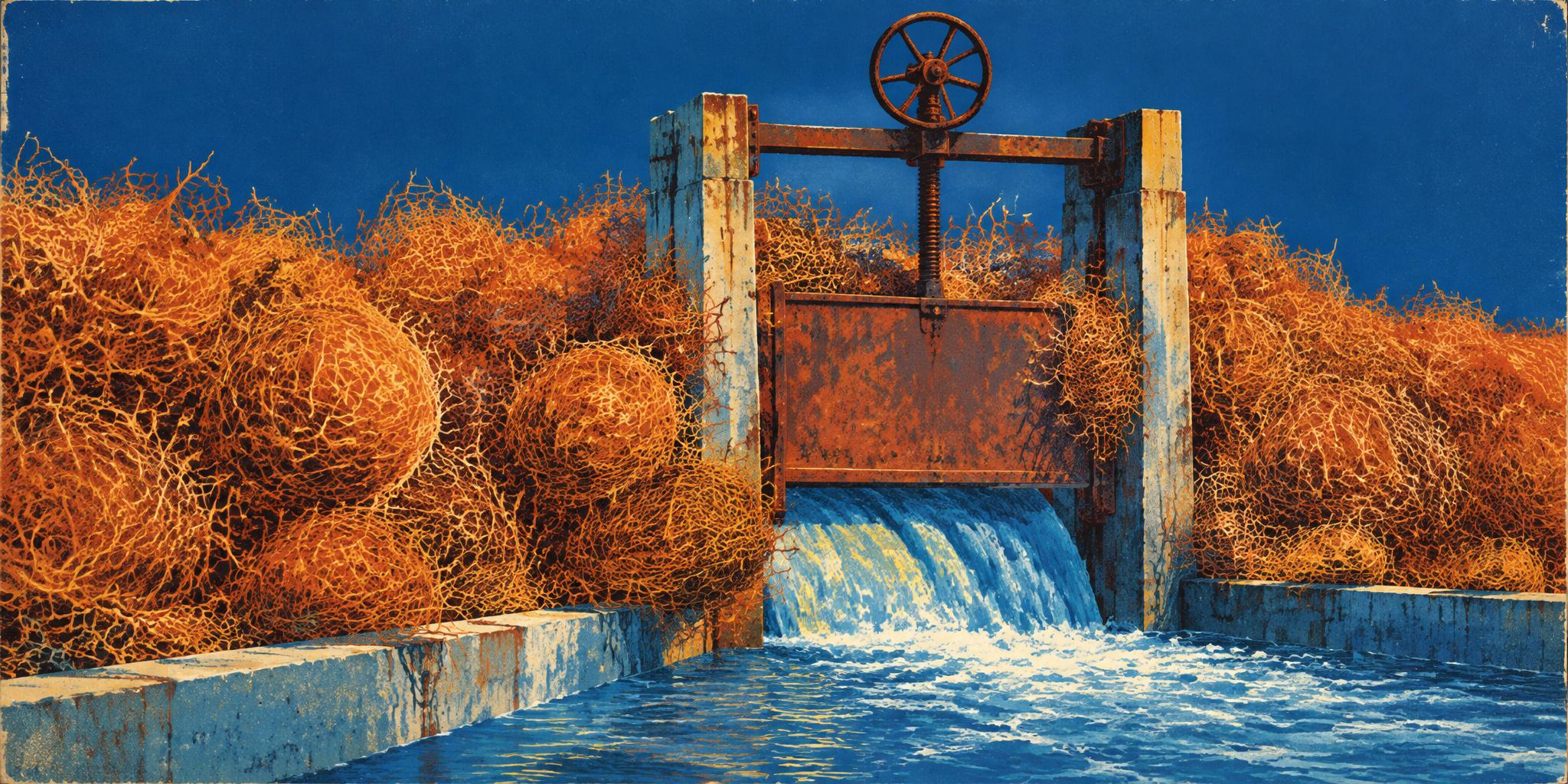
A new study tracks what western farmland becomes after the irrigation stops. In most of the watersheds it examined, the answer was grass and scrub, which burn more easily than crops. One Colorado county sold its farm water to cities, and it has spent half a century finding out who ends up tending the ground that's left.
A watered field in the dry West stays green through August, and green plants are hard to burn. A study published in October in Environmental Research Letters looks at what grows on that land once the water is gone. Its title puts the answer as a question: "Out of the frying pan, into the fire?"
Austen Lorenz and colleagues, in work announced by the Desert Research Institute, drew on 39 years of satellite records across 11 western states. They studied 477 watersheds where farming and wildfire overlap. A watershed is all the land that drains into a particular river or stream. From 1985 to 2024, those watersheds lost about 10.6 million acres of cropland. In 77 percent of them, most of the lost farmland became grass and scrub. The authors call that pattern "consistent with fallowing," meaning a field left unplanted and unwatered. In about one in five, most of it became houses and pavement. The study also confirms that cropland is less likely to burn than other vegetation.
That 77 percent is a count of watersheds, and some watersheds are very large, so it is not a share of acres. It says that in most of the places studied, land leaving farming shifted toward the kinds of plants that carry fire. It doesn't say how much ground that covers.
Where the saved water comes from
The seven states that share the Colorado River couldn't agree on how to divide a shrinking supply. On September 1, the Bureau of Reclamation, the federal agency that runs the river's big dams, issued its own plan for 2027 through 2036. Paying farmers to leave fields unwatered is still one of the main ways that plan keeps water in Lake Mead and Lake Powell.
A second October study, in Water Resources Research, asks where that saved water actually comes from. Hydrologists Oyedele, Werth and Carlson compared underground water levels with the river and its reservoirs. In the Upper Basin (Colorado, Utah, Wyoming and New Mexico), groundwater tends to rise and fall with the river. In parts of the Lower Basin (Arizona, Nevada and Southern California), it tracks the river less closely. The authors think the likeliest explanation is that people there keep pumping no matter what the river does, treating groundwater as a "primary or default source."
Where pumping is the default, water a farmer stops taking from the river only stays saved if the farmer can't replace it from a well. If the farmer can, the reservoir gains and the aquifer loses. That is why Coachella Valley's fallowing program in the Southern California desert includes a rule that participants may not pump groundwater to make up for the river water they give up. With that rule in place the field really does go dry, and what grows there next becomes a real question. The Lorenz study's pattern suggests one possible answer, though it hasn't been shown to apply to Coachella and it doesn't separate a season's rest from permanent retirement. The groundwater study works with blocks of land roughly 190 miles across, so it can't tell you anything about one farm's well.
Crowley County after its water was sold
Crowley County sits on the plains east of Pueblo, Colorado. Some of its irrigation water used to come from the other side of the Rockies. Twin Lakes water was carried through tunnels from the headwaters of a Colorado River tributary into the Arkansas River.
In Colorado, a water right can be sold separately from the land it waters if a special water court approves. Robert Sanchez, writing in 5280, traced what happened after that. Around 1970 a development company started buying Crowley farms along with their water. In 1974 a water court approved moving that water off the land. Pueblo and Colorado Springs bought it, and by 1980 almost all the Twin Lakes shares had gone to the Front Range, the line of cities along the eastern edge of the mountains. A second wave in the mid-1980s brought more buyers, Aurora among them, who bought shares in local irrigation canals. If you live in one of those cities, some of the water your utility owns once grew crops in Crowley.
The federal farm census shows how quickly it happened.
Much of the record of what grew on the dried-out fields comes from the people who live next to them.
On April 15, 2008, near Ordway, the county seat, a burned pile of farm debris flared back up in high wind. The fire spread across about 9,000 acres. Two firefighters died when their truck crossed a bridge the fire had weakened, according to the federal investigation. Two weeks later, county assessor Warren Davis told The Gazette that all 16 fields inside the burn area had been out of farming, and only about a quarter had livestock grazing on them. The investigators didn't blame the water sales, and no one has worked out whether watered fields would have changed where the fire went. Afterward, topsoil blew across Highway 96. The local federal soil conservation official said cutting furrows into the ground could hold the soil for a while, but bringing the grass back would depend on rain.
Three years later, the county's wildfire plan listed "weeds/tumbleweeds (former farm ground)" among its high fire-fuel concerns. Abandoned irrigation ditches filling up with dead plants and windblown debris were on the same list. Fallow ground that was still being farmed on rainfall alone went into the plan's low-fuel category. The county's own categories, in other words, treated "dry farmland" as more than one thing: a field resting in the hands of someone who meant to plant it again was rated differently from ground left to weeds. Nothing in the Lorenz study's published summary suggests that it can tell, from orbit, a field resting for a season from one retired for good or one nobody has touched in years.
In 2014, Sarah Gilman of High Country News described Russian thistle, the plant most people call tumbleweed, piling up over roads and against houses. One of those houses belonged to resident J. D. Wright. A state agriculture official blamed the problem partly on fields left fallow after water sales and partly on drought. County crews chopped the weeds and hauled them off. Volunteer firefighters burned the piles whenever conditions allowed. That same year Sanchez found Matt Heimerich, a farmer and former county commissioner, out mowing weeds and worried about dirt blowing onto his land from a neighbor's property that no longer had irrigation water. Heimerich called it "a recurring nightmare." In 2018 he told Colorado Politics that in his experience, lasting grass only took hold when there was water to get it started. He said long-term responsibility fell apart after the older sales, though he gave Aurora credit for replanting more thoroughly than most.
Who the law makes responsible
Before 1992, Colorado law didn't directly require anyone to restore these fields. That year the legislature started requiring court orders that move water off farmland to address replanting. As amended since then, the law calls for "reasonable provisions" for revegetation and for controlling the harmful weeds on the state's official list. The requirement covered requests filed after it took effect, so Crowley's largest sales weren't included. Judges could already add such conditions on their own, which means some older orders may contain them anyway. The only way to know is to read the order for that particular field.
Where no order named a duty, the work went to whoever lived nearby. State weed law does allow counties to inspect land, notify the owner, control officially listed weeds themselves, and send the owner the bill. But a drift of tumbleweeds doesn't automatically count as one of those weeds. For years most of the county's response came from neighbors with mowers, road crews, and unpaid firefighters burning brush piles.
In May, Colorado passed a much more detailed rule for the Arkansas River basin, which includes Crowley. Under HB26-1340, when a court approves changing a farm water right in that basin to another use, like city supply, on or after January 1, 2027, the owner of the water becomes responsible for the land it leaves behind. Each field gets its own standards for replanting or dryland farming, erosion, and weeds. A neutral expert, picked by the court and paid by the water owner, inspects every field every year until a judge rules that the plants are established. The owner has to back that obligation with financial assurance or accept limits on how the water is used. If a field keeps failing, the court can restrict how much of the transferred water the owner may use, so neglect on the ground costs the owner water.
For the most part, the law doesn't touch Crowley's earlier sales. It only reaches an older transfer if water that has already moved is changed again and the original order had no replanting conditions. It also has an end point. A judge rules the grass established on a particular day, and drought on the plains can still set it back afterward. The court can extend oversight for a limited time if success is "substantially at risk." Once that runs out, the law doesn't say who takes over.
What temporary fallowing contracts require
Crowley's sales were permanent. Most of the Colorado River fallowing being paid for today, whether by urban water agencies or the federal government, is temporary. A farmer is paid to leave fields dry for a set period and can farm again when it ends. These contracts spell out who takes care of a field while it's dry, and say much less about what happens once the contract is over.
Since 2005, the Metropolitan Water District of Southern California, which supplies much of the Los Angeles region, has paid landowners in the Palo Verde Valley along the river to leave fields unwatered under a 35-year agreement. The landowner contract generally caps a field at five dry years in a row. The landowner pays to keep weeds and blowing soil under control, whether by spraying, mowing, leaving stubble, or rough plowing. Metropolitan pays the landowner, and the contract states that Metropolitan owes nothing to a tenant who rents and farms the land. The contract form has no specific fire-safety standard and no lasting duty to restore the ground once the deal ends.
Coachella's water district has extended its program through 2028. Farmers can enroll for one or two years and get $275 for each acre-foot they save. An acre-foot is enough water to cover one acre a foot deep, about 326,000 gallons. The federal government pays the district $325 per acre-foot, and the district keeps the difference to run the program. Keeping down dust and weeds is up to the farmer.
In both programs, that work belongs to whoever signed up. In Palo Verde, the check goes to the landowner even when someone else is farming the ground.
A rotation built to bring farmers back
Farther down the Arkansas, farmers who had seen what happened to Crowley spent years trying to find a way to sell water to cities without losing their farms. In 2008 they formed the Lower Arkansas Valley Super Ditch Company and built a rotation into its Catlin pilot project. A farm couldn't leave more than 30 percent of its land dry in any year, and a field couldn't sit dry more than three years out of ten.
Participating farmers had to prevent blowing soil and weeds. The project's 2022 report describes them spraying, breaking up the soil, planting a sorghum-sudangrass mix for animal feed, and leaving stubble in place. It reports no erosion or weed problems that year and says 54 percent of the previous year's dry fields were irrigated again. Farmers averaged $553.67 per dry acre. The report is the project's account of itself and should be read that way.
The volumes were small. In 2022, 182 acres delivered about 202 acre-feet to cities, against a contract ceiling of 500. Colorado water law protects downstream users' claim to the water that seeps back into the river from irrigated fields. That obligation, together with limits on moving water through the river and losses along the way, cut down what reached the cities. An earlier attempt in 2012 was withdrawn in the middle of a legal fight after the available water ran out. The rotation moved far less water than its contract allowed, but it did put on every dry field a farmer who planned to plant it again within a few years, and that farmer had every reason to keep the weeds down.
Who looks after the field now
If your water utility has bought or leased farm water, who tends the dry field depends on how and when that water moved.
- For Crowley's old sales, the work has often fallen to the people next door.
- For Arkansas Basin transfers approved from 2027 on, it falls to the water's owner, with an inspector checking every year until a judge says the grass is established.
- In Palo Verde, it falls to the landowner while the contract lasts; the contract sets no lasting duty after that.
- On the Catlin farms, it falls to the farmer who intends to return.
People in cities and on farms can ask some of the same questions about the fields their water came from. Is the field resting, retired, or abandoned? Does a court order or a contract say who controls weeds and dust, and for how long? Is the person doing that work the same person getting paid? The Lorenz study can't answer any of these for a single parcel, or say whether a particular field has tumbleweed or wheat stubble on it this fall. What it shows is that across most of the watersheds it studied, land coming out of farming moved toward plants that burn more easily.
In Crowley County, residents have been recording that change for more than forty years, in assessor's counts, fire plans, newspaper interviews, and brush piles burned when the wind allowed. The new law covers part of the future, in part of one river basin, up to the day a judge signs off. No one has yet decided who takes over the fields once the contracts expire and court oversight ends.
- Colorado's paused conservation program: State officials have said they won't launch a 2027 Upper Basin conservation program until federal officials guarantee in writing that the saved water stays in Lake Powell, according to Heather Sackett's October reporting for Aspen Journalism.
- The study's watershed list: Whether the Arkansas Valley, Palo Verde, Imperial or Yuma fall inside the 477 watersheds, and how the authors told temporary fallowing from permanent loss, should become clear from the full Environmental Research Letters paper and its supplement.
- Coachella's next fallowing round: The district's July 2026 board material on the program extension sets a target of 10,000 acre-feet a year at a lower grower rate, so it will be worth watching who signs up and how the dry fields are kept.
- Imperial's summer irrigation pauses: Imperial Irrigation District pays growers to stop watering established forage fields for 45 or 60 days under its 2026 Deficit Irrigation Program, but its rules on weeds, dust and restoring the fields afterward have not been published in full.