

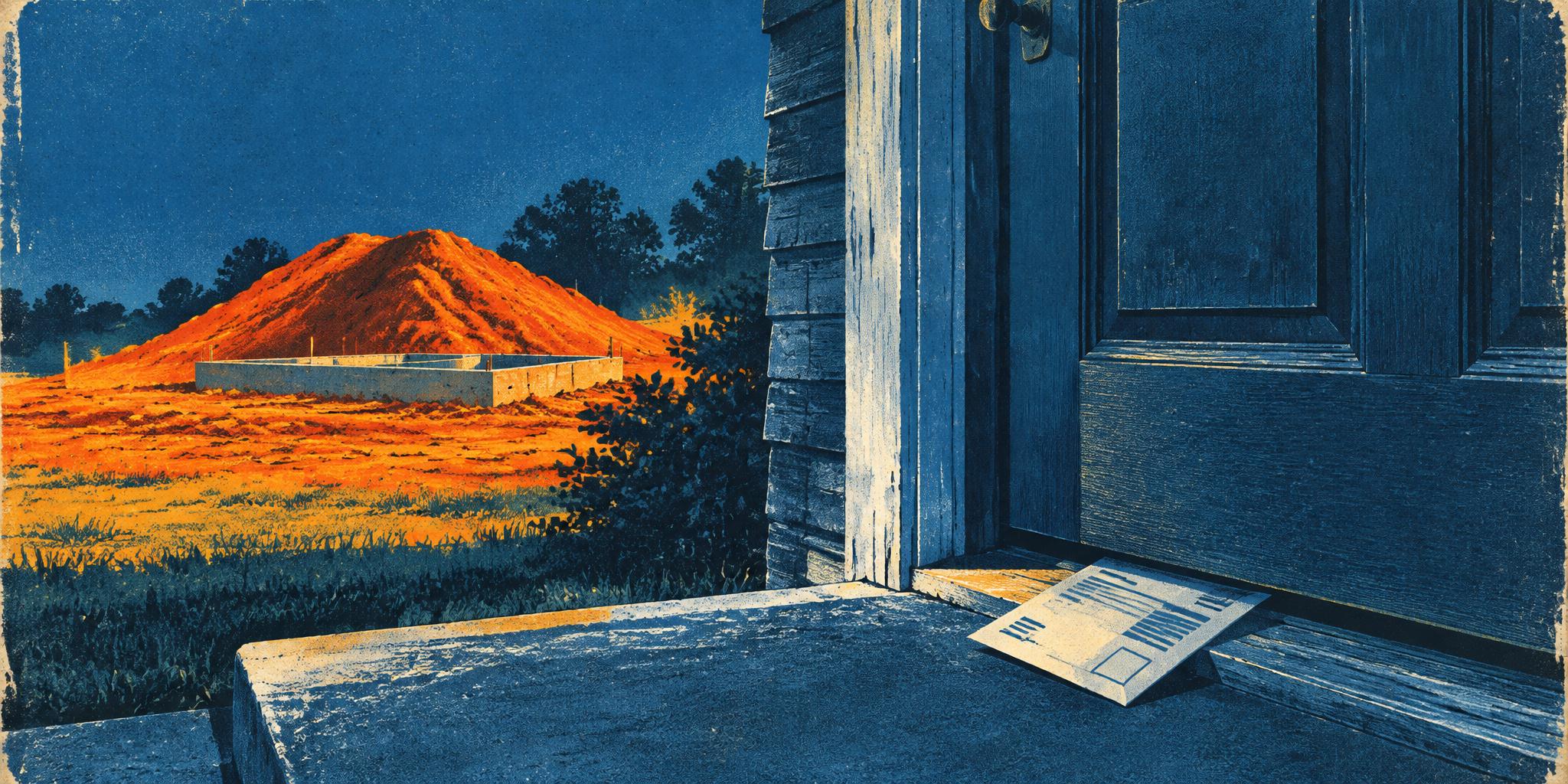
In October 2016, Ann Garstang wrote to Boulder County's planners about the September 2013 flood, when South Boulder Creek came over its banks and into Frasier, the retirement community where she lived. She listed what the water had done: neighbors pushed out of their homes, cars ruined, the community's health-care center damaged. Then she made the request Frasier residents had been repeating since the water went down. "Please, please build the berm."
A berm is a long mound of earth built to hold water back. Garstang's email is one page in the county's planning record for the project. It is in the file because she sat down, wrote it and sent it. Most of the people who will live behind the finished project appear in official documents only as a total.
That total is about 2,300 people and 260 structures, according to the city. This week, crews along South Boulder Creek near U.S. 36, the highway between Boulder and Denver, put up fencing, cut trees, pumped groundwater out of the work zone and started digging. The city's project update says construction will take three to five years. Once finished, the system is designed to protect against what engineers call a 100-year flood, meaning a flood with a 1 percent chance of happening in any given year.
The city estimates the project at $76.5 million, split between two public bodies. One is Boulder's stormwater and flood utility, the city department responsible for rain runoff and flooding. The other is the Mile High Flood District, a regional agency that pays for flood work across the Denver area. Boulder residents cover their share through the monthly utility bill. This year a single-family home on a lot of up to 15,000 square feet pays a stormwater and flood charge of $29.88 a month, or $358.56 a year. In 2024 the charge was $27.11. That money supports the whole stormwater system, so it isn't a fee for this project alone, but the creek work is paid out of that account.
In 2018, Boulder County and the City of Boulder sued two oil companies, Suncor Energy and ExxonMobil, arguing the companies should help pay for costs like these: flood repair, wildfire prevention, buildings that need cooling as summers get hotter, and water systems strained by drought. The case, Suncor v. Boulder, is now before the U.S. Supreme Court. The justices heard arguments in October. On the Court's usual schedule, a decision would come by late June or early July 2027.
Next month's stormwater charge will be the same however the Court rules. What the ruling settles is whether anything Boulder has spent can ever be put in front of a jury.
What the justices are deciding
Boulder filed in Colorado state court under ordinary state injury law, the everyday rules that let people and governments sue over harm done to them. A city could use the same law against a company that polluted its groundwater. The companies want that route closed. Their question to the Court asks, in plain terms, whether federal law shuts out a state-law lawsuit over climate damage caused by pollution that crosses state and national borders. The Court added a second question of its own: whether it has the authority to take the case now, before the Colorado courts have held a trial.
Colorado's highest court has already answered the first question in Boulder's favor. In May 2025, it ruled 5–2 that federal law does not block the claims and sent the case back to the trial court. It expressly declined to say whether Boulder should win.
So the Supreme Court is not deciding whether ExxonMobil or Suncor caused any flood in Boulder or owes Boulder any money. It is deciding whether a trial on those questions can take place.
The companies' May 2026 brief argues that the Constitution prevents one state from applying its own law to pollution that crosses its borders. In the companies' account, Congress replaced the old judge-made rules for interstate pollution with the Clean Air Act, the main federal air-pollution law, and did not hand the subject to state courts. They add that a large enough damages verdict works like regulation, effectively setting terms for fuel production worldwide without any court ever ordering it. The brief closes: "Our Nation's climate policy should not be left in the hands of six jurors in Boulder, Colorado."
Boulder's brief answers that state law has always governed damage to local property and public safety, and that neither the Constitution nor the Clean Air Act shields the companies from suit. Boulder says its claims are about how the companies marketed and sold fossil fuels, which it treats as separate from regulating smokestack emissions. "Nothing in the Act charges EPA with determining the appropriate level of deception in marketing fossil fuels," the brief says, referring to the federal Environmental Protection Agency. Boulder pursues two theories: that the companies misled the public, and that they knowingly contributed to the harm by producing and selling fuel. The brief describes the remedy Boulder wants as damages and disclaims any order limiting production, sales or emissions.
The federal government, 26 states led by Alabama and West Virginia, and a group of northwest Colorado governments filed in support of the companies. Those Colorado governments argue the litigation puts jobs and tax revenue at risk in counties whose budgets depend on energy production. Nineteen states led by Colorado and California, along with national associations of counties and cities, back Boulder. So Colorado local governments are on both sides of this case.
The outcomes look like this:
A narrower ruling could leave part of the case standing, since Boulder argues some claims survive even if others fail.
Back in a trial court, Boulder would still need to prove the companies are legally responsible, that their products caused its harms, and what, if anything, they owe.
What the lawsuit counts, and the fire it leaves out
The amended complaint, filed in June 2018, reads like a list of local expenses. It cites more than $100 million in flood damage to county roads and bridges, a $45,000 city study on heat, and $397,151 the county spent on mosquito control in 2017. It projects roughly $170 million in future flood-control investments. These are Boulder's allegations, not proven damages, and some of the flood figures overlap. A consultant's estimate commissioned by the county put selected adaptation costs at $96 million to $157 million through 2050. That range left out home air conditioning, public health, business interruption and the cost of securing water in severe droughts. Some of those, air conditioning most obviously, fall straight on households.
Paul Chinowsky's firm prepared that estimate. He also evacuated from Louisville, the town just east of Boulder, during the Marshall Fire, the December 2021 grass fire that destroyed more than a thousand homes in Boulder County. He told Colorado Public Radio in October that he supports letting the suit go forward. His firm worked for the county, so he is speaking from inside the case.
The complaint was filed three and a half years before the Marshall Fire, and the fire is not in it. Louisville and Superior, the towns that lost the most, are not plaintiffs. For a lot of people along the Front Range, the Marshall Fire is when climate risk stopped feeling distant, but it is not part of the case the justices heard.
A sales tax, a rebate and a co-pay for fire prevention
In November 2022, county voters approved a permanent sales tax of 0.10 percent, 10 cents on every $100, to pay for wildfire mitigation, the work that makes it harder for fire to reach homes. The county's 2026 budget plans to spend $12.1 million from that fund this year while collecting $9.3 million. The $2.8 million difference comes out of savings from earlier years.
Much of the work happens one house at a time through Wildfire Partners, the county program that inspects homes and helps pay for fixes. This year's rebate contract sets aside $1.625 million for households. On October 19 the county announced a pilot program for home hardening, meaning changes that make a house harder to ignite. It pays half the cost of approved work, up to $2,000, and participants generally have to take on at least $4,000 of work. A household doing the minimum still puts in $2,000 of its own money, and every dollar past that $4,000 is the household's alone.
Homeowners have been covering a gap like this for years. In 2021, Ken Feldman and Gayle Gordon, who live near Lyons, told the Longmont Times-Call they had spent $2,000 to $2,500 on gravel around the house, metal fencing next to it, screened roof vents and clearing flammable material from the yard. Their rebate came to $800. Feldman said a bigger incentive could have let them do more of the work at once.
The work also takes time, and no budget records that. In 2024, Jim Webster, who runs Wildfire Partners, told The Colorado Sun that some households finish a single item in a month while others need two years to get through a long checklist. "We have to match our message to meet each homeowner's specific situation," he said.
Some of the work looks like ordinary ranching. Andy Breiter, a Boulder County rancher, told CPR that drought had thinned the grass his cattle depend on, forcing extra moves and a planned herd reduction to keep winter hay costs down. He was also grazing cattle near the Flatirons, where they eat down the dry grass that feeds wildfires. Breiter supports the lawsuit and signed onto a ranchers' brief backing Boulder, so he too is speaking from one side.
Taken together, the people paying and the people getting help are not the same group. Everyone who buys something in the county pays the sales tax, renters included, and a renter would need a landlord's agreement before any hardening could happen on the place they live. The household money goes to people who control a house, can commit $4,000 to the pilot and cover half of it themselves, and have the months or years Webster describes to work through a checklist. The county does offer some need-based help on top of its awards, but the basic terms favor households with cash and time to spare. And the plaintiffs in the climate case are the county and the city, seeking damages for their own costs. A homeowner's $2,000 co-pay is not part of the claim.
What the Marshall Fire settlement left on a town budget
The Marshall Fire did produce a case about responsibility, against different defendants and under different law. The way it ended shows how little of a settlement can make it onto a local budget.
In June 2023, the sheriff's office concluded the fire had two origins: a burn on a residential property that reignited in high winds, and power lines that threw sparks near the Marshall Mesa trailhead. Xcel Energy, through its Colorado utility, agreed to pay $640 million in settlements without admitting fault, all of them signed by this September. Public bodies, including Boulder County, Louisville, Superior and the Boulder Valley School District, shared a separate $3 million public-entity settlement.
That $3 million was divided among the public bodies according to their damages, after legal fees and costs. A December 2025 Louisville staff memo projected the city would keep roughly $222,000 to $230,000 of its share, because part had to be repaid to the state and to FEMA, the federal disaster agency. A settlement can't pay a town again for damage disaster aid already covered. In its 2022 financial report, Louisville had estimated about $9.6 million in fire costs and lost revenue that insurance and FEMA didn't cover. Towns carry costs like these for years while reimbursements and claims get sorted out, as we found in Plainfield's flood budget.
The climate case has its own fee terms. Boulder County says its private lawyers receive up to 20 percent of any award, and only if Boulder wins, while lawyers from nonprofit groups work without charge. The county describes the cost to taxpayers as "nominal" and acknowledges that salaried staff spend time on the case. We found no published accounting of what that staff time has cost.
The Court's calendar and everyone else's
The Supreme Court is expected to rule by next summer. South Boulder Creek construction runs into 2031. The wildfire sales tax has no end date. If Boulder wins, a trial court would then start gathering evidence, and any damages would come years after that. If the companies win, the court route closes, and the sales taxes, utility charges and co-pays carry on without it.
If your town is taking on similar costs, Boulder's experience suggests a few questions to ask:
- Which taxes and fees pay for this protection, and when do they expire?
- What share is left to households as co-pays, and which households can actually cover it?
- If a lawsuit ever brought money back, which public account would receive it, and what would be left after legal fees and repayment of disaster aid?
Ann Garstang asked for the berm in 2016. It is being built now and paid for on the monthly bill, and flood spending like this is among the costs Boulder's complaint asks a jury to weigh. This winter, other households in Boulder County are working out whether they can afford $4,000 of fire hardening on their homes.
-
Watching for the ruling: No decision has been entered yet, and the Supreme Court's docket for No. 25-170 will show when the justices rule and whether the opinion closes the case or leaves part of Boulder's claims alive.
-
How the berm gets financed: Council authorized up to $66 million in bonds in 2025, but the city's South Boulder Creek FAQ now says it is paying with appropriated stormwater revenue, which matters for what ratepayers carry through 2031.
-
Who uses the pilot: It is worth watching whether renters, lower-income owners and households without $4,000 on hand actually participate in the county's home-hardening pilot announced October 19, which pays half of approved work up to $2,000.
-
Louisville's final settlement numbers: The December 2025 memo only projected what the city would keep from the public-entity settlement, and newer reports on Louisville's budget and financial reports page may show the final amount after fees and FEMA repayment.