

On July 16, 1891, Dr. Isaac Monroe Cline, chief meteorologist of the U.S. Weather Bureau's Galveston station, published an article in the Galveston Daily News. The headline read: "West India Hurricanes." The sub-headline: "Record of twenty years — The Texas Coast Not Liable to Serious Damage."
The article made two arguments. The first was meteorological: tropical cyclones in the Gulf followed a parabolic track that carried them west and then curved them back northeast, striking Florida or running up the Atlantic coast. Cline had analyzed twenty such storms and found only two had reached Texas, both following what he called "an abnormal path which can only be attributed to causes known in meteorology as accidental." The coast of Texas was, according to the general laws of the motion of the atmosphere, exempt.
The second argument was geographic. Some people worried about storm surge overwhelming the island. Cline dismissed this as "an absurd delusion" that could "only have its origin in the imagination and not from reasoning." His logic: the territory north of Galveston was lower than the island itself, so any surge would spread harmlessly across that vast low-lying expanse. "It would be impossible for any cyclone to create a storm wave which could materially injure the city."
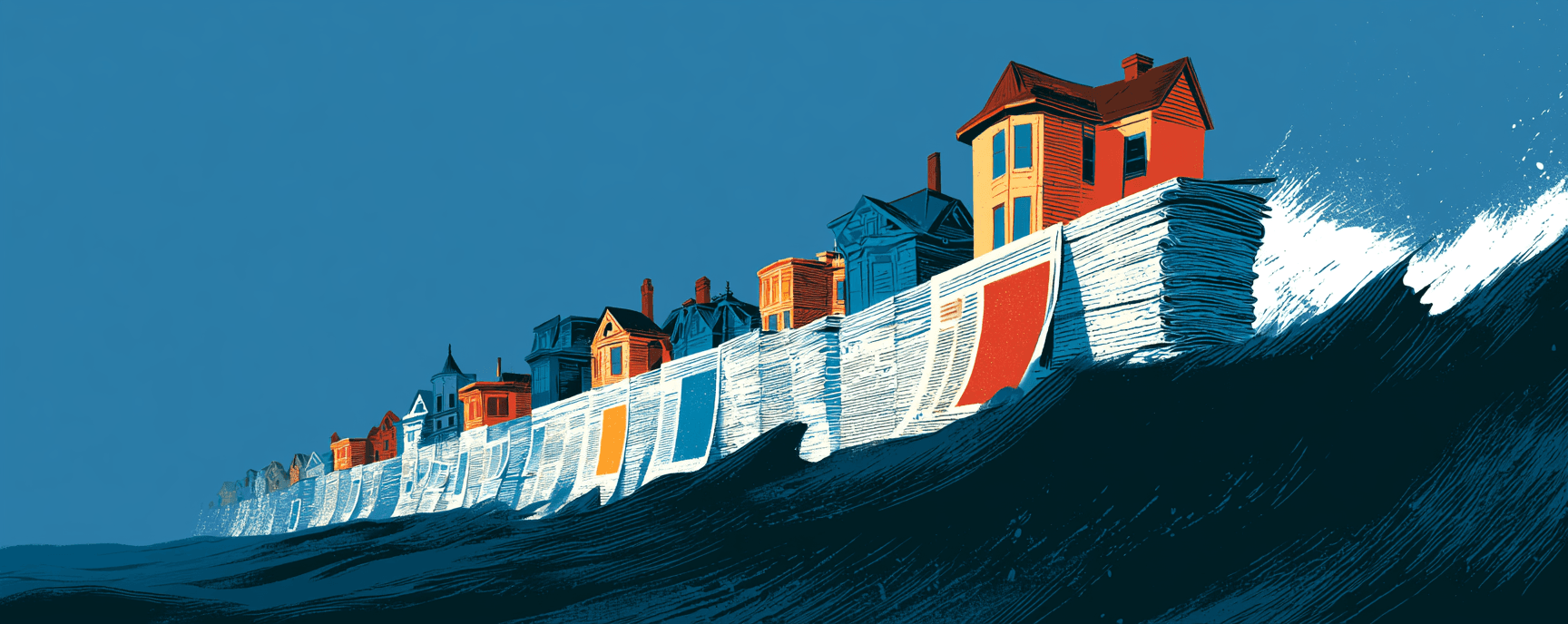
Both arguments were wrong. The second was a particular kind of wrong. It took the feature that made Galveston most vulnerable, a low flat barrier island surrounded by low flat terrain with nowhere for water to drain, and presented it as the reason the city was safe.
Cline was twenty-nine years old. He held a medical degree from the University of Arkansas. He was not a crank. He was the federal government's man in Galveston, running a station he'd been sent to establish from scratch two years earlier. The Weather Bureau had formally transferred from the Army Signal Corps to civilian control under the Department of Agriculture on July 1, 1891. Cline published fifteen days later. He was a young station chief in a brand-new civilian agency, posted to the largest city in Texas and its primary port, a city that handled more cotton than anywhere in the world and was in open competition with Houston for commercial supremacy. The record does not document specific pressure from Galveston's business community on Cline. But a twenty-nine-year-old establishing his office's credibility in a city whose entire economy depended on outside investment had reasons beyond meteorology to project confidence. His article's treatment of Indianola suggests as much: he never mentioned the hundreds who died in the 1875 and 1886 storms, comparing only property damage to that caused by a single tornado in Louisville, Kentucky. Erik Larson calls this "boosterism" in Isaac's Storm. That's Larson's interpretation rather than documented motive. But two city-killing hurricanes reframed as property-damage events roughly equivalent to a midwestern twister is a choice, and the choice points in one direction.
The Wall That Almost Was
The article appeared in a city that had recently decided not to protect itself.
Five years earlier, in 1886, a hurricane had destroyed Indianola, Texas, a rival port city 150 miles down the coast. Indianola had already been devastated once, in 1875. The second storm finished it. The town was abandoned. It remains abandoned today.
The lesson was about as subtle as a hurricane. Six weeks after the second Indianola storm, a group of thirty prominent Galveston residents calling themselves the Progressive Association met and resolved to build a seawall. The city's Evening Tribune endorsed the plan. The state of Texas authorized a bond to pay for the work.
Then nothing happened. The city's engineer, E.M. Hartwick, later observed that the bond authorization came "some months after the flood, and by then the attitude was, 'Oh, we'll never get another one.'" The urgency faded. The money was never spent. The seawall was never built.
Cline's 1891 article arrived five years into this forgetting. As Larson writes, "If Galveston had any lingering anxiety about its failure to erect a seawall, Isaac's 1891 article would have eased them." The complacency already existed. The article gave it a scientific signature and the authority of the federal weather office.
The Bureau's Machinery
In 1895, Willis Moore became Bureau director and tightened the institutional screws. Moore centralized all storm warnings in Washington. Local forecasters were to cable observations to headquarters, where clerks assembled a national weather map and telegraphed it back. He banned the use of the word "hurricane" in official communications. He cut off direct transmission of storm reports from the Bureau's Havana office. Cuban meteorologists, who had become expert at tracking Caribbean storms through decades of direct observation, were effectively silenced.
Moore believed local weathermen had been "over-warning the public," creating "an unhappy impression that the Bureau was not fully in control." His system was designed to prevent exactly the kind of local challenge that might have forced a reassessment of published risk judgments like Cline's. If a Cuban forecaster tracked a storm heading straight for Galveston, that data could no longer reach Galveston directly. It went to Washington, where it was filtered through the same parabolic-track doctrine Cline had articulated in 1891. The article stated the orthodoxy. Moore's Bureau made it structurally impossible to revise.
What the Confidence Built
Throughout the 1890s, with the seawall question settled and the Weather Bureau's chief meteorologist on record that the island was safe, investors built on Galveston's beaches. The construction diminished the sand dunes and destroyed the shoreline's natural capacity to absorb storm surge. Galveston's highest point stood 8.7 feet above sea level. The city had no seawall, no elevated grade, and, thanks to a decade of beachfront development, less natural protection than it had possessed when the Progressive Association first proposed building one.
By 1900, Galveston had an opera house, electric streetcars, telephone service. It was called the Wall Street of the Southwest. All of it sitting on a sandbar eight feet above the Gulf of Mexico.
September 8, 1900
On September 4, the Bureau's Washington office noted a "tropical storm disturbance moving northward over Cuba." Cuban meteorologists had tracked it accurately and knew it was heading into the Gulf. Their reports never reached Galveston. Moore's office predicted the storm would curve northeast toward Florida.
It did not curve.
On the morning of September 8, Cline observed the Gulf's behavior and grew alarmed. What happened next is disputed. Cline later claimed he rode a horse-drawn cart along the beach that morning, warning residents to move to higher ground. His brother Joseph, who was at the station with him, never corroborated this. Other sources conflict. The record does not resolve it.
By afternoon the question was academic. The storm surge that Cline had called impossible reached fifteen feet. It covered the entire island. The highest point in the city was underwater. Between six thousand and twelve thousand people died. The precise number has never been established because entire families were erased with no one left to report them missing.
Cline's wife, Cora May, was among the dead. She drowned when their house collapsed. Cline survived by clinging to wreckage with his three daughters and his brother Joseph.
The Second Act
In 1901, the Weather Bureau quietly transferred its Gulf Coast regional forecasting center from Galveston to New Orleans. Cline went with it. The move was kept quiet because, according to the Galveston Monthly, the Texas congressional delegation would likely have blocked it had it been publicized. Louisiana officials had lobbied for the transfer.
He spent thirty-four years in New Orleans. And here the story refuses to behave the way a cautionary tale is supposed to behave.
The man who had been catastrophically wrong became one of the most accurate forecasters in the country. He developed new methods for predicting river flooding, using observed rainfall data and river-stage measurements rather than the broad synoptic charts that had been standard. He was, by multiple accounts, the first to demonstrate that the deadliest feature of hurricanes was not wind but flood surge driven by wind.
He also became a man willing to fight his own headquarters. In 1903, after heavy rains, he warned that the Mississippi would crest at a record flood stage of twenty-one feet. Washington told him to temper his warnings. He refused.
"Is it not better to warn people of approaching disaster sufficiently in advance to enable them to prepare to meet it, than to let them be caught unprepared?"
The river crested where he said it would.
The Mississippi, 1927
In the spring of 1927, the Mississippi River system began the most catastrophic flooding in American history. Two weeks before the worst of it, Cline issued warnings of unprecedented specificity: he named the area the water would cover, two hundred miles long and fifty miles wide, and predicted the depth it would reach. Nothing like this had been attempted before in American meteorology.
The newspapers refused to print it. A local censorship committee, concerned about the impact on New Orleans commerce, pressured publishers to suppress the warnings. Cline called reporters into his office and learned what was happening. He went to the censorship committee directly and threatened to use other channels if they did not release the warnings through the press. The warnings were printed. City officials heightened New Orleans's levees before the floodwaters crested.
Commerce Secretary Herbert Hoover, coordinating the federal relief effort, said publicly that too much credit could not be given Dr. Cline for the work he had done. The people of New Orleans presented him with a silver amphora. Tulane University awarded him an honorary doctorate. The National Weather Service's highest honor, the Isaac M. Cline Award, carries his name today.
He published his autobiography, Storms, Floods and Sunshine, in 1945. By most accounts he never fully reckoned in it with the 1891 article or what it had cost.
What Cascaded
The comfortable reading is redemption: the man who got it wrong spent the rest of his life getting it right. That reading is true as far as it goes, but the six thousand dead in Galveston are not redeemed by accurate flood-stage predictions in New Orleans. The seawall that wasn't built in 1886 stays unbuilt regardless of the silver amphora.
The confidence was not fraudulent. The science was not fabricated. The institutional pressures were real, and the parabolic-track theory was standard doctrine. Nobody with standing challenged the surge-dispersal argument. A civic body that had already been looking for permission to stop worrying received that permission from the federal government's own weather office, and a city grew on an unprotected barrier island for nine more years while investors flattened its dunes. Six thousand people drowned.
The hurricane would have hit Galveston regardless of what any meteorologist published. Cline's article removed the last institutional basis for the one adaptation measure that might have reduced the killing. The Progressive Association had proposed the wall. The state had authorized the bond. The city's own engineer noted the fading urgency. Cline's published confidence was the final weight on a scale already tipping toward inaction. It made the reasonable choice to do nothing feel scientifically settled.
In 1927, the same man fought a censorship committee to make sure his warnings reached the public. Whether he ever connected that fight back to his own 1891 article, the record does not say.
-
Galveston's unfinished sequel: The proposed "Ike Dike" coastal barrier system, conceived after Hurricane Ike's 2008 devastation, has a $57 billion price tag against roughly $5.5 million in federal funding so far.
-
The 1927 flood's deeper cascade: The Caernarvon levee dynamiting, carried out to save New Orleans during the same flood Cline predicted, displaced ten thousand people in St. Bernard and Plaquemines parishes who were promised full compensation and received almost nothing.
-
The levees-only doctrine's long failure: The Mississippi River Commission spent nearly fifty years insisting that levees alone could control the river, a confidence that collapsed in 1927 and produced the Flood Control Act of 1928, which finally adopted spillways, floodways, and reservoirs.
-
Cuban forecasters silenced: The meteorologists whose Caribbean storm-tracking expertise might have saved Galveston were cut off by Willis Moore's centralization policy, a story documented in detail in Erik Larson's Isaac's Storm.