
The water rights were in a manila folder in my mother's filing cabinet, between her Medicare statements and a stack of paid electric bills held together with a rubber band. Certificate of Appropriation. Her name, the legal description of the quarter section, the well location, the authorized quantity in acre-feet. Filed with the Register of Deeds in 1974, the year my father drilled the well.
I'd been in the house for two hours. Gary had given me the key that morning at the café in town, slid it across the table without ceremony. The house was worth maybe sixty thousand. The quarter section, without water, maybe a hundred and twenty. The water rights were worth more than both combined.
I read the certificate twice at the kitchen table. The authorized quantity was 280 acre-feet per year. I couldn't have told you what that looked like on the ground. But I knew someone in Hays or Garden City would pay real money for the right to pump water that my mother had used to grow wheat and that Caleb had used, more recently, to grow sorghum. The aquifer under the quarter section had maybe fifteen years of irrigation left, according to the numbers Gary had heard from the district. Fifteen years of declining yield. Or it had the rest of its life as a municipal water source for a city that needed it now.
I put the certificate back in the folder and went to make coffee. The tap water came out clear but tasted like iron and something mineral underneath, stronger than I remembered. Maybe it always had been this strong and I'd just been away long enough to notice.
My mother's coat was still on the hook by the back door. Her boots underneath it, the left one tipped against the right. I hung my own coat on the next hook over and stood there for a second looking at the two of them side by side, hers and mine, like we were both about to walk out to the truck.
Caleb came by that evening. He was twenty-nine and had been farming the quarter section for six years, since Gary's back gave out and Gary took the job at the co-op. He'd switched most of the operation to grain sorghum after the district tightened the allocation rules in twenty-eight. He'd kept one center pivot on corn for a feedlot contract but the rest was sorghum, planted late May, harvested October. He said the math worked better than people thought. Lower input costs. Less water per acre.
He told me this in the kitchen, drinking a beer, while I sorted through another drawer of my mother's papers. He talked about the sorghum the way Gary talked about the elevator closing.
"The China market never came back," he said. "But there's a feed buyer in Dodge who takes what I can haul."
I asked him what he wanted to do about the water rights.
He looked at the beer in his hand. "I want to keep farming."
"I know."
"The rights stay with the land unless you pull them off. They just transfer with the deed."
"I know how it works."
"So if we let it go through probate, they stay attached."
He was talking about the process, but he meant himself. He meant the land and the water and the sorghum and the truck to Dodge City and the whole life he'd built on something that was running out.
"Gary and I have to agree on that," I said. "And there's a form. DWR has to be notified of the ownership change either way."
"Right."
We sat with that for a minute. The refrigerator hummed. My mother's calendar was still on the wall, turned to November, the month she'd gone into the hospital. She hadn't come home.
"I'm not saying I want to sell them," I said. "I'm saying I need to understand what we're deciding."
"Okay."
"There's a water use report that came in the mail last week. It's got her name on it. Due March first."
"I can fill that out," he said. "I've been filling it out for her the last two years."
I didn't know that. I should have known that.
The next morning I drove out to the section with Gary. He wanted to show me the sorghum stubble, which I didn't need to see, but he wanted to show me, so I went. We took his truck west on the county road. The land was flat and brown and frozen. I don't mean that unkindly. I grew up here. I know what it looks like in June when the pivots are running and the sorghum is waist-high and green. That was before I left. Before a lot of things.
The elevator in Grinnell was still operating but running half capacity. Gary said they'd laid off two guys in the fall. The one in Dighton had closed three years ago, the concrete silos standing over the town the way they always had, visible from ten miles out, but the scale pit was empty and the office windows were dark.
"Caleb hauls to Dodge now," Gary said. "Hundred and ten miles each way."
"That's a lot of diesel."
"It's what there is."
We drove past the section. The sorghum stubble was shorter than corn stubble would have been. Caleb had left it standing for the soil. The center pivot on the north end was shut down for winter, the pipe sitting on its wheels, still.
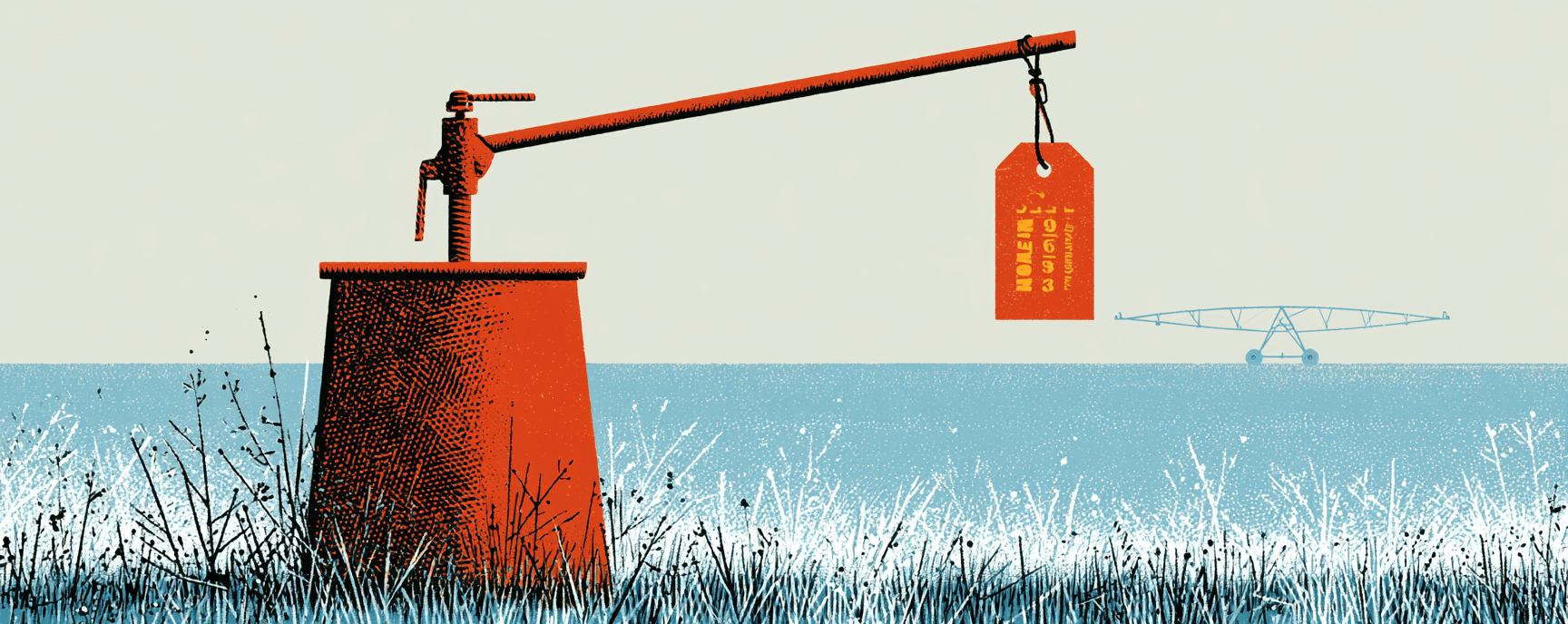
Gary pulled off the road near the well head. The pump was off. There was a steel casing sticking up out of the ground with a cap on it, and wired to the casing was a small plastic tag, bright orange.
"KGS was out last week," Gary said. "They measure every January."
I got out and walked over. The tag had the well location, the landowner's name — my mother's name — and three numbers. Depth to water, current year: 247 feet. Previous year: 245. Year before that: 242.
Five feet in two years.
I stood there looking at it. The wind was coming from the northwest and it was maybe fifteen degrees. Gary stayed in the truck with the engine running.
I thought about the person who'd come out here with a steel tape and blue chalk and lowered it four hundred feet into the dark and pulled it back up and read where the wet started. Then wrote the number on this tag and wired it to the casing and drove to the next well. Doing that across the whole western half of the state, well by well, January after January. Writing down the same direction.
I got back in.
"Five feet," I said.
"Yeah."
We drove back toward town. He turned on the radio. Crop report out of Dodge City and then a song I didn't recognize and then the weather, which was going to be cold and dry, which was what it always was.
After a while Gary said, "Caleb's a good farmer."
I looked at him. He was watching the road.
"He's better than I was," Gary said. "He pays attention to things I didn't."
I waited for the rest of it but there wasn't any. That was what he wanted to say.
Thursday I went to the lawyer's office in Scott City, forty minutes east. Young guy, maybe thirty-five, who handled estates and water law and whatever else came through the door.
He had the probate file open on his desk. He called me Mrs. Brandt, which was my married name, which was on the will. I told him Carol was fine.
He said the rights were the most valuable part of the estate. I told him I knew. He said if we kept them attached to the land, it was straightforward. Transfer of ownership, notify DWR, file the annual report under the new name.
"And if we sell them separately?"
He pulled out a form. Change application. Place of use, point of diversion, use made of water. Signatures required from all parties with an interest. He pointed to the signature lines. Three of them. Mine, Gary's, and the buyer's.
"Both of you have to sign," he said. "DWR won't process it without both signatures."
"And if one of us doesn't?"
"Then it doesn't get processed."
I looked at the form. It wanted names and addresses of all well owners within half a mile of the proposed well. Names and addresses of all landowners half a mile downstream and upstream. A narrative description of the proposed change. I thought about the neighbors Gary had grown up with, the ones still farming, the ones who'd watched their wells drop and their neighbors sell and their kids leave. I thought about what it would look like if my mother's water rights went to a city two counties over while they were still trying to grow sorghum on what was left.
"Has anyone around here done this?" I asked. "Sold to a municipality?"
He told me about a ranch south of Hays. The cities filed to change the rights from irrigation to municipal in 2015. The orders came through in 2019, contingent on a state-level transfer review. Neighboring irrigators fought it.
"How long did the whole thing take?"
"They're still working on it."
I put the form back on his desk.
Friday night, Caleb made dinner at his place. He had a small manufactured home on the north end of the section, put on a foundation. Clean and spare. He'd made chili, which was what my mother used to make when it was cold, and I didn't know if he knew that or if it was just what you made.
We ate at his kitchen table. He had the water use report out, half filled in. The form said 2033 at the top. His handwriting was neat and small.
"I've been thinking about what you said," he told me. "About understanding what we're deciding."
"Okay."
"There's maybe fifteen years of irrigation water left under that section. Maybe twenty if I keep cutting back. I'm already down to sixty percent of the authorized quantity. The sorghum doesn't need what corn needed."
"And after fifteen years?"
He looked at the report in front of him. "Dryland."
"Can you make that work?"
"I don't know. People used to."
He said it flat, like a fact he'd already sat with. I thought about asking what dryland sorghum yields looked like, what the cash flow numbers were, whether the feed buyer in Dodge would still be there in fifteen years. But those were my questions, from my distance. He'd been doing the math every season for six years. He knew what I'd be asking before I asked it.
"And if we sell the rights to Hays or Garden City, you get your share of the money and you can—"
"Do what?"
It was a real question. He was waiting for an answer.
I didn't have one. I'd left western Kansas when I was twenty-two. I'd gone to Wichita and gotten a job at an insurance company and then another job at a different insurance company and I'd built a life that had nothing to do with water tables or sorghum prices or the annual report due March first. I'd visited my mother when I could, which wasn't enough, but she didn't say that. I'd watched from a distance while the aquifer dropped and the elevators closed and Caleb switched crops and Gary's back gave out and everything rearranged itself around what was left, and I hadn't been there for any of it.
I didn't have the authority to tell him what to do with fifteen years of water. I also had a legal right to half of it.
"I don't know," I said.
"I know you don't," he said. Not mean. Just true.
We finished the chili. He washed the dishes. I dried. The water from his tap tasted the same as my mother's.
Saturday morning Gary came by the house. I was packing up the last of my mother's kitchen, wrapping plates in newspaper. He sat at the table and drank coffee and didn't help, which was fine. That was Gary.
"You talk to the lawyer?" he asked.
"Yeah."
"What'd he say?"
"He said we both have to sign if we want to sell."
Gary nodded. He looked at the coffee in his hands. "Caleb called me last night."
"What'd he say?"
"He didn't say anything. He just called."
I wrapped another plate. The newspaper was from October, the Hays Daily News. Wheat prices and a high school football score and an ad for a farm auction in Ness County.
"What do you want to do?" I asked.
Gary took a long time. He finished his coffee. He set the mug down carefully on the table, right on the ring where my mother's mug had sat for thirty years.
"I don't want to be the one who sold it," he said.
I didn't ask him what he meant by "it." The water. The land. The chance that Caleb might make something work. All of it.
"Okay," I said.
"Okay."
That was as close as we got.
I drove back to Wichita on Sunday. The water use report was due March first. The Certificate of Appropriation was still in the manila folder in my mother's filing cabinet. I hadn't signed anything. Neither had Gary. The water rights would transfer with the land through probate, which would take months, and during those months Caleb would keep farming and filing the reports and running the pumps at sixty percent and hauling sorghum to Dodge City, a hundred and ten miles each way.
We hadn't decided anything. But selling required forms and approvals and both our signatures, and not selling just required us to let it go. The rights were appurtenant to the land. They followed the deed unless expressly severed. Silence did the work for us.
I thought about the tag on the well casing. The orange plastic, the three numbers, my mother's name. Next January someone from the KGS would come back with a steel tape and blue chalk and lower it into the hole and pull it back up and read where the wet started. They'd write a new number on a new tag. The trend would keep going in the direction it had been going for fifty years, and Caleb would see it, and he'd keep farming, and at some point the number would mean something he couldn't work around.
I figured he knew that. I figured he'd known it longer than I had.
Somewhere past Hays the land started to change. More green. More trees along the creek bottoms. The aquifer was deeper here, or the rain was enough. I drove east into country that didn't look like where I'd come from, and I thought about calling Gary to tell him I wasn't going to fight it. But I didn't call. Not yet. I figured I'd wait until the report was due and see what happened.
The highway was straight and flat and mostly empty. I had three hours to Wichita. I figured that was enough time to think about it, or not enough.
-
Sorghum's fragile export market: Kansas sorghum farmers harvested their biggest crop in years in 2025, but tariffs had already killed their primary buyer in China, leaving producers without the single most critical outlet for a crop they'd switched to for conservation reasons.
-
The infrastructure that locks crops in: Feedlots, ethanol plants, and grain elevators across western Kansas are fine-tuned for corn, and a sorghum berry takes twice as long to process at a feedlot, which means growing it doesn't guarantee anyone will buy it.
-
The aquifer's latest numbers: Ogallala levels in southwest Kansas fell 1.52 feet in a single year between January 2024 and January 2025, a steeper drop than the year before, with most areas declining faster than their long-term averages.
-
When cities buy farm water: The cities of Hays and Russell purchased a 6,700-acre ranch in 1995 and filed to convert its irrigation rights to municipal use in 2015, triggering a multi-year legal process that neighboring irrigators challenged and that remains unresolved.