

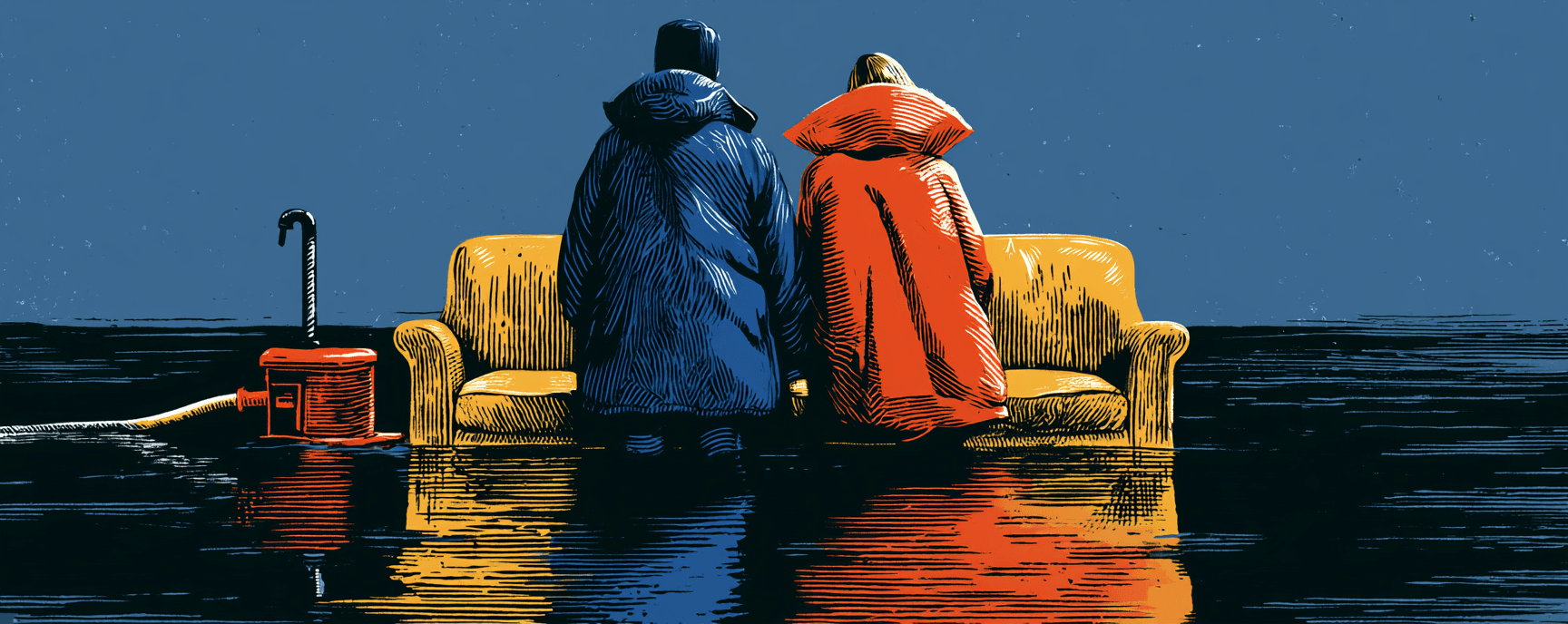
The pump woke her. The vibration first, a low pulse through the mattress that her ribs picked up before her ears did. She lay still. The bedroom was dark except for the glow from his phone on the nightstand, the weather app open, its blue light touching the ceiling.
Thirty-eight degrees. She didn't need to look. She could feel the temperature in the house, in the particular way the walls held cold in April, different from the way they held it in January. January cold was static, structural. April cold was wet. It moved.
The pump cycled off. Silence. Then back on.
He was already awake. She could tell from his breathing, the shallow, even rhythm of someone calculating. His thumb moved on the screen.
"How long has it been running?" she said.
"Since about four."
She got up. Her feet found the floor and the floor was cold in a way that made her ankles ache. She walked to the basement door and opened it and the smell came up: iron, clay, something mineral and deep. The smell of ground releasing what it had held since November.
She went down three steps. The fourth was wet.
From the bottom, maybe an inch of water covered the concrete, spreading from the east wall where a dark line of seepage ran along the cove joint. Clear and cold. The sump pit was full and the pump was working, cycling on and off, doing what it was built to do while the ground sent more than it could handle.
Her throat tightened. She gripped the railing.
An inch. In Houston an inch had been the first twenty minutes.
He came down in the old running shoes he kept by the back door. She watched from the stairs as he moved along the east wall, pressing his palm flat against the block, reading the house the way he read everything: with his hands first, then his phone. He found the crack. Horizontal, about eighteen inches up, running nearly three feet. Water wept from it in a thin sheet, steady and even, like the wall was sweating.
"Probably been here a while," he said. "The frost heave opened it up."
She went to make coffee. The city's free filter pitcher sat on the counter, almost empty. It had arrived in a padded mailer eighteen months ago with a letter explaining that their service line was lead, that they were enrolled in the replacement program, that their neighborhood was scheduled for 2034. The letter was on the fridge, held by a magnet from Bent Paddle Brewing. Below it, a takeout menu from the Thai place run by a couple from Portland who'd arrived the same summer she and Cal had. The prices were Denver prices. She ordered from it anyway.
She filled the pitcher from the tap and set it on the counter. The charcoal insert was gray and soft. Two weeks past replacement.
The coffeemaker beeped. The pump ran. She poured two cups and carried one down to him.
His feet left dark prints on the kitchen floor when he came up. The laces of his shoes were soaked through. He wrapped both hands around the mug and she watched the heat move into his fingers, watched them loosen.
"It's manageable," he said. "I'll call someone."
Manageable. She drank her coffee and looked out the kitchen window. The backyard was gray and white, old snow collapsing into dark ground, water pooling in the low spots near the fence. The neighbor's sump discharge was running across the property line again, cutting a channel through the mud toward their foundation.
The contractor couldn't come until Thursday. He spent the morning moving boxes away from the east wall, stacking them on the higher ground near the stairs. Every twenty minutes he went down to check. The water held at an inch. The pump kept pace. His shoulders stayed squared, jaw set, hands already reaching for the next thing to move. She'd seen him like this through every repair and estimate and permit delay since they'd arrived. Only twice had she seen something different: once in the Houston house, water past the bottom step, when his arms had hung loose at his sides and his face had gone slack. And once at the closing table here in Duluth, when he'd signed his name and his hand had trembled so slightly that only she noticed.
Around noon he went outside to check the discharge line. She heard him talking to Janet next door. Janet was seventy-one, had lived in her house since 1987, and delivered information with a flat, friendly precision that landed somewhere between neighborly and geological.
He came back in with mud on his shoes and something tight in his jaw.
"Janet says the wall's been wet every spring since the Lindgrens owned it."
"What else did Janet say?"
"That the new people on the other side regraded their lot and redirected their sump our way." He sat down at the kitchen table. Opened his laptop. "City says private drainage is between neighbors."
"Of course it does."
"And she said to tell us the clay here goes down nine feet. She said it like she was giving directions."
Through the floor, the pump cycled. On, off, on. She could feel it in the balls of her feet, standing at the counter. A rhythm she was learning the way she'd learned the rhythms of this house over three years: the furnace clicking on at dawn, the pipes knocking when someone ran the shower, the particular creak of the third stair that meant he was going down to check something.
In Houston the house had been quiet. Slab foundation, no basement, no pump. The water had come at night, warm and Gulf-smelling, and it hadn't announced itself with mechanical loyalty. It had just arrived. She'd stood at the top of those stairs too, in that house, and looked down at water that was already lifting the cardboard boxes they'd never unpacked, turning the first floor into something that didn't belong to them anymore.
Three years and a thousand miles from Houston. The tightness in her chest hadn't loosened since morning.
The rain started at two. Fine and cold, coming off the lake from the northwest. Houston rain had been warm and percussive, hitting the windows like someone throwing handfuls of gravel. This rain was quiet. It fell on frozen ground that couldn't absorb it and ran downhill toward every crack and seam and ninety-six-year-old foundation it could find.
The pump's cycle shortened. Eight minutes on, two off.
He was at the kitchen table with three browser tabs open: waterproofing contractors, the county soil moisture map, a forum thread about interior drain tile systems. His fingers moved across the trackpad with the same careful pressure he'd used on the basement wall that morning, reading surfaces.
"The pitcher needs a new filter," she said.
He looked up. "I'll order one."
"You said that two weeks ago."
"I'll order it now."
"It's not just the filter." She was at the fridge, looking at the letter. Its careful language about enrollment and scheduling. The 2034 date that had already slipped once from 2033. "The funding ran out. The extension runs through 2027. That was the extension."
"The line is on the list."
"When?"
"When they get to it."
She opened the fridge. Took out the milk. Closed it. The letter fluttered from the broken seal.
"I'm not saying we made a mistake."
"I know."
"I'm saying it's coming through the walls and it's coming through the pipes and I'm tired of being told it's manageable."
He closed the laptop halfway. The pump ran beneath them. Rain hit the kitchen window. Her knuckles were white on the milk carton.
"It's not the same," he said.
"I know it's not the same."
She poured the milk into her coffee. The surface swirled and settled.
The rain stopped at six. The pump kept running.
He went down. The water had receded to half an inch. The crack still wept, but slower. The dehumidifier he'd bought last spring hummed in the corner, its reservoir already filling. He stood in the basement and listened. The pump clicked off. Silence. Then the slow, steady sound of water finding its way through block and clay, the ground releasing degree by degree what five months of frost had held in place.
He put his hand on the wall. The concrete was cold and slick. Beneath his palm, the faintest vibration, something deeper than the pump. The house itself, the whole mass of it, ninety-six years of stone and mortar and pipe and wire, settling into the softening ground.
Upstairs she was on the couch with her laptop. She'd pulled up Houston real estate listings again. She didn't want to go back. She needed to see that the house they'd left, gutted and rebuilt and sold to people who'd never smelled what grew in the walls after, was still standing in a place she could point to on a map. It was listed again, she noticed. Price up forty percent. The photos showed new floors, new drywall, a kitchen island that hadn't existed when they'd lived there. Nothing in the listing mentioned water.
She heard him come up the stairs. She closed the laptop before he reached the landing.
He sat down next to her. A foot apart. Close enough that the couch cushion shifted under his weight and her body registered the change.
"Janet says the Lindgrens ran a dehumidifier all summer."
"Janet says a lot of things."
"She's been right about all of them so far."
Through the floor, the pump kicked on. They both felt it. That small mechanical pulse, the one thing in the house still doing what it was supposed to do. It would run all night, all spring. It would send the water out and the ground would send it back and the pump would send it out again, and in June the frost would finally leave the deep soil and the clay would stop pressing and the seepage would slow and they would go weeks without hearing it. Until next April. Until the next thaw found the crack and the cycle started over.
He reached for her hand. She let him take it. Her fingers were cold against his, which were still damp from the basement wall. Outside, the last of the rain dripped from the eaves. The lake was out there in the dark, vast and full. All that water they'd come for, arriving the way it did.
-
Duluth's lead pipe funding: Federal money for lead service line replacement is only guaranteed through 2027, and without state legislative action, Duluth's program could stall with roughly three-quarters of the city's estimated 10,700 lead lines still in the ground.
-
The "climate haven" illusion: An analysis of the most-cited refuge cities, including Duluth, found that five of six face moderate or major flood risk and have averaged one severe storm or flooding disaster declaration every 3.9 years since 2000.
-
Housing pressure from newcomers: Longtime Duluth residents are watching climate migrants from California, Texas, and Colorado arrive with purchasing power that is reshaping the local real estate market, raising fears that their own children won't be able to afford homes in the city where they grew up.
-
Century-old stormwater, changing storms: Duluth's stormwater infrastructure dates to 1880, with roughly 36 miles of pipe past its expected lifespan, and the city's own planning documents acknowledge that climate change is already outpacing the system's capacity.