

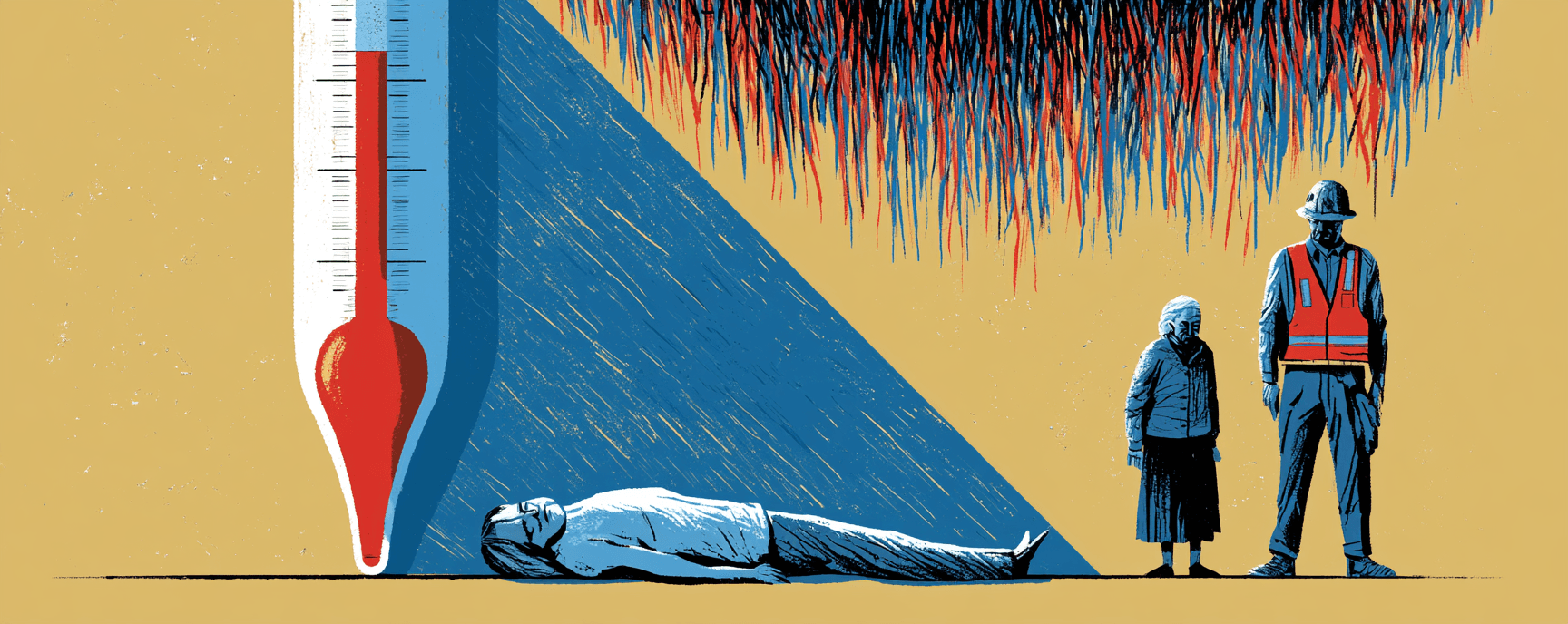
On July 19, 2023, the air temperature in Phoenix reached 119°F. The wet-bulb temperature, the metric combining heat and humidity that measures how effectively a human body can cool itself, peaked at 24.32°C. That is more than ten degrees Celsius below the number that virtually every heat-survivability model, climate risk projection, and adaptation planning document treats as the line between livable and lethal.
By the end of the summer, Maricopa County had recorded 645 heat-related deaths. A 52 percent increase over the prior year. A more than 700 percent increase from a decade earlier.
The number those deaths were supposed to be impossible below is 35°C wet-bulb. It has been the theoretical upper limit of human survivability since 2010, when it was published in a widely cited PNAS paper. It has since become load-bearing infrastructure in climate science, embedded in risk models, planning documents, and the implicit architecture of how institutions decide when heat becomes an emergency. A paper published in Nature Communications this March tested that number against six real heat events where people actually died. The finding: lethal conditions were crossed in every case, all below 35°C wet-bulb. The title the researchers chose is blunt: "Deadly heat stress conditions are already occurring."
The gap between the number and the bodies is already here.
The body that doesn't exist
In 2010, Steven Sherwood and Matthew Huber published "An adaptability limit to climate change due to heat stress" in PNAS. Their reasoning was thermodynamic: at a sustained wet-bulb temperature of 35°C, the temperature gradient between skin and air disappears. Sweat cannot evaporate. The body cannot shed metabolic heat. Core temperature rises until organs fail.
The physics is sound. But the person it describes is an abstraction.
As Jennifer Vanos, one of the researchers behind the physiological model that would later challenge the threshold, has explained: the 35°C limit assumes a person who is indoors or shaded, unclothed, completely sedentary, fully heat-acclimatized, and of "average size." These assumptions describe no construction worker in direct sun, no 72-year-old waiting for a bus, no one wearing clothes.
Sherwood and Huber knew this. Their paper flagged 35°C as an upper bound and acknowledged that a lower, "more realistic" number existed but was not estimated. That caveat was rarely carried forward into the downstream literature. Clean numbers propagate through citation networks in ways conditional ranges cannot. By the time 35°C reached adaptation planning, it was treated as measured fact. A theoretical ceiling became the floor on which every downstream system was built.
What the model measures
The model at the center of the Perkins-Kirkpatrick paper is called HEAT-Lim. Developed by Vanos, Ollie Jay, and colleagues and published in Nature Communications in November 2023, it was built to close the gap between atmospheric thermodynamics and human physiology. Their own language is direct: most studies projecting human survivability limits "use a 35°C wet-bulb temperature threshold without integrating variations in human physiology." HEAT-Lim was designed to integrate them.
Where the 35°C threshold models the atmosphere around a body, HEAT-Lim models what happens inside one. It accounts for metabolic heat production, sweating capacity, cardiovascular response. It differentiates by age and by sun exposure, the two variables that most dramatically shift where the lethal line falls. And it distinguishes between survivability and what the researchers call liveability: the maximum safe sustained activity level, which declines long before survival itself is threatened. Their finding on liveability carries its own weight. Reductions in safe activity for older adults are driven more strongly by aging than by warming. The body's declining capacity to shed heat outpaces the climate's increasing demand that it do so.
The survivability results redraw the map. For young adults, HEAT-Lim places limits at wet-bulb temperatures between roughly 25.8°C and 34.1°C, depending on humidity and sun exposure. For older adults, the range drops to approximately 21.9°C to 33.7°C. For older women in dry conditions, the limit falls as much as 13.1°C below the 35°C threshold. The researchers call this a "vast underestimation of risks by the 35°C Tw model in hot-dry conditions."
In humid environments, physiological limits and the thermodynamic 35°C limit converge somewhat. In dry heat, they diverge sharply. The difference between the two models, in dry conditions, is the difference between classifying an event as survivable and recognizing that people are dying in it.
The dry-heat finding matters most for Phoenix. A body in 47°C dry-bulb heat with low humidity faces a massive radiative and convective heat load that wet-bulb temperature alone does not capture. The 35°C model treats wet-bulb as the sole relevant variable. HEAT-Lim models the full thermal environment bearing down on the body.
Six events, one pattern
Sarah Perkins-Kirkpatrick and her co-authors applied HEAT-Lim to six historical heat events: Phoenix in July 2023, Bangkok in April 2024, Mecca during the June 2024 Hajj, Seville in August 2003, Larkana, Pakistan, in May and June 2015, and Mount Isa, Australia, in January 2019. Using ERA5 reanalysis data at six-hourly resolution, they generated time series showing when conditions crossed physiological survivability thresholds for four categories: older people in direct sun, younger people in direct sun, older people in shade, and younger people in shade.
The results: non-survivable conditions for older people in direct sun occurred during all six events. Older people in shade were briefly exposed during Phoenix 2023 and the Larkana 2015 event. Younger people in direct sun were exposed toward the end of the Larkana event. In Mecca 2024, Phoenix 2023, and Larkana 2015, local populations faced deadly conditions on most or all days. These three events were associated with the highest reported mortality.
None of the six events reached 35°C wet-bulb. The highest peak wet-bulb among them was Larkana at 30.85°C. Phoenix, at 24.32°C, was the lowest and still recorded 645 heat-related deaths.
The paper's limitations deserve attention. ERA5 reanalysis data has known biases in urban environments and may not capture the full intensity of urban heat islands, which means the model could understate conditions in the densest, hottest parts of a city. The direct-sun calculations use biophysical modeling of solar radiation load rather than direct measurement, introducing additional uncertainty. And the model produces physiological predictions that cannot be validated against individual deaths without detailed case data that rarely exists. These are real limitations. They all point in the same direction: the findings, if anything, are conservative.
Who was in the gap
The demographics of Phoenix's 645 deaths trace the contours of the physiological model closely.
Nearly two-thirds of all heat-related deaths occurred among people aged 50 or older, the most prevalent group being those between 50 and 64. About 75 percent occurred outdoors. The largest share of outdoor deaths were among people experiencing homelessness. About 6 percent happened at bus stops. African Americans and American Indians were overrepresented relative to their share of the county's population.
For the roughly one-quarter of deaths that occurred indoors, the pattern was stark: in 85 percent of cases, the air conditioner was not working. In the remaining cases, AC was absent or not in use. Every indoor heat death in 2023 occurred in an uncooled environment.
HEAT-Lim predicts that older people in direct sun face non-survivable conditions at far lower wet-bulb temperatures than younger people in shade. Phoenix's dead were disproportionately older, disproportionately outdoors, disproportionately unsheltered. The model describes a physiological gradient. The mortality data fills it with specific people in specific circumstances, waiting at specific bus stops in specific neighborhoods where shade structures do or do not exist.
Seventy-one percent of the deaths occurred on days when the National Weather Service had issued an excessive heat warning. The warnings were in effect for 42 days that summer, every single day from July 1 through July 29. Over the prior five years, an average of only 32 percent of heat deaths occurred on warned days. The 2023 summer was exceptional both in total deaths and in the fraction occurring during officially warned conditions. The warnings were accurate. They identified dangerous days. Whether you can act on a warning depends on whether you have somewhere cooler to go, whether you can stop working, whether your AC unit functions, whether you have a home at all. The people who died were, overwhelmingly, people for whom the warning described conditions they could not escape.
The range is the finding
Prior studies have reported critical wet-bulb thresholds ranging from 24.1°C to 34.6°C (note: range reported in a 2025 preprint, not yet peer-reviewed). That spread is evidence of something the 35°C threshold obscured: the lethal line depends on who is being exposed and how.
The foundational empirical work comes from the Penn State HEAT Project, led by W. Larry Kenney with researchers including Daniel Vecellio and S. Tony Wolf. Their 2022 study in the Journal of Applied Physiology was the first systematic empirical test of the 35°C threshold using human subjects in controlled chamber conditions. No subject reached 35°C before thermoregulation failed. In humid conditions, the mean critical wet-bulb temperature for young, healthy adults was 30.55°C ± 0.98°C. In drier conditions, it dropped further. Their conclusion was unequivocal:
"A wet-bulb temperature threshold cannot be applied to human adaptability across all climatic conditions and where appropriate (high humidity), that threshold is well below 35°C."
Their 2023 PNAS paper projected these empirically determined limits onto climate models and found that humanity is more vulnerable to moist heat stress than the 35°C threshold suggested. A 2025 PNAS study validated the experimental protocol itself, confirming that the step-test method used to find these limits reliably identifies the point above which thermoregulation becomes impossible.
What drives the variation across studies is agreement about direction, with every study finding limits well below 35°C. The variation reflects real differences in who is being studied and under what conditions. Humidity versus dry heat is the largest single driver: in humid environments, critical wet-bulb temperatures cluster in the low 30s; in dry environments, they fall into the mid-20s or lower. Age shifts the threshold substantially. So do activity level, acclimatization status, and whether a person is in shade or direct sun.
A preprint (not yet peer-reviewed) from 2025 tested survivability directly at wet-bulb temperatures between 32°C and 35°C using 108 healthy young adults. This is the closest thing to a direct empirical test of the Sherwood-Huber limit itself. But it studies healthy young adults at the upper end of the range. The Perkins-Kirkpatrick finding is about what happens at the lower end, to older bodies, in direct sun, in dry heat. The populations are different. The findings are complementary. They are measuring different positions on the same gradient.
No formal peer-reviewed response to the Perkins-Kirkpatrick paper has appeared as of this writing. The paper is recent, and formal commentaries take time.
What the systems assume
There is no federal workplace heat standard. OSHA's proposed rule, which would have covered approximately 36 million workers, was frozen under the current administration's regulatory review and has no finalization date. The proposed triggers were a heat index of 80°F and 90°F. Phoenix exceeds 80°F before most outdoor shifts begin. OSHA's national emphasis program on heat hazards expired in April 2026. Without a standard, workers are protected in theory by OSHA's general duty clause. In practice, OSHA has generally cited employers only after heat has killed or hospitalized workers.
The National Weather Service advisory system uses heat index, not wet-bulb temperature, with thresholds that vary regionally. Some of those thresholds were established over 20 years ago and were not based on heat-health associations.
The 35°C figure's deepest influence, though, has been in climate risk projections: the models that determine when regions will cross "habitability" thresholds, the assessments that inform infrastructure planning, the timelines that tell planners when buildings will require mechanical cooling to remain survivable. If 35°C wet-bulb was the danger line, and climate models showed it arriving late-century under high emissions, then the problem was serious but distant. The Perkins-Kirkpatrick finding collapses that distance. The conditions that kill people are already here, and they arrived at wet-bulb temperatures in the mid-20s.
What the number describes
Sherwood and Huber's physics holds. At 35°C wet-bulb, everyone dies. There is a legitimate argument that the threshold retains value as a planning tool: knowing when a region will cross even an extreme upper bound helps planners understand when conditions become categorically unprecedented.
Planning, though, has always turned on when people start dying. When cooling centers open, when building codes change, when someone installs shade at a bus stop. The answer, now empirically established across multiple research groups using different methods: at wet-bulb temperatures in the low-to-mid 20s for older people in direct sun. In the upper 20s for young, healthy adults in humid shade. The 35°C threshold describes a theoretical person, unclothed and acclimatized and resting in shade, whose physiology represents no one actually navigating a Phoenix summer.
The range of 24.1°C to 34.6°C across empirical studies is the finding itself. It says that the lethal threshold is a distribution, shaped by the variables that determine where any person falls on the gradient: age, health status, sun exposure, activity level, acclimatization, access to cooling, access to shade. A 35-year-old roofer and a 70-year-old woman whose AC unit broke occupy different positions on that distribution. So does a person who can go inside and a person who cannot. The 35°C threshold treats them as the same body. HEAT-Lim does not.
The Perkins-Kirkpatrick paper extends a converging line of research, from Penn State's empirical chamber studies to Vanos and Jay's physiological modeling, into the historical record of actual heat events where actual people died. What it adds is the demonstration that these lower, physiology-based thresholds have already been crossed, repeatedly, in events we can name and count. Phoenix 2023 is the sharpest case because the wet-bulb temperature was so far below 35°C that the theoretical threshold would have classified the entire event as survivable. The 645 people who died were inside the gap between what the number says and what their bodies experienced.
That gap is where every heat-related decision is currently being made. The number those decisions reference describes no one. The people inside the gap are already there, and the distance between the theoretical threshold and the physiological one tracks along the lines of who is oldest, who is most exposed, who has the least access to shade and cooling and the option to stop.
-
OSHA's stalled heat rule: The proposed federal workplace heat standard covering 36 million workers has no finalization date after the administration's regulatory freeze, and OSHA's national emphasis program on heat hazards expired in April 2026 with no replacement announced.
-
U.S. coastal sea-level acceleration: A Woods Hole Oceanographic Institution study found the average rate of U.S. coastal sea-level rise has more than doubled over the past 125 years, directly contradicting a July 2025 Department of Energy report that used five tide gauges to WHOI's seventy.
-
Wildfire smoke and cognition: An EPA-affiliated study found that wildfire PM2.5 exposure was associated with decreased attention in adults within hours of exposure, adding to growing evidence that smoke affects brain function, not just respiratory and cardiovascular health.
-
Dengue expanding northward: California reported its first locally acquired dengue cases in Los Angeles County in 2023, and a PNAS study estimates that 18 percent of current dengue incidence in studied countries is attributable to historical climate change, with the U.S. among the fastest-expanding risk zones globally.