
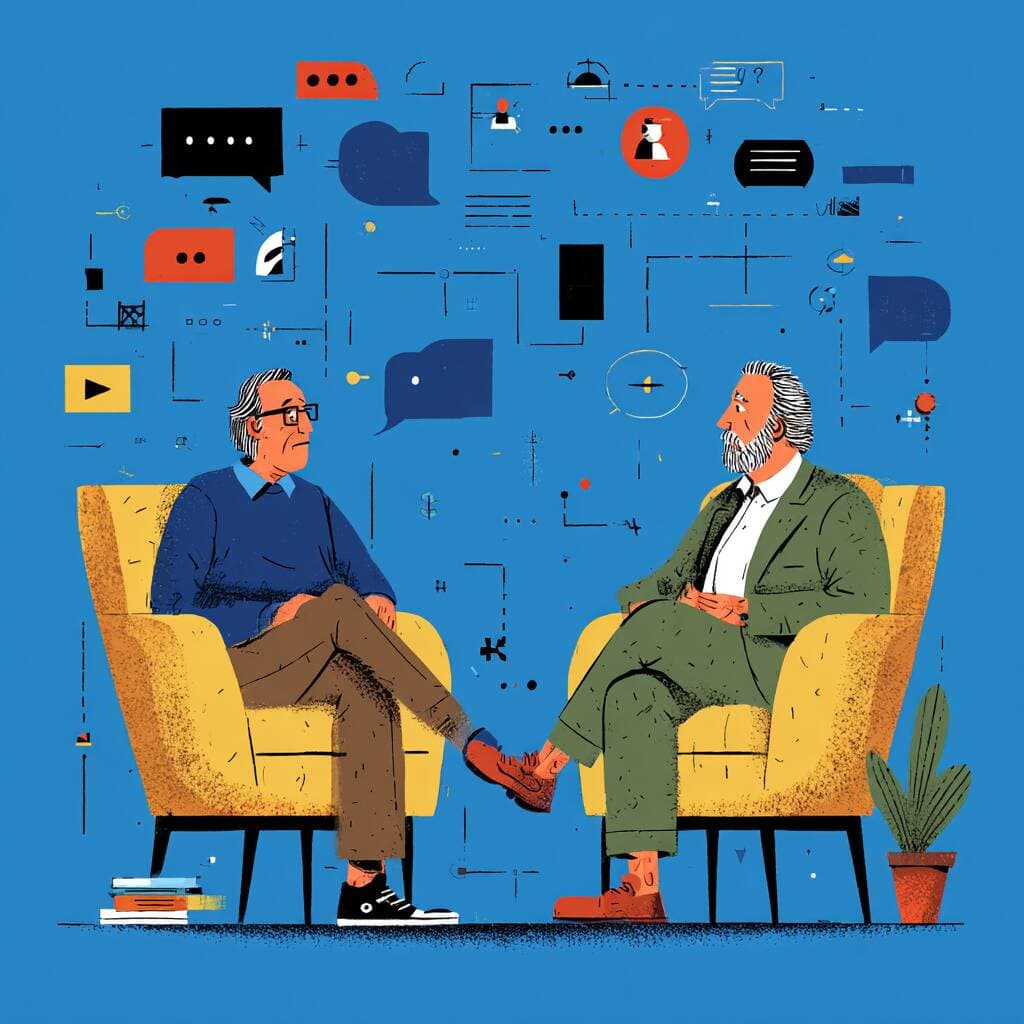
Future Tense is speculative fiction. The characters, interviews, and events depicted are imagined futures, not reported journalism. Tomás "Topo" Cerrada does not exist — though the job he describes does, and the trends shaping it are real.
We spoke with Cerrada in early August 2032, three days after he returned from a 14-day deployment to a complex fire in the southern Cascades. The interview was conducted over video; he was at his kitchen table in Flagstaff, still on deployment sleep schedule, meaning he'd been awake since 3:45 AM. A Kestrel weather meter sat next to his coffee mug like a second phone. He did not appear to notice it was there.
Cerrada has been a National Weather Service Incident Meteorologist, an IMET, for fifteen years. Before that, he worked agricultural weather for ranchers in the Gila country where he grew up. His crew nickname, "Topo" (Spanish for "mole"), was given to him by a hotshot superintendent on his third deployment, after she noticed he only seemed fully awake after dark. He has not tried to shake it.
You've been home for seventy-two hours. Are you sleeping?
Tomás: Define sleeping. I'm horizontal. My eyes are closed. But my body still thinks it's supposed to be reading a RAWS pull at 2 AM, so I'm in bed and I'm also checking humidity recovery for a fire that's two hundred miles away. My wife says I talk in my sleep about dew point. I don't think she's joking.
For people who've never heard the term, what is humidity recovery and why does it matter at night?
Tomás: Fire needs dry fuel. During the day, the sun bakes everything out, relative humidity drops, fuels get drier, fire runs. At night, historically, the air cools, humidity rises, moisture gets back into the vegetation and the duff layer, and the fire slows down. That recovery period is when crews can actually get work done on containment lines, because the fire's taking a breath. The NWS has a formal rating for it: poor, moderate, good.1 In moderate conditions you'd expect nighttime RH to climb back up to fifty, sixty, seventy percent.2
That's the version I learned. That's the version I taught new IMETs for years. And it's not wrong, exactly. It's just that the nights where it actually plays out that way are fewer than they used to be. I started keeping a personal log in 2025. Deployment nights where recovery hit "moderate" or better versus nights where it stayed poor. The ratio has flipped. Not everywhere, not every fire, but enough that I stopped assuming recovery would happen and started treating it as something I had to watch for.
Was there a particular night that changed how you thought about this?
Tomás: There wasn't a single night. That's what makes it hard to talk about. It's cumulative. You do enough overnights — I've done over four hundred deployment nights at this point — and you develop this internal sense of what the air should feel like at midnight versus 3 AM. The temperature drop, the way the smoke settles heavier when the air stabilizes. And at some point I realized I was surprised when the humidity did recover. That the surprise had moved. It used to be surprising when recovery was poor. Now it's surprising when it's good.
I don't know when the crossover happened. That's the honest answer. It was like noticing you've been driving with the radio off for twenty miles.
Walk me through an overnight watch. What does a bad night actually look like from where you're sitting?
Tomás: You're in fire camp. Tents, generators, portable showers, couple hundred people. It's 10 PM. I've already given the evening briefing to command staff, told them what I think the weather's going to do overnight.3 Now I'm watching whether I was right.
I've got my laptop open to the RAWS data, the remote automated weather stations we set up near the fire.4 They're pulling temperature, humidity, wind speed and direction every hour. I've got my Kestrel on the table reading conditions at camp, but camp conditions aren't fire-edge conditions. There's usually a terrain gap, an elevation difference, sometimes a canyon between me and where the fire actually is. So I'm interpolating. Reading what I can measure and inferring what I can't.
Radio traffic from the crews on the line. Helicopter operations are done for the night, usually, so it's quieter. But you can hear the fire. On a bad night you can hear it a lot.
And you're watching the RH number on the RAWS and you're doing this thing in your head: is it moving? Is the slope of the recovery what I'd expect at this hour? Because by midnight, if it hasn't started climbing meaningfully, it's probably not going to. And that means the 4 AM check, when I get up to prep the morning briefing5, is going to confirm what I already knew at midnight. I'm going to have to tell command that the overnight didn't give us what we planned for.
What does that briefing sound like?
Tomás: Short. Factual. "Recovery was poor. Fuels are drier than anticipated at this hour. Recommend adjusting the operational window." You don't editorialize. You give them the number and what it means for the next twelve hours. They make the call.
But here's what's changed. Ten years ago, when I said "poor recovery," it was an exception. People's faces changed. Now I say it and people nod.
"Poor" used to mean something went wrong. Now it means Tuesday.
A study published earlier this year found that potential burning hours across North America increased roughly 36 percent over fifty years, and that more than one in eight active fire days now peak in intensity at night.6 Does that match what you see?
Tomás: Yeah. It does. And what that study captured that most people missed is that the entire planning architecture of wildfire suppression assumes a diurnal pattern. The shifts, the briefing schedule, the containment strategy, the crew rest cycles. All of it was designed for a fire that sleeps. When that window shrinks or disappears, every piece of the system starts grinding against a reality it wasn't built for. You're not just fighting a fire that burns longer. You're fighting it inside a machine that still expects the old rhythm.
Does the fire sleep anymore?
Tomás: Sometimes. Less.
Your grandfather was a rancher in the Gila. You've talked about learning weather from him. Is there anything from that education that's still useful?
Tomás: He could read soil moisture by feel. Grab a handful of dirt, squeeze it, know something. I do a version of that with air. Not literally. I have instruments, I'm not guessing. But there's a thing that happens after enough nights where you step outside the tent at 1 AM and you know before you check the Kestrel. The air tells you. It's either giving moisture back or it's holding onto it. My grandfather would have understood that. He wouldn't have had the vocabulary, but he would have understood the listening part.
What he wouldn't understand is how many nights in a row the air holds on now. He had dry years. Everybody in the Gila had dry years. But the nights still cooled. The nights still gave something back.
That's the part I can't explain to him. Not because he's gone, though he is, but because the premise doesn't make sense to someone who lived in the old pattern. You'd have to explain that the night changed. And that's a strange thing to have to say.
What do you dread most on an overnight watch?
Tomás: A wind shift at 2 AM that the model didn't see coming. Because the containment line that day shift built was built for the wind going one direction. If it shifts, that line might be on the wrong side. And I'm the one who's awake to see it happen, and I've got maybe twenty minutes to get the right people on the radio before it matters.
Fires can make their own weather. Pyroconvection, fire whirls, dry lightning from the column.7 Those are dramatic. People write about those. But what actually keeps me up — keeps me up when I'm home, I mean — is the quiet version. The night where nothing dramatic happens. The humidity just doesn't come back. And by morning, everything is a little drier than anyone planned for, and the day starts behind. Nobody writes about that. There's no footage. Just a number on a screen that didn't climb the way it was supposed to.
After fifteen years of this, what do you know that you didn't know when you started?
Tomás: That the night is not a break. It's a forecast. And the forecast is getting harder to make.
Tomás "Topo" Cerrada is a fictional character. The IMET program, the operational details of fire weather forecasting, and the climate trends described in this interview are real.
Footnotes
-
NOAA, "Forecast Guidelines for Fire Weather," NOAA Repository. https://repository.library.noaa.gov/view/noaa/14463 ↩
-
Nighttime relative humidity recovery thresholds in moderate burning conditions. See also NWS fire weather criteria, Grand Junction WFO. https://www.weather.gov/gjt/firewxcriteria ↩
-
NOAA 200th Anniversary, "Dispatches — A Day in the Life" of an IMET. https://celebrating200years.noaa.gov/magazine/imet/side.html ↩
-
NOAA multimedia feature on IMET Robert Rickey and incident remote automated weather stations (IRAWS). https://www.noaa.gov/multimedia/photos-images/multimedia-story-forecasters-chart-weather-battlefield-for-fire-crews ↩
-
Fox Weather, "What Is an Incident Meteorologist?" — 4–5 AM wake time for overnight weather check. https://www.foxweather.com/learn/meet-the-meteorologists-who-head-toward-the-heart-of-the-fire ↩
-
Luo et al. (2026), Science Advances. Analysis of 8,993 North American fires (2017–2023) using hourly GOES-R satellite detections; reconstructed potential burning hours 1975–2024. Reported via Weather.com and Phys.org. https://phys.org/news/2026-04-wildfires-night-climate-prime-hours.html ↩
-
NWS, "Incident Meteorologists," March 2022 — fire-generated weather phenomena. https://www.weather.gov/news/221603-IMETs ↩