
Tam set the last thermal logger at 2214, wedging it between two basalt cobbles where the spring channel met the Grande Ronde. The junction read 11.2°C. Thirty meters downstream, where the cold plume lost coherence against the mainstem, the water was 18.4. Seven-degree differential. By 0400 it would be less than half that, and by 0400 the compact's monitoring window would still be six hours from opening.
He wiped his hands on his pants and checked the acoustic counter zip-tied to a willow root two days earlier. Battery at sixty-one percent. The unit pinged every four seconds, logging returns off anything with a swim bladder inside the cold plume's footprint. Twenty-three adults holding in the refuge as of his 1600 visual count. Chinook, mostly. Three steelhead had been parked in the same thermal slot for eleven days, which was long enough that he'd started thinking of them as residents rather than migrants. Category error. He'd correct it before he wrote anything down.
The compact's monitoring protocol pulled data between 0800 and 1800. Ten hours of river, packaged as the whole river. The other fourteen hours belonged to nobody. Which meant they belonged to whatever actually lived in the water.
The spring junction at 11.2 was thirteen degrees colder than today's mainstem peak. By the compact's math, this refuge was so robust it barely warranted a second look. But the compact's math ran on daytime numbers collected during daytime hours by sensors reporting on a daytime schedule to analysts who went home at five. What the refuge did between 2200 and 0600 was, administratively, nothing. A hole in the record shaped like the entire night.
Tam was here to fill the hole. He was not yet sure filling it was the right thing to do.
He settled onto the bank above the sensor array, tablet propped against his pack, screen dimmed to minimum. Below and to the south, maybe fifty meters down the draw, Fern's headlamp moved through the sorghum in slow arcs. East beds first. Bean terrace. Then the herbs along the spring channel where the water came out of the hillside at 9°C year-round, because the aquifer feeding this spring was deep enough and slow enough that it still carried a memory the surface had abandoned. He'd learned her sequence without trying. Three nights of data collection and he could set his watch by her irrigation pattern, which said something about her discipline or his attention or both.
Twelve kilometers southeast, on a ridge above the old Hilgard junction, the compact's nearest relay station ran its monitoring dashboard for an audience of nobody. Solar-charged battery pack. Screen cycling through its displays in the dark: air temperature, humidity, wind speed, river stage from a pressure transducer bolted to a bridge pier three klicks downstream. The thermal-refuge sensor suite had logged its last reading at 1753. Status: SLEEP. Next scheduled reading: 0800.
The battery bank held eighteen hours of charge. The maintenance budget assumed twelve. The monitoring protocol had been written to match the budget, not the battery, which meant it matched the budget, not the river. Seven hours between 1800 and 0100 when the sensors could have run but didn't. Nobody had requested that gap. Nobody had needed to. The protocol's authors built it during business hours, reviewed it during business hours, tested it during business hours. The river they designed it to watch was a business-hours river.
Screen cycling. Air temp: 21.3°C, falling. Wind: 2.1 kph, southwest. River stage: 0.41 meters. The thermal-refuge field read NO DATA, which was accurate the way a locked door is accurate about what's behind it.
Fern opened the valve on the east drip line and counted to three before the hiss came. Pressure. The spring was running strong, which meant the aquifer was still giving more than it took, which meant she could water the sorghum at boot stage without guilt. Or at least without the specific guilt of drawing down something she couldn't replace. She had other guilts. They had their own schedule.
Boot stage was when sorghum drank hardest. A hot afternoon with wind could pull a third of an inch per acre out of the soil before the plants touched any of it. At 2230, air at 19°C and dropping, she'd lose almost nothing to evaporation. The night was the best tool she had. It cost nothing. Nobody had figured out how to take it from her yet.
The drip lines were her best work. Scavenged poly tubing from a collapsed greenhouse operation near Elgin. Pressure-compensating emitters she'd traded a full season of dried amaranth for, which had felt like getting robbed until the first summer when she ran the water-saved numbers and realized the emitters would pay for themselves in three months of not losing crops. Gravity header tank Tam had helped her mount on the rock shelf above the spring. No pump. No power draw. No battery to charge, no uplink to barter for, no dependency on anything that could be switched off by someone in a building she'd never entered. The spring did the work. The night did the rest.
She moved down the terrace to the beans. Sonoran teparies. Not the snap beans from the old seed catalogs she sometimes found in church caches, the ones with pictures of green pods so fat and wet they looked like they'd been invented by someone who'd never been thirsty. Teparies didn't need much. But they were flowering, and flowering beans that caught overhead water at night stayed wet until morning and grew mold that could take a whole row in three days. She'd lost a terrace that way her first year. Watering the canopy at midnight like she'd learned nothing from anyone, waking up to white fuzz on every leaf by the third morning. Now she hand-watered the root zone with a can. Bent to pour at the base of each plant. Pressed two fingers into the soil to check yesterday's depth. Two knuckles. Enough. She skipped every third plant and moved on.
The prickly pear along the south-facing slope she didn't even look at. Three years since she'd planted the pads and they'd rooted and spread without intervention, storing water in tissue that treated the afternoon heat like a suggestion it could take or leave. She harvested the fruit in October and the young pads in spring and the rest of the year the cactus just sat there being alive, which was more than most things managed on ground the compact's risk models had priced at zero.
She straightened and killed her headlamp. Stood in the dark and let her eyes adjust.
The valley below was a sound more than a shape. The river. Above it the Blue Mountains were a darker dark against a sky so thick with stars it looked structural, like someone had taken a chisel to black basalt and the light was coming through the fractures. No moon. She could hear Tam's equipment, a faint electronic chirp every few seconds from the fish counter, carried down the draw by the same channel that carried the spring water to the river. He'd been up there since dusk. She'd brought him food at sunset: amaranth cakes with ground prickly pear seed worked into the flour, and the last of the dried venison Reyes had dropped two weeks ago on one of her circuits through the high Blues. He'd eaten without looking up from his screen. Which meant the data was doing something he hadn't expected. Which meant something was happening in the river that the daytime numbers hadn't predicted.
She didn't ask what. Tam's silences were load-bearing. When he had something to say, he said it with the compression of someone who'd spent decades writing reports nobody read and had decided that if he was going to open his mouth at all, every word was going to carry freight. When he was quiet, the quiet meant he was still calculating what the information would cost once it left his hands.
She turned her headlamp back on and went to the herb beds. The wild bergamot was blooming. She could smell it before she reached the terrace, sharp green sweetness cutting through wet soil and the fainter mineral edge of the river below. She pinched off three flower heads for drying and put them in her belt pouch. Sparrow's people always wanted bergamot. Sparrow's people always wanted everything, because the church circuit ran on barter and barter ran on wanting, and Sparrow had told her once that the entire post-collapse economy was just a more honest version of the old one: people trading what they could make for what they couldn't, except now nobody pretended the prices were set by anything other than need and proximity to desperation.
Three heads wouldn't be enough. She'd cut again in a week if the heat didn't cook the flowers first. Last July the bergamot had bolted and gone bitter in four days of 42°C afternoons. This July was tracking cooler. "Cooler" meant 38. Thirty-eight was the kind of number that would have shut down schools in the world her mother described. The one with schools.
June had the convoy through the Ladd Canyon switchbacks by 2300, forty minutes ahead of schedule. Three trucks. Lights off. The lead vehicle was hers: retrofitted diesel flatbed, exhaust baffled to cut noise, bed reinforced with angle iron she'd welded herself in Boone's shop at Pendleton. She'd worked from a diagram she drew on the back of a compact patrol schedule one of Boone's people had pulled from a dead camera's memory card. She drove by memory and starlight, reading the grade through the steering column the way she'd once read irrigation grades through a transit level, back when she'd been a different person with a different name working for a farm outside Kennewick that was now under four inches of dust where the water table used to be.
The cameras on this stretch were compact-maintained. Seven units between Exit 270 and the canyon floor. She knew which five still worked because the compact replaced their batteries on a quarterly schedule and the schedule had slipped to semi-annual eighteen months ago. Two units died in the gap. She'd walked the route in daylight, twice, counting housings and checking for the green status LED that meant someone in an office somewhere still cared about this particular set of eyes. The dead cameras were at the second and fifth switchbacks. She took the convoy through those curves at normal speed and crawled past the live ones with the trucks tucked against the cut bank, below the camera's angle of view.
The cargo was pump components. Impellers, housings, shaft assemblies, mechanical seals. Industrial equipment from a warehouse in Hermiston that Boone had been drawing down for six months, moving it south in small loads, caching it along the Grande Ronde and Wallowa corridors. Not enough to rebuild a dam's powerhouse. Enough to make it clear that Boone could, if the politics broke right, put generation capacity back online at any of three derelict sites within ninety days. The threat of capability was worth more than the capability itself. Boone understood this about power the way June understood grades: you didn't need to build the thing. You needed the other side to believe you could.
June didn't think about whether the dams should be repaired. That calculation belonged to Boone, and Boone's calculations had kept her fed and purposeful for nine years, which was longer than anyone else's math had managed since the farm went to dust and the man she'd followed to Kennewick went to whatever came after dust. She thought about the road. The grade. The sight lines. The weight distribution on the flatbed. The fact that the second truck's driver, a kid named Cortez who'd come up from the church circuit three months ago and still drove like someone who'd learned on flat ground, kept drifting wide on the curves.
She keyed her radio twice. The second truck tightened its line.
She'd been teaching Cortez the way Boone had taught her: repetition, correction, no explanation. Brake here. Shift here. Watch the shoulder, not the center line. Boone's method was to make the body learn the road before the mind tried to understand it. It worked. She'd never questioned it until she heard herself on the radio using Boone's cadence, Boone's clipped phrasing, the same flattened tone that turned instruction into something you obeyed before you processed it. She'd absorbed it the way she absorbed everything from Boone: by proximity, by repetition, by the slow replacement of her own instincts with his until the seam stopped showing. Cortez was tightening his line because she'd keyed the radio twice, the same signal Boone used. The kid had learned in three months what it took her a year. Which meant she was a better teacher than Boone or a worse one, depending on what you thought teaching was for.
The canyon opened onto the valley floor. The Grande Ronde valley spreading south in starlight, the river a dark braid somewhere below the bluffs. They'd cross at the old Perry bridge, climb into the Wallowa foothills, reach the cache site by 0430. Two hours of margin before the compact's morning patrol started its circuit at 0700. Comfortable. If Cortez stopped riding his brakes on the grades.
She scanned the hillsides.
A light. Small, brief. On the hillside to the southwest, maybe a kilometer out, in one of the draws above the river. It flashed once and went dark.
June noted the bearing. Two-two-zero from the canyon mouth. Filed it. Kept driving.
Could be anyone. Trapper, church rider, someone from one of the small camps that clung to the spring-fed draws above the valley floor. The draws were beneath notice. Too small to hold anything worth controlling, too steep to farm at scale, too far from the road to matter tactically. Boone's maps didn't bother with them. That was the draws' primary defense, though the people living in them probably didn't think of it that way. They probably thought they were just living somewhere nobody wanted. Same thing.
She checked her mirror. Cortez was holding. Third truck fifty meters back. She crossed the Grande Ronde at the old Perry bridge at 0248, crawling down the gravel ramp her people had graded last month and climbing the matching ramp on the south side. The river was low. She could smell it through the open window: algae, warm stone, something metallic underneath she'd never been able to name. The smell of a river in late summer pretending it had enough water to be a river.
Cortez ground his gears on the south ramp.
"Second gear," she said into the radio. "Don't ride the clutch. It's not yours to replace."
"Copy."
She waited until all three trucks were across and climbing the bench road before she let her shoulders drop. The bridge was the exposure point. Thirty seconds of open ground, visible from the bluffs on either side. If anyone had been watching from those draws above the river, they'd have seen three trucks crossing in the dark. They'd have had thirty seconds to wonder what was worth moving at three in the morning with the lights off.
The pump components were not, technically, contraband. The compact didn't regulate industrial equipment. But the compact regulated activity at the derelict dam sites, designated as environmental remediation zones under the treaty. Any work required a permit from the treaty council. Which meant Della's signature. Which meant Della's politics. Which meant the equipment would sit in Hermiston until the river dried to salt if Boone waited for authorization.
Boone didn't wait. He cached. He positioned. He let the equipment accumulate close enough to the dam sites that moving it was a day's work, and he waited for the politics to shift. If the politics didn't shift, he'd move anyway and let the compact figure out how to stop three trucks' worth of fait accompli with a document.
June understood this the way she understood grades and sight lines. You worked with what the terrain gave you. The terrain right now gave Boone the night, the dead cameras, and a valley full of people who needed power more than they needed permits. She didn't need to agree with it. She needed to get the trucks to the cache site and back before dawn turned the road into evidence.
The convoy climbed into the foothills. Coyotes called from somewhere east, two rising notes and a scatter of yips that pulled something loose in her chest before she could stop it. A porch. A screen door with a spring that sang when it closed. A voice, not the words but the register, the specific frequency of someone calling you in from outside when the light was going. She could feel the wood grain of the railing under her palms, the way the paint had cracked in a pattern she used to trace with her thumbnail. Evening air that had been cool in a way evenings hadn't been cool in a long time.
She put her hands at ten and two and watched the road.
Cortez was holding. Third truck keeping interval. The basalt outcrops closed in on both sides and the road narrowed to a single lane of broken asphalt and she put her attention where it belonged. The next curve. The grade. The weight.
At 0047, the mainstem temperature at Tam's downstream sensor dropped below 16°C. The spring junction held at 10.8. Differential: 5.2, down from 7.2 at dusk.
He watched the acoustic counter's return signatures shift. Two of the larger Chinook moved out of the cold plume, downstream, into mainstem water that was now 15.9 and falling. They'd been packed into the thermal slot all day, metabolic rate suppressed by the cold, holding position in a space the size of a living room because everywhere else would cook them. Now the river was cooling and they were leaving.
He tabbed to the temperature log. The pattern was clean enough to teach from. Refuge temperature: nearly constant, varying less than a degree over twenty-four hours, because groundwater didn't care what the air did. Mainstem temperature: a sine wave, peaking at 24.3 around 1500, bottoming out near 14.5 between 0400 and 0500.
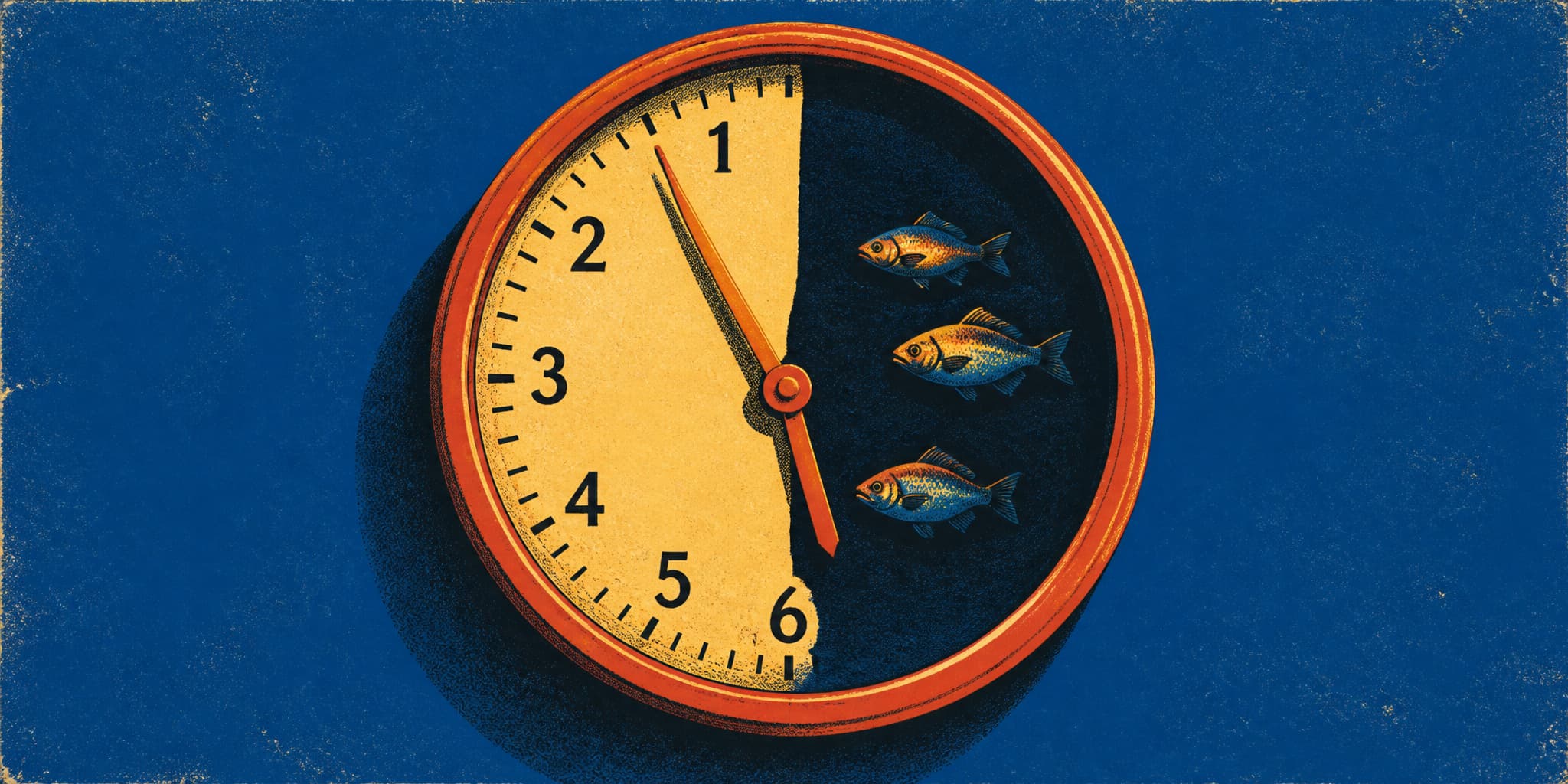
At 14.5, the mainstem would still be warmer than the refuge. But the fish weren't reading definitions. They were reading the water. And the water was telling them that for six or seven hours, the river outside the refuge was survivable. The refuge wasn't a place. It was a time. The time was the part of the day that didn't exist in any monitoring system because the monitoring system kept business hours, like a dentist.
He pulled up the spatial data. The twenty-three adults from his 1600 count were redistributing. Fourteen still in the cold plume. Six downstream in the cooling mainstem. Three gone entirely, past the counter's range.
The daytime count said twenty-three fish in the refuge. The nighttime count said fourteen. Both numbers were true. The compact would use the daytime number because that was the number the protocol produced. The nighttime number lived on Tam's tablet and nowhere else in any system maintained by any institution with the authority to do anything about it.
Della wanted the lower Snake dams opened. Her argument ran on numbers like these: the fish need cold-water refuges, the dams block access to upstream spawning habitat where cold water is more abundant, twenty-three adults crammed into a tiny cold plume because the mainstem is lethal. Open the dams. Let them reach the cold water upstream.
The nighttime data complicated that. The fish weren't crammed into the refuge around the clock. They used it during the day and dispersed at night. The river's own overnight cooling was doing work that the compact's monitoring couldn't see, work nobody had measured because nobody had been here at two in the morning with a fish counter and a thermal array and the specific kind of stubbornness that came from spending your twenties writing reports that got filed in drawers that got locked in offices that got abandoned.
And if the dams were repaired, as Alahmoot wanted, the reservoirs behind them would alter the mainstem's thermal regime. Reservoirs stratified. They released water from depth. The overnight cooling pattern that let the fish disperse for six hours might compress or disappear entirely. The invisible infrastructure that nobody monitored and nobody owned and nobody had ever named in any proceeding would be altered by a decision made in a room where it had never been mentioned. You can't mention what you've never measured.
He ate one of Fern's amaranth cakes. Dense, slightly sweet, with a mineral grit from the prickly pear seed she'd started adding this season. It tasted like the ground it grew from, which was either a compliment or not depending on how you felt about dirt. He chewed slowly because there were four left and they needed to last until the church relay at Granite, a day's hike if the heat cooperated and two if it decided to be the heat.
At 0358, he heard the engines.
He was packing the upstream sensors, pulling them from the spring channel and wrapping them in neoprene sleeves. The sound came from the south, below and across the river. Low diesel rumble, carried through the canyon by still air and cool-air drainage the way sound always carried when there was nothing competing with it. He stopped moving.
Three vehicles. Climbing south. The sound faded as they gained elevation and the terrain folded around them. Diesel. Multiple. On the bench road south of Perry, which went exactly two places: the Wallowa foothills and the old dam sites on the upper Grande Ronde.
Boone.
He looked at his tablet. Last data frame: mainstem 14.8°C, spring junction 10.7°C, differential 4.1°C, fourteen fish holding, nine dispersed, three unaccounted. Timestamped 0355. GPS coordinates embedded in every data point because the sensors tagged automatically and he'd never turned it off because until this moment there had been no reason to.
His uplink window was open. Six hours of bandwidth bartered from a church relay node at Granite, paid for with a water-quality assessment of their cistern system that had taken him half a day and saved them from drinking cadmium. The window ran until 0500. Enough time to push the full dataset to Della's encrypted relay in Toppenish.
The full dataset. Thermal profiles, fish counts, acoustic returns, spatial distribution across twelve hours. Every data point tagged with the GPS coordinates of a spring-fed draw on the upper Grande Ronde where a woman grew sorghum and beans and bergamot on ground the compact's risk models had priced at zero and walked away from.
Della would read the nighttime data and understand immediately. The river's diel cooling cycle was doing unmeasured work. The dams would alter that cycle. The fish that dispersed into the mainstem every night would lose six hours of habitable water that no one had ever documented because no one had ever been here to document it. Strong argument. The kind with numbers attached. The kind that moved treaty councils.
But the argument required a location. You couldn't argue that nighttime cooling mattered without showing where you'd measured it. And showing where you'd measured it meant entering this draw into the treaty database. Refuge designation. Monitoring protocols. Quarterly visits from compact technicians with their own sensors and GPS tags and reports feeding databases accessible to anyone with treaty-council clearance. Margo's people at Bonneville. The sovereign's apparatus. The financial models that decided what ground was worth reclaiming and what ground was worth buying.
A tide pool survives because it's priced at zero. You chart it and the price changes.
And now Boone's trucks were caching pump components somewhere in these foothills. This valley was about to become contested ground for reasons that had nothing to do with Tam's fish survey. The compact might increase its presence here regardless. Fern's draw might lose its invisibility whether Tam sent coordinates or not.
He opened the file manager. Six thermal loggers, one acoustic counter, one ambient air station. Each file carried embedded metadata: coordinates, elevation, sensor serial number, calibration date. He could strip the metadata manually. Ten minutes. The thermal curves and fish counts would survive without positions. The data would say what the river did at night without saying where the river was.
Della would ask. She'd want the location. She'd want to send her own people to verify, build a monitoring record, enter the refuge into the treaty database where it would become evidence. She'd be right to want that. The argument was stronger with a location. Nearly useless without one.
He started stripping files. Thermal loggers first: open properties, delete GPS fields, save. The acoustic counter was harder. Spatial data was woven into the return calculations. He couldn't strip coordinates without degrading the fish-count accuracy. Thirty seconds of staring at the screen. Then he exported the summary table with counts and timestamps but no positions, and deleted the raw acoustic file.
The ambient air station he left intact. Its coordinates pointed at a bare ridgeline two hundred meters above the draw. Rock and sky. Let them look.
He composed the transmission. Text only, compressed.
"Nighttime thermal survey, upper Grande Ronde tributary. Location withheld pending field review. Mainstem diel range 14.5–24.3°C. Refuge source constant 10.7–11.2°C. Differential compresses from 7.2 to 4.1 overnight. Adult Chinook disperse from refuge into mainstem after 0100 when mainstem drops below 16°C. Daytime protocol overstates exclusive refuge dependency. The river's overnight cooling cycle provides 6–7 hours of habitable mainstem. Reservoir thermal regimes from repaired dams would alter or eliminate this cycle. Recommend nighttime monitoring protocol for all designated refuges before dam decision. Full data attached, coordinates stripped. I'll explain when I'm in range."
He read it twice. The part about the dams was as close to advocacy as he'd ever put in a data transmission. But Della wasn't an institution. Della was a seventy-year-old woman trying to keep a river open, and the data said what it said, and if he didn't send it the dam decision would be made on daytime numbers alone and the nighttime river would stay invisible and the invisible thing would be the thing that got destroyed. Nobody measured it, so nobody fought for it, and then twenty years later someone would write a report about what had been lost and the report would get filed in a drawer.
He sent it. The upload bar crawled. Twelve seconds. A single green confirmation character, there and gone.
He saved the full dataset, coordinates intact, to his local drive. Opened the encryption utility. It asked for a key.
His fingers found the string without thinking. Thirty years of carrying it had moved the sequence out of his conscious mind and into his hands, the way a guitarist's hands know a riff the guitarist can no longer whistle. Corin had written it on a slip of recycled paper in the shelter at Sumpter, her handwriting already going unsteady, and told him it opened her testament in the church's geocache network. Search when ready. He'd memorized it that night and burned the paper and had never typed it into anything.
He typed it now. Twenty-three characters. His hands knew where each one lived on the keyboard without looking. The encryption utility accepted the string and the progress bar moved and the file locked. Corin's key was supposed to open something she'd left for him. He was using it to lock something she'd never seen. A dead woman's cipher protecting fish data in a draw she'd never visited, keeping coordinates out of a system she'd spent her life trying to build.
The drive light blinked twice. Done.
He powered down. Pulled the last sensor from the spring channel. The water closed over the gap without a seam.
He packed the sensor wet, cinched his bag, and walked downhill.
Fern was sitting on the rock wall at the edge of the bean terrace, headlamp off, drinking from the spring pipe. She heard him coming. She always heard him coming because he walked like someone who'd spent his life on loose rock, placing his feet with a deliberateness that was quieter than most people's walking but more rhythmic, and rhythm carried.
"Differential's compressing," he said. He sat on the wall next to her. Close enough that she could feel the heat off his arm in the cool air.
"The fish?"
"Some of them left the refuge. Moved downstream. The river's cool enough right now to swim in."
She handed him the spring pipe. He drank. The water was cold enough to ache.
"How many stayed?"
"Fourteen. Out of twenty-three."
"So the refuge works."
"During the day. At night the river works."
She was quiet. An owl called from the timber above the draw, two notes that sounded like a question nobody was expected to answer. Something small moved in the bean terrace below them.
"I heard trucks," Tam said.
Fern took the pipe back. Drank. Didn't look at him.
"When?"
"About twenty minutes ago. Diesel. Three of them. South side of the river, heading up the bench road."
"Boone's."
Not a question. There was no one else running diesel convoys through the Wallowa foothills at four in the morning. Tam waited. Below them the drip lines ticked their measured doses into the soil. The spring exhaled its constant 9°C into the draw.
"How far is the cache site?" Fern said.
"I don't know where the cache site is."
"But you know there is one."
He didn't answer. Which was an answer.
Fern set the pipe down on the wall between them. She looked out over the draw. Her garden. The dark shapes of the sorghum and the bean terrace and the prickly pear on the south slope and the herb beds where the bergamot was blooming. Three years of work. Three years of learning what this ground would give and what it wouldn't, of trading and scavenging and hand-watering at midnight, of being invisible on purpose because invisible was the only safe thing to be on ground the compact had written off.
"You sent the fish data," she said.
"Without coordinates."
"But Della will want coordinates."
"Yes."
"And Boone's people are caching equipment in the hills above us."
"Yes."
She looked at the garden. She could smell the bergamot from here, and the wet soil around the sorghum, and the faint mineral edge of the spring. The sorghum would head out in ten days. The teparies would set pods in two weeks if the heat held and the mold didn't come. The prickly pear would fruit in October. She had planned each of those timelines the way Tam planned a data collection: working backward from the constraint, fitting the sequence to the window, building the whole operation around what the ground and the season would allow. Three years of that. Three years of being too small to see.
"So either way," she said.
She sat with it for one breath. Then she stood up. Picked up her harvesting knife from the bench where she'd left it. Walked to the bergamot bed and bent over the plants, cutting flower heads in the dark with the practiced motion of someone who knew exactly where the stems were because she'd planted every one of them and could find them by smell alone.
"How many heads does Sparrow usually want?" she said.
Tam watched her work. The bergamot smelled like something that shouldn't exist here anymore.
"More than you've got."
"Then I'd better cut while they're still mine to cut."
She kept cutting. The knife moved through the stems with small, precise sounds. Tam stood and shouldered his pack. He walked to the spring channel where his last sensor had been. The water ran over the cobbles in the dark, carrying 9°C groundwater toward a river that was, for another hour, cool enough for a fish to swim in.
He knelt and put his hand in the current. Held it there. The cold was immediate and total and it came from deep enough that nothing happening up here had touched it yet. Give it time.
He pulled his hand out. Dried it on his pants.
The sky to the east was not lighter but less dark, the stars near the horizon starting to dissolve into something that wasn't yet dawn but was done being night. In an hour the sun would clear the ridgeline and the valley floor would start its climb toward 38 and the mainstem would warm past 20 and the fish would retreat into the cold plume and the compact's sensors would wake up and count them and record the number and enter it into a system that called ten hours of data the whole truth.
Tam started up the trail toward the ridgeline, toward Granite, toward the relay and whatever Della would say when she opened a dataset with no coordinates and a recommendation she hadn't asked for. Behind him, the knife kept working. Below him, the spring kept running.
-
Cold-water refuges are diel: Oregon defines cold-water refugia as places or times during the diel temperature cycle at least 2°C colder than the mainstem daily maximum, a definition that makes time itself a form of habitat in EPA's Columbia River Cold Water Refuges Plan.
-
Grande Ronde refuge capacity: CRITFC field surveys found 17,945 m² of cold-water refuge surface area in the Upper Grande Ronde, averaging 5.8°C cooler than ambient water, with connected refuges estimated to support thousands of juvenile salmonids in their 2017 technical report.
-
Steelhead staging can last months: A study of 2,900 radio-tagged adult summer steelhead found that 61% temporarily staged in coolwater tributaries, with residence times ranging from less than one hour to 237 days in lower Columbia refugia.
-
Hydropower and grid stress converge: FERC's 2026 summer assessment identifies record-low Western snowpack as a reliability issue, noting that drought could curb hydropower generation in the same season that heat drives peak electricity demand.