

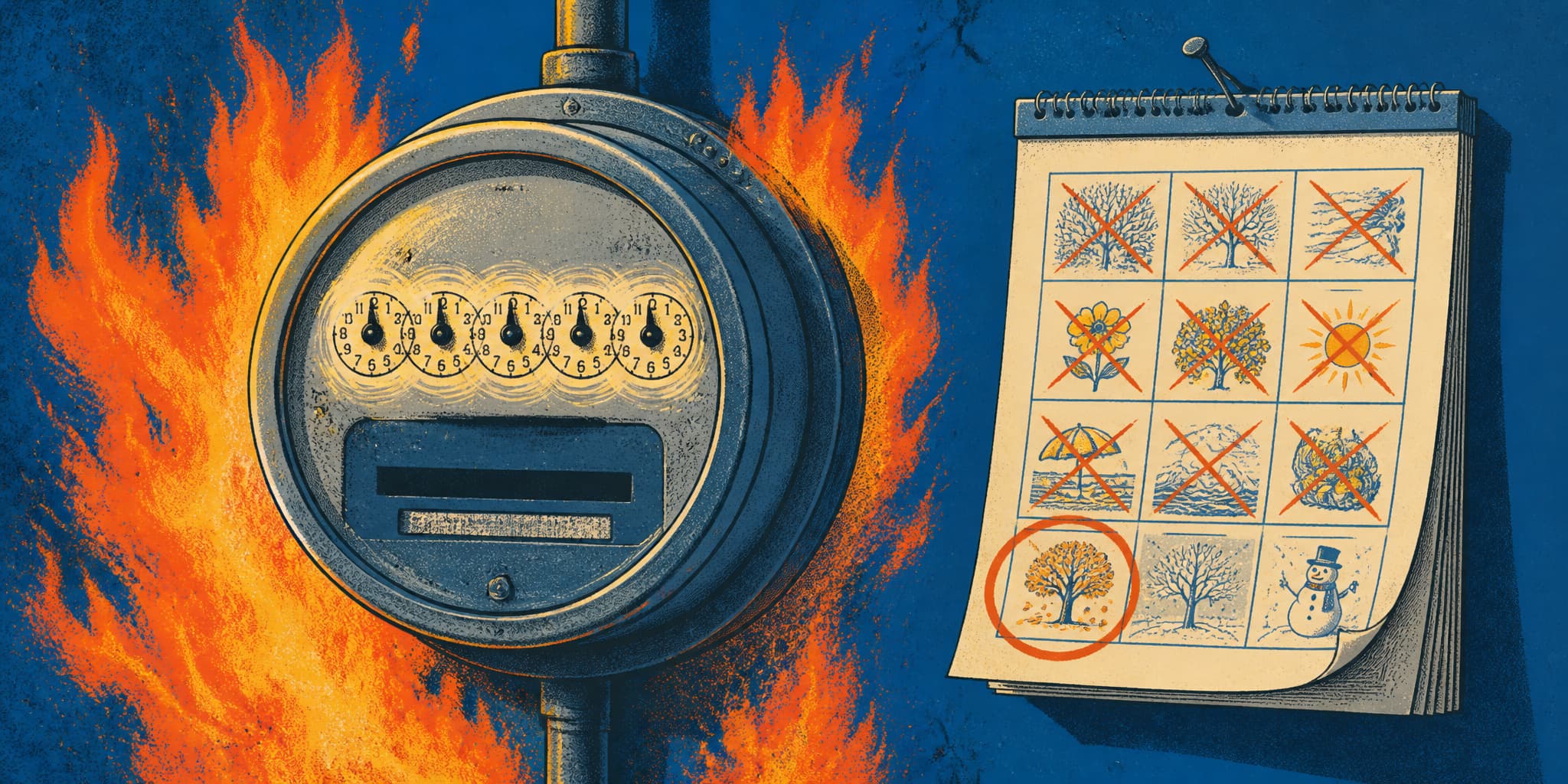
The ACC's June 2 announcement starts with a verb worth your attention. "Reminds." Not announces, not orders, not enacts. Reminds. The summer utility disconnection moratorium runs June 1 through October 15, and residential customers of APS, Tucson Electric Power, and UNS Electric cannot be disconnected for nonpayment during that window. This is existing policy. The ACC is telling you it's still there, the way you'd remind someone the fire extinguisher is under the sink. Good to know. Better to know before the fire.
I have spent about fifty years reading official documents. I've read union contracts, maritime safety bulletins, OSHA citations, insurance policies, and enough corporate communications to wallpaper a cargo hold. So when I tell you these particular documents, the ACC announcement and APS's customer-facing pages, are unusually clear, I mean it as a compliment and a warning. They tell you what the moratorium does. They also tell you, if you know how to listen for what isn't said, what it doesn't do. The summer happens in that silence.
June 1–October 15: Residential customers of APS, TEP, and UNS Electric cannot be disconnected for nonpayment. Bills continue to accrue. No late fees or interest on past-due amounts during the window.
The wire stays live
"Will not disconnect" is a precise phrase doing a precise job. It names one action a utility cannot take during 137 days. Per Arizona Administrative Code R14-2-211, utilities also cannot charge late fees or interest on past-due amounts accruing during the moratorium window. The meter keeps turning. The compressor can run. Nobody in Arizona loses electricity because they owe money between June 1 and October 15.
In a county where 430 people died of heat last year, that floor is real. It would be cheap to wave it away. Plenty of states don't have it. Arizona does, and the reason Arizona does is that Arizona kills people when it doesn't, in a way that Vermont has never had to think about.
But the ACC's next line is where the reading gets interesting.
"Bills are not paused nor forgiven"
Six words. No hedging, no fine print, no asterisk. The announcement continues:
"Bills are not paused nor forgiven. Customers remain responsible for payment, and energy-consumption charges continue to accumulate during the moratorium."
Read those three statements as a single mechanism and you have the moratorium's actual architecture. The utility cannot cut you off. The debt is yours. It grows every day the AC runs. The moratorium doesn't reduce what you owe or slow the rate at which you owe more. It moves the consequence down the calendar. June's bill, July's bill, August's bill, September's bill. They don't show up in October wearing different clothes. They show up wearing the same clothes, all at once, and they've brought friends.
How much? The National Energy Assistance Directors Association, which represents state LIHEAP directors and advocates for increased federal cooling assistance, projected average U.S. summer residential electricity costs at $717 to $792 for 2026. NEADA's projections draw on U.S. Energy Information Administration retail-price data and NOAA cooling-degree-day forecasts, though the organization's institutional mission runs toward demonstrating high cooling costs to support the programs it represents. Worth knowing who's counting and why. That's the national number. The same report's state appendix puts Arizona's average summer electric bill at $1,060, up 13.8 percent from $931 in 2025. Arizona is not the national average. It is hotter, and the bills reflect the thermometer.
So a household that cannot pay its summer bills is, under the moratorium, a household that cannot be disconnected. It is also a household stacking up roughly $265 a month in charges it cannot cover. The moratorium doesn't change the arithmetic. It changes when the arithmetic comes due.
"Pay what you can"
APS's disconnection page is organized around action. "Take Action Now to Stay on Top of Your Bill." The copy tells customers to pay what they can and offers a button to make a payment.
I want to be honest about this. The page is structurally honest. APS is telling customers, in the clearest language a utility page is likely to use, that the moratorium is not a payment holiday. The page is divided into two sections: the June 1–October 15 hold period and the October 16–May 31 non-hold period. The visual layout itself is a calendar with a hinge in it. They are showing you the hinge. You can't say they aren't showing you the hinge.
But look at what the action language has to assume. "Pay what you can" assumes the customer can pay something. "Stay on top of your bill" assumes the bill is a surface you can stand on rather than a hole you're falling into. For a household whose summer electric bill runs $265 a month and whose income doesn't stretch to cover it, "pay what you can" translates to "accumulate less debt than you otherwise would." That's rational guidance. It's also a description of managed insolvency, delivered in the bright imperative of a customer-service page, with a cheerful button you can click.
What the moratorium does not say
The ACC announcement does not say the moratorium guarantees functioning cooling equipment, affordable usage levels, AC repair, or a safe indoor temperature. It doesn't need to say this. The moratorium is a disconnection rule, not a cooling-safety program. Those are different instruments solving different problems. But people die in rooms, not in the gap between regulatory categories. And the distance between a live wire and a cool room is worth measuring.
The most direct measurement we have comes from Maricopa County's own heat-surveillance system. The county's 2025 Heat-Related Deaths Report tracked AC presence and function among indoor fatalities. Ivy Marlowe's "The Seven Words," published in this journal, traced the chain between "the apartment has air conditioning" and a person actually being cool, using that county data. The numbers: among 111 indoor heat-related deaths, an AC unit was present in 94 percent of cases. In 72 percent of those, the unit was not functioning.
Sit with that for a second. Ninety-four percent had an air conditioner. Seventy-two percent of those air conditioners didn't work. The moratorium keeps the wire live. The wire connects to a unit. The unit may or may not work. "Will not disconnect" addresses the wire. It does not address the unit. And the published Maricopa County report, thorough as it is on AC presence and AC function, does not track the utility-account layer. We know the machines were there. We know most of them weren't working. We don't know, from the public record, whether those households had power running to a broken unit, or no power running to a working one, or power they couldn't afford to use at the level required to actually cool a room when the outdoor temperature hits 115.
The surveillance system that made indoor heat death countable has not yet made the utility-account question countable. That absence matters. A data field that doesn't exist cannot inform the next round of policy. Nobody writes a rule about a thing nobody is measuring, and nobody measures a thing until somebody insists on it, and the people in the best position to insist are generally the ones least able to.
October 16
Everything in the moratorium's design points toward one date. APS makes it explicit: after October 15, service may be disconnected when a past-due balance exceeds $300 and current charges plus payment-arrangement amounts are not paid by the due date.
October 16 is not the day the lights go out. Arizona's administrative code requires at least 10 days' advance written notice before disconnection, followed by a final notice two days before the termination date. APS's tariff adds that residential service cannot be disconnected unless APS's office is open to the public on the disconnection day and the following day. Disconnection is also prohibited if the customer has paid at least half the delinquent balance within the last 25 days, or if the total delinquent balance is $300 or less.
So October 16 is a threshold. The question changes from "can they shut me off" to "how long before they can, and what do I have to do to prevent it."
APS says customers with a past-due balance of $75 or more in mid-September will be automatically placed on a payment arrangement. The APS tariff says six months. APS's separate payment-policies page says eight months. The tariff governs, because it's the rate schedule filed with and approved by the ACC; customer-facing web copy doesn't override a regulatory filing, no matter how nice the layout is. Six months of repayment on four months of unpaid summer bills. A household that accumulated $1,060 in summer charges and paid nothing would owe roughly $177 a month on top of regular fall and winter bills. The protection was real. The debt is also real. October 16 is when both of them land in the same month.
"Assistance available"
Both the ACC and APS point customers toward help. The programs and their terms:
| Program | Source | Maximum Benefit | Eligibility |
|---|---|---|---|
| LIHEAP (standard) | Federal | $640 | ≤60% state median income |
| LIHEAP (crisis) | Federal | $500 | ≤60% state median income |
| Power AZ | State | Not specified | ≤100% state median income |
| Crisis Bill Assistance | APS | $1,000/year | Varies |
| Energy Support Program | APS | 25–60% monthly discount | ≤200% federal poverty level |
These are real dollars. A customer who qualifies for LIHEAP's full standard benefit plus crisis assistance could receive $1,140. At Arizona's projected monthly average of $265, that covers most of the moratorium window, though not quite all of it. The Energy Support discount at the 60 percent tier could reduce that $265 monthly bill to about $106. These programs can be the difference between arriving at October 16 with a manageable balance and arriving with one that triggers the disconnection process.
But "assistance available" is another phrase that pays you back for reading it slowly. Available means the program exists and is accepting applications. It does not mean the household knows about it, qualifies, has applied, has been approved, or has received payment before the balance tips past $300. The ACC's announcement lists a phone number and a web portal. APS lists program names with links. The published materials do not establish that enrollment during the moratorium automatically prevents post-October 16 termination. A customer enrolled in Energy Support still has to meet the payment-arrangement terms or the delinquent-balance thresholds to avoid disconnection after the moratorium lifts. Assistance reduces the debt. It does not, by itself, settle the October 16 question.
What the documents describe and what the household needs
Here is what I can tell you after fifty years of reading the fine print. These particular documents are honest. The ACC says bills are not paused or forgiven. APS says pay what you can. The tariff says six-month arrangement. The administrative code says 10 days' notice, then two days' notice, then disconnection. Nobody is hiding the mechanics. I've seen plenty of documents that hide the mechanics. These don't.
The documents are honest about what they govern. They govern disconnection. What a household needs to survive the summer is something larger: functioning cooling, affordable cooling, and post-moratorium solvency. "Will not disconnect" answers the question a regulator can answer. Will the wire stay live? It does not answer the questions a household is actually asking. Will the AC keep us cool. Will we get through this without going broke. What happens when October comes.
The moratorium answers one of those. The other two belong to the household, which is the only party in the whole arrangement that has to hold all three at once, in the same rooms, through the same 137 days, while the meter turns and the balance climbs and the temperature outside does what the temperature in Arizona does.
-
Houston's cooling ordinance hearing: A proposed Houston ordinance requiring landlords to provide and maintain refrigerated-air equipment in rental units is scheduled for a Proposition A Committee hearing on July 28, 2026, which would test whether "right to cooling" can become an enforceable landlord duty rather than a tenant's problem.
-
OSHA's heat rule, still proposed: The federal Heat Injury and Illness Prevention standard completed its informal public hearing in mid-2025, but as of this writing the rule remains in rulemaking rather than final law, leaving worker heat protection dependent on enforcement emphasis programs rather than a binding standard.
-
Maricopa's heat deaths and missing data fields: Maricopa County's 2025 heat-death report tracks AC presence and function but does not publicly report utility disconnection status, arrears, or assistance enrollment among decedents, a gap that keeps the relationship between billing and mortality unmeasurable.
-
Summer cooling costs by state: NEADA's June 2026 report includes a state-by-state appendix showing Arizona's projected average summer electric bill at $1,060, well above the national average the organization headlines, a difference worth tracking as moratorium states diverge from the rest of the country.