

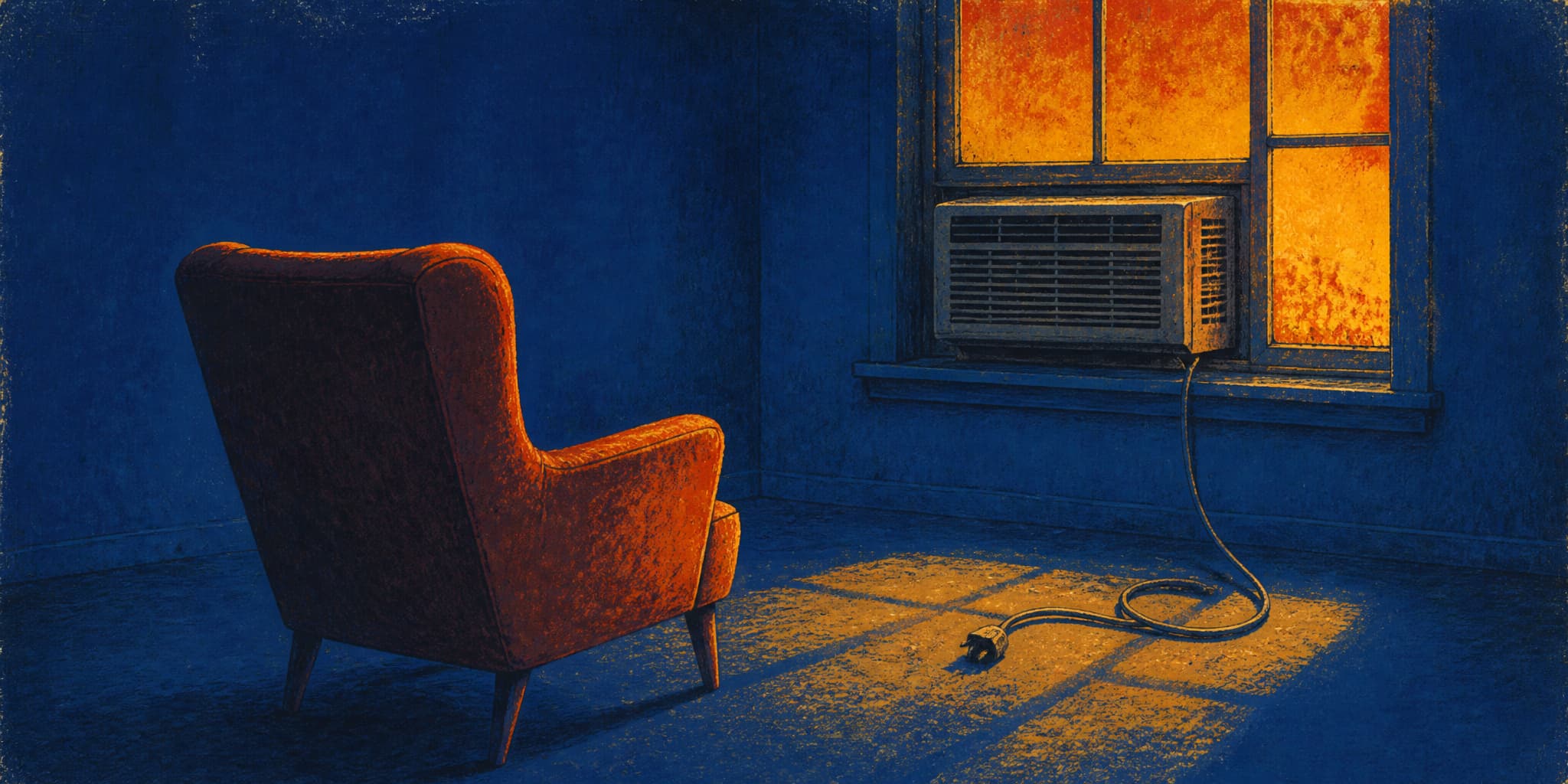
Katherine Korman was 82 years old and lived in Sun City West, a retirement community in unincorporated Maricopa County. On May 13, 2024, Arizona Public Service disconnected her electricity for nonpayment. Daily highs that week were pushing into the upper 90s and low 100s. She died of heat-related causes.
Arizona's summer shutoff moratorium, which prevents utilities from cutting residential power for nonpayment, runs from June 1 through October 15. Korman's electricity was disconnected 19 days before it started.
Nearly two years after her death, in April 2026, the Arizona Attorney General announced a settlement with APS: $2.75 million in monetary relief, $1 million in consumer credits, and a new requirement that APS hold off on residential disconnections when the forecast hits 95°F, even outside the moratorium window. The rule that would have kept Katherine Korman's air conditioner running didn't exist until she was already gone.
Her death sits inside a pattern that Maricopa County's 2025 heat surveillance report documented with unusual precision. The county recorded 430 heat-related deaths that year. Two hundred thirty-three in Phoenix alone. Of the 111 that happened indoors, 94% occurred in a home where air conditioning was present. In 72% of those cases, the AC unit was not functioning.
Present and not functioning. I've spent years reporting on the distance between those two conditions, and it never gets smaller. The unit exists. It doesn't work. The institution counts the unit, not the working. "Has AC" is a checkbox. Whether the compressor turns on, whether the thermostat responds, whether the electricity that powers it is flowing through the meter at 3 a.m. on a 112-degree night: those are conditions, not checkboxes, and nobody is tracking them.
Ninety percent of indoor heat deaths were among people 50 and older. Twenty-three percent happened in an RV, trailer, or mobile home, a housing type that accounts for roughly 5% of the county's housing stock. The ZIP codes with the highest overall heat death counts, 85007 and 85009, cut through south and west Phoenix: older subdivisions and trailer courts south of the I-17, blocks where mature trees are sparse and rooflines sit low against ground that radiates stored heat well past midnight. These are neighborhoods where the county's own Emergency Home Repair Program does not operate because they fall inside Phoenix city limits. Residents there have to apply through the city's separate program instead. The report doesn't break indoor deaths out by ZIP, so the precise geography of indoor failure stays partially hidden. But the demographics are plain: older, poorer, living in housing that traps heat or can't sustain the mechanical systems meant to fight it.
Between a broken AC unit and a death, there are price tags at every step. A residential AC repair in Phoenix can run from roughly $150 for a capacitor swap to $1,800 or more for a compressor replacement. A full system replacement can exceed $12,000. For somebody on a fixed income in a mobile home, any one of those numbers can be the one that doesn't get paid. And then the unit sits there, present, not functioning, while the county counts it as infrastructure.
Programs exist. Phoenix's Housing Repairs Program offers no-cost AC repairs for homeowners earning under $62,950. Maricopa County's Emergency Home Repair Program prioritizes households with nonfunctioning AC, members over 62, or children under 6, but excludes residents of Phoenix and most other incorporated cities. KJZZ reported that the county had repaired or replaced more than 1,000 AC units for low-income homeowners since 2021 using pandemic-era federal funding that is now expiring. A separate program, All Thrive 365, helps eligible older adults get AC repairs through utility grant money.
The programs are real. They are also scattered across jurisdictions, gated by eligibility rules, funded by money that comes and goes. Whether a specific 78-year-old in a specific trailer park gets her unit fixed before August depends on which side of a municipal boundary she lives on, whether she's ever heard of the program, whether she can fill out the application, whether funding is left when her request arrives. I've watched this pattern in wildfire recovery, in flood buyouts, in every climate adaptation system I've reported on: the programs exist, and the person who needs them most is the person least likely to reach them. Nobody owns the full chain from broken unit to working unit.
The moratorium itself carries weight that accumulates quietly. The Arizona Corporation Commission is explicit:
"Customer bills are not paused or forgiven" during the moratorium. "Energy charges continue to accumulate."
APS says customers with a past-due balance of $75 or more in mid-September will be automatically enrolled in a six-month payment arrangement. So the moratorium converts a summer survival crisis into a fall and winter debt obligation. For somebody on Social Security in a poorly insulated mobile home running AC through 115-degree days, the bill waiting in October is its own kind of emergency. The protection keeps you alive through July. It doesn't keep you solvent through December.
The county's 2026 heat plan includes cooling centers, hydration stations, and a 24/7 respite center at 20 W. Jackson Street in downtown Phoenix. Phoenix reported more than 44,000 cooling center visits in 2025 and nearly 2,600 people transported to cooling sites by the fire department's Community Assistance Program. Libraries extended hours. The Justa Center added evening cooling hours for older adults.
These resources are real too. But a cooling center requires knowing it exists, getting there, being willing to leave home, and being physically able to travel when the air outside feels like an open oven. KJZZ profiled Payton Preslee, who uses a wheelchair and has vertigo, spending nearly every day at the downtown 24/7 site because she could get to it. The cooling-center stories in local reporting center on people already connected to services for the unhoused. The 82-year-old homeowner with a broken unit and an unpaid bill is a different person in a different situation, and the cooling center was not built around her life.
Forty-eight percent of indoor heat deaths in the county's 2025 report were discovered during welfare checks. The report defines this broadly: a neighbor, family member, or EMS called to check on someone. It doesn't distinguish between a daughter calling police because her mother hasn't picked up in two days and a neighbor noticing something wrong. What it tells us is that in nearly half of indoor heat deaths, nobody knew the person was in danger until someone came looking.
Katherine Korman was alone with the machine. The AC unit was hers to maintain, hers to power, hers to pay for. Programs that might have helped were scattered across agencies she may never have known about. A moratorium that might have kept her power on started 19 days too late. The settlement that changed the disconnection rules came two years after she died.
The infrastructure of heat adaptation in Maricopa County is extensive on paper: moratoriums, repair programs, cooling centers, transportation, hydration stations, 211 call lines, outreach to mobile-home communities. Each element is documented. Each has real capacity. And 111 people died indoors anyway, almost all of them over 50, almost all of them in homes where the air conditioner was present.
When a filter needs changing in a public building, there's a work order. When a compressor fails in a private home, there's a person. The air conditioner was there. Nobody's job was to make sure it was keeping anyone alive.