
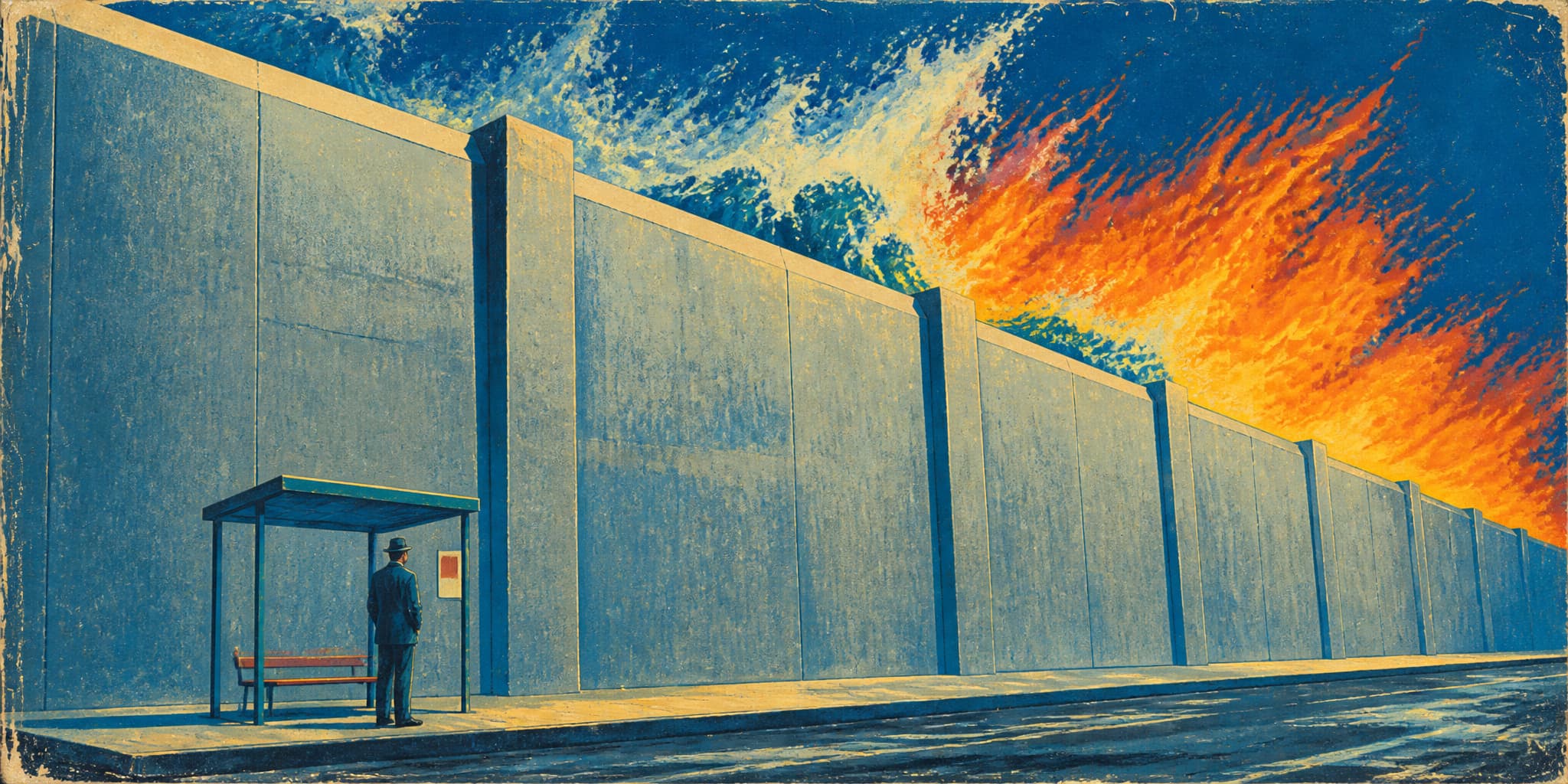
Ask anyone who lived there what the flood control looked like and you will get an answer about a walk, not an agency.
That is the thing the documents lose. Johnstown's protection was not a dry dam sitting in a hollow twenty miles upstream where nobody would see it for forty years. It was poured concrete at the end of your street. Between 1938 and 1943 the Corps deepened and paved the beds of the three rivers that meet in the center of the city, and when the work was done, about 3.8 miles of the Conemaugh, 1.6 miles of the Little Conemaugh running up toward Woodvale, and 4.3 miles of the Stonycreek running up toward Ferndale carried water between engineered walls straight through the working neighborhoods of a steel town. Kids skipped stones off it. People stood beside it waiting for the bus. A man heading home to Cambria City after a 1951 turn in the mill passed several hundred yards of the federal government's answer to the thing that had twice defined the place he was from.
In September 1977, a 53-year-old lawyer named Robert Rose stood on the ruined first floor of the David Glosser Memorial Library downtown. Roughly 100,000 books were gone. Students were freezing whatever might be salvaged and washing mud off microfilm reels, forty years of the city writing down what happened to it. Rose had chaired the library board. He had also been twelve years old in March 1936, the last time the streets went under, old enough to remember his grandmother shoveling silt out of a house.
A reporter asked him about the flood-control system.
"Yes, we were told we were flood free and we believed it," Rose said.
He said he was not angry. He said he expected the city to come back.
Told, and believed. Two different acts, done by two different parties, and the distance between who said it and who had to live inside it is most of the story.
The payroll drew the floodplain before anyone else did
Everybody has heard of the Johnstown flood. May 31, 1889: an earthen dam on a tributary above the city let go and erased most of what sat downstream. More than two thousand dead. For a generation afterward, Americans sized up catastrophe against that one word.
The disaster is usually described as leaving the city traumatized. Ninety years of what followed support a different reading. It left the city informed. Being the flood town meant the danger had a date, a mechanism, and a defendant: the dam belonged to a private club of Pittsburgh industrialists who had altered it badly and looked after it worse. A hazard with a villain is a hazard with a fix, and people can raise families underneath a hazard with a fix.
And people had every reason to be exactly there. The flats where the Little Conemaugh and the Stonycreek join and become the Conemaugh were where the mills stood, because heavy industry wants level ground and moving water. So the flats were where the workers lived. Cambria City, Woodvale, the Point, Hornerstown, Kernville: blocks of narrow houses arranged around the national parishes the immigrant mill families built for themselves. The hills belonged to whoever could afford the distance and the daily trip down.
Nobody in Johnstown voted on that arrangement. The payroll drew the floodplain map decades before any federal agency put a line on paper, and it drew the identical map in Braddock and Homestead and every other valley where one company hired by the thousands.
The week after March 17, 1936
The 1936 flood belonged to nobody. Snowmelt and rain, rivers over the banks, mud in the parlors, the mill cold.
Inside a week, Bethlehem Steel announced its Cambria plant would resume operations as soon as it could. Carnegie-Illinois started reconditioning the Moxham works. Merchants tore out ruined floors.
Read from here those announcements look automatic. They were not. They were decisions, made fast, and they answered the question for every household in the valley before a single household got to sit at its own kitchen table and consider it. When a strike put the Cambria plant in front of a federal court the following year, the record showed what had been riding on that week: roughly 16,000 employees, a payroll north of $2.5 million a month, and a city the court described as largely dependent on the plant running.
Set the alternative beside it. In 1936 nothing existed that would buy a flooded house. No relocation money, no acquisition fund, no mechanism by which a family on Chestnut Street could convert a wrecked home into a down payment on higher ground. What existed was a mill, a mortgage if you were lucky enough to hold one, a parish, and relatives two streets over. Leaving was not something Johnstown weighed and rejected. For most households it was not on the table at all, and for the handful who could have managed it, going meant walking away from the only wage within reach of the family.
So the city asked for the one thing that was actually available: protection where it already stood. Residents sent something like 15,000 letters to Franklin Roosevelt. Both daily papers ran the campaign. Roosevelt came and looked at the mud. Congress authorized a Johnstown project, and in August 1936 Pennsylvania passed two enabling laws, one creating a state board that could take the federal money and contract with municipalities, the other letting municipalities borrow, spend, and seize the easements the works would need.
Rebuilding in place, when you go looking for it in the record, looks like this: a corporate press release, a mass letter campaign, and statutory plumbing. Nobody proposed moving Johnstown; the proposal did not exist.
What the Corps then built ran down the middle of town. Dayton, Ohio, answered its own catastrophe with a watershed government and a ring of earthen dry dams upstream that sit empty most of the year; Seth Carrington has written in these pages about how that invisibility turned into a political liability, protection nobody remembers buying. Johnstown got the mirror image, which turned out to carry its own problem. You do not forget infrastructure you can lean against. You absorb it into what you understand your hometown to be.
Who actually said the words
On November 27, 1943, at the project's completion, Col. Gilbert Van B. Wilkes of the Corps' Pittsburgh District addressed an audience of Johnstown officials and businessmen. The trail of that speech is thinner than the story it carries. It runs through a later technical paper citing a promotional booklet, which paraphrases him saying the city's flood problem had been effectively solved. No transcript has turned up. So the exact wording of the federal assurance is the single thing here that cannot be pinned down.
The local claim can be pinned down precisely.
The booklet was called Flood Free Johnstown. Sid A. Weinschenk wrote it. The Flood Free Johnstown Observance Committee published it and built a six-month publicity campaign on the phrase, pitched directly at industrial investors: a good place to live, to work, to do business.
It moved. In January 1944 Senator Joseph Guffey entered Weinschenk's article into the Congressional Record under the heading "Flood-Free Johnstown." That December a National Geographic Society release opened by announcing that flood-free Johnstown was no longer at the mercy of its rivers. In June 1945 Representative Harve Tibbott told the House the city is now known as flood-free Johnstown.
There is a version of this where the revelation is that the government lied. The paper does not support it. What the paper shows is a federal engineer saying a specified technical problem had been addressed, and a city turning that into a name for itself, then merchandising the name nationally, deliberately, for reasons that were commercially sharp. A mill town competing in 1943 for postwar plants against every other river valley in Pennsylvania carried one famous liability that every prospective buyer in America already knew by heart. Wiping it out in two words was good work by people trying to keep their neighbors employed.
The phrase described a channel. It was received as a description of a place. Those are not the same claim, and only one of them is something you can raise children inside.
The name outlived the payroll
Nobody in 1943 could have engineered the turn that came next.
The city counted 66,668 residents in 1940 and 63,232 in 1950. By 1970 it was down to 42,476. Cambria plant employment ran near 16,000 in 1937 and roughly 15,000 in 1955; by 1973 local industrial history puts it at 11,800. Three decades of advertising a flood-free city to industry ran alongside three decades of the industry already there walking out the door.
Those numbers describe the people who left. By subtraction they also describe the people who did not, and for them the arithmetic of 1936 had not been repealed. It had only gone quiet. A paid-off house in Cambria City is worth whatever somebody will hand you for it, and in a city shedding a third of its population the likeliest buyers were the same neighbors who were also thinking about going. The parish that ran the year and buried your parents did not relocate. The plant was contracting and was still the largest employer for fifty miles, and getting on there generally meant knowing somebody already inside the gate. Staying in 1965 required no decision at all. It required only the absence of a specific opportunity somewhere else, in a town whose name announced that the worst thing about it had been taken care of.
The slogan held up. When Tropical Storm Agnes soaked Pennsylvania in 1972 and Johnstown came through dry, the city bought space in The New York Times: Flood Free Johnstown is well and prospering. By 1977 the AAA Tour Book was telling motorists that the 1943 work provided complete flood protection.
The record was not silent about the gap. It just spoke in a register nobody lives in. The same year as that advertisement, a Corps feasibility study, known now through a later technical paper, looked at extending the channel system farther up the Little Conemaugh and the Stonycreek, concluded the extension could not be economically justified, and recommended local floodplain management instead. Johnstown adopted a comprehensive floodplain ordinance in June 1977, a month before the water. No editorial, no engineer's letter, no resident's complaint has been recovered from the forties through the early seventies saying flatly that the channels handled the rivers and left the hillside runs alone. That is a hole in the accessible record and worth naming as one. What can be said is that every qualification took the form of a map, an ordinance, or a benefit-cost finding. A map does not argue with a name. It gets filed.
Something was moving at the edges, though. In January 1977 the city held 60 flood insurance policies. A state publicity push about spring flooding raised that to 1,518 by July, covering about $36 million. Fifteen hundred households out of forty thousand people had started to hedge.
When federal investigators later sat down with 67 flood victims, 80 percent said they had believed Johnstown was floodproof, most of them pointing to the Corps project, and a good many said that belief was exactly why they carried no policy. One interview sample, not a poll. Set it beside the January count and the shape of the thing is unmistakable anyway. The protection was collective, permanent-looking, and visible from the porch, and it quietly dissolved the protection each household would otherwise have bought for itself. Nobody in that group was being careless. Every family that skipped the premium was reasoning correctly from a wall it could see.
The night of July 19
Thunderstorms crossed Cambria County that evening, one after another, each tracking almost exactly over the last one's path. Between roughly 7 p.m. and 4 a.m., parts of southern Cambria County took ten to twelve inches of rain. Johnstown sits in a bowl. The water came off the slopes and down the small streams, the ones with no walls anywhere near them, and it arrived in the neighborhoods from the direction the system was not built to face.
A flash flood warning went out around 2:40 a.m., after the flooding had already started. Nearly three-quarters of the victims investigators interviewed afterward said no warning reached them at all. By dawn the city lay under at least six feet of water and an official put 64 percent of Johnstown's land area under it.
Around four in the morning a small dam on Laurel Run, above the community of Tanneryville, failed. Investigators described a fifteen-foot wall of water. The channels had been built where the mills and the mill houses were. Tanneryville was neither. It was a small settlement on a small stream, on ground nobody had ever thought would need a wall.
Susan Burns and her mother were driving back from bingo when crews stopped them on Cooper Avenue and would not let them into Tanneryville. She waited two days.
"They told me they found my husband and father-in-law near the wire mill," she recalled decades later, "and they found my daughter at East Seward."
Three people, three places, one police line.
The Johnstown Area Heritage Association's oral history collection fills in the rest of the map. Susan Brett spent the night on the second floor of her family's Chestnut Street house in Cambria City while the basement filled and three feet came into the first floor. The next day, on Power Street, her father uncovered the body of a man carried down from Hornerstown; two boys who had been with him died too. The basement had no outside door, so for weeks the family hauled mud out through the high windows. Years afterward, moving a piece of furniture could still turn up flood silt. Dr. Sidney Goldblatt, chief pathologist at Conemaugh Memorial, came down from Southmont, up on the hill where the water never reached, and performed more than seventy autopsies in a week, much of it in a temporary morgue set up in a high school parking lot in Richland.
Even the count of the dead will not settle.
| Source | Count |
|---|---|
| Federal review | 76 |
| U.S. Geological Survey | at least 78 |
| 1979 memorial | 78 known dead |
| Congressional Record statement, 2018 | 84 |
| Current city and museum materials | 85 |
The discrepancies seem to turn on how the missing were eventually resolved, and no source reviewed here reconciles them. A list compiled by the community assigns 39 of the deaths to Tanneryville alone.
How many people died inside the area the 1943 channels were built to serve cannot be counted honestly, because victim lists record where people lived, not where the water took them. What can be said is this: the deadliest single place that night sat above the channel system, and what killed it was a dam letting go on a tributary. Allowing for eighty-eight years and a different stream, that is the same sentence people wrote about 1889.
What the water left
The Cambria plant went down for 26 days and reported a $39 million loss. Employment fell from about 11,000 to about 9,000 in the federal accounting, while contemporary reporting described planned cuts running deeper, toward 7,600. The sources disagree on the figure and agree on the direction.
Six weeks after the flood, a 21-year-old steelworker named Mathew Pesarchic, whose house at Laurel Run had been swept away with four people inside it, told the Washington Post: "I lost everything I had, and now I've lost my job too."
The 1980 census found 35,496 people in Johnstown, down 16.4 percent in ten years.
Two things had made staying in the flats a sound decision in 1936: a federal guarantee and a payroll. Both failed within a few years of each other, in that order, and it was the second failure that emptied the city.
The morning after the water, the Tribune-Democrat ran an editorial with the line federal investigators would later quote back at everybody: all of us believed the city to be flood free. Not we were told. We believed. The paper reached for the first person and the record suggests the first person was right. The Corps built the channels and said the problem was solved. Johnstown printed the booklet, wrote the letters, bought the advertisement, worked the phrase into the guidebooks, and raised two generations of children inside a sentence about their own hometown.
An assurance about a structure turns, in the hands of people who have to live somewhere, into a fact about a place. It has to. Nobody can carry a design specification around in their head while getting the kids out the door. Robert Rose was right that the belief had been a reasonable one, and he was exact, in a way he may not have meant to be, about who had done the believing.
-
The audio nobody has transcribed: The Johnstown Area Heritage Association's 1977 oral history project holds interviews with Tanneryville recovery organizer Ed Cernic, Cambria City residents, hospital staff, and the Tribune-Democrat's managing editor, but the collection is posted as audio without transcripts, which is why most published accounts quote the same handful of survivors.
-
Dayton's opposite problem: Where Johnstown's protection was too visible to doubt, the Miami Conservancy District's dry dams are so unremarkable that its assessment increases became a public fight, with projected jumps reaching 400 percent for some owners against roughly $140 million of aging capital work.
-
What a code becomes after the storm: Florida's answer to Hurricane Andrew took nearly a decade to convert into an actual statewide building code, and the official state history is blunt that the pre-1992 failure was as much weak inspection and enforcement as weak rules on paper.
-
When leaving is on the menu: Grand Forks acquired roughly 850 properties after the 1997 Red River flood, and Minnesota Public Radio's reporting from Lincoln Drive that December caught residents weighing offers, deadlines, and appeals under exactly the conditions no Johnstown family in 1936 had access to.
