The Underline Series · Run Three
Reyes · Service Creek
The rule was whole fish.
Reyes had been on the station lot since before light, and by ten she had watched the rule get around itself six separate ways. Nothing illegal in any of them. Nothing false, either. Boats came up out of the low water at the confluence, people dragged their totes across the gravel, Delph measured and scanned and wrote, and every fish that touched the length board came in whole, and every fish left the lot in a different truck than it arrived in, and the day's file would read clean from top to bottom.
Army surplus shade cloth over the trailer, third-hand, sun-rotted down to the color of weak tea. Under it you got maybe a few degrees, which was the difference between working and not. Delph ran a fan off a stack of cells and had taped a card to the housing in his own careful hand. DO NOT UNPLUG. AUDIT SEASON. He was twenty-three, and he wrote signs like a boy who had never once watched an adult behave reasonably during a heat advisory.
"Weir," he said.
Hollis Weir dragged her tote up. Fifty-something, forearms like a farrier's, one lens of her glasses fogged permanently on the inside where the seal had let go. She brought the bass out two at a time, gill and gill. Bronze going dull under the ice, the dark bars still showing along the flank. Nine inches was the legal floor. Nothing in that tote was under thirteen.
"Forty-one." Delph thumbed the counter. "Nineteen sixty for the season."
"Put the running total on the slip."
"You want the day total too?"
"I want the running total. My brother-in-law doesn't believe me."
The slip came out on recycled stock, gray as an old tooth, the compact's plain type across the head of it and the payment schedule printed underneath. Six a head for your first twenty-five. Eight from twenty-six to two hundred. Ten after that. The escalation was the entire reason a trap line made sense; somebody in an office had run the arithmetic once, decided volume was the point, and priced it so volume happened. Reyes had never yet met a payment schedule that didn't tell you exactly what the people who wrote it were afraid of.
Delph passed the wand over each fish anyway, slow, listening for the tone.
"Anything?" Hollis said.
"No."
"Boy at Kimberly pulled a tagged one in March."
"I heard."
"Paid his whole season in an afternoon and then went and bought a boat." She said it the way a woman says it when she has been eighteen months into saving for a lower unit. "A boat. Not a compressor."
"That's a lot of money," Delph said.
"It's a lot of ledger." She had a fish up by the jaw and was talking to it rather than to him. "Ledger buys a boat, because there's a man in Umatilla who sells boats. Ledger has never once bought me a lid."
He laid the fish in the chest, iced them down, wrote a weight on the lid in grease pencil, initialed it. That was the end of the compact's interest in the animal. Forty-one head, verified whole, presented fresh, tallied, iced, the voucher clearing into Hollis Weir's ledger account inside a minute, because whatever else the compact had failed at, it had never failed to pay.
Then Hollis's nephew backed the same flatbed she had driven in on up to the chest and loaded it, because the disposal endorsement for Service Creek station was held by Weir Hauling, four miles up Cottonwood Draw. Rendering and disposal. Paid by the hundredweight.
Reyes laughed. Four years and it hadn't gotten less funny, and it hadn't gotten any cheaper either.
Hollis didn't look over. "Don't."
"I didn't say a word."
"You made the noise."
"They pay you to catch it. Then they pay you to haul it off. Then you drive it four miles to your own smokehouse and it comes out the other end as winter for two hundred households, and there is not one lie anywhere in the paperwork. That's not a scam, Hollis. That's a cathedral."
"It's a permit. It's two permits and a hauling endorsement, and I renew all three on time, and if you say the word cathedral where anybody from Toppenish can hear it I will put you in the brine."
Nailed to the post under the official notice board was a second board Delph had lettered himself, straight capitals, no authority behind it of any kind:
NOTHING OVER SIXTEEN INCHES TO A KID.
NOT TO ANYBODY CARRYING.
IF YOU DON'T KNOW HOW OLD IT IS, IT'S OLD.
Nobody argued with that one. Big ones went into barrels for the freight trade, small ones went up the plateau, and every shed in the drainage ran it the same way. It appeared in no document the compact owned. It had propagated on its own, shed to shed, like weather.
Reyes went down to the water while Delph worked the next tote, because she wanted to see it and because she was still old enough to be offended by it.
The river was down to a third of its channel and the bass were stacked into whatever was left. Above the gravel bar the water moved with nothing moving it. A low continuous shrugging in eight inches of it, backs breaking and going under, fish turning over each other, and the sound of it was somebody wringing out a wet coat over and over and over. Forty years ago she had stood on this bar with her mother in August and there had been nothing living in that water at all. Nothing. You came here to put your feet in a river that had no opinion about you.
Ninety minutes into a run the rack house four miles up smelled like a hot animal and sweet smoke and the inside of a salt bag, and it made her hungry every time, and that was the part she had never managed to get used to.
She had her own load down out of the Blues. Rewound compressor motor. Sixty feet of hose. Four cases of canning lids that had cost her more grief than the motor had. Nobody was paying her in ledger dollars for any of it. Nobody ever had, for one single thing she intended to keep.
Three hundred yards down the bar a man worked a trap line by himself. He had not registered that morning and would not register that afternoon and had not registered in the two years Reyes had been coming through. He caught his fish and salted his fish and ate his fish, and he was leaving money in the water deliberately, because a voucher is a payment and a payment is a name, and there were people on that plateau who had done the arithmetic and decided six dollars a head was a poor price for a name.
"Lids now or after?" she said, back under the cloth.
"After. Delph, where's my manifest."
"Coming." He was frowning into the tablet, and then he said the thing that ruined her morning. "Oh, hey. Somebody filed at the seat. A determination."
Hollis stopped with a fish in her hand.
"On what," Reyes said.
"On this. On us." He turned the screen around, pleased with himself, and there it sat, a docket line plain as a weather notice. Determination of Use, Willow Creek and John Day reaches. "It's good, right? Because right now I can't even file this properly. Look at the dropdown."
"I've seen the dropdown."
"No, look." He scrolled it for her anyway. He was not wrong and it was the funniest thing in the county. Depletion. Mortality event. Loss adjustment. Refuge failure. Nuisance removal. Salvage. "Every box is something going away. There's no box for more of it. So I put it under nuisance removal, and then the tonnage lands in the disposal column, and as far as the ledger has ever known I've spent four years destroying twelve hundred tons of nothing. If they actually decide what it is, they have to build a box for it, and then they can't cut the rate to zero next quarter, which everybody says they're doing anyway because the rate's discretionary, it says right in the schedule the rate may be revised at the discretion of"
"Delph."
"which is why nobody's shed can plan more than one season out, and if there's a quota then a freighter can't come up here with four boats and strip a"
"Delph."
He stopped.
Reyes took the tablet out of his hands. She found his supplier list, found WEIR HAULING — COTTONWOOD DRAW with the coordinates auto-filled off the endorsement, deleted the entry, then went into the recycle queue and deleted it out of there too. Then she took the grease pencil off the chest lid, pushed his sleeve up past the elbow, and wrote on his forearm: 4.1 W past the cattleguard, left at the two dead pines, up.
"That's the same information," Delph said.
"No, it isn't." She capped the pencil and dropped it in his shirt pocket. "Wash it off Sunday."
Forty miles above Picture Gorge there was a slab of basalt her mother used to call the elbow. When Reyes was a girl, the bass stopped at the elbow. Every year, dead reliable, because above it the water came up out of the rock too cold to hold them. Nobody had needed a study for that. You knew where the fish quit the way you knew where the road quit.
They were sixty miles above the elbow now. She hadn't driven up to look at it in six years and today was not going to be the day.
She was in the rig and rolling before Hollis got the last of the ice on.
Della · Toppenish
She ate at four-forty in the morning and she ate hard, because there would be nothing again until after dark, and at seventy-eight her body had stopped forgiving her for skipping the dawn meal.
Sorghum flatbread off the dry griddle. Amaranth greens wilted down in the last of the fat. A fist of smoked bass off the rack behind the kitchen, third batch of the season, brined three hours and held at heat long enough that she could put it in anybody's child's hand without thinking about it twice. The strips had the lacquered mahogany look you only get when the surface has gone tacky before the smoke takes. Dense. Faintly sweet. They pulled apart along the grain in a way that reminded her, every single time, of nothing at all.
Salmon did not pull like that. Salmon had never pulled like that.
She ate four of them standing at the counter and they were good.
The senior fish-and-water claim of her nation sat in a fireproof case eleven steps from where she stood. It named the run and the temperature the run required. It had been filed and amended and defended and re-filed for a hundred and thirty years by people who understood perfectly well that winning was not the point. The point was that the record would say taken. Not relinquished. Not abandoned. Not the beneficiaries elected an alternative.
She licked the fat off her thumb.
Alahmoot came in at five with the door swinging behind him and his coat over his arm and the road still on him, which meant he had driven all night out of Lapwai, which meant he wanted something he was not willing to put on a link.
"Eat," she said.
"I ate."
"You ate at a tollgate."
"I ate at a tollgate," he said, and sat, and ate.
He was her step-brother and had been since they were children. He got to the number faster than anybody she had ever worked with, which was why she trusted him, and also why she set her feet before he opened his mouth.
"Eleven hundred pounds." He was chewing. "Salted, in barrel, delivered to the Corridor at Umatilla. You know what I got for it."
"Tell me."
"A generator coil rewound and the copper to do it with. Nobody has rewound a coil in that country since before your grandchild could vote. My people run four hours of power a day and I bought them a working machine shop for a season with a fish that eats your young salmon on their way downriver. Say something."
"I'm chewing."
"You're stalling."
"Both." She sat down across from him, which she did not do for most people. "What do you want."
"I want it called a harvest."
Four minutes. He hadn't finished the bread.
"A harvest has a tonnage," she said.
"A harvest has a contract. I cannot write a contract against garbage. I can't get a second rewind. I can't get a transformer. I can't get one man at Umatilla to hold a delivery window for me next spring, because what I am legally hauling out of my own water is nuisance material, and there is no forward market in nuisance material. Nobody signs for it. Give me a name I can put at the top of a page and I will keep four thousand people in light."
"And the tonnage goes in the record."
"The tonnage goes in the record."
"With the location."
"With the location, yes, obviously with the location, there is no contract without a delivery point." He stopped. Rubbed his face with both hands. He was not a stupid man and he arrived everywhere at the same speed. "Say the rest of it. You like saying it."
"I don't like saying it. If it has a tonnage and a place, it has a value. If it has a value, somebody buys the right to it, and it will not be you, and it will not be me, and it will not be that woman up Cottonwood Draw who is feeding the entire plateau off a hauling endorsement and two hundred pounds of salt."
"So we stay worthless."
"We stay unpriced."
"Same sentence in a nicer coat."
"It isn't. But I'll allow it's the same coat."
He got up and stood at the window. The sun coming over the sheds put the light on the valley it had put there every August of both their lives, which was the only thing about that country that had not moved.
"There's a filing," he said.
"I know there's a filing."
"Your girl put it in."
"My grandchild put it in."
"Without you."
"Yes."
He laughed once, not unkindly. "Her father would have done exactly that."
"Her father did exactly that," Della said, "and I have spent nineteen years getting it back out of the record." That was all she intended to say about her son, and he knew her well enough to leave it lying where it fell.
She walked him out to the truck. With the door open he said, "If you kill it, I file on the Idaho side. I'd rather you heard that in your kitchen than off a docket."
"I know."
"That's it? I know?"
"You have four thousand people on four hours a day," Della said. "I'd file too."
After he was gone she took the ATV up the draw. She did this a dozen times a summer and she did it alone. The upper pool held a cold layer down at the bottom that no listed refuge in the basin's monitoring frame had ever recorded, because nothing in that frame had ever been asked to go looking for a hole in a creek forty feet across. Every year she put her arm in it to the shoulder. The cold was still down there, three degrees to the good. And every year the water she pulled her arm back out of was warmer than the year she started counting.
The fish in it were small and they were the right fish and there were not very many of them.
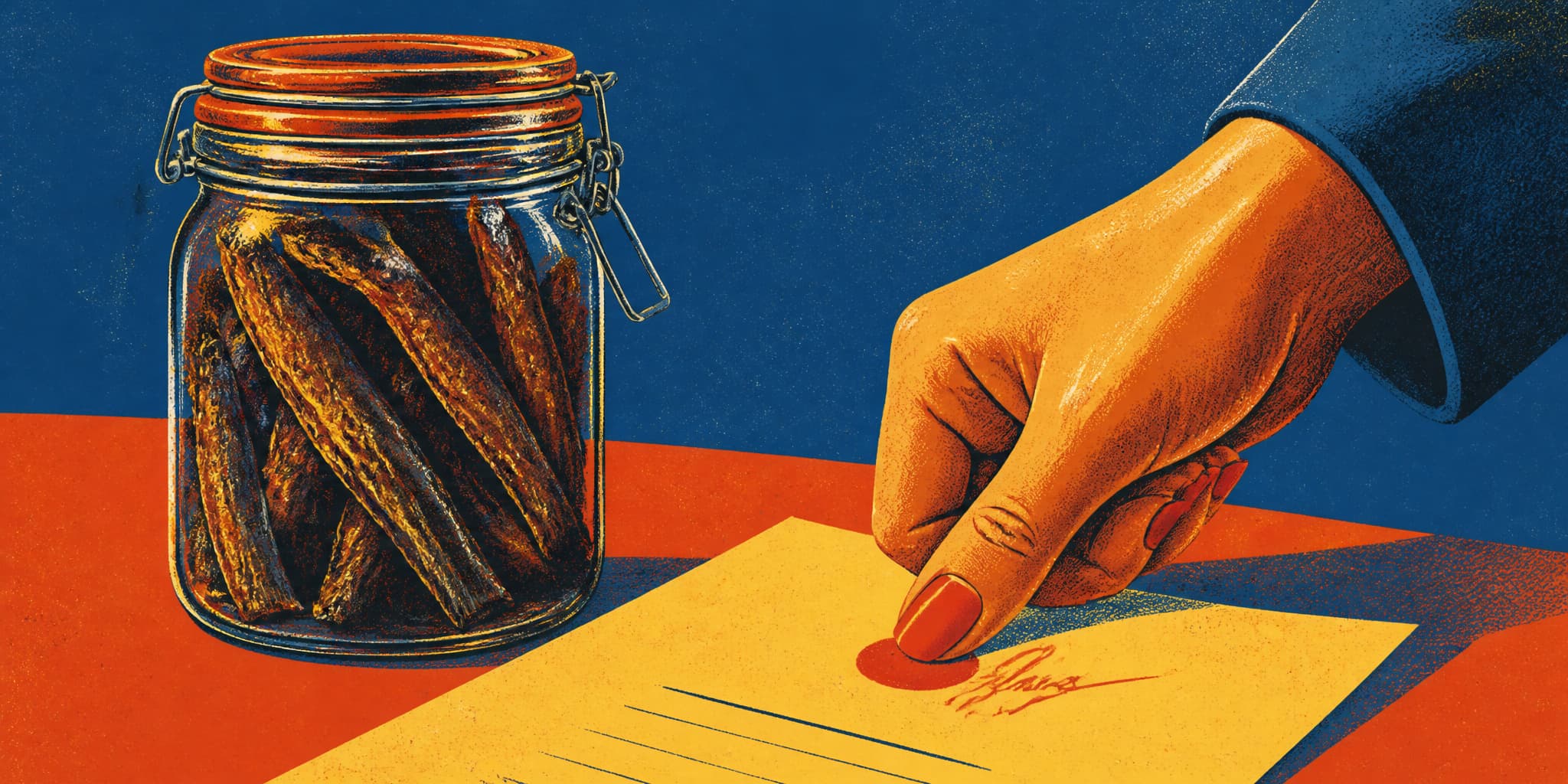
She lay on the bank a while. Then she drove back down, went out to the rack behind the kitchen, took every strip of the third batch off it, the whole run, packed it into a two-quart jar with a new lid, and set the jar on the table where the hearing would be held.
Margo · Bonneville
The room held seventy-one degrees the way a bank vault holds a number. It did not comment and it did not vary, and nobody in the building was aware that a decision about the air was being taken eleven hundred times a minute.
Margo had eleven items. Item four was an inquiry, routed to her because the compact's disposal payables were public, and they were public because a generation of reformers had believed that publishing what you spent was a kind of armor.
The inquiry was polite. On behalf of a client whose name appeared three entities back and was itself a holding vehicle, it asked whether the treaty seat could confirm recoverable biomass, verified tonnage, and character of use on the Willow Creek and John Day reaches, and whether any exclusive-take instrument existed or was contemplated.
Two paragraphs. Beautifully drafted. Whoever wrote it had read the disposal column and understood immediately what they were looking at, which put them four years ahead of every person who had been fishing it.
Margo did not stop it. There was no mechanism by which she could have stopped it, and she noted, with the honesty she permitted herself only inside her own scheduling, that she would not have gone looking very hard for one. Her cooling came off the same array as the archive. The archive came off the same array as the pumps. Everything she had was contingent on the sovereign's apparatus continuing to find her useful, and the fastest way to stop being useful was to become the woman who lost a routine inquiry.
She acknowledged receipt. She put herself into the hearing at Toppenish with a hard stop at ten.
Item six was the compressor at The Dalles, open six weeks, which was the actual substance of her employment and which nobody upstream would ever ask her about. A tray came in at eleven and she ate it while reading the maintenance history. Some white fish over rice, a warm roll, a wedge of melon out of season, all of it correct in temperature and quantity and none of it requiring anything from her. She reached for the roll twice without looking at it. When the plate went out she could not have said what the protein had been. It did not occur to her to wonder, because there would be another tray at three if she wanted one, and there had never in her adult life been a single day organized around when it was survivable to eat.
Then she opened the other thing.
What did you call it, she typed, when there was more of something.
It came back in her brother's cadence, which the model had learned off forty years of journal pages and had never once gotten wrong. Depends who's counting. If it's in your inventory you call it a surplus. If it's in someone else's you call it an infestation, and then you go and offer to remove it for them.
"Yes," Margo said out loud, in a room with nobody in it.
You've already sent it, the model wrote.
She closed the window. Fished the ice out of her glass with two fingers, dropped it in the sink, and went back to the compressor.
Tam · upper Grande Ronde
The request came in as a standing-stock estimate for the Willow Creek and John Day reaches. Biomass and distribution, thirty-day turnaround. It was the first job anyone had asked him for in eleven years that concerned there being more of something.
He built it the way he built everything. Temperature loggers off the plateau. Four seasons of catch-per-trap-line from the sheds that kept books, three seasons of grudging recollection out of the ones that didn't. The leading edge of the invasion walked upstream at a rate he could put an honest error bar around. A little over a week, start to finish, and it was the cleanest thing he had made in years, because for once the signal was not a small number getting smaller, and small numbers getting smaller are the hardest thing in the world to see through noise.
He looked at the finished pool-scale layer for about as long as it takes to boil water.
Sixty-one pools, each one carrying a centroid, a standing biomass, and a coordinate good to four decimals. In nine days, on request, he had produced a price list.
He had done this once before, with a cold-water refuge. Della had told him then that a map is the shape a thing takes just before somebody comes for it, and he had assumed she was being poetic.
He aggregated up. Sixty-one pools collapsed into three reaches, wide intervals on all three, the methodology written out plainly enough that any hydrologist alive would put their name under it. Then he deleted the pool layer. Then he deleted the intermediate products the pool layer had been built out of, which took four seasons of raw temperature series with it, data he could not get back and had no way to reconstruct.
What he delivered was true. It said there were a great many fish across a very large piece of country. It was worth precisely nothing to anybody who wanted to go and get them.
Fern came in from the beds with dirt to the elbow and a bowl of amaranth she'd cut before the heat, looked at the screen, and said, "Is it done?"
"It's done."
"Is it good?"
"It's useless."
"Good," she said, and went to wash.
Then, because he had two hours of allocation left and a bad habit, he opened the payables side. Rendering and disposal endorsements. Service Creek, Kimberly, Monument, Spray, Twickenham. Four years of them, hundredweight by hundredweight, dated and invoiced and paid, with a pickup point on every line because you cannot pay a hauler without telling the system where he stopped, and the plate number of every truck, and a year-over-year tonnage curve so steep a child could have drawn it freehand.
The map already existed. It had existed for four years. It was an accounts-payable file and nobody had ever called it a map, because nobody goes hunting for a boom in the disposal column.
He shut the machine and went out to stand in the shade of the pole barn where the jars were racked, four hundred and some of them, last year's fish in oil. The shelf above them was empty. The shelf above them was where the lids went and there were no lids.
Smoke does not keep fish. Everybody on the plateau who had learned to smoke in the first years learned that expensively. Get it to heat, hold it there, and it is magnificent for a week and a half and then it is a hazard. What turns a season into winter is salt and glass and a lid that seals. The sheds were not short of fish. There were more fish than the entire drainage could process before they spoiled. The sheds were short of lids, and salt, and whether a woman named Weir could hold a hauling endorsement through the next re-tender. Every voucher in that country cleared. Nobody up there was short of ledger. They were short of the one object that turns a good August into a fed February, and no currency that clears in a minute can make that object exist inside two hundred miles.
He had two hundred and forty minutes of uplink allocation banked. That was his eyes for the next four months and the only reason anybody at the seat took his calls.
He spent all of it in one sitting. Four pallets of lids off a Corridor jobber at Umatilla who charged him like a man who could hear the hurry in the request. Eight hundred pounds of coarse salt. He routed it to Reyes, because Reyes required no explanation and would not put a destination in a file. He confirmed the buy and watched the balance settle at a number that meant blind until December.
Then he sent Della one line, unencrypted, because there was no longer any point in the other thing.
The tonnage is already in the payables. Whatever they decide to call it, they can already find it. T.
Fern was in the doorway with her hands still wet. Out past her the wind had come up out of the southwest again, dry and warm and steady, the way it had been for most of two weeks.
"That was your season," she said.
"Yes."
"That was every minute you had."
"Yes." He picked up the hand truck. "Come help me clear the shelf."
Cass · Toppenish
The room was a hundred and four by nine-fifteen, because the seat's cooling ran off the same array as everything else and everything else came first. Vaccine chest. Archive case. Pumps. Two floor fans pushed the same hot air around in a circle. Fourteen people. A two-quart jar of smoked bass on the table in front of her grandmother.
Cass had come in, seen the jar, understood she had already lost, and sat down anyway, because the filing was in and the filing was hers.
Margo joined on the screen from Bonneville. Cass could see the light behind her, even and unmoving, and a glass of water on the desk with ice still in it at nine in the morning.
"I have a hard stop at ten," Margo said, pleasantly.
"Then we'll be quick," Della said, and neither of them believed a word of it.
The docket line was read out. Determination of Use, Willow Creek and John Day reaches. On the question of the character of the take. Filed at the request of the seat's own office of records, by Cass, and every head in the room came around.
"Right now what we're doing isn't anything," she said. "There's a payment per head and the payment is discretionary, so it can go to zero on a quarterly notice and nobody owes anybody an explanation. There's no limit on the take, so a freighter could come up the John Day with four boats and strip a reach and it would not even be an infraction. There's no license, so every shed in the drainage is running on a hauling endorsement that gets put back out to bid every three years to whoever underbids Hollis. Two hundred and eleven households on that plateau eat because one woman keeps her paperwork straight. That is not a fishery. That's a favor."
"It's a favor that's worked four years," Hollis said.
"It worked four years because nobody looked."
"Right," Reyes said from the back wall. "And?"
"And they're looking now."
Sparrow had the windowsill because she had refused a chair. She had walked in with nine people off the Willow Creek ruins, not one of them enrolled anywhere, and she had her boots up in a room three times more formal than she was ever going to be.
"Say the names," Sparrow said. "All of them, out loud. It's better when you hear them stacked up."
Delph said, from the very back, out of a chair too small for him, "It has to be one of six. That's the dropdown. There isn't a seventh."
"Nobody's asking the dropdown," Hollis said.
"I'm only saying that whatever you decide, I have to file it, and if it isn't in the list I can't"
"Sit down, sweetheart."
"I am sitting."
"Then keep at it," Sparrow said. "You're very good at it."
Hollis went first, because she had been holding it since the drive in. "Leave it what it is. Nuisance removal. You want to know why? Garbage is free. It's worth nothing, so I can take all of it, and I can put it in an unrefrigerated flatbed in August and drive it four miles with the tarp off, and I can hand a strip of it to a seven-year-old, and there is no record anywhere on this earth that any of that ever happened. That isn't a loophole. That's my entire operation. You cannot put a limit on garbage."
"You also can't protect it," Cass said.
"No. I can't." Hollis took the fogged glasses off, looked at them, put them back on. "The rate can go to zero on a Tuesday. My endorsement goes back out to bid in fourteen months and any outfit with a newer truck takes it off me. Four years feeding that plateau and I have got the exact standing of a man with a shovel and a hole in the ground. I know that. I'm telling you what it buys me anyway."
"It buys you nothing forward," Alahmoot said. "That's the whole disease. Call it a harvest."
"Here we go," said Reyes.
"A harvest has a name a man can put at the top of a page. I have eleven hundred pounds in barrel at Umatilla and I got one rewound coil for it, once, off a handshake, and I cannot get a second one, because nobody at that gate will hold a delivery window against nuisance material. There is no forward market in garbage. So my people run four hours a day, and every single year I buy the same season over again from scratch, and if you leave this thing unnamed I will keep buying it until I die and it will never once compound. Not one time. Give me a tonnage and a delivery point and I will have a transformer by spring."
"And a coordinate in a public contract," Della said.
"And a coordinate in a public contract, yes. We did this at five o'clock this morning."
"Do it again for the room."
"Fine." He turned in the chair to face all of them. "She thinks that the minute it has a tonnage and a place, it has a value, and the minute it has a value somebody buys the right to it, and it won't be me. She's right. She has been right about that for fifty years and it has never yet helped one person get power."
"License it," Cass said. "License, limit, gear rules, a season. A name that stands up in the record. If it's a licensed fishery then a freighter needs the license too, and the sheds hold the licenses, and then it isn't a favor, it's a right, and a right survives a bad quarter."
"It would have to clear," Margo said, in the reasonable voice of a woman who had never once had to raise it.
"Clear."
"Licensed proceeds are ledger transactions. That isn't a policy choice, that's what a license is. A license is an instrument. It has a value and it's transferable, and once it's transferable there is a register of who holds it, and payments against it either clear or they don't." She let that sit exactly as long as she meant it to. "You should also know there has been an inquiry. Downstream. On the tonnage in the disposal column at four stations. I don't know who's behind it and it wouldn't help you if I did. But the reason we are having this meeting is not this meeting."
The quiet that came after had a particular texture, and inside it Cass thought about the message she had read over her grandmother's shoulder two nights before without permission.
"Transferable," Reyes said. "So the day after you license it, some outfit in Portland owns nine of them and Hollis is leasing back her own water."
"Not necessarily"
"Name me one instrument in this basin that ever stayed with the people it was issued to."
Nobody did.
"Subsistence," said one of the Willow Creek people, a woman with a scarf over her mouth against the dust. "It's food. Call it food."
For about the length of a held breath it sounded like the answer. Then Della said, "Subsistence use is allotted per enrolled household," and Sparrow started laughing and did not stop for some while.
"There it is. That's the one. Allot me, Della. I would love it. Take my census." She swung her boots down off the sill. "I have nine people in your hallway and between them there are four given names they'll admit to out loud. Two of them were born in a place that isn't on the map anymore and one of them was born in a truck. You put subsistence on this and every one of them is a poacher by Tuesday. Not by accident. Not by oversight. By the operation of the exact thing you wrote down to protect them. Enrollment is a fence, and I don't care how kindly you build it, I'm still on the outside of it eating."
"That isn't the intent," Cass said.
"Sweetheart," Sparrow said. "Nothing ever is."
"Then continue it." Cass heard how thin it came out even as it left her. "Take no decision. Leave it open another season and let us come back with something better."
"No." Reyes, flat, off the wall. "Undetermined character defaults to unauthorized take. Ninety days and every trap line on those reaches is illegal on paper."
"Nobody enforces up there."
"Somebody enforces once." Reyes came off the wall. "That's how it works. It isn't a patrol, it's a visit. They don't have the bodies to do a whole drainage, so they do the biggest thing they can find, one time, with cameras, and the biggest thing they can find is whoever has the most paper. That's Weir. Four years of invoices with a pickup point printed on every line. You continue this, and the first arrest in the history of this fish is the woman who fed the plateau, and every unregistered man on that river keeps right on working, because he isn't in the file. You'd be picking the one person to lose."
"I'd survive it," Hollis said.
"Your endorsement wouldn't."
Hollis was quiet a long time after that. Then she said, "Can I ask a stupid question."
"You never have yet," said Della.
"If we call it food. Am I going to have to start telling people not to eat it?"
Nobody answered her.
"Because the big ones aren't clean. Everybody knows the big ones aren't clean. That's why there's a board nailed up at every station in this drainage saying nothing over sixteen inches goes to a kid, and I wrote the first one, and no advisory in the world made me do it. We worked it out ourselves, out of what our people already knew, and we hold it, and I have never once seen it broken. You make it a licensed food fishery and somebody upstream has to write the real limits down, and the real limits are going to say two meals a month for a child. And then what am I? I'm running a shed that feeds two hundred households four times what the paper allows them. The day the paper exists, I'm the violation. Not the freighter. Not the man in Portland who buys nine licenses. Me. Because I'm the one who wrote everything down."
"So we don't write it down," said Reyes.
"So we don't write it down," Hollis agreed. "And then it's a favor again."
"It's a favor with a name," Sparrow said. "The name is Hollis Weir, and when she throws a clot at sixty-one it goes into the ground with her, and the plateau eats out of somebody's cousin's smokehouse and hopes he read the board."
Then it turned and stopped being about the fish.
Cass heard it come out of her before she had decided on it. "The record has never protected us. Not once."
Della's head came around.
"A hundred and thirty years of filings. You have a claim in that case that names a temperature the run has to have, and it has been true and on file and defended every year of my life, and the river has not been under that number since before I was born. So what is it for? You keep telling me it's so the record says taken. Fine. Taken. Who reads it? Who has ever come back, read it, and given anything back?"
"Nobody," said Della.
"Then what is it for."
"It's for the day somebody does." Her grandmother's voice did not rise. It went down, which was worse. "And on that day the file will say what happened, and it will not say that we agreed."
"That's not a strategy. That's a grave."
"It's an inheritance. You are standing in it. It is the only thing I have that they were never able to buy, and you have spent five weeks trying to trade it for a fish."
Sparrow said, into the middle of that, without any particular cruelty, "Della. Your grandmother's fish is inside my fish."
Della looked at her.
"That's what it eats. The young salmon going down the river, that's the whole diet, that is the entire reason there is so much of it. Fifty years everybody in this basin prayed for a run, and what came back came back the wrong shape and starving, and this thing ate the prayer, and now it is the only protein you can count on between the Cascades and the Bitterroots, and it is sitting in a jar on your table." She opened her hands. "You want me to spit it out? I'll do it on your floor. My people eat tonight either way. I'd just like to know what you'd like me to call it."
Della picked up the jar. She turned it over once, the way you check a seal.
"You brought that in here on purpose," Cass said.
"I brought it in here so nobody could be delicate."
"I have four minutes," Margo said.
She withdrew the filing.
In its place she moved for a consolidated nuisance-removal designation covering the entire take on both reaches, the rendering-and-disposal endorsements attached to their existing holders, and a five-year clause barring re-tender. Nobody objects to a non-tender clause on garbage, because nobody bids on garbage. It was the one durable thing anywhere in the instrument.
And the designation required, because every designation requires the fact that makes it true, a statement of fact entered in the record of the treaty seat.
The take is not a food fishery. The material is not consumed as human food. The material is rendered and disposed.
It took under two minutes to draft, because Cass had drafted it eleven days earlier in the middle of the night, told nobody, and hoped very much not to need it.
It needed her grandmother's mark. Everything in that record needed her grandmother's mark.
Della read it. She read it twice. She read it the way she read everything, at arm's length, because she had refused glasses for years, out of what Cass had always taken for vanity and had lately begun to suspect was something else entirely.
"A century from now," Della said, "somebody is going to pull this file."
"Yes."
"And it will say that in the worst decade this country ever had, when the one thing there was enough of was a fish, my people wrote down that we did not eat."
"Yes," Cass said. "It will."
"And that will be a lie."
"Yes."
From the back of the room Alahmoot said, "Della," and there was something in it Cass had never once heard out of him, and Della did not turn around.
She signed.
Her hand didn't shake. She also did not put the pen down. She sat in a hundred and four degrees in front of fourteen people with her thumb laid over her own mark, and for about three breaths her face was not the face she wore, and Cass looked away, because she had not earned the right to be watching. When she looked back it was over and Della was capping the pen.
"Margo. You have one minute."
"I'll enter it today. For what it's worth, it will work. Nobody prices a rendering stream."
Sparrow made a short sound through her teeth.
Margo's eyes came up to the camera and stayed a moment past what composure required. She did not walk it back. "I'm sorry about the inquiry. I couldn't have stopped it and I didn't try very hard."
"I know," said Della.
Alahmoot was already in the truck when Cass got out to the lot.
"You lose the rewind," she said.
"I lose the rewind. I lose Umatilla. There is no forward market in rendering." He started the engine. "Idaho files anyway. I told her so in her own kitchen at five in the morning like a man, and I'm still doing it, and she knows exactly why."
"It doesn't hide anything. You understand that. Tam says they can already find the tonnage in the payables, they've had it four years. It doesn't hide her. All it does is mean that when they get here, Hollis is still the one holding the paper."
Alahmoot looked at her for a second, and something in his face conceded a point he was not going to say out loud.
"Then they'll find me first," he said.
"They'll find you first."
"Somebody has to be first. It isn't going to be Weir."
Cottonwood Draw at four in the afternoon ran a hundred and twenty-four in the shade of the shed roof. The rack house was worse. Cass had been in it ninety minutes and had sweated through everything she owned.
The stencil was cut out of a sheet of roofing tin with a chisel by Hollis's nephew, because the paper ones went soft in the humidity coming off the racks. The ink was oil-based, black, out of a can stirred with a broken screwdriver.
NUISANCE MATERIAL
RENDERING AND DISPOSAL
NOT FOR HUMAN CONSUMPTION
Barrel after barrel, forty gallons apiece, coarse salt and split fish packed to the shoulder, bound for the Corridor and the plateau and the church ruins and every place inside two hundred miles that ran on four hours of power and a good seal. The crew loaded behind her while she worked down the row. Nobody said one word about the words. The tin came away with a wet clack every time, and she set it on the curve of the next barrel, and the ink ran a little in the heat, and around the fifteenth one she stopped caring.
Reyes came in at five with the pallets and the wind behind her, that same dry southwest wind that had been blowing for most of two weeks. Four cases of lids. Eight hundred pounds of salt. A note in Tam's handwriting that said only from the shelf. Hollis looked at the lids for a long moment, then went and got her ledger and wrote nothing in it.
One of the plateau kids, seven maybe, came through the rack house with the sideways gait of a child intending to steal something, reached up, and pulled a strip off the bottom rung of the third rack. A small one. Under sixteen inches. He knew it, and he had checked.
He ate it standing next to the barrel Cass was working on, watching her hand.
"What's it say?"
"It says it isn't food," Cass said.
He chewed.
"It's food," he said.
"I know."
Cass shook the can, laid the tin flat against the next barrel, and pulled the brush.
From the drafting file: smallmouth bass are nonnative in the Columbia Basin, and modeling suggests warming will substantially expand the river habitat thermally suitable for them, pushing them farther into the reaches where juvenile salmon rear. Work in Lower Granite Reservoir documented what that overlap costs: hundreds of thousands of juvenile Chinook eaten across three years, nearly all of them subyearlings, with the heaviest June losses landing right on top of the hatchery releases. The basin already runs a real per-head reward instrument, though for a different fish. Washington's rule calls it a "bounty voucher program", it pays on an escalating schedule for northern pikeminnow, and it requires that the whole fish be surrendered to collect. The awkward part of the abundance is real too: state health guidance already limits bass meals for children and pregnant people. Everything else here is invented. For the view from the other end of the ladder, see David Kern's "The Yard She Chose," which opens with a walleye on a haven dinner plate.
- The bounty already exists: Washington's northern pikeminnow reward fishery pays anglers per head on an escalating scale and last year returned more than 150,000 fish, with the top angler collecting $159,310 for a single season's work — a nominally recreational program that already functions as a job for a handful of people.
- What the paper allows you to eat: Oregon's advisories are reach-specific in a way that makes "is this fish food" a question with a different answer every few river miles, including a stretch above Bonneville Dam where the state advises everyone not to eat resident fish at all.
- Smoke is not storage: extension guidance on home fish smoking is blunt that lightly salted hot-smoked fish is not shelf-stable and must be refrigerated, frozen or properly canned, which is why the binding constraint in a good year is often the lid rather than the catch.
- Fish as a currency with no posted rate: Alaska's fisheries agency has documented real barter transactions in mixed cash-and-subsistence economies — smoked salmon strips for five days' use of a car, a bucket of salted sockeye for two frozen turkeys — in a technical study of sharing and trade that shows exchange value tracking processing labor and reputation rather than any fixed price.
