Three-ten in the morning and the dryer still hadn't shut off. Marit put her bare hand into the stream coming off the cooling section and let the kernels run between her fingers, warm at first contact and then barely anything, and she held it there for a count of five.
Warm. Not hot. Fine.
She'd carried her jacket out of the house and hung it on the rail by the shop door without putting it on. Second week of October, three in the morning, and there was no edge on the air anywhere. Wet corn and diesel. Past the machine shed a cricket was still working, and it registered on her about as much as a bulb left burning in a room nobody was in.
Nineteen into the dryer, fifteen out. Fifteen because fifteen percent water was what the elevator paid on, and anything under that was moisture she'd burned propane to take out and then handed across the scale for free. She had done that once, her second year alone on the place, and it still came up in her more often than most things did.
Wet bin. Fan. Burner temperature. She put the numbers on the back of her hand with a carpenter's pencil because it was faster than the phone and because both her thumbs were split open at the corners.
Then the pile.
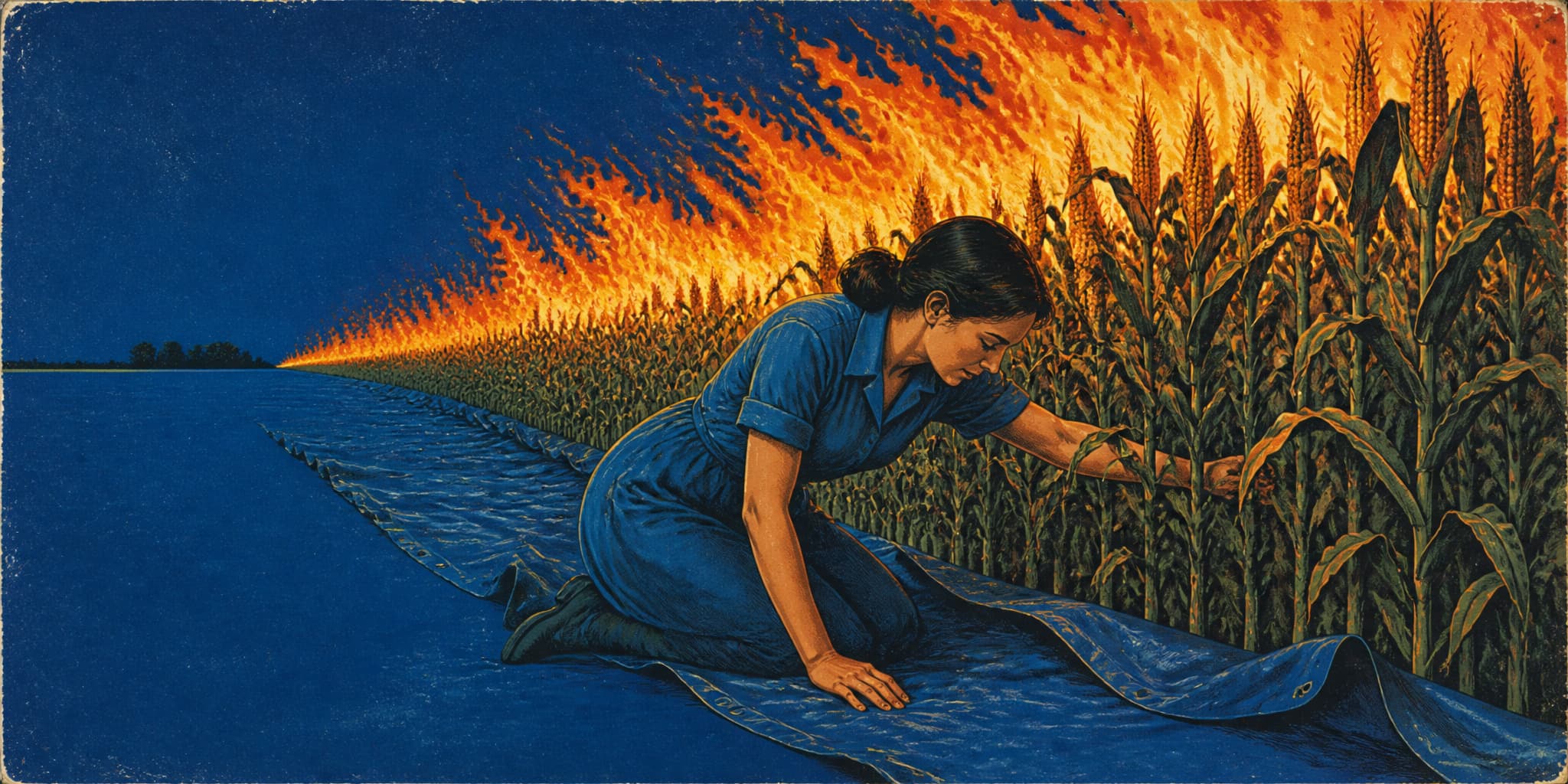
Her father had crowned that gravel pad for a machinery shed he never built, and in August she had stood on it and been grateful to him, having run the bin space three times and come up eleven thousand bushels short every time. Now a ridge of corn lay out there the length of the yard, tarped, straps cinched every four feet, a fan at the north end pushing air up through the mass. She knelt where the tarp lapped the shoulder and worked her arm in past the elbow. The corn closed around her forearm, dense, dry, giving a little and settling back against her skin.
Cool. Cool all the way in.
Except Tuesday's last load, which had gone on warm off the dryer at eleven at night because the cart was full and the truck was full and she was not shutting down for it. That corn was in there. Northeast quarter, under two days of everything since.
Rain Thursday. She had looked at the forecast enough times to stop looking.
The dew came off around a quarter after seven and she took the head into the north eighty.
Eleven feet of corn, dark, leaves hanging down dead-dry. The snouts took the first rows and the sound came up through the floor of the cab into her hips, and her shoulders dropped an inch on their own. Stalks going down. The pull of it. Then the pitch dropped as the threshing drum took the weight, the whole machine bending its note to whatever work was in front of it.
Two hundred feet in, the monitor found a number.
Two eighty-one. Two ninety-four. Then it sat in the low three hundreds all through the point rows and she said something out loud that she wouldn't have said with the kid in earshot.
A yield monitor doesn't see bushels, it sees grain hitting a plate, and it will lie to you very politely all week while the crop dries down under it. She'd calibrated it Monday against a weighed cart, twice. She had also crossed the scale in town forty-one times, and the scale and the screen were saying the same thing, and what they were saying was that this field would come in over two seventy dry on ground that made one ninety for her father in a year he called excellent.
None of the pleasure was complicated. That was the part that had never once made it across to anybody who didn't do this for money. It was in her forearms and behind her sternum and it made the coffee better than the coffee was. A machine doing exactly the thing it was built for, in a crop that got what it needed at the hour it needed it, and her hands on all of it.
Cole came up on her left with the grain cart at half past eight and matched her speed inside of four seconds. She swung the auger out and started it without looking, because on this combine every part of that lived under her right thumb. Fingertip. Header height, auger, engage, resume.
That was Dale Ostby's combine.
She'd bid on it in March in a shop with forty men in it and coffee in styrofoam and Ostby off by the parts washer with his hands in his jacket pockets, not talking to anyone. She got it for less than it was worth. Everybody got everything for less than it was worth that day. And her right shoulder, which had been waking her at two in the morning for six years off ten thousand full reaches a season on the old machine's throttle, had quit hurting sometime in the first week of September.
She had noticed that.
The grain came over the auger in a brown rope, and Cole held the cart just off her hip with his eyes up under the bill of a cap that carried his mother's co-op name. Nineteen. He set his header height by ear. When they broke for a plug in the cart auger he came off the tractor without touching a rung, one hand on the rail, and landed flat-footed on the stubble with his knees loose. She backed down her own ladder facing it, three points of contact, and the last step arrived in her hips. He had never been in a cool August. Nobody had kept it from him. There had never been one.
The Hovde ground came up to her west fence. Two quarters and a bad-drainage forty. Cole's mother had been paying somebody's custom rate on it three seasons running and last spring she'd put beans in late, and late didn't work the way late used to. From the road you could count the combine's passes.
Marit had been working out how to ask her about renting it. She'd been working on it while she greased the head, which was worse than asking.
Loss check at ten. You check when it's bad and you check harder when it's good.
Twenty feet back into the stubble, down on her heels, a square foot of dirt framed between her hands. Two kernels in that space is a bushel an acre on the ground. She counted three, and a foot off, a cob with a thumb's width of corn still riding it, which is a couple hundred kernels lying in one place where anybody could see them.
Back in the cab she pulled four-tenths off the ground speed and closed the plates that strip the ear off the stalk by a quarter turn. The sound in the head changed. The number on the screen dropped two bushels and the ground coming out behind her came up cleaner.
By two the cab was doing what it could and losing. Sun coming in flat off the glass and lying on her left forearm and staying there. Sweat down inside the collar, out of the hairline, dragging a rim of chaff dust along with it, so there was grit in every crease where wet skin folded on itself. The bandana was already loaded. Her eyes went sandy at the corners. Dust rode the cab in a slow spiral no matter what the filters were rated for, laid itself along the window ledges, packed into the seat seams; she pulled her hat off and her forehead was gray to the line of it. A liter of water. A cheese sandwich in eleven bites with the machine still going. And her lower back had that specific stiffness by then, the sitting-and-twisting kind, left to the cart, right to the head, back to the screen, left again. Her knees would bring it up to her at four-thirty in the morning.
Somewhere in that pass, monitor sitting at two ninety-eight, tank filling faster than she could keep a cart under it, she did the arithmetic. Not by deciding to. It came up the way a phone number from childhood comes up.
She'd first seen this hybrid at a plot day in a field outside Danvers. Folding chairs, a tent with a logo, little orange flags with numbers on them stuck at the end of every strip, cans in a stock tank of ice. A man with a laminated card. She'd stepped into row four and pulled a husk back with her thumbnail and thought, well, look at that.
Eight years ago. She put it on the whole farm three years after. And before the tent and the folding chairs it had sat in test plots four or five seasons while somebody watched what it did in a wet June and a cool August, the kind of season that gets averaged into a recommendation. Before that, greenhouses. Somebody's crosses. Somebody's notebook.
She could not bring up the last wet June that came when it was supposed to instead of three weeks late and all at once.
It was the best corn she had ever grown. Bred to be excellent somewhere that used to be here.
The monitor climbed to three-oh-four. She watched it climb.
The section along the road into town was still standing.
Standing wasn't it. Leaning, ears pointed down at the dirt where the stalks had gone soft at the base, and a flat patch in the low spot where the water sat in June. It could have been anything. Too wet to get in. The moisture never coming down far enough to be worth the propane. The propane not being there. The operating note coming due, and no sense putting six hundred dollars of fuel into a crop the bank already owned. From the road you can't tell a decision from a collapse. It was not her business. She looked at it going and looked at it coming back.
Past the corner, on the sand ridge the Erdahls quit on, forty acres of sorghum stood rust-red and shaggy in the ditch light, headed out and nowhere close to ready. She thought about the frost date and nothing else and kept driving.
Fourth in line at the elevator, which at four in the afternoon in the second week of October used to be twelfth. The scale house knew her truck without asking for an account number. Tim Lund was two ahead with his tarp rolled back, and he came down out of the cab, and the two of them stood in the diesel smell watching the probe go into the load in front of them.
They talked about a bearing he'd lost in a leg auger. Then she said, because she had never once gotten less direct with age, "What are you putting in over there next spring?"
Tim looked at the scale house. He said the corn was coming good this year, wasn't it.
"Best I ever had," she said.
He said, "Yeah," and nodded three times, and got back in the truck.
That was all of it. She stood with her hands in her back pockets and the sun on her face in October the way it comes in August. The question had been rude and she wasn't going to be sorry about it. He'd be gone.
Two trucks up, a load got pulled out of line and parked against the west wall to wait on a test. She'd had that, three years back, when the rot came in through the tip of every damaged ear on her light ground and the elevator wanted a number before it wanted her grain. You find out how long an hour is, sitting in a truck cab next to your own corn, waiting to hear whether it's food.
She'd been topping bins one at a time since the weekend and running the overflow across the pad. The last bin took its cap Wednesday afternoon. She stood in the yard with the empty cart behind her and the sky doing nothing in particular and laughed once, one syllable, at herself and at nobody.
Eleven thousand short in August. Nineteen thousand over at the end.
Everything after that went on the pile, and it went on at fourteen, not fifteen, because a pile is not a bin. A bin you can push air through and fix what you got wrong. A pile you can only maintain. She'd read that sentence twenty years ago in a bulletin with her father's handwriting out in the margin and it had gone into her like a splinter and stayed. So she ran the whole week through the dryer, the loads that came off the field at seventeen and the loads that could have gone straight to storage both, and she took every one of them a point past what anybody was going to pay her for.
Forty minutes to walk the tarp that night with a flashlight, hand on each strap feeling for slack, ear on the fan. Where the cover met the crown she got down and pushed her arm in.
Cool. Except.
An inch of rain takes the top foot of a pile from fourteen percent water to twenty-three, and no fan is pulling that back out before it starts. She knew the other number too, the one for warm grain at twenty percent, the days you get before it stops being grain. Sixteen. Sixteen days at seventy degrees, and it had not been under seventy in the daytime since the second week of April.
Tuesday's load in there. Northeast quarter, under everything, doing whatever it was doing.
Thursday's rain came in at half an inch and quit, and the wind behind it was southeast and warm, and she stood in the yard at six in the morning with the fan running and could not learn one single thing from the sound of it.
Friday night, kitchen table, the spiral notebook that went back eleven years because a season only takes six pages.
Date. Field. The seven-digit hybrid number off the tag she kept folded in the door pocket of the tractor. The tag gave the lot and the germination rate and the day some lab had tested it. It did not give the year somebody first stood in a plot and liked what he saw. There's no place on a bag for that.
Population. Planting date, April 9, which was two and a half weeks earlier than her father ever went to the field and which nobody around here considered early. Moisture at harvest, high and low. Bushels wet, bushels dry. A line for each bin. Then a line for the pile, which she'd had to add, because there had never been a line for the pile.
Under all of it she wrote best ever. Sat with that a while. Didn't cross it out.
Then she turned the page. Thirty-one ruled lines.
At the top she put the hybrid number she'd ordered in August. Not this year's. Seven digits she had never had in the ground, out of somebody's greenhouse and somebody's notebook and some run of seasons she had no way to go back and ask about, and what she knew about it was what the man had told her and what it had done in strips two counties south.
Under that she wrote the north eighty and the home quarter and the school section. Her hand came to the next line down, the one where Hovde's two quarters and the bad-drainage forty would go, and stopped there with the pencil resting on the paper, and stayed stopped, and then went past it to the line below.
She put her palm flat on the blank page. Outside the wind came around and the fan on the pile shifted its note, up a little, the way it does when the air moves, and she left her hand where it was until the paper had taken her heat and started giving it back.
-
The pile is not a bin: North Dakota State University's guidance on alternative grain storage explains why grain has to arrive dry and cool, why a crowned and drained site matters, and why a single inch of rain can take the top foot of a corn pile from 14% moisture to 23% with no practical way to dry it back down.
-
What the screen actually knows: A yield monitor infers bushels from mass flow, moisture and calibration factors rather than counting them, which is why Iowa State's combine calibration guidance recommends recalibrating for every 2.5-percentage-point change in corn moisture to hold error under 5%.
-
How long a hybrid takes: Iowa State's model of commercial maize line development walks a candidate from breeding crosses through roughly four years of performance testing and a precommercial strip-trial season, which is the arithmetic behind Marit's memory of a plot day eight years back.
-
Whose target climate: A review in The Plant Cell on breeding for drought-affected environments describes the "target population of environments" a variety is selected for, and notes that how fast those environments shift determines whether adaptation can keep pace with them.
