
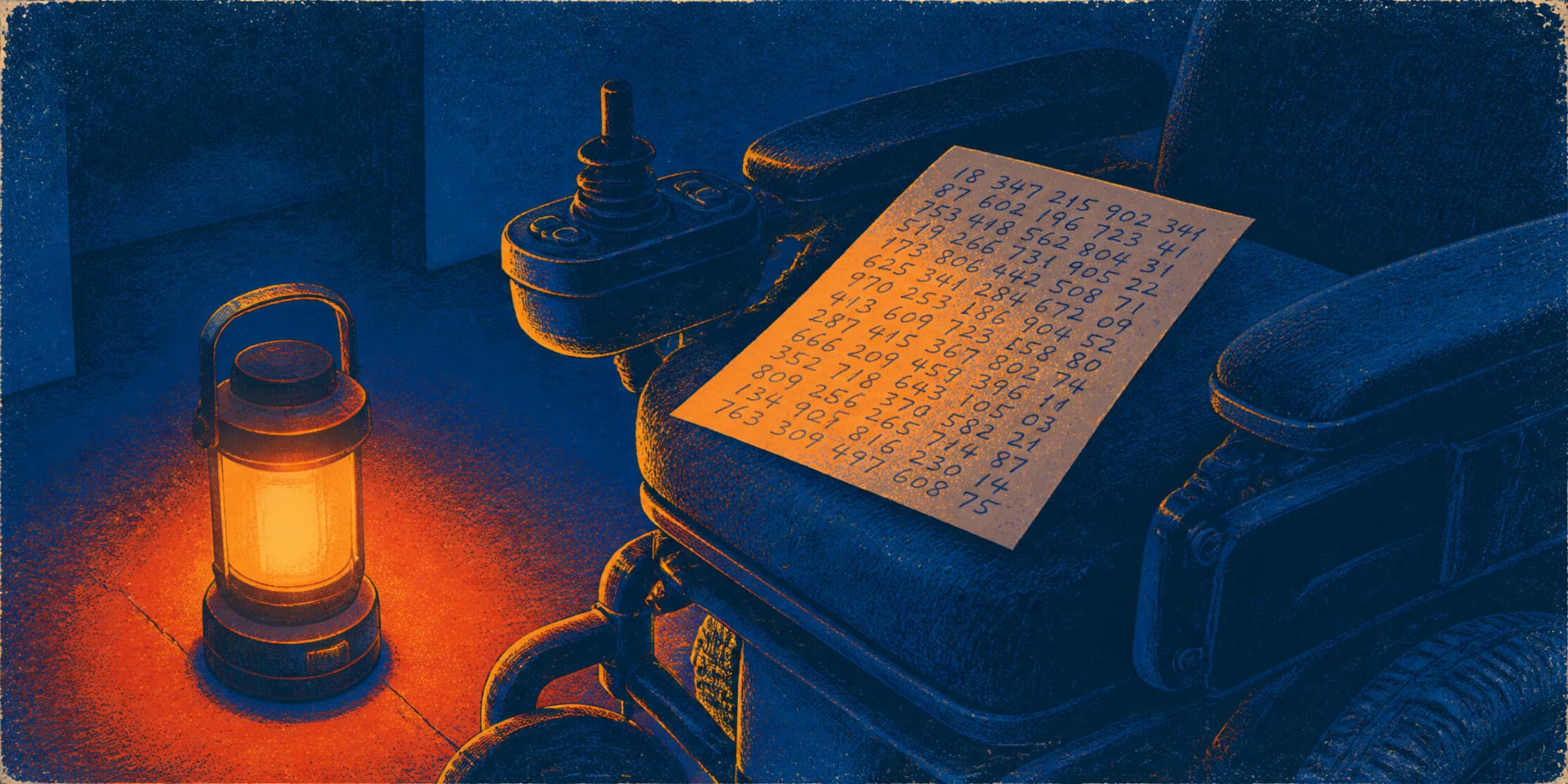
Just after midnight, in the second week of October 2019, the lights went out in Napa and Gina Biter-Mundt started counting.
She got her motorized wheelchair onto the generator. Part of the house had light in it and part of it didn't. The chair is how she crosses a room; the electric lift bed is how she gets out of one. Both were running that night on fuel and stored charge she had bought with her own money.
She told the San Francisco Chronicle she figured the chair had about two days in it.
Two days is not the same statement as "I'm covered." It's a quantity with an end on it, and she knew the number because she had sat down at some point and worked it out, understanding that nobody else was going to do the arithmetic for her.
Pacific Gas and Electric, the utility serving most of Northern California, now switches off its own lines deliberately. When the wind picks up and the brush is dry enough that a snapped branch or a failed piece of hardware could start a fire, the company de-energizes whole circuits, sometimes for days at a stretch. The industry calls this a Public Safety Power Shutoff. In most houses it means a warm refrigerator, spoiled groceries, a week that gets ruined and then gets over.
In a house where the bed is a machine, a shutoff behaves differently from a breakdown. Nothing malfunctions. The chair works and the bed works; they simply drain, on a schedule she can calculate days out, while every institution that has her name in a file moves slower than her batteries discharge.
Then she said this, which is the part I keep going back to:
"And I'm one of the fortunate people where I've already thought about this stuff. There are some very vulnerable people out in the community who probably don't have the financial means to be able to just purchase a generator. … I'm concerned for those people that really are dependent on power, especially for oxygen to be able to breathe."
She is the prepared one. Generator, lithium battery, a plan she had walked through. She has taught disaster preparedness to other people. She has sat term after term on Napa's building-code and disability-access boards, and on a state advisory committee whose entire job is making emergency plans work for residents like her; the Cal OES evacuation planning guide thanks her by name for that service. If a private system in Napa County was going to hold, hers was the one.
Hers was measured in days.
How long a shutoff actually lasts
The shutoffs are a fire-protection measure, which is the part of her situation that doesn't resolve: the thing that starts her countdown is the thing keeping her house from burning. Napa sits inside the high fire-threat territory where the utility concentrates this work, and the same county circuit names keep surfacing, filing after filing. Two hazards are pressing on the same woman, and only one of them arrives with a program attached.
Every time the utility cuts power it has to file a report with state regulators. Those reports are public, which is how anyone outside the company can learn how long a shutoff actually runs.
Long enough that an evening is the wrong unit. In October 2024, PG&E de-energized a Napa circuit called Silverado 2104; the post-event filing records the first customer losing power at 6:30 p.m. on the 17th and the last one restored at 1:18 p.m. on the 20th. Sixty-six hours, forty-eight minutes. A circuit near King City ran 71 hours, 35 minutes by that same measure in June 2025. Those figures describe the outer envelope of an event rather than any one household, and plenty of homes on a circuit sit dark for less. Which circuit feeds Biter-Mundt's house, I don't know. It isn't in the public record and I'm not going to guess at it.
What the record does establish is that Napa is still on the map. This past June the utility switched off two circuits serving the county for 17 hours 40 minutes and 16 hours 26 minutes, taking in 4,256 customers across eight counties. Of those, 228 were enrolled in the utility's program for households running medical equipment.
That counted as a short event by recent standards. It still outlasted the rated battery life of most portable oxygen concentrators. Take one current model from a major manufacturer: on its largest optional battery it is rated at 12 hours 45 minutes if the prescribed setting is the lowest, and 2 hours 30 minutes if it's the highest. That extended battery lists at $618. Getting through 66 hours on the high setting would take twenty-six of them, all charged in advance, in a house where nothing can be charged.
One Napa circuit shutoff in 2024 lasted 66 hours. The largest optional battery for a portable oxygen concentrator is rated at 2 hours 30 minutes to 12 hours 45 minutes, depending on the prescribed setting. Biter-Mundt's wheelchair had about two days in it.
One of the people she was worrying about at midnight is in the record too. Up in the Sierra foothills in Grass Valley, during that same October shutoff, Deanne Mediati was woken at 3:30 in the morning by her husband, who said, as she told the Guardian, "Honey, the power is out. You're not breathing." Her oxygen concentrator had quit. "I could have died," she said. Earlier shutoffs had skipped their area, so the household hadn't stocked up, and she spent part of that night hunting in the dark for a hose that would fit an emergency tank.
Her husband was the alarm, and there wasn't a second one.
What being on the list actually buys
There is a list, and most Californians assume it covers somebody in her position. Her published account doesn't say whether she's on it, and I can't confirm that she is. But the list deserves reading in its own language, because the language isn't ambiguous.
PG&E's Medical Baseline program gives households with qualifying equipment additional electricity at the cheapest rate tier, roughly 16.438 kilowatt-hours a day, or a percentage discount depending on the plan. Getting in requires a doctor or other qualified practitioner to certify the condition or the device, and then recertify periodically. Enrollment also buys notice: the utility says it tries to reach these customers about 48 hours ahead of a shutoff, again near 24 hours, and once more just before the power drops, with additional attempts if the alert goes unacknowledged. Someone may come ring the doorbell.
So: a discount, and a phone call. The application form is candid about the rest.
"PG&E cannot guarantee uninterrupted gas and electric service. I am responsible for making alternate arrangements in the event of a gas or an electric outage."
The utility's tariff, meaning the rulebook state regulators sign off on, promises "reasonable diligence and care" in supplying electricity while stating that it "does not guarantee continuity or sufficiency of supply." A Medical Baseline account can also be shut off for nonpayment, the same as anyone's.
I've written in these pages about the distance between an institutional milestone and what's actually happening in a household, about how the word "awarded" in a disaster buyout program describes the condition of a file and not the condition of a family. By that standard Medical Baseline is unusually honest, because the gap isn't hidden anywhere. It's printed on the paper you sign. Enrollment moves a name into a database and a call queue. Responsibility for the electricity stays where it started: on her, out of her budget, with her body setting the deadline.
Rebecca Fortelka, who has cerebral palsy and uses a power wheelchair, went 48 hours without electricity in Livermore during that same 2019 event. Her family bought a $10,000 diesel generator, which the Guardian reported cost $1,000 to $1,200 a day to run. That is what hours cost at retail.
Nobody is named beside her
I went looking for the people around her that night: a neighbor with a working outlet, an attendant, a relative who could help with a transfer, whoever ran out for fuel.
The published record doesn't produce anyone. The Chronicle's account names no aide, no family member, no neighbor. What it shows is a woman in her own half-lit house, doing arithmetic and worrying about somebody else's oxygen. I also looked for her in the public materials of the boards and the state committee she served on, for anything she has said about shutoffs or evacuation. The state guide lists her as a member. It doesn't quote her. Those two paragraphs from 2019 appear to be the whole of her public voice on this.
I'm not going to conjure up the person who might have been standing in that room. The absence is itself information, and it's a strange one: the woman documented as a fixture of Napa's disability-preparedness infrastructure, the one on the boards and the state committee, is documented by herself, once, after midnight.
I recognize this arithmetic from childhood. The autumn I turned thirteen, in the smoke season, the Oakland neighborhood I had landed in from Guatemala organized itself around the families who could not evacuate, while help arrived fast and coordinated somewhere up the hill. My grandmother had come from highland farming and my mother from organizing, and what both of them knew, in different vocabularies, is what I understood that fall and have never had cause to revise: emergency response follows the addresses already known to somebody with a vehicle.
Where the record does show the network Biter-Mundt's account lacks, it looks like a household in Placerville. Deborah Kurtti was the caregiver for her sister Valerie, who used home dialysis, a CPAP machine, and oxygen every day. Their propane generator, Deborah told CBS Sacramento, was "lucky if we get four hours." In 2020 the California Foundation for Independent Living Centers lent the family two batteries, sixty pounds each, worth roughly $3,000 apiece, with no return date attached. In that house it meant Valerie could breathe and run dialysis through the night without her survival being her sister's unpaid shift.
Two separate things had to fall into place: a sister who lived in the house, and an organization outside the utility willing to hand over $6,000 in equipment. There's no form for either one.
The batteries nobody can apply for
Public routes to backup power do exist. The conditions attached to them explain why the gap stays open.
PG&E's Portable Battery Program takes no applications. The utility decides who is prequalified and has a partner reach out. To qualify you have to depend on medical or assistive equipment, already be enrolled in Medical Baseline or a related vulnerability program, and already have lived through a shutoff since 2024, or three of the shorter automatic outages the company triggers when its equipment detects a fault. PG&E reports handing out more than 28,000 batteries between 2020 and 2025, with at least 3,000 more planned this year, and its 2026 filing counts roughly 64,444 medically dependent or self-identified vulnerable customers living in high fire-threat areas. There's no published waitlist, because there's no line you can join. If the utility hasn't picked you out, you don't exist to the program. And whoever gets a battery pays for the electricity that refills it.
The state's bigger program, the Equity Resiliency portion of California's Self-Generation Incentive Program, can cover 80 to 100 percent of installing a home battery for eligible households. An approved contractor has to file for you. PG&E reports 10,888 applications since 2020, cancellations included, and 4,194 finished installations for Medical Baseline customers. It also reports zero households on the formal waitlist, a figure that is accurate and tells you almost nothing, since anyone who never found a contractor is not counted as waiting for anything.
Then there's the rebate: $300 toward a generator or portable power station, another $200 if you're on a low-income rate. Its terms include a sentence that could sit at the top of this whole piece.
"We are not responsible for providing backup power during power outages."
The plan says the right thing
Napa County's 2024 emergency operations plan understands the problem. It says plainly that deliberate shutoffs and fast automatic outages can create life-safety risk for residents who depend on electrically powered medical equipment. It commits, in general terms, to accessible transportation, evacuation assistance, assistive equipment, and accessible emergency facilities.
What it doesn't contain is the operational half: no trigger tied to a shutoff, no agency named as the owner of the task of reaching electrically dependent residents, and nothing on service standards, timelines, equipment loans, guaranteed powered shelter, or what a welfare check consists of.
The same generality carries a second problem, and the record documents this one least of all. A shutoff is a countdown. A fire is an order to leave, and leaving is a different kind of physics for a woman whose exit from bed depends on a powered lift, whose mobility is a motorized chair that has to be charged before it can go anywhere, and then carried in a vehicle built to hold it. "Accessible transportation" is a phrase in a document. Who shows up, in what vehicle, with how much warning, and whether the chair travels too, is not written anywhere a resident of the county can read. She sat on the state committee that produced guidance on exactly this question. Her own county's plan still stops at the intention.
Things did happen anyway. In October 2019 the county opened charging centers, mostly on daytime hours, with one location at the Calistoga police department running around the clock. Ahead of a shutoff earlier that summer, according to the Los Angeles Times, county staff worked from a list broader than the utility's, and when a man with a heart-support device showed up on a federal list with no phone number attached to his name, a deputy drove out to find him.
Somebody got in a car because a database had a hole in it. That was real work, and it depended on a deputy having the hours to spare that day. I could not locate any published after-action review testing whether Napa's charging centers, transportation, or checks actually reached the residents who needed them, in 2019 or in any year since. Internal reviews may well exist. None of them sit anywhere a resident could read.
Whether two days is still two days
Ask whether Napa's shutoffs are getting shorter and the people who know the most give you different answers.
PG&E is spending heavily: burying lines, stronger poles, covered wire, switching gear that lets it cut smaller sections, finer weather modeling. It argues all of that shrinks the number of customers swept into any given event. It also concedes that burying one stretch doesn't clear a neighborhood's exposure while the line feeding that neighborhood is still overhead. Its own preseason report states that "it is not possible to predict potential outages more than a week in advance."
California's Office of Energy Infrastructure Safety approved the utility's 2026–2028 wildfire plan in February, after first flagging twelve critical issues that required revision, and said that approving it did not mean agreeing with what it costs. Ratepayer advocates and technical intervenors disputed how much of the undergrounding emphasis and the risk modeling would translate into fewer hours in the dark. No one in that proceeding put forward a competing figure for how many hours Napa loses in 2028.
For what the count is worth: six shutoff events in 2024, four in 2025, another Napa event this June. Weather is doing most of the work here, and weather doesn't answer to a plan.
Which means the calculation she was running after midnight in 2019 hasn't been retired by anything. The most recent public trace of her I can find is a City of Napa reappointment to the boards where she has represented disability access for six terms, running through September 30, 2025. That term has expired. What equipment she owns now, what the generator cost to run last month, whether a lithium battery bought in 2019 still holds what it held then, whether two days is still two days: none of it is in the record, and writing as though it were would be a lie.
The calendar, though, isn't in doubt. It's the end of July. The wind months are ahead of her, the county has already logged one shutoff in June, and the arithmetic she did seven years ago is what she and everyone else in her position carry into this season.
The shape of the choice stays visible even when her inventory doesn't. Buy hours out of pocket, at $618 for a battery or $10,000 for a generator, then keep buying them again as cells degrade and fuel burns. Stay on the list, which amounts to a discount, a phone call, and a signature acknowledging that the alternate arrangements belong to you. Or leave the county where she spent six terms trying to make the emergency plans better, giving up the boards, the neighbors, the version of the plan she helped write, for somewhere the lines don't get switched off.
She called herself one of the fortunate ones. That wasn't modesty; she was describing the ceiling.
- Who never gets contacted: PG&E's 2026 Access and Functional Needs plan counts batteries delivered and assessments completed but publishes no figure for qualified customers who were identified, contacted, and still ended a season without equipment.
- Which recertification rule governs: PG&E's current tariff on Medical Baseline quantities says permanent conditions need self-certification every four years, while an older application PDF still linked from the program pages says two, and nobody enrolled can tell from the outside which document their account is being run against.
- Whether the capital work converts: the state safety regulator's decision on PG&E's 2026–2028 wildfire plan approved the plan while withholding agreement on its costs, which leaves open whether undergrounding and sectionalizing will shorten anyone's outage hours or only move whose hours they are.
- Who lends the equipment instead: the two 60-pound batteries that let a Placerville family run overnight dialysis came from an independent living center, not a utility program, and how many such loans exist statewide isn't tracked anywhere in the reporting that documented that one.
