
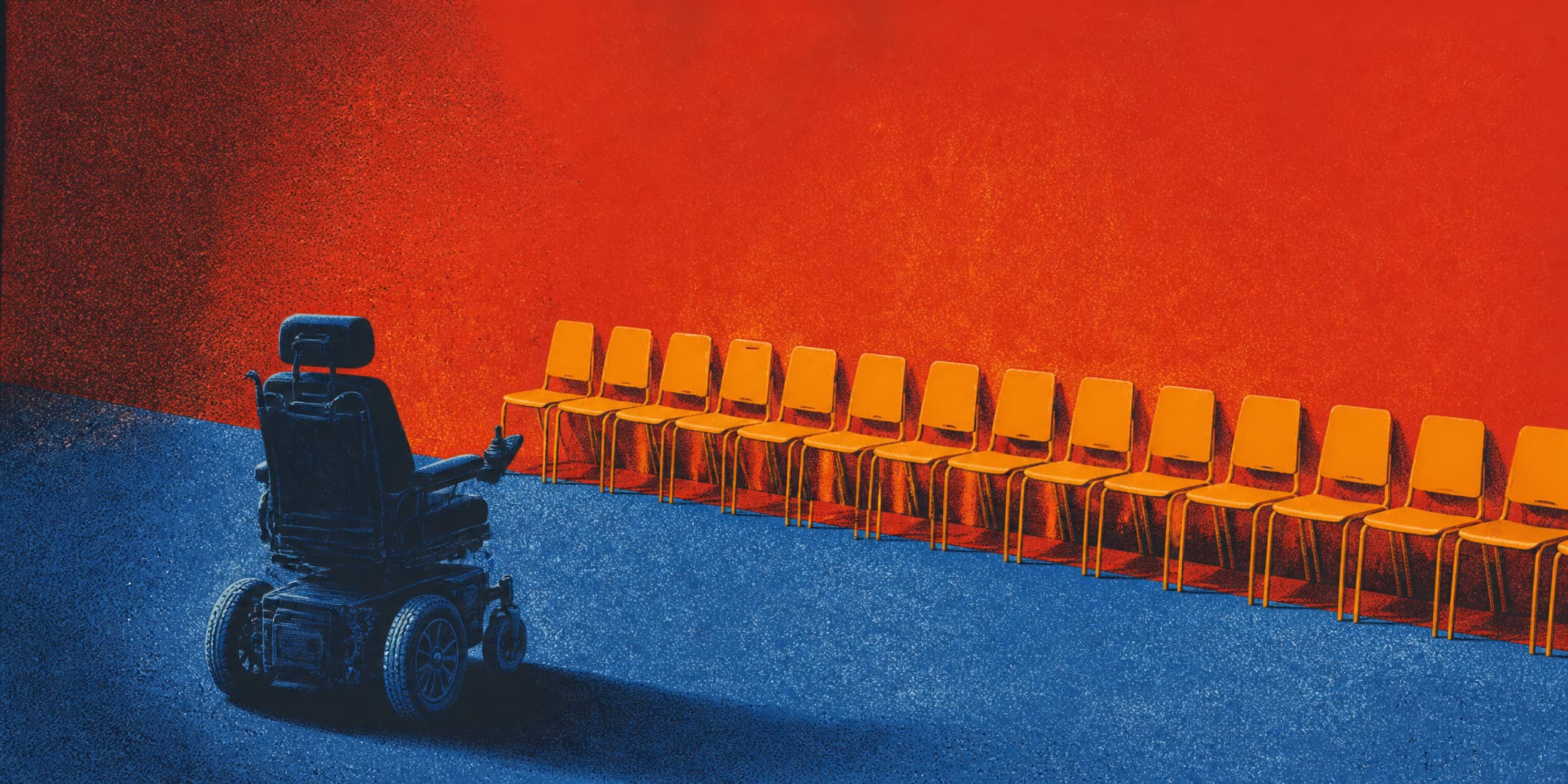
Say the warning landed.
Say a Phoenix resident got the alert on a July afternoon in 2024, understood that it meant her, and decided to go somewhere cooler. Most heat coverage stops at that decision and treats it as the finish line. It's the starting line. Between deciding and cooling down there is a trip, a doorway, a screening, a seat, and a closing time. Each of them carries requirements. None of those requirements was written as disability policy, and all of them work as disability policy anyway.
Start at the doorway of Burton Barr Central Library, the single Phoenix site that stayed open around the clock. In August 2024, people coming in passed through security screening and metal detectors, under rules covering weapons, drugs, and smoking. Rachel Milne, who runs the city's homeless services response, called the place low-barrier: you could sleep there, you could bring a pet. That's accurate, and it describes a policy somebody fought for. Sleeping and animals are the two things nearly every public building refuses.
Autumn Williams was using the site and had recently had heatstroke. She described the same doorway from the outside of it. Metal detectors, she said, can set off people whose trauma involves jail, which in a city with Phoenix's incarceration history covers a substantial share of anyone arriving on foot in the middle of the night. She also said people stayed outside, or got turned away, over smoking, drinking, or weapons. The rules that make the room safe enough to keep open until morning are the same rules doing the sorting on the sidewalk.
Two accurate descriptions of one door. The variable between them is the body walking through it.
The document that specifies a body
The regional network that coordinates these sites publishes standards, and those standards are the plainest available statement of who the system pictures showing up.
The March 2024 site standards from the Maricopa Association of Governments require:
- A fixed, air-conditioned location
- Drinking water, seating, restrooms
- Visible signage, consistent posted hours, staff present
- Admission for at least two hours, unless the site is at capacity or closing
- Admission of service animals
- No discrimination of specified kinds
The silences are longer than the requirements. Nothing in the common standards requires:
- A wheelchair-accessible entrance, an accessible route through the building, or an accessible restroom
- A seating layout that accommodates a chair someone arrived in, rather than assuming a chair will be vacated
- Electrical outlets, or any provision for charging a power wheelchair, a portable oxygen concentrator, or any other powered medical device
- Backup power, in a network whose whole reason for existing is to be the cool place when other places fail
- Staff training in intellectual, developmental, communication, sensory, or behavioral disability
- A quiet area, or simplified or pictorial signage
- Admission of a caregiver alongside the person they support, or any account of what happens when a visitor can't complete intake on her own
None of which proves that any particular library is inaccessible. Many are municipal buildings covered by other law, and some are certainly better than their minimums. What it proves is smaller and more useful: when the region sat down and wrote out what a heat relief site must be, it wrote air conditioning and water and chairs, and it did not write outlets, or ramps, or any way to communicate with a person who can't read the sign on the door.
For someone in a power chair, an outlet isn't an amenity. The battery is the legs. A KJZZ visit to Burton Barr found phone charging available, but nothing in the official network material speaks to device charging, outlet priority, how long anyone may charge, or what a site does when the power blinks. A woman whose chair runs flat inside a cooling center has not been cooled. She has been stranded somewhere cool.
The trip nobody measures
In 2023 the CDC evaluated Maricopa County's cooling centers and found sites setting their own schedules with no standardized operating protocols, many of them keeping something close to weekday business hours, and no central count of how many people came through the doors. Of the visitors surveyed, 54 percent had walked. Forty percent used public transit. Seven percent were picked up by an agency. Among those who named barriers, 31 percent said lack of transportation and 14 percent said a center wasn't open when they could get to it.
Read that breakdown with a wheelchair in the frame and the biggest number turns into the worst one. Walking in July here means crossing surfaces that produce contact burns; a Phoenix woman with a spinal cord injury took second- and third-degree burns off a railing that same summer just getting through a door. Rolling means crossing those surfaces slower, closer to the ground, on a seat that has been parked in the sun waiting for you. Dale Dean was living unhoused in Phoenix during the July 2023 heat wave, and he said his wheelchair seat felt like sitting down on hot coals.
The chair is what makes the trip possible and what injures him during it, and there is no version of the journey where he sets it down and walks. The published account doesn't say what caused his disability, or its level, or whether he reached a cooling center at all that week. He enters the record as a sensation on a sidewalk. Public transit, the second-largest category, means a stop that is usually unshaded, a wait of unknown length, and a lift that has to be working that day.
The county's answer to the transportation problem is a phone number. Residents got pointed to 2-1-1 for site locations and transportation help, staffed in English and Spanish from 9 a.m. to 7 p.m. through the 2024 season. What the public materials don't say is whether that transportation includes an accessible vehicle, whether it can carry a power wheelchair, whether it works like same-day paratransit, whether a caregiver can ride along, or what exists between 7 p.m. and 9 a.m., which is most of the night.
Extending hours helps at the edges. Phoenix's 2024 plan pushed several libraries to 10 p.m. through the core of summer, added Sunday hours, kept Burton Barr running around the clock, and put overnight capacity in a senior center. All of that is real, and people who understood the problem built it. It is also a handful of buildings in a county of more than four million, and the same plan counts 67 heat-associated deaths in 2023 on days when the high never touched 110, meaning on days when nothing about the response looked like an emergency.
Longer hours also assume the decision to head for the door. Patricia Miletich died in an RV northwest of Phoenix in June 2024 with her air conditioner running and blowing hot air; a neighbor told investigators she had memory problems, though no diagnosis appears in the record. This publication went through her case at length in "Has AC: Yes." Her file makes one point against any argument about library closing times. A 10 p.m. extension is worth nothing to a person who does not know she is in danger.
Adaptations that don't produce a visit
Every cooling center statistic is a survey of people who arrived. That is the structural limit of the whole evidence base, and it falls hardest on disabled residents, because arriving is the thing in question.
That measurement gap is documented and unresolved. The CDC evaluation found that 18 percent of cooling center visitors and 11 percent of surveyed members of the general public self-reported a disability. The survey didn't publish disability type and didn't tie disability status to any particular barrier. So the network holds a single number suggesting disabled residents use these sites at a somewhat higher rate than the population at large, and no way to say what happened to them once inside, what kept anyone else out, or how many never made it to the parking lot.
I learned to watch for this from the other side of a different disaster. October 2003, the Oakland hills burning, and the evacuation instructions coming through in a form that assumed a car, an address on file, and English. Down in Fruitvale, where I was thirteen, the real response was flyers and phone trees, built by people who knew which apartments held families that were never going to call anyone official. An evacuation order is written for a person who can leave. Everything downstream of that assumption is somebody's improvisation.
A cooling center is that same instrument pointed the other direction, and the improvisation looks like Amanda Kaminskas.
Kaminskas lives in Maryvale, takes her nutrition through a feeding tube, and lives on disability income. She told KJZZ in July 2024 that she had moved her tube feeding to nighttime, because the heat could spoil her formula, and that she sometimes woke up sweating because she couldn't afford to run the thermostat any lower. Two adaptations, both of them hers, both paid for out of her own body: she rescheduled a medical routine around an ambient temperature she doesn't control, and she absorbed the remainder in her sleep.
None of that produces a visit. She is not walking to a library at nine in the morning with a feeding pump and a night's worth of formula, and there is no clause in the network's standards that anticipated her showing up. She appears in no visitor count, no barrier survey, no percentage. She solved her problem, which is exactly why the system cannot see that she has one.
The standards specify water, seating, and two hours of admission. A woman waking up sweating in Maryvale at two in the morning, having engineered her own survival out of a schedule change, is not a failure of that document. She is what the document leaves out, and the county has no field for her either.
