
Chicago, July 1995
The Cook County Medical Examiner's Office was built to handle seventeen to twenty cases a day. On Friday, July 14, 1995, eighty-seven bodies arrived.
Nobody called it a disaster yet. Disasters, as everybody understood the word in 1995, came with wreckage and a site you could rope off and a number somebody read off a clipboard at a podium. What Chicago had that Friday was a lot of old people dead in a lot of hot apartments, each death individually explicable (cardiac arrest, renal failure, respiratory distress) and all of them arriving at the same loading dock.
The heat killed somewhere between 485 and 739 people during July 14–20, depending on which method of counting you trust. Both numbers are defensible. The gap between them, 254 dead people who show up in one column and not the other, tells you a good deal about what happens when a catastrophe arrives wearing ordinary clothes. But before anybody could argue about arithmetic, the dead had to become visible, and the thing that made them visible was the morgue, because the morgue was the one institution in the city that couldn't refuse delivery.
The daytime temperatures were savage. On Thursday, July 13, Midway Airport hit 106°F, with a heat index around 124–125°F and dew points near or above 80°F. But the killing happened at night.
A body can take remarkable punishment during the day if it gets a few hours of recovery after dark. When the air drops into the low 70s overnight, you shed what you accumulated. When it doesn't drop, you start the next morning already in debt, and the debt compounds. The overnight lows at Midway went 73°F on July 11, then 76, then 81, and on the night of the 14th, 84°F, the highest minimum temperature in the station's record that summer. Concrete and asphalt hold the day's heat and give it back all night. The air was wet enough that sweat couldn't do its job even with a breeze, which most people in upper-floor apartments did not have.
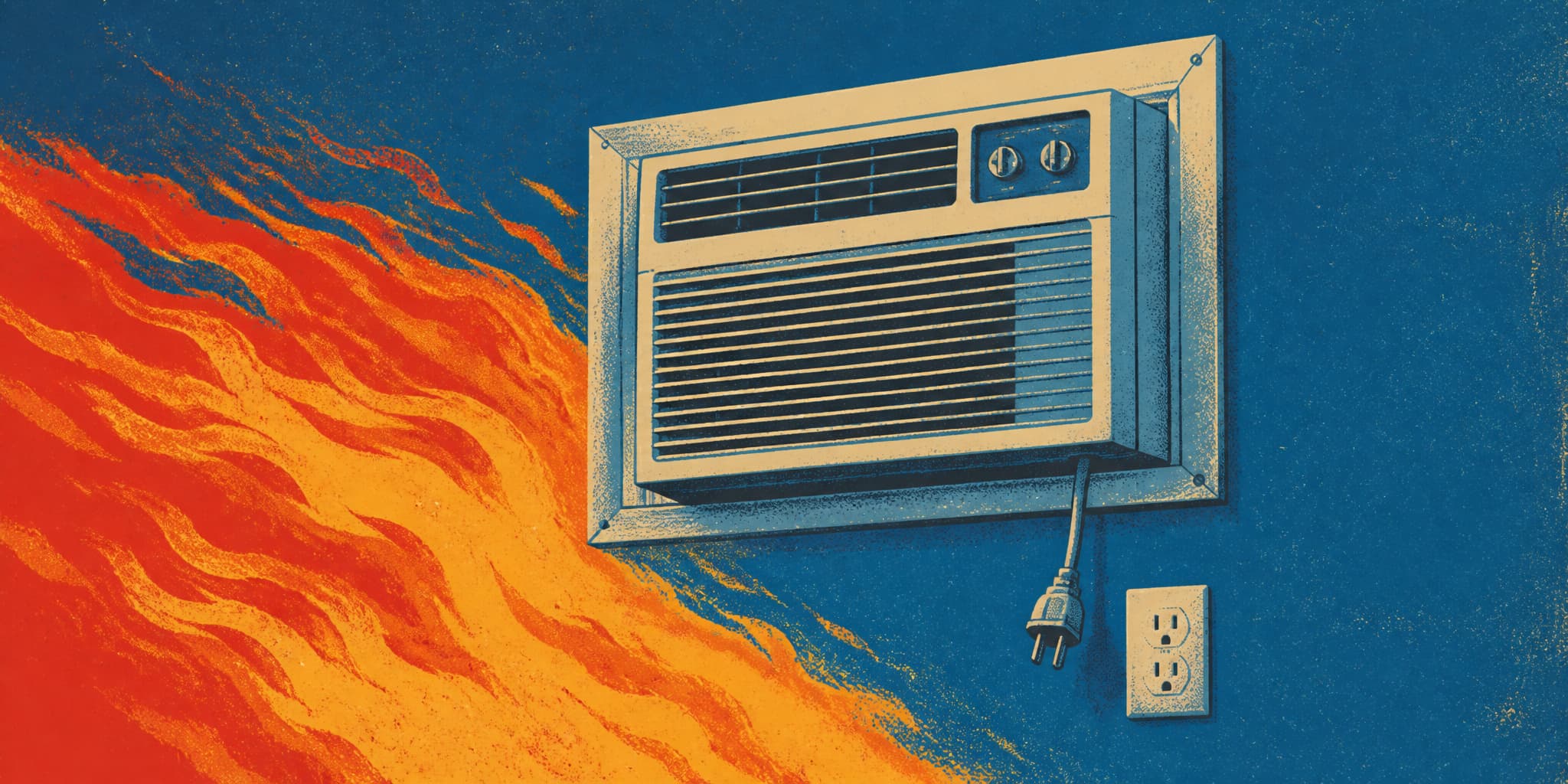
In the 3000 block of North Clifton Avenue in Lake View, a woman named Gabriele Kuhn had a neighbor, Mabel Swanson. Swanson's nephew had tried to install a window air conditioner a few years earlier, but the unit kept blowing a fuse. Old wiring, overloaded circuit, a landlord who never got around to the panel. So Swanson gave up on it. During the heat wave, Kuhn offered her air-conditioned home. Swanson declined; walking was hard. Kuhn set up fans and left a wet cloth and water. The next day, Kuhn and her daughter found Swanson dead on her bathroom floor.
I've spent enough time around old buildings to know what that fuse means. The machine exists. You can buy it at Sears and carry it up the stairs. But the building where the person actually lives won't run it, and the reason is sixty-year-old wiring behind plaster, an absent owner, and a fixed income that can't argue with either. If you fill out a survey asking whether the household has air conditioning, Mabel Swanson counts as yes.
On the afternoon of Friday the 14th, Mayor Richard M. Daley held a press conference at City Hall. "We all have our little problems," he said, "but let's not blow it out of proportion. It is a crisis." He went on to compare the situation with Chicago's more familiar extremes, heavy snow and bitter cold, and described the heat as part of the city's ordinary climatic range.
In fairness to Daley, and I don't often find myself writing that phrase, this was not an insane thing to say at the moment he said it. The remark is more confused than callous, acknowledging a crisis while insisting it was the normal kind. Chicago had survived hot summers. The city had cooling centers. The fire department had opened hydrants. What Daley didn't know, what nobody in city government appears to have known on Friday afternoon, was that the medical examiner's office was already going under.
Edmund Donoghue, the chief medical examiner, got a call around 9 p.m. Friday: forty cases already scheduled for the next morning, a number he'd never seen. By the time he reached the office Saturday, more than eighty bodies had piled up, Friday's intake compounding overnight, with another fifty awaiting autopsy by Saturday evening. The refrigeration was filling at a rate that would exhaust it within days.
On Saturday, staff borrowed a refrigerated truck from the state. By Monday there were seven parked outside. Eventually ten.
Donoghue told reporters Saturday:
He reached for "plane crash" because he needed a word that meant disaster, and the available vocabulary for disaster was built around things that happen all at once in one place: a crash site, a debris field, a manifest with names on it. A heat wave produces the same body count but scatters it across thousands of addresses over several days, each death ordinary on its own. The morgue was the only place in Chicago where they all showed up in the same room.
The shift from "summer" to "catastrophe" happened in lurches, and each lurch was forced by information that arrived from outside the channel it was supposed to travel through.
Late Friday night, deputy chief of staff Sarah Pang learned that police squads across the city were reporting people dead in their apartments. Senior staff gathered at City Hall. Late Saturday morning, health officials declared a citywide heat emergency.
John Wilhelm, the city's public-health bureau chief, the man whose entire job was knowing when Chicagoans were dying at abnormal rates, later said he found out that police wagons were lined up at the morgue from a television interviewer. Not from a subordinate, not from a report. Somebody put a microphone in his face and told him. He then called Donoghue directly.
On Sunday, Daley returned to City Hall and cited 339 nonviolent deaths since Thursday. "When you have people dying like this, it's frightening," he said. On Monday he asked Governor Edgar for a disaster declaration and got one.
Also on Monday, Human Services Commissioner Daniel Alvarez Sr. told reporters the victims were "people that die because they neglect themselves." He apologized immediately and said later that in his limited English he had meant that some frightened residents refused the help city workers offered at the door. Maybe so. But the sentence captured with brutal economy the assumption the refrigerated trucks had just run over: that dying of heat is a personal failing rather than something that happens to a city.
Inside the morgue, a mortuary-science student named Karl Koball volunteered to help process the dead. He moved bodies for hours, treating identification as the thing that mattered most, making sure each person kept a name. After his shift, the smell on his clothes and the weight of what he'd handled made him pull his car over and vomit. He was doing the work that made the dead countable. Somebody had to.
Every one of those bodies needed a cause of death written on a certificate. The medical examiner's office had been using the same criteria since 1978. A death counted as heat-related if the body's core temperature was 105°F or above at or near death, or if the surroundings showed heat had contributed (a very hot room, closed windows, no air conditioning), or if a decomposed body had no other evident cause and the person was last known alive during the heat wave.
By those criteria Donoghue's office certified 485 heat-related deaths during July 14–20. Wilhelm was quoted calling him "liberal" in his classifications. Donoghue answered that City Hall had accused his office of exaggerating and that the final number would more likely turn out to be an undercount.
Two years later, the epidemiologist Steven Whitman and colleagues published a different figure in the American Journal of Public Health: 739 excess deaths over the same seven days. They took sixteen years of summer mortality data to establish what a normal week looked like, then subtracted it from what actually happened.
The two numbers are counting different things. The 485 are people whose deaths a medical examiner looked at individually and attributed to heat. The 739 are everybody who died that week who wouldn't have died in a normal one, including people whose certificates said "cardiac arrest" and said nothing about the temperature in the room. A 1998 peer-reviewed comparison found that the medical examiner's neighborhood-level rates tracked excess mortality closely in most parts of the city but fell further and further short in the hardest-hit neighborhoods, which is exactly where bodies were most likely to be found late, decomposed, and hard to classify.
The CDC reviewed both and concluded the medical examiner's criteria were reasonable, with no sign of overcounting. Which leaves Chicago with two defensible numbers and 254 people in the space between them, dead of the heat and carrying diagnoses that don't say so.
Chicago moved fast afterward. An interim heat-emergency plan started almost immediately, and the Mayor's Commission on Extreme Weather Conditions delivered its final report before the end of the year. What came out of it was daily weather monitoring, tiered alert levels triggered by heat-index thresholds, a command center, cooling centers in air-conditioned public buildings, transportation for people who couldn't get to them on their own, and phone and door-to-door checks on isolated elderly residents.
When another bad heat wave arrived in late July 1999, the plan ran at full scale for the first time. The CDC later credited it with holding the death toll down, largely through the sheer number of daily contacts with older residents. The partnership with the National Weather Service is still running. The triggers now fire at a forecast heat index of 110°F on any day, 105°F on two days running, or 100°F on three or more.
Something was learned. The 485, or the 739, bought a warning system and a set of institutional reflexes that did not exist before, and that counts for something. It was an expensive way to learn it.
What broke through the official story in July 1995 was a physical fact nobody could talk around: a building full of dead people and refrigerated trucks parked on a public street where the cameras could get at them. Once the trucks were on the news, the language changed.
The plan Chicago built afterward was meant to intervene before the next morgue overflow, to make an administrative trigger fire earlier than the physical one. For an acute event, the sharp spike over a few terrible days, it works better than what came before.
Most of what warming delivers now doesn't arrive as a four-day spike. It comes as a slow drift upward in the baseline, a quiet climb in the cooling bill, insurers withdrawing a county at a time, chronic illness accumulating in people who spend their summers in buildings where the wiring blows a fuse when you plug in a window unit. It arrives one body at a time, wearing ordinary diagnoses, spread across thousands of addresses, and no morgue anywhere fills up to force anybody to notice.
Mabel Swanson owned an air conditioner. It blew a fuse, so it sat there. Thirty-one years on, the question of who is responsible for the wiring in the building where the person actually lives is still, as far as I can tell, nobody's. We built the warning system and the cooling centers. We haven't touched the buildings.
- Neighborhood mortality diverged sharply: A 2006 peer-reviewed study found that commercial decline helped explain why adjacent Chicago neighborhoods had vastly different heat-wave death rates, partly supporting and partly narrowing Eric Klinenberg's social-infrastructure argument.
- Classification shortfall in hardest-hit areas: The 1998 forensic comparison that found medical-examiner counts fell increasingly short of excess mortality in the worst-affected neighborhoods raises a question about whether case-by-case death classification systematically undercounts diffuse environmental harm where it concentrates most.
- The warning system still operates: NWS Chicago's thirtieth-anniversary account confirms that the city-NWS partnership created after 1995 remains active, with updated trigger thresholds and alert terminology revised as recently as 2025.
- Florida's parallel lesson in capacity: After Hurricane Andrew, a state commission found that the problem was not simply a weak wind standard but a fragmented system of codes administered differently by more than 400 local jurisdictions — a reminder that writing a stronger rule and building the capacity to enforce it are different achievements.