
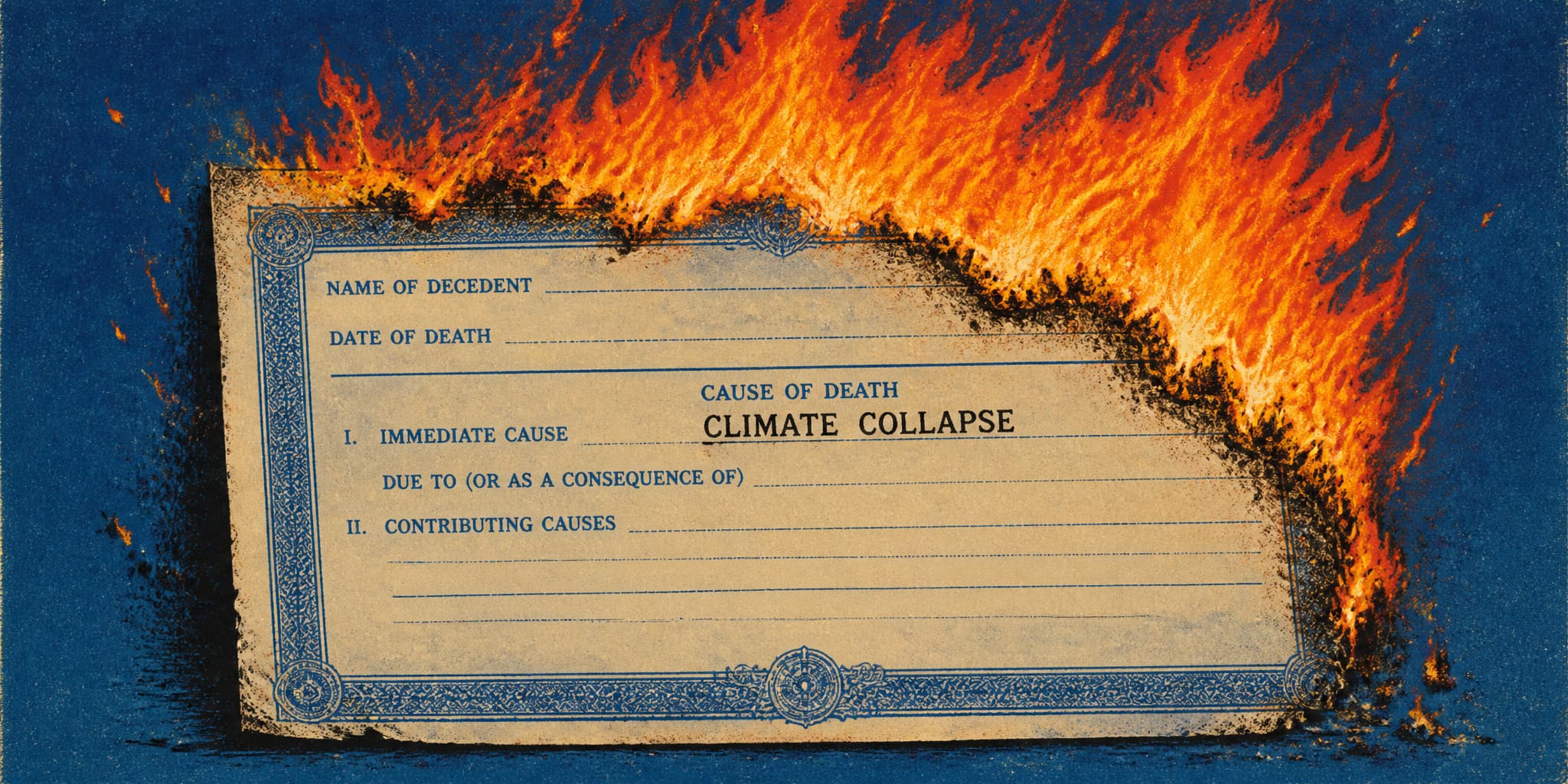
Three numbers came out of Chicago's July 1995 heat wave, and people have been arguing about them ever since. The Cook County medical examiner certified 465 heat-related deaths between July 11 and 27. A later analysis of the completed death records counted 485 heat-related deaths among Chicago residents during the seven worst days, July 14 through 20. That same analysis put excess deaths for the week at 739.
The mayor's office liked the small number. Advocates liked the big one. All three are honest measurements of the same catastrophe, and each one catches something the others drop. The space between them tells you something about heat, and something about the instruments we built to write down what heat does to people.
What the medical examiner was actually signing
A death certificate wants a cause specific enough that a professional will put his name under it. Edmund Donoghue, the Cook County medical examiner, worked from a definition his office had used since 1978. A death could be certified heat-related when there was no fatal injury and at least one of three things was true:
- Body temperature at or above 105°F, measured near death
- Substantial environmental evidence of heat exposure: a sealed apartment, no air conditioning, an extreme room temperature
- Decomposition with no other cause identified, plus evidence the person had been alive during the heat wave
The definition didn't require heat stroke to be the whole story. Heat could be listed when it pushed an existing cardiac, kidney, or lung condition over the edge, so long as the scene investigation supported dangerous exposure. The CDC looked the definition over in August 1995 and found it reasonable.
What the definition could not do was capture a death that never reached the medical examiner with enough evidence attached. If somebody died in a hospital where nobody took a temperature near the end, if the apartment had been cleaned up before an investigator saw it, if the organ damage was done in July and the person died in August, the certificate would name whatever quit and say nothing about what had been working on it.
This is where heat separates itself from flood or tornado. Pull a body out of floodwater and the chain of causation is short and visible to anybody. Find a body in a 120-degree apartment after a cardiac arrest and somebody has to decide whether the heart failed because of the heat or would have failed that week regardless. The honest answer, most of the time, is that the heat got there first and hurried along a process already underway. The form asks for a line. The body doesn't provide one.
What 739 actually means
Whitman, Donoghue, and their colleagues came at it from the other end. They pulled death certificates from Illinois vital records, kept the Chicago residents, and modeled expected daily deaths using regressions run on sixteen years of summer mortality. A normal Chicago July runs about 72 deaths a day. For July 14 through 20, the models expected 504. The city recorded 739 more than that.
The number makes no claim about any particular person. It says that in the week the heat sat on the city, 739 more people died than experience predicted. It doesn't sort them by cause. Heart attacks, strokes, kidney failure, lungs giving out, all in the same bucket. It picks up the deaths where heat did its work through some other diagnosis and left nothing behind that would have satisfied a medical examiner.
The authors gave the medical examiner's count real credit: it identifies the emergency while the emergency is still happening. You can't run an excess-mortality calculation until weeks or months later, when the paperwork is complete. For measuring the total after the fact, excess mortality is the better tool. Two methods, two questions, two clocks.
Where the two counts diverge
If these were only different rulers laid against the same board, the neighborhoods would line up proportionally. They didn't.
A 1998 study by Shen and colleagues compared the measures across Chicago's community areas. Citywide, the medical examiner's rate came to 19 deaths per 100,000; excess mortality ran 24 to 26. The two correlated, in that neighborhoods with high certified counts also had high excess mortality. But the regression slope fell well below one, which means the harder a neighborhood got hit, the wider the gap between the two counts opened.
Think about what those neighborhoods were like that week. More people living alone. Fewer neighbors to notice somebody hadn't been seen in three days. Bodies found later, further gone, with less left to test. Emergency rooms swamped and in no condition to write down the clinical detail that would have supported a heat classification months afterward. The same circumstances that made people likely to die made their deaths hard to classify, and, as the city would find out when it went to build a response, hard to prevent. The isolation, the absent neighbors, the doors that stayed locked: that is what kept the medical examiner from clean evidence, and it is what would later define the reach of an emergency plan. A form records a cause, not a situation — and neither, it turned out, does a knock on the door.
The mayor and the useful ambiguity
By July 26, Mayor Richard M. Daley was publicly disputing the count:
"Every day, people die of natural causes. You can't put everything as heat-related."
Donoghue answered that his office was more likely undercounting.
Daley wasn't lying, exactly. A 2007 analysis attributed roughly 26% of the excess deaths to mortality displacement, meaning deaths the heat moved up by days or weeks from the period that followed. Which leaves 74 percent that weren't moved up from anywhere. During the peak week, that study counted 1,686 deaths in Cook County. Eighty listed excessive heat as the underlying cause. Another 473 listed heat as contributing, and among those 473, cardiovascular disease was the underlying cause 93.7% of the time. The certificate named the organ that failed and put the weather in the second slot. Depending on which line you read aloud, you had two different stories about the same July.
That is what makes heat deaths different from nearly any other disaster you could name. The ambiguity is genuine. And because it's genuine, it's available. A mayor who wants to shrink a catastrophe doesn't have to invent a thing. He reads out the proximate cause, the heart or the kidneys or the lungs, and lets the contributing cause fade back where nobody's looking. The classification system hands him the material. Nobody has to lie or convene a meeting. The form was built to answer one question, the disaster asked another, and the gap between them is available to whoever needs it.
The contemporaneous record shows Daley's public challenge. It does not show any order to alter individual certifications. Donoghue went on to coauthor the principal mortality study. The pressure was rhetorical, which may have been plenty, since the system already had enough give in it to support two narratives without anybody doing a single improper thing.
The form and the weather
Heat introduces nothing foreign. It degrades the body's capacity to manage what it was already managing, which is more or less how poverty kills too. The certificate has a field for cause of death. It has no field for "this person was holding together until the room got hotter than he could compensate for, and then the weakest system quit." That sentence is closer to the truth of most heat deaths than anything that fits in the box.
I wrote earlier this year about California's property disclosure form, which accurately reports mapped legal categories and says nothing about projected heat, insurance availability, or what the place will cost to keep livable. The death certificate is in the same line of work. It answers what it was designed to answer. The phenomenon is asking about something else. When Chicago went to build an emergency response after 1995, the same diffuseness that beat the certificate — heat working through conditions people already had, over hours and days, in bodies already worn — turned out to mark the outer edge of what a plan could reach.
