
What Chicago had before
In July 1995, extreme heat wasn't classified as a disaster hazard in Chicago's emergency-management system at all. It belonged to the health department. The protocol on the books amounted to summer public-service announcements, relaying excessive-heat forecasts to the news organizations, and calling a few agencies so community centers could open as cooling facilities.
The city's round-the-clock weather watch sat at the Streets and Sanitation dispatch center. It used private forecasts and kept an eye on the Weather Channel. It had no direct line to the National Weather Service.
Nobody was blindsided about the temperature. Officials knew July 13 and 14 would be hot and prepared for uncomfortable. Cooling centers were open and, by the accounts, lightly used. The city had a mass-casualty medical plan on the shelf, but its monitoring never picked up the rising hospital load, so nobody activated it. Hospitals started diverting ambulances away from overloaded emergency rooms on their own, with nobody coordinating where the patients went instead.
The first real signal of what was happening was bodies arriving at the medical examiner's office in numbers, the same office whose classification rules, as the companion piece describes, could capture an individual heat death only when the scene evidence survived. By early Saturday morning, July 15, police were calling in deaths from apartments across the city. Health officials declared a citywide heat emergency later that morning, roughly 48 hours after the heat index had crossed into dangerous territory.
What they built
A mayoral commission produced an Extreme Weather Operations Plan, first drafted in 1996 and updated before the summer of 1999. It moved extreme heat out of the health department and into the citywide emergency structure, put a Central Heat Command Center under the Fire Commissioner, and set graduated alert levels keyed to National Weather Service forecasts.
The operational parts were real work. Warnings went out through broadcast and print, with press statements that named the 1995 death toll out loud. Cooling centers were designated and added as demand got measured. Transportation was free. Wellness checks put police and city workers on foot, door to door, working from lists drawn up in advance: elderly people living alone, public-housing residents. Between July 21 and 25, 1999, more than 30,000 people got a visit.
Four years earlier the city hadn't classified heat as a disaster. Now it could put 30,000 door knocks on the street in five days. The people who built that had watched their own city come apart, and it ought to be said plainly, because what follows is about limits, and a limit is not the same thing as a failure.
The 1999 test
The heat came back in late July 1999, and far fewer people died: 93 heat-related deaths in Chicago, against 485 in the 1995 peak week. The CDC gave the plan the credit. Other assessments were more careful about it. The 1999 heat wave had a lower daytime peak and a slower warm-up that let people acclimate somewhat, and a 2007 analysis concluded the meteorological differences didn't allow you to hand the lower death toll to the city response. Probably both mattered. Nobody gets to rerun 1995 with the plan in place and 1999 without it.
The activation also showed where the machinery bound up. A cold front dropped conditions below threshold and the command center was closed, then had to be reactivated two days later when the heat returned — heat that had been sitting in the forecast the whole time. In that same stretch, burned-out transformers cut power to 72,000 residents. About 10,000 of them waited three days to get it back.
The man and the air conditioner
The 1999 case-control study examined 80 Chicago residents who died with heat recorded as a cause. A working air conditioner carried an odds ratio of 0.2, which is to say roughly an 80 percent cut in the chance of dying. Not leaving home daily: 5.8 times more likely to die. Living alone: 8.1 times.
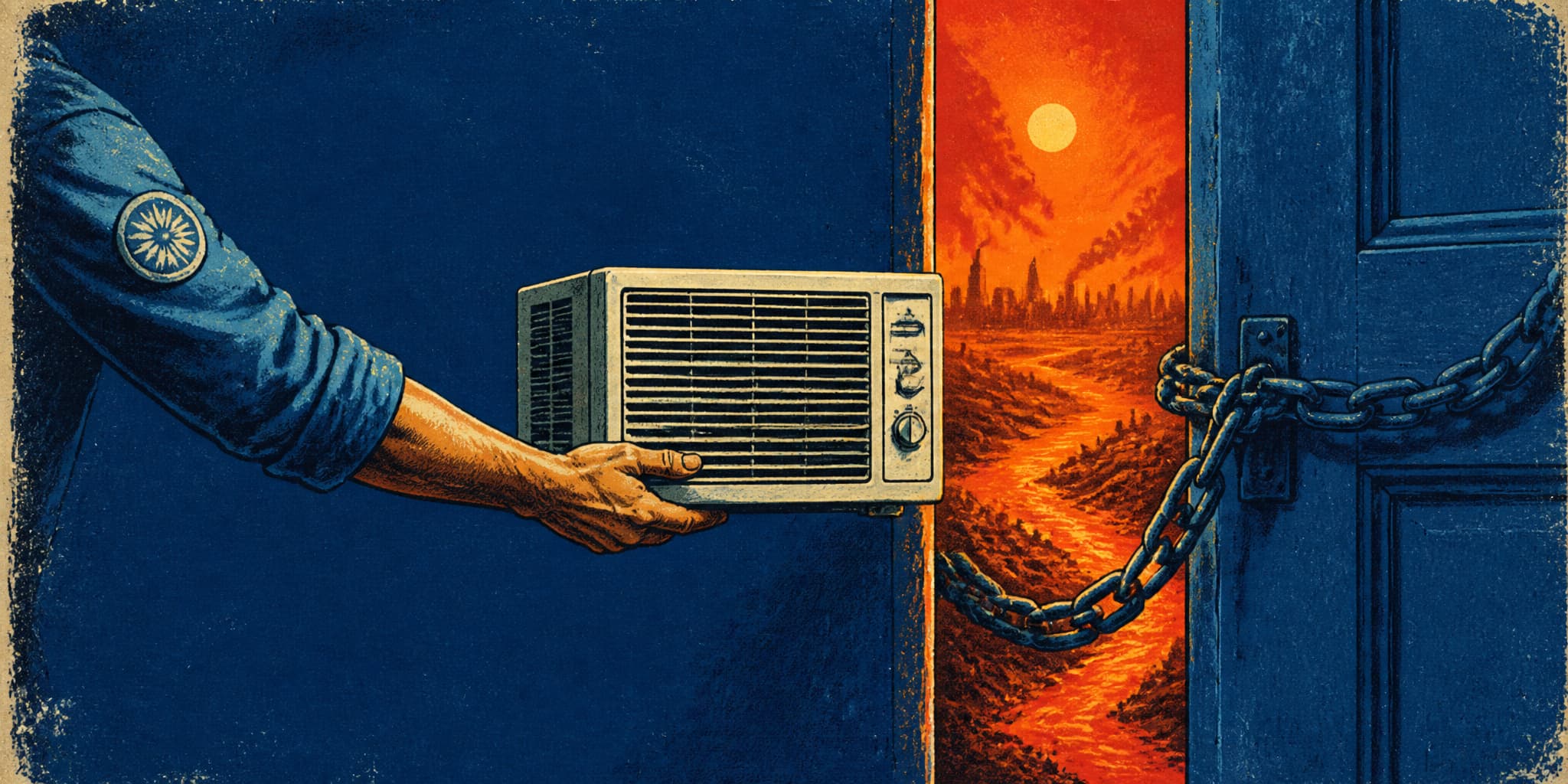
One case in the record is a man who turned down a free air conditioner because he was afraid of the electric bill.
The whole problem is in that man's arithmetic. The plan could hand over the machine. It could not hand over the conditions under which running the machine was possible. Illinois had no hot-weather disconnection prohibition on the books until December 2006, and a 2023 amendment lowered the temperature threshold and added NWS heat advisories as triggers. Neither protection existed in 1995 or 1999. He wasn't confused about anything. He was doing the arithmetic his income permitted.
The neighborhood underneath
Klinenberg's ethnographic work turned up conditions that kept recurring in the high-mortality areas: people living alone, fear of crime, public space gone bad in segregated neighborhoods that had lost the stores people used to walk to, and social-service systems that required an isolated person to go find help and ask for it.
His comparison of North Lawndale and Little Village made the pattern concrete. North Lawndale: 40 heat deaths per 100,000. Little Village: about four. Similar proportions of poor elderly residents living alone. What differed was how stable the population was, whether anybody was out on the sidewalk, whether there was commerce left, and whether a resident would leave the house or open the door to a stranger. Browning and colleagues tested portions of this account quantitatively and found commercial decline positively associated with heat-wave mortality, enough to statistically account for the association with neighborhood affluence.
The places where people died fastest were the places where the stores had closed, the sidewalks had emptied, and whoever was left had gone behind the deadbolt. Those are also, as the companion piece describes, the places where the gap between certified and excess deaths ran widest, where the dying was hardest to count because the conditions producing it were hardest to see from outside. The heat didn't build any of that — decades of disinvestment and abandonment did. July 1995 was when somebody counted what it cost.
Where the wellness check ends
Of the study's 80 case patients, 53% had been seen or spoken to on the day they died or the day before. Contact didn't necessarily find the danger, and finding it didn't necessarily fix it. You can knock, confirm the person is alive, offer a ride to a cooling center, and go. If they say no, because they're afraid of burglary, because they don't trust strangers, because they can't afford to run the air conditioner, because early heat illness has already muddled them enough that they can't judge how much trouble they're in, then the wellness check has arrived at the end of what a wellness check is.
Among those same 80, 53% were under 65. Psychiatric illness was almost twice as common among the younger cases. The researchers suggested this might reflect the plan's concentration on elderly residents — that outreach aimed at old people may have shifted the dying toward a population the plan wasn't built to find.
The plan could send somebody to a door. It could not put air conditioning in a fourth-floor apartment under a flat tar roof, or make the electricity affordable, or rebuild the commercial strips whose closing left old people with nowhere worth walking to and no reason to go out.
A companion piece describes what all this looked and felt like at the point of contact. This one has stayed at the structural level because that's where the boundary shows. Emergency outreach answers what it was designed to answer. The heat wave was asking about housing, energy, neighborhood, and the accumulated consequences of decisions made by people who were never going to be standing on those porches in July.
What Chicago built after 1995 was an achievement. That it couldn't solve the problem is no verdict on the people who built it — only a measure of how far emergency response reaches, and how much of the problem lay beyond it.
