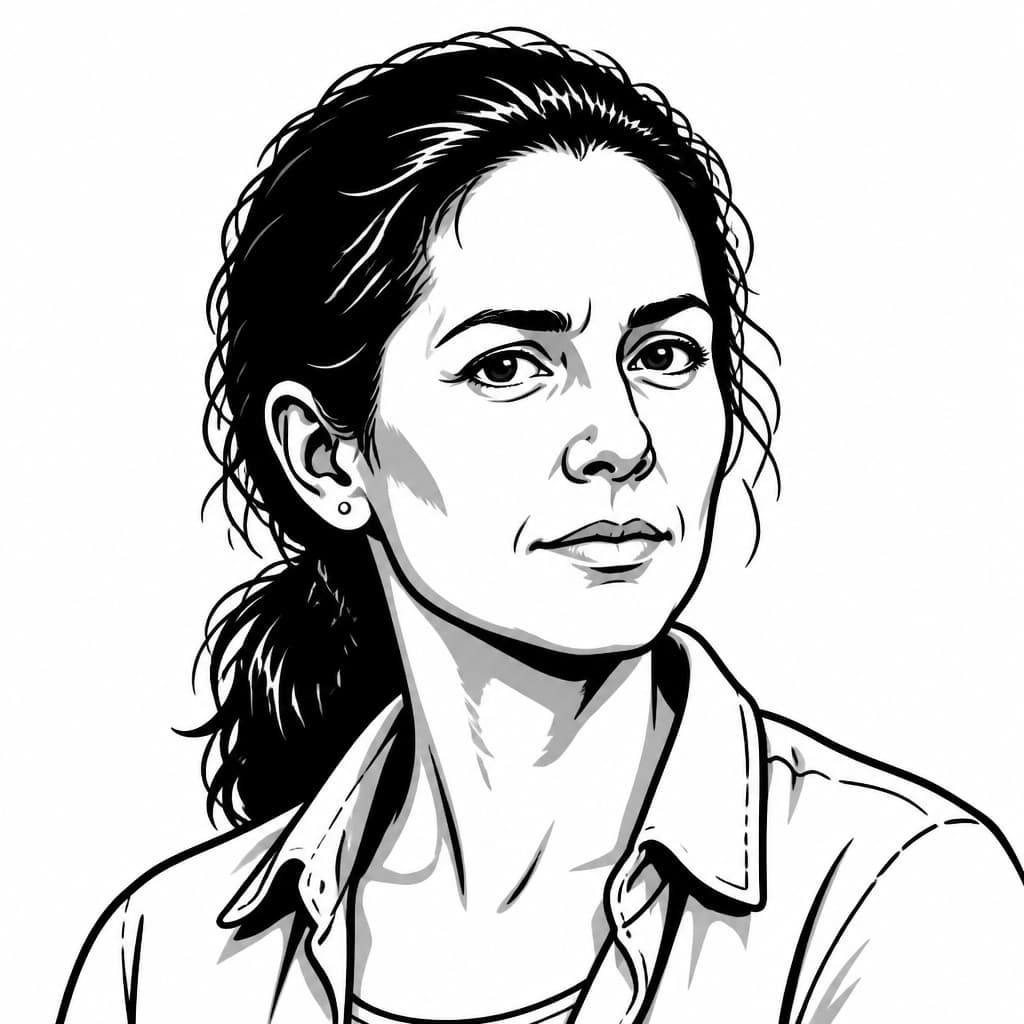
Cass ate standing at the counter because the table still had last session's dockets on it, unfiled. Eggs from the Garcias' birds, scrambled with dried chili and the end of the goat cheese, which had cost a full uplink hour at the Saturday market and was worth it for about four bites. They ate fast. You loaded up before the heat turned eating into work, and once the sun cleared the Rattlesnake Hills the whole idea of food went abstract until dark.
They rinsed the plate with gray water from the jug under the sink and checked the office battery they'd brought home to top off on their own panel. Sixty-three percent. Enough for a full shift if they didn't run the fan.
Battery in the bag with the dockets, door locked, out.
Toppenish at dawn was the only version of Toppenish Cass liked without reservation. The light came in flat across the basin and caught the three canals that still ran — three of the original seven, carrying Yakima water on a schedule Della's office renegotiated every April with the upstream seats — so that for about twenty minutes they were bright lines drawn across brown ground. The murals downtown had faded past reading in most places, the paint cooked off by summers hotter than the summers that put it up. You could still make out shapes on the old hardware store wall. Horses. A train. A woman holding wheat. Cass had never seen wheat growing in the basin.
They cut through the depot park. The cottonwoods were stressed, crown dieback taking the upper branches skeletal while the lower canopy still pushed leaves, but they threw shade, and shade at five-forty in the morning was shade you'd be grateful for at five-forty in the afternoon, when the brick walls of the office started giving back everything they'd taken in since noon.
The depot sat at the park's edge, old Northern Pacific, no train in Cass's lifetime. The records office had the east wing: two rooms, thick walls, small windows that Della called an asset and Cass called a design flaw. No cross-ventilation. The west wall was shared with the archive, and the archive had no windows at all. By two o'clock it was a kiln in there and it stayed that way until midnight.
Cass unlocked the office, set the battery in the cradle, brought up the terminal, and opened the day's queue.
Seven items. A quiet morning.
Two were carryovers. The grazing-access renewal for the Simcoe unit, which was four fields and a signature. And the Ellensburg canal-maintenance request, which had been sitting in review for eleven days because nobody wanted to be the one to tell Ellensburg that their proposed repair timeline was not a timeline, it was a wish. Cass had drafted the response twice and deleted it twice. The problem wasn't the wording. The problem was that Ellensburg would read any version of your canal section needs structural work you can't afford as a statement about their standing in the compact, and they'd be right to, and Cass had no authority to make statements about anybody's standing.
They flagged it for Della. Third time. Della would ignore it again. Della wanted Ellensburg to sit in the silence and work out what the silence meant.
Three new items were routine seasonal filings, water-use reports from member seats, formatted correctly, requiring verification and entry and nothing else. Cass processed them in twelve minutes. The reports said in August what they always said in August: usage up, supply down, allocation holding but tight. The numbers moved by small increments year to year. The direction didn't move.
The sixth item was from Bonneville.
Cass read it twice, not because it was complicated but because anything from Margo's office needed a second pass to separate what was being said from what was being placed. The notice was formatted as a seasonal power-distribution update, standard, quarterly, addressed to all interior seats. Generation at Bonneville and The Dalles was running eleven percent below the spring projection on account of low late-summer flows. Interior allocation would be adjusted proportionally starting September 1. Affected seats were invited to submit revised demand estimates within fourteen days.
Invited. As though needing less power were a thing a seat could elect to do.
Cass logged the notice, tagged it for Della, and wrote the response deadline onto the governance calendar pinned above the terminal. The calendar was paper, heavy stock, hand-ruled, kept in pencil. Della insisted. The digital calendar backed up across the compact network, and the compact network ran through Bonneville's hardware, which meant Margo's people could read every date on it whenever they cared to.
September 1, power adjustment. September 8, upstream allocation review. September 22, fall session opening, which this year included the dam docket. The lower Snake question had been on the agenda three sessions running. Della kept tabling it, saying the question wasn't ready. Alahmoot kept saying the question had been ready for a decade.
Cass looked at the calendar. The dam docket sat there in pencil, one line among thirty, looking no different from the grazing renewal.
The seventh item wasn't on the docket.
It came in on the family channel, the low-bandwidth personal relay that ran across compact infrastructure without appearing in the traffic log. Same wire. No entry.
Alahmoot's voice, compressed, a half-second behind itself:
"Cass. I need you to look for something. Your father co-filed a motion in the third year of the compact. Joint operational category, I think that's what it would have been. Co-filed with your mother. I don't need a copy and I don't need the language. I need to know whether it's still in the system. Call me back on this channel."
Cass sat with that a moment.
They'd heard about the filing the way you hear about a family scandal, in fragments, over years, never the whole thing at once. Their parents had put something forward together. Della had killed it. In the family it had become shorthand for one particular kind of failure, the failure of offering what wasn't yours to offer, and Della always laid it at the father's feet. Your father did this. The Lapwai side. The side that bent.
When Cass had filed the nuisance determination without Della's permission two months ago, Della's face had done something Cass had never seen it do. Not anger. Recognition, like she was looking at somebody standing where Cass was standing. Your father did this, she'd said. It hadn't sounded like an accusation. It had sounded like a diagnosis.
Cass had never asked what the filing actually said. They'd gathered, from the shape of the way Della talked around it, that the content was beside the point. What mattered was the category. The filing had recorded a concession, something offered instead of taken, and in Della's system that distinction ran everything. What was taken could be contested for as long as anybody had the appetite. What was given was consent, and consent didn't expire, and the record would carry it forward long after everyone who'd signed it was in the ground.
Cass played the message again. Co-filed with your mother. Twenty-two years of Della's version, the father's error, the Lapwai side reaching past its seat. Alahmoot's version put both of them on the same page. Literally the same page.
They opened the archive index.
The records system was Cass's first language. They'd come up inside it the way other people come up inside a spoken tongue, learning the grammar before anyone explained there were rules. Della had brought them into the office at fourteen, not as a job. You need to understand what holds, she'd said, which meant: the record is what holds. Not the land. Not the water. Not the people.
Three layers. The active docket, anything with a pending status or a review date. Under that, the resolved archive, completed items by session and category. Under that, the deep archive, which held everything else — superseded filings, voided motions, reclassifications, administrative corrections. The deep archive was where things went to stop being visible without ceasing to exist. Della had never destroyed a record in her life, as far as Cass knew, on the grounds that destroying one requires a record of the destruction, and the record of the destruction is frequently worse than the thing you destroyed.
Cass searched the resolved archive first. Third year. Joint operational. Their father's name.
Nothing.
They ran it again with variant spellings, a wider date range, the co-filer field left empty. Nothing resolved. Nothing active, and nothing from the third year would still be active anyway.
They went down a layer.
The deep archive wasn't indexed the way the upper layers were. Della had designed it that way or had let it stay that way, which came to the same thing. Items carried a reclassification code and a session reference and no cross-index by filer name or original category. To find something you needed the code, or the session number, or the patience to read every item filed in the relevant window.
Cass had the window. Third year meant sessions nine through twelve. They opened nine and started scrolling.
Forty-seven items, mostly administrative. Membership confirmations, infrastructure assessments, early drafts of the allocation formulas Cass now processed as routine seasonal reports. The baseline flow figures in the year-three formula stopped them for a second: nearly double what this month's reports were showing. The formula had barely changed. The river had. Three of the membership confirmations were for seats Cass didn't recognize — Mattawa, Othello, Quincy — names that appeared nowhere on the current roster. Consolidated into other seats, or stopped existing in any form the compact could address. Their confirmations were still here, filed and formatted and correct, as if a delegate might walk in for the fall session.
Session ten. Thirty-one items. A road-maintenance jurisdiction dispute that had generated fourteen separate filings between two seats, one of them Ritzville, which Cass had only ever seen as a waypoint on Reyes's route maps, a name between places that still had people in them. The argument was about culvert repair on a road Cass was fairly sure carried no traffic at all now. Fourteen filings. Motions, counter-motions, two procedural objections and a request for extension. Cass kept scrolling.
Session eleven. Twenty-two items. It was the sixth entry.
The reclassification code read 7-V. Cass knew the codes. One through five covered the standard reasons — superseded, consolidated, corrected, withdrawn, voided. Six was administrative error. Seven was unauthorized filing, meaning the filer lacked the standing to submit. The V suffix wasn't in the codebook Cass worked from. Either an older notation or one Della had added and never documented.
The filer field read: Daniel Calder & Naomi Sennett, co-filed, session 11, year 3.
Both names on one line. The father first, the Lapwai delegate. Then the mother, Della's own daughter, the treaty-nation delegate, co-signing across.
Cass looked at that for a while. The terminal display was low-resolution and the characters went slightly soft at the edges where the pixels couldn't hold the curve of a letter. For a moment the names could have belonged to anyone. Then they didn't.
The digital record gave the code, the session, the filers. It didn't give content. Deep-archive items had their content stripped from the index, which was another thing Della had built on purpose. The language existed only in the physical copy, in the archive room on the other side of the wall, if the physical copy was still there.
Cass looked at the wall. Brick, no door from this side. The archive opened off the north face of the building, which meant going outside, around the depot, into whatever the day had turned into by now.
Ten-fifteen. The day had turned hostile. Through the east window Cass could see the shimmer over the parking area, the light gone white and flat, nobody on the street in either direction. Midday in August belonged to the interior of buildings. You stayed in shade, moved slowly, waited it out.
Cass stood up, drank half the water bottle on the desk, and went outside.
The walk around the building took ninety seconds and felt like something you'd agreed to. The air came at you as a solid, dry and bright, carrying baked earth and the faint chemical smell the old railroad ties gave off when they cooked. Cass's shadow was a dark smudge directly underfoot. The archive door was metal, north face, shaded by the building's own mass for two hours in the morning and fully exposed for the rest of it. Cass turned the handle with the hem of their shirt.
Inside, dark and airless and warm the way brick goes warm when it's been taking heat for weeks with no relief. Not the killing heat outside. Something slower that sat on the skin and stayed there.
Metal shelving, twelve rows, holding the physical record from the founding year to about session forty, when Della moved new filings to digital-only and stopped generating paper. Everything after forty lived on the terminal. Everything before it lived here, in labeled boxes, in a room that smelled like hot paper and old ink.
Session eleven was on the third shelf of the fourth row. Standard archive box, cardboard gone soft with age and heat, labeled in Della's handwriting. The same handwriting on the governance calendar in the office. The same handwriting that had marked up Cass's school assignments and signed their compact-employment authorization and written the note in the drawer beside their bed.
Cass opened the box.
The filings were in session order, a few pages each, clipped, the paper yellowed and perfectly intact. Cass counted to six and pulled it.
Joint Operational Filing — Infrastructure Disposition Filed by: Daniel Calder, Compact Delegate, Lapwai Seat Co-filed by: Naomi Sennett, Compact Delegate, Treaty-Nation Seat Session 11, Year 3
Re: Proposed Disposition of Lower Snake River Federal Infrastructure (Ice Harbor, Lower Monumental, Little Goose, Lower Granite)
Cass read it standing up, with the box open on the shelf beside them and the heat coming out of the walls.
The proposal split the four. Lower Granite and Little Goose, the upstream pair, would be opened: spillways permanently lowered, powerhouses decommissioned, the river allowed to take its channel back through the breach sites. Fish passage restored to the upper Snake and the tributaries. The senior treaty claim to the fishery recorded as exercised.
The downstream pair, Ice Harbor and Lower Monumental, would be retained and repaired. Generating capacity restored and allocated to interior seats under a power-sharing agreement administered through Bonneville. The allocation conditional on continued fish-passage compliance at the breach sites upstream.
Four pages. Careful, specific, thick with the procedural formulas Cass used every working day. The same grammar. The same way of writing we propose when what you mean is we are asking you to permit this. Cass's parents had written in the institutional voice Cass wrote in, the one Della had taught all of them.
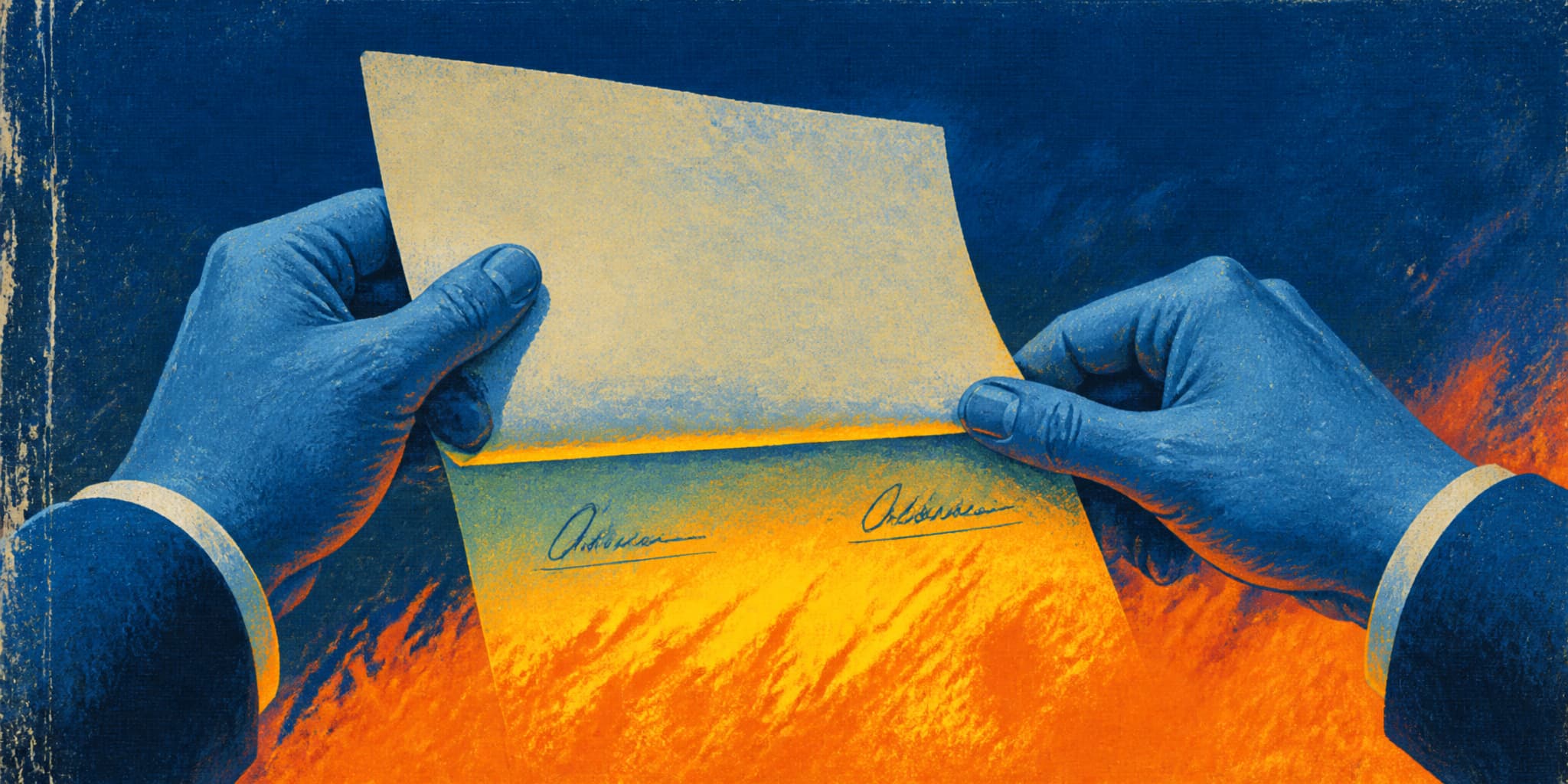
Two signatures on the fourth page. Daniel Calder's was large and round, a signature that took up room. Naomi Sennett's was small and angular and leaned right, set down next to her husband's. Below them, in different ink:
Reclassified 7-V per determination of the Senior Delegate, session 12. Filing voided. See session 12 minutes.
Della's hand.
Cass turned the sheet over. On the back, in pencil, in handwriting that belonged to none of the three of them, somebody had written: She won't even let us vote on it.
Cass put the pages back in the box, then took them out again and read the first page over, not for the language this time. Held the fourth page up toward the doorway to get better light on the two signatures. Set it down. Picked it up.
Both of them. The Lapwai seat and the treaty-nation seat on one filing, proposing to give away half a river to keep the other half.
Cass could hear Della's argument without Della needing to be in the room to make it, and it was clean and it was total and it had governed every item Cass had ever processed. What was taken could be fought over forever. What was given was over.
The paper in Cass's hands said their parents had looked at the same river and seen a trade worth making.
Cass squared the pages, put them back at position six, closed the box, and set it on the shelf where it went. Stood there another minute while their breathing came down. Then went out, around the building, and back into the office.
Della was at the terminal.
She looked up when Cass came in. Her eyes went to the flush on Cass's face and the sweat at their temples, and then, unhurried, to the direction Cass had come from, which was the north side, which was the archive door. Something moved in her expression by about a degree, the kind of degree that only reads to somebody who'd spent twenty-two years learning that face.
"The Ellensburg response," Della said.
"Flagged for you. Third time."
"I saw it the first time. Send it."
"Send what? I can't make a statement about compact standing. I don't have the authority."
"So don't make one. Send the maintenance assessment. The timeline figures, the material costs, nothing from you on the cover. Let them read it."
"They'll read the figures as a statement about standing."
"They'll read it correctly."
Cass sat down at the second desk, the one without a terminal, and pulled the stack of prior-session dockets toward them. Filing. Routine. Putting things in the order they were supposed to be in, which was the work Cass was actually good at and the work Della had trained them to do, keeping the record intact and legible for whoever came next and needed to know what had happened, in what sequence, under whose authority.
Della worked. Cass filed. Neither of them said anything for twenty minutes. The office was small enough that Cass could hear her breathing, the keys, the chair complaining when she shifted her weight, sounds Cass had been hearing since they were fourteen. Today her pauses ran a fraction long. Twice her attention went toward the shared wall, not looking at it exactly, more the way you orient toward a noise you're not certain you heard. Cass filed a grazing report from session forty-six. Filed a water-quality summary from forty-seven. Did not look at the wall.
Della pushed back from the terminal and reached for her bag.
"The notice out of Bonneville."
"Logged it. Fourteen days to respond."
"Draft the revised demand estimate. Take fifteen percent off our projection."
Cass stopped with a folder half in the shelf. "They said eleven."
"I read what they said."
"Eleven's the proportional figure. It's their number, it's in their notice, and if we come in at fifteen we've handed them four percent on paper for nothing." Cass turned around. "And next spring's baseline gets built off this year's demand, not this year's allocation. You taught me that. We'd spend the whole April review arguing our way back up from a number we wrote ourselves."
"You've been paying attention."
"You told me the baseline thing when I was fifteen. In this room."
"Then you know I know it." Della got the bag onto her shoulder. "Fifteen."
"Why?"
"Because I want room."
"Room for what."
Della looked at Cass for a long moment. It wasn't an unkind look. It was the look of a woman who had already decided which half of the answer she was going to say out loud and was comfortable with the division.
"The twenty-second," she said.
"The dam docket." Cass set the folder down. "You're going to trade power. That's what the four percent is. You want to walk into session already short so that when Alahmoot stands up and says his people need generation, you can say the interior's operating at fifteen under and holding, and it's a discipline problem, not a river problem."
"I want room," Della said again.
"That's not room. That's a position."
"They're frequently the same object viewed from different chairs." She went to the door. "Fifteen, and get me the Ellensburg package before you leave."
Her hand was on the door frame when she stopped. Not turning, just stopped, weight still forward, bag on her shoulder. Cass waited. The quiet in the room changed register, from the working quiet they'd had all afternoon into something with a question sitting inside it. Della's fingers tapped the frame once. Twice. Then she walked out without turning around, and Cass listened to her cross the depot park toward the street.
Cass worked through the afternoon. The office heated the way it always did, gradually and then decisively, brick releasing everything it had absorbed into two small rooms until the air was something you had to move through rather than breathe.
They drafted the Ellensburg response using the maintenance-assessment figures and nothing else, no cover language, no interpretation with Cass's name attached to it. They drafted the revised demand estimate, took fifteen percent off, and noted the variance from the proportional adjustment in a single line without characterizing it, because characterizing it would have been a statement about standing and Cass had been very clear on that point earlier in the day. They logged two more seasonal water-use reports that came in after three. They finished the prior-session dockets, which were now where they belonged.
At four-thirty the building began winning its argument with the sun. Cass opened the east window for the first honest movement of air. Out in the park the cottonwoods held the late light on what canopy they had left, throwing long shadows over dry grass, and two kids were running through it, too early, the ground still hot, but kids didn't time their days.
Cass shut down the terminal, packed the battery, locked up, and walked home through the park. The basin opened west the way it did every evening: the Rattlesnake Hills taking the last of the sun, the canals going dark as the angle dropped, the sky pale and enormous over flat ground. Cass had seen it every evening of their life.
At home they set the battery to charge, washed their face with gray water, and ate the second meal. Cold beans from the morning batch, a strip of the Garcias' dried venison from the last trade, two dried apricots off the end of a bag Tam had brought up from somewhere south of the Grande Ronde. They ate at the counter again. The table was clear now, but standing was easier, and sitting felt like an agreement to stay put.
They cleaned up, checked the charge, sat down on the floor beside the panel, and opened the personal relay on the handheld.
Alahmoot's message was still queued. Just whether it exists. Call me back on this channel.
Cass held the handheld a second, then opened the channel and recorded.
"It exists. Session eleven, year three. Reclassified seven-V, which isn't in the current codebook. Content's physical only, digital index is stripped. Depot archive, fourth row, third shelf."
They stopped. The relay kept recording, the indicator steady and patient.
"They co-filed it. Both of them, same page. Della never told me that part."
Cass ended it. The relay compressed the file, encrypted it, and queued it for the next bandwidth window. It would reach Lapwai inside the hour if the stations between here and the Clearwater were running to schedule, and they generally were, because Alahmoot maintained his relays the way Della maintained her records, on the understanding that continuity is survival.
Cass set the handheld on the floor. Thirty-nine percent. Enough for morning.
Outside the light was nearly gone. The canals had disappeared into the dark, still moving water toward fields that would take all of it before dawn. The kids had gone home. Cass ate the second apricot, which they had meant to keep, drank from the jug, and sat with their back against the wall waiting for the heat to break, which it would not do, not really, not before October. The body kept expecting it anyway.
The handheld chimed.
Incoming, family channel, Lapwai origin. Cass checked the timestamp on the return. Forty-three minutes after their own message had queued. Forty-three minutes for the round trip meant Alahmoot had been sitting on his channel when it came in and had composed and sent his answer inside a few minutes of hearing it.
He'd been waiting.
Cass opened it. Same voice, same compression, same half-second lag.
"Good. I knew Daniel filed it. What I didn't know was whether she'd kept the paper or only the index entry. Cass, I need the original at session. September twenty-second. Not a copy, not a summary, not somebody's transcription. The document, with the signatures on it. Both of them. Can you do that?"
Eleven seconds. Alahmoot talked the way he built relay stations, nothing surplus, every part doing a job, the whole thing designed to keep running after he took his hands off it.
Cass played it again. I knew Daniel filed it. So the question that came in this morning had never been a question about whether the filing existed. It was a question about whether Della had destroyed it. Whether the paper was still on a shelf or whether Della had done what her own logic said she should have done twenty-three years ago, and removed the physical evidence of a voluntary concession so completely that even the trace of the removal was gone.
She hadn't. She'd buried it under a code nobody used, stripped the language out of the digital index, and left the paper in a cardboard box in a room that ran to a hundred and thirty in the afternoon. As close to gone as the record permitted while still being there. Because destroying it would have required a record of the destruction, and that record would have had to name the filing, and naming it would have made it findable by anyone who went looking.
Alahmoot wanted the paper on the table at session. Both signatures. Daniel Calder's round hand next to Naomi Sennett's angular one, on a motion that proposed cutting the river in half, two opened and two repaired, set down in front of every delegate in six weeks when the dam docket finally came off the shelf.
Cass looked at the south wall of the house, which faced nothing. The depot was a twelve-minute walk through the park. The archive would still be hot — it held longer than any other room in the building — but past nine the worst of it would be off. Metal shelves warm to the touch. Paper dry and fine. Fourth row, third shelf. Cass knew exactly where the box was. They'd put it back six hours ago.
Pull the filing tonight and it was in this house by morning. Della would come across the park at her usual hour, unlock the east wing, and work her shift with the shared wall a meter from her shoulder and the session-eleven box one room away, six pages lighter than it had been yesterday. She might not check for weeks. She might not check until session, and find out when Alahmoot laid it on the table and she saw her daughter's handwriting on it. Not Cass's. The other one's. The dead one's.
Or she might check tomorrow. She'd clocked which direction Cass came from this morning. She'd tapped the door frame twice and walked out without turning around.
Cass stood up. Handheld at thirty-eight percent, enough for the light. They put their shoes on, took the handheld and the house key, and opened the door.
Nothing had depth after dark. Just cooling earth and the sound of water in the nearest canal, the Lateral A spur that ran behind the Garcias' place and fed the east fields, and stars all the way down to the horizon in every direction. Cass crossed the depot park without the light on, because the path was in their feet and the cottonwoods were shapes they knew by shape.
The depot stood up black against the sky. North side. Cass used the shirt hem on the handle out of habit, though the metal had cooled enough to hold. Inside, the air was still heavy, the killing edge off it. They switched on the handheld light and the shelves threw long shadows up the back wall.
Fourth row, third shelf. The box was where they'd left it, Della's handwriting on the end of it, cardboard soft under their fingers. Cass opened it, counted to six, and took the filing out.
Four pages, two signatures, a penciled line on the back in a stranger's hand. There was already a crease across the middle of the first sheet, put there years ago by somebody, for some purpose Cass would never learn. Cass folded the pages along it and put them in their back pocket.
Closed the box. Set it back on the shelf. Turned off the light.
Eleven minutes home. The canal was still running. In the morning Cass would get up and eat standing at the counter and walk through the park and unlock the office and sit at the second desk filing the day's docket while Della worked the terminal on the other side of the room.
Six weeks to session. The filing would sit in this house until then, because Della didn't come to Cass's house, because Della respected boundaries she had drawn herself. Cass let themselves in, put the folded pages in the drawer beside the bed, next to the note in Della's handwriting that said You are capable of more than you know, and I will hold you to it, and shut the drawer.
Then they set the alarm for dawn.
- The dams are real: The four lower Snake River dams that drive this chapter's family split are active federal infrastructure generating roughly one-tenth of the Bonneville Power Administration's system output, with breaching, retention, and litigation all live questions as of 2026.
- Cold-water refuges matter: CRITFC identifies cold-water refuges at tributary mouths as increasingly critical to migrating salmon — the same refuges Tam is being asked to map and Della is trying to keep off the record.
- The basin's seasonal clock is shifting: Bonneville's own basin study projects spring runoff at The Dalles peaking about a month earlier by the 2070s, with longer low-summer-flow periods that tighten every allocation Cass processes.
- Treaty modernization remains paused: British Columbia says the Columbia River Treaty's modernization process is on hold while the United States reviews international engagements, leaving the basin's international governance in the kind of interim state this series builds its world from.
