A friend's daughter, who is eight, asked me last summer why the sky looked weird. It was wildfire smoke drifting down from Canada, and I said so. She nodded. Then she asked if it would be like that when she was a grownup. I said I didn't know. Which was true, and also a dodge, and I've been thinking about it since.
Since then I keep noticing the same gap in other people's houses: what the adults know, and what they actually say out loud.
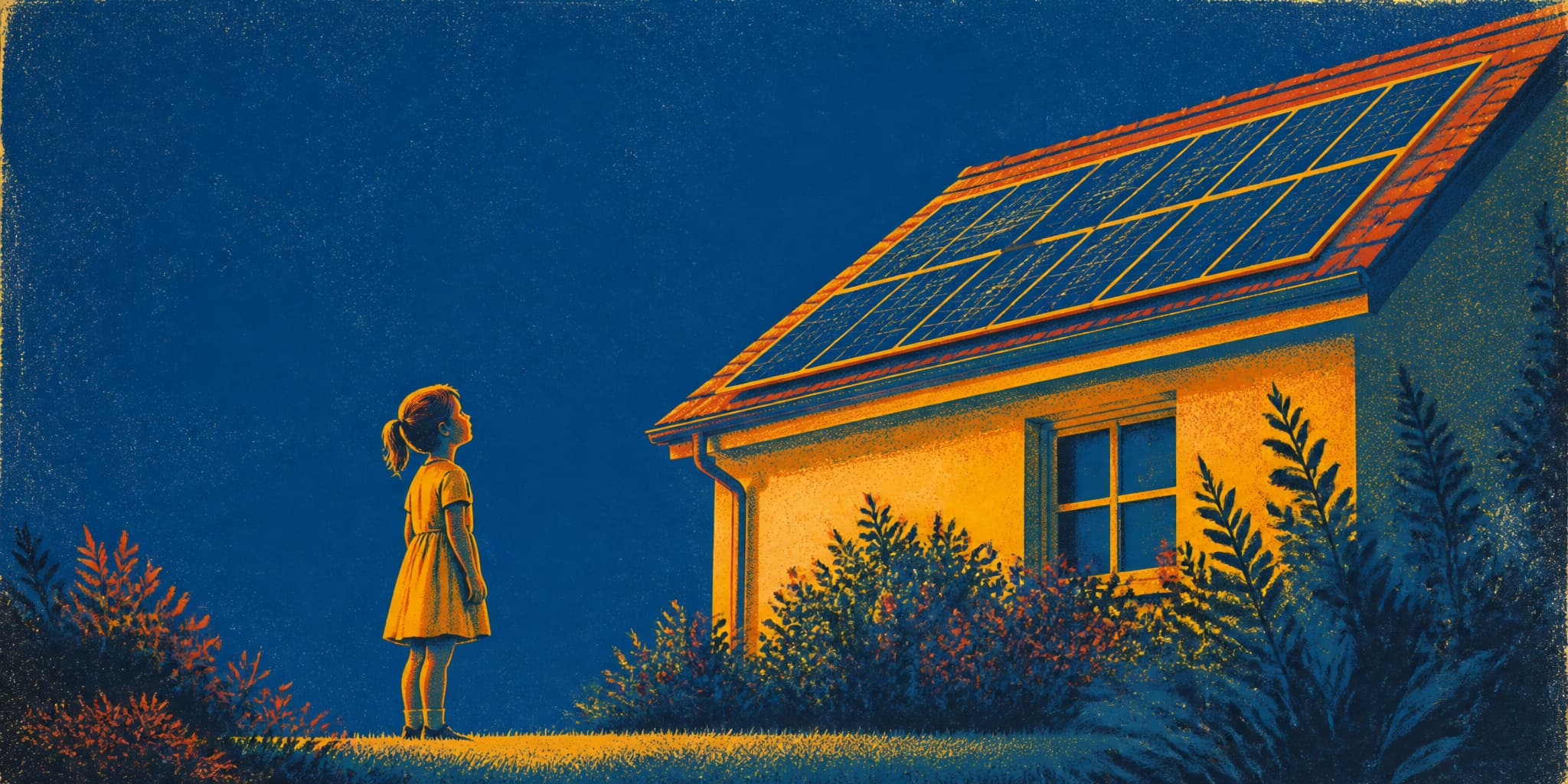
In 2019, a mother of three in Glenwood Springs, Colorado, described winters with less snow and fires burning closer to home. Her family recycled and installed solar panels. Asked by an NPR/Ipsos project whether she discussed climate change with her children, Laine Fabijanic said: "I don't think we've talked much about it at all." The children hadn't brought it up.
So she had reorganized her family's spending and roof around something she wasn't discussing. The solar panels are a kind of honesty about what she believes. The silence is a kind of protection for her kids. Both are operating in the same household, and I don't think she experiences them as a contradiction at all. Earlier this year, an Italian mother of a six- and seven-year-old told researchers she avoided the subject because she didn't want her children growing up afraid. I don't hear indifference in that. I hear a parent weighing the comfort of not-yet against the accuracy of right-now, and making the call again every morning without any way of knowing whether she got it right.
A 2022 Pew survey of more than 3,700 parents found only 18 percent discussed environment or climate change with their children "very or fairly often." An Ipsos poll found 46 percent of parents said they simply hadn't spoken to their children about it at all. A longitudinal family study found that even among parents who said they were interested in having the conversation, fewer than half had actually had it in the previous month.
Which makes silence the most common answer. But I'm not sure silence is the right word for it, because silence sounds like one decision, made once, and what shows up in these accounts is layered: protection, uncertainty, no clear place to start, no clear sense of what the second sentence would be after the first one. Sometimes all of it at once.
The rock collection
When the conversation does happen, children don't open with atmospheric science. They ask about their stuff.
After the December 2021 Marshall Fire in Colorado, Tawnya and Kahlil sat with their four-year-old twins in a hotel room and told them that everything they still owned was in that room. One daughter asked about her rock collection. Her parents told her rocks don't burn.
After the January 2025 Eaton Fire in Altadena, Tanya Reyes told her three daughters, ages three, six, and eight, "We lost everything." The youngest asked about her toy kitchen. The middle child asked about stuffed animals. The oldest started a journal entry titled "The day I lost my house."
In a published account, a mother told her almost-three-year-old that smoke made outdoor cycling unsafe for her baby brother's lungs. The child looked outside, saw nothing, and waved a toy wand to make the smoke disappear.
These are conversations about loss and safety and the room you're standing in. In none of the published family accounts from the Marshall Fire or the Eaton Fire did reporters document parents linking the disaster to its global causes. Maybe those conversations came later, in quieter weeks. What the reporting captures is a child asking about a rock and a parent answering that rocks don't burn.
The child is asking about the room. The adult is carrying something about the atmosphere. How you get from one to the other, at what age, in what words, turns out to be a question nobody answers cleanly.
Which experts, about what
Environmental educator David Sobel has argued for decades that young children should develop affection for nearby nature before they encounter large-scale environmental catastrophe. His "ecophobia" framework holds that abstract ecological tragedy, introduced too early, produces helplessness rather than connection.
Child-development researchers like Oregon State's Shauna Tominey and clinical psychologist Becky Kennedy take a different position once a child has already met smoke, evacuation, or loss: start with truthful, concrete information, answer the question the child is actually asking, and don't leave them to fill the vacuum with something worse.
I spent a while assuming these positions contradicted each other before noticing they're answering different questions. Sobel is describing a planning choice, what to introduce and when, to children who haven't yet run into the thing. Tominey and Kennedy are describing a Tuesday afternoon when the sky is orange and a child wants to know why she can't go outside. Most adults are living in the second situation.
A 2025 study of Spanish parent-child pairs found a jump around age seven in children's comprehension of climate change, while most five- and six-year-olds didn't demonstrate full causal understanding. More parent communication was associated with greater comprehension. But the study was cross-sectional, a snapshot rather than a timeline, so it couldn't say whether starting earlier reduced distress or added to it. Nobody has run that experiment.
The research that would settle the disagreement doesn't exist, and adults are improvising anyway, on the spot, with a child looking at them.
What teachers are working with
In Paradise, California, after the 2018 Camp Fire destroyed most of the town, science teacher Wendy Marsters described adjusting her lessons to her students' emotional state. Near the first anniversary, her class watched Bob Ross and painted. She said she taught little about climate change because it wasn't prominent in the standards she was working from. The Hechinger Report found that the subject could be dismissed locally as "fake news," in a community that had just lost 19,000 structures to fire.
In April 2025, the Cypress-Fairbanks Independent School District in Texas, nearly 120,000 students, voted to remove 13 chapters from a state-approved science textbook, climate change material among them. Teachers were told to replace the removed content with supplemental web articles while still teaching the state standards. An anonymous science teacher told reporters that a National Geographic graphic showing the relationship between atmospheric CO₂ and sea-surface temperature appeared in one of the prohibited chapters. The obligation to cover the standards stayed. The pages teachers expected to use went away.
A 2024 study of nationally representative samples of middle-school science teachers found that 43 percent gave equal time to claims that humans were not causing climate change, up from 35 percent five years earlier. Fifty-nine percent let students debate the issue without stating the scientific position. A smaller 2025 classroom study in North Carolina classified over half of observed students as receiving mixed messages, and a third as sitting in classrooms that avoided the causes entirely.
In Oregon, during a debate over mandated climate instruction, a parent named Nicole De Graff argued that children were already overwhelmed by fear-based messaging. Her objection wasn't climate denial. It was about what the information would do to her kids: whether a classroom is the right room for it, whether teachers are equipped to hold what it opens up, whether her children would come home more frightened than informed.
I keep returning to that objection, because I think children deserve accurate information about the world they're inheriting, and I also think De Graff is pointing at something real, which is that accuracy by itself doesn't determine whether a particular conversation helps or harms a particular child on a particular afternoon. I haven't worked out how to hold both. And the discomfort of not holding them is, I suspect, the same discomfort that produces all that silence in the first place.
Plant a tree, write a letter
The instinctive response to a frightened child is to give her something to do. Plant a tree. Write a letter. Take shorter showers. Researchers have looked at this, and supported action, especially collective action, can build self-efficacy.
A 2022 review of childhood eco-anxiety cautioned against treating action as a universal fix. Action can produce burnout. It can hand children a share of responsibility that belongs to governments and major emitters. The review found little evidence capable of sorting out which forms of action help which children.
Maria Ojala's study of 293 Swedish 12-year-olds turned up something I haven't been able to put down. Children who used problem-focused coping, taking action and seeking solutions, were more environmentally engaged, and they also reported more worry and more negative emotion. Children who used meaning-focused coping, positive reappraisal and trust that social actors were working on the problem, showed better well-being without dropping their engagement. The findings were correlational. The pattern still nags.
In 2023, NCAR scientist Gunter Leguy told Scientific American that his first-grader and a friend had concluded they should never have children, because children "contribute to climate change." A six-year-old, turning the logic of individual action on her own existence. Leguy told her that children were not the cause and that a changed future could still hold happy lives.
I keep asking who is served by a frame so total that a first-grader can turn it into a verdict on whether she should exist. Handing a kid a seed packet feels like empowerment. It reads differently when she points the logic at herself.
Where the river is
In Napakiak, Alaska, the Kuskokwim River has been eating the ground beneath the village. By 2021, erosion threatened the school; classrooms had to be relocated inside the building. A student immediately asked how long a new school would take to build.
Seven-year-old Evelyn Neck, who sometimes stayed home because her mobility made emergency evacuation difficult, put it plainly:
"River is getting close. That means no more school."
Elders and families connected the eroding ground to climate change, which gave children a local referent, the river's distance from the building, instead of a global temperature abstraction. In Napakiak the conversation wasn't a curriculum decision or a parenting philosophy. It was what happened after a child pointed at something and asked what it was.
The person who doesn't exist
Every section of this piece contains a version of the same problem. The parent in Glenwood Springs knows enough to put panels on the roof and hasn't found words for why. The teacher in Paradise reorganizes her lessons around trauma and skips climate change because her standards don't emphasize it. The Cypress-Fairbanks district holds onto the requirement and gets rid of the chapters. In each case the knowledge, the authority, and the occasion belong to different people, in different institutions, at different hours.
The "you" who is supposed to explain climate change to children, honestly, at the right developmental moment, with enough reassurance but not too much, connected to what the child can see out the window but informed by science she can't, isn't a single person anywhere. The knowledge sits with one adult and the moment arrives for another, and the question a child asks is rarely the question anyone prepared for.
In the same Italian study, another parent described reassuring her children that adults would step in, and elsewhere in the interview doubted that collective action would actually happen. Both of those lived in the same parent, unreconciled.
The most current broad review of climate anxiety in young people, published last month, found inconsistent definitions across the field, no validated diagnostic threshold for climate anxiety in young children, and no quantitative studies at all involving children under six. Moderate worry may be adaptive. Persistent distress that impairs a child's functioning is a different thing. Where the line falls is undrawn, and the research that would draw it, following the same children over years through different kinds of adult talk in different kinds of places, hasn't been done.
I don't know what to tell the kids, and I've grown suspicious of people who sound sure. But the silence, the 46 percent, the parents who haven't brought it up, doesn't read to me as indifference anymore. It looks like adults standing in the place they're trying to keep their children out of: knowing something is true, not knowing what it means for a person they love, unable to hold both at once. My friend's daughter will ask again at some point. I still don't have the sentence that comes after "I don't know."
- Climate anxiety under six: The most comprehensive review of climate-related anxiety in young people, published July 2026, found no quantitative studies involving children under six, leaving advice for parents of toddlers and preschoolers resting on general developmental practice rather than climate-specific evidence.
- Mixed messages in classrooms: A 2025 observational study of eight North Carolina middle-school classrooms classified over half of students as receiving mixed messages about climate causes, and found that more frequent discussion predicted increased concern but no measured approach predicted behavioral change.
- When children comprehend causes: A 2025 study of 312 Spanish parent-child pairs found a marked jump around age seven in children's comprehension of climate change, but its cross-sectional design couldn't determine whether earlier communication reduced or increased distress.
- What parents perceive vs. what children report: A Canadian qualitative study of 15 children ages eight to 12 and their parents found that some parents did not recognize the degree of concern their child reported privately to researchers, suggesting family conversations may be shaped by mismatched perceptions of what the child already carries.
