
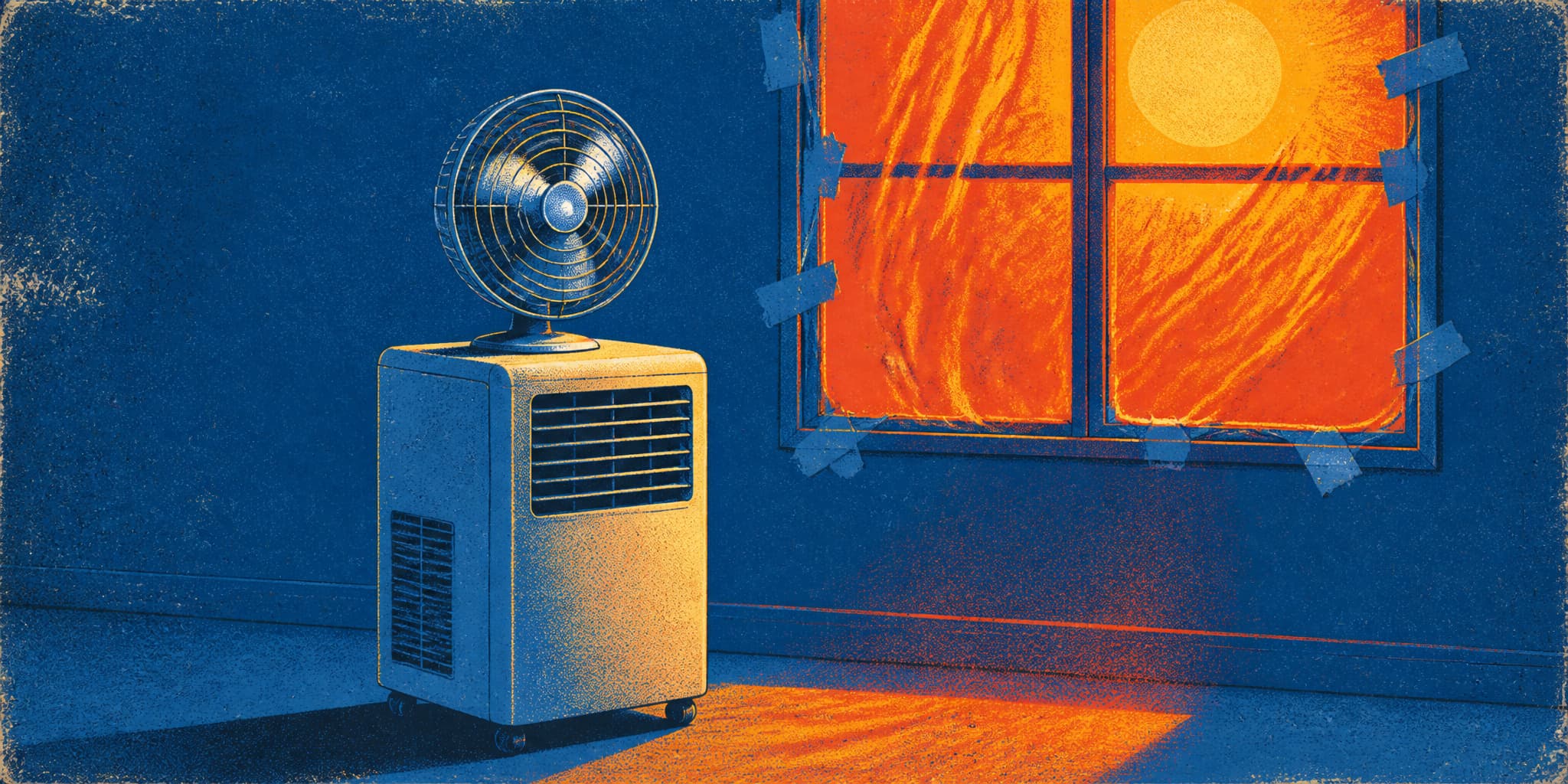
On July 28 a Houston television crew went up to an apartment in Third Ward and filmed what Cheryl Henderson had: four portable fans, two ceiling fans, two portable air conditioners. The bigger portable unit had a dead compressor. The smaller one was taped into a window. Blackout curtains were drawn against the afternoon. She wasn't using the oven. She told them she takes cold showers in the middle of the night when she wakes up sweating, and that the bedroom sometimes doesn't get comfortable until ten or eleven, sometimes midnight.
Henderson has COPD.
"The heat closes my lungs up," she told KPRC.
Three minutes of local news is the entire public record of her cooling system. Nobody has published a measured indoor temperature from that apartment, documented the capacity or age of the equipment, the condition of the building's insulation, what the lease says about cooling, or whether central air exists in the building and doesn't work or was never put in. What we have is an inventory she recited on camera and the visible fact that she was managing it.
Managing it turns out to have a structure. That structure is worth laying out, because it shows how livability actually gets assembled in an American city in 2026, which is to say not by any institution but by the person sitting in the apartment.
The equipment and what it depends on
Start with the hardware. One portable air conditioner works. One doesn't, the compressor being dead, which makes it a plastic box that reminds you of cooling. The working unit is taped into a window, and anybody who has ever sealed a portable AC into a window that wasn't built for one knows the tape is doing about sixty percent of the job and the Houston air is winning the rest. Four portable fans and two ceiling fans push air across her body, which helps for exactly as long as the air they're pushing is cooler than she is. Hold that thought.
Every device on the list runs on electricity. Henderson reported recent bills of $171 and $188 and said her usage could run $200 to $300. KPRC didn't name her electric provider, her rate plan, or her billing arrangement, which matters more in Texas than it would elsewhere. A customer on a prepaid electric plan can be disconnected once the account balance falls below a threshold, with as little as one day's warning when usage spikes. A customer on standard monthly billing accumulates the debt and meets it later. A customer on a level-payment plan gets smoothed bills until the provider reconciles actual consumption, at which point the whole accumulated difference arrives at once. Under any of them, every hour she runs the working unit is a decision about cooling and a decision about money in the same motion. Shut it off to hold the bill down and the apartment climbs back up.
Texas rules prohibit disconnection for nonpayment on days when the National Weather Service issues a heat advisory, plus the two preceding calendar days. The rule delays the disconnection. It does not forgive the bill. The bill sits there, accumulating, waiting for a day cool enough to collect on. So the weather and the electricity run backward from what Henderson needs out of them: the hotter it gets, the more power she draws, the higher the bill goes, the closer she comes to whatever her plan's failure point happens to be.
What was outside her walls
The week she talked to KPRC, Houston had just come through July 22, 102 degrees at Hobby Airport, a daily record. At 1:53 that afternoon a central Houston observation recorded 99 degrees at 42 percent humidity, heat index 109. The overnight low was 80. NWS had forecast heat indices up to 116 across the warned area.
Henderson didn't date her account of midnight comfort and KPRC didn't ask. The late-June data show a stretch where overnight lows never dropped below 76. In early August, eleven of twelve days reached 90 or above, with an overnight low of 82 on the second. Those are readings from an airport weather station and not from an upstairs apartment in Third Ward, where the roof is right there soaking up sun all day and giving it back all evening. Her indoor conditions remain undocumented because nobody has bothered to document them.
Her description of a bedroom that cools at midnight fits the recorded weather. It would be stranger if it didn't.
The shared wire
On July 22, the day of the 102, ERCOT set a peak demand record of 91,089 megawatts. That evening the grid operator deployed non-spinning reserve, 119 megawatts at 7:42 p.m., held until 10:25. An operational action, not an emergency. ERCOT issued no conservation appeal, no Weather Watch, no Emergency Alert, and ordered no controlled outages anywhere this summer through mid-August.
The grid held and the fans kept turning. But every device in that apartment depends on a system that was running close enough to its limit on the hottest day to need reserves called up. ERCOT's revised August outlook put the probability of entering emergency conditions around 10 p.m. at 5.96 percent, partly because battery storage might run down before demand did.
Ten p.m. is roughly when Henderson says her bedroom starts to become bearable.
What the fans are doing
There is a real disagreement here between two outfits that ought to know. The CDC says to use fans only when indoor temperatures are below 90 degrees, warning that above that, a fan can raise your body temperature instead of lowering it. The WHO, in guidance published last month, says fans may provide relief below 104. That leaves fourteen degrees of expert uncertainty inside which Henderson's four portable fans are either helping her or cooking her, depending on which authority you asked, plus humidity, hydration, airflow, and the particular body involved.
The particular body has COPD. A 2024 systematic review of 25 studies found extreme heat associated with higher COPD morbidity and mortality. The CDC says extreme heat can worsen lung disease including COPD. Neither source names an indoor temperature at which COPD symptoms begin, or one that protects a given patient. The WHO's housing guidelines concluded the evidence isn't sufficient to set a universal maximum indoor temperature that would protect everybody vulnerable.
Her primary cooling tools are fans, and the experts can't agree whether fans help or hurt in her temperature range. She has a respiratory condition that heat aggravates, and nobody with a letterhead has established what "safe" means for a woman in an upstairs unit in Third Ward. All of that is documented in separate places by separate institutions. Henderson is the one combining it.
The ordinance as one more thing to manage
Houston's proposed cooling ordinance would require landlords to provide and maintain air conditioning capable of holding indoor temperature at least 20 degrees below outdoor temperature, or no higher than 80 degrees, whichever is warmer.
Sit with "whichever is warmer" for a second, because that is the whole ordinance. On a day when the air outside hits 109, and Houston has recorded heat indices that high and its climate is not finished warming, the formula permits 89 indoors. One degree under the CDC's line for when a fan starts working against you. On July 22, when Hobby hit 102, the formula would have allowed 82, above the nominal 80-degree floor and comfortably inside the range where Henderson says her lungs close up. The clause was written by somebody who understood that 20 degrees of relief sounds generous and produces the least protection precisely when protection matters most.
The city's FAQ lays out the enforcement path: tenant calls 311, the city sends an inspector, the owner gets an "opportunity to correct." What the FAQ doesn't say is how fast an inspector shows up, which room gets measured, at what hour, with what instrument, whether Henderson has to be home for it, how long the landlord gets, or what the penalty costs. A council-office investigation of ten apartment properties found 311 calls misrouted and closed automatically after voicemail, before any inspection happened at all. "Opportunity to correct" floats there without a number attached to it, which is a choice.
Texas property code creates a rebuttable presumption that seven days after notice is a reasonable time for repairs, adjusted for the nature of the condition and the availability of labor and materials. During those seven days Henderson is in the apartment with her fans and her taped window unit and her lungs. The law also prohibits landlord retaliation against a tenant who reports a code violation, covering eviction, rent increases, and reduction of services for six months after the complaint. The protection is on the books. Using it requires her to recognize retaliation, document it, and pursue a remedy. One more component in the system she's running.
The committee hearing on July 28 lost its quorum before it finished. The ordinance is expected back August 25. Her summer continues on schedule.
What gets recorded and what doesn't
I wrote something earlier this year about Maricopa County's indoor heat-death records, where the database field said Has AC: Yes and the person in the room was dead. The field recorded a machine. It didn't record whether the machine ran, whether the electricity was on, whether the walls held anything, whether the body could still regulate its own temperature. In a census-tract estimate Henderson's apartment almost certainly counts as having air-conditioning access, and she does have access, to a dead compressor and a unit taped into a window in an upstairs room that stays hot until midnight. Nobody has described her building except her, once, on television.
She knows her way around a public process, incidentally. She testified before City Council in June about drainage and flooding in Third Ward. She has worked with the Northeast Action Collective on flood recovery, sat in on disaster-recovery planning with Texas Housers, attended a national housing coalition convening. Same neighborhood, different infrastructure failure, repeatedly. She knows how to navigate public processes. That knowledge has not so far changed what they deliver.
Utility assistance exists in Harris County. BakerRipley, the local administrator, took 3,000 applications starting July 13 and shut the online portal. It reopens September 14, which falls after the summer. Applicants need a current bill, thirty days of income documentation, and identity verification, and can expect a decision inside six weeks. The state's income ceiling for energy assistance is 150 percent of the federal poverty guideline, $23,940 for a single person. Whether she applied, qualified, or got anything isn't in the public record either.
What Henderson is running
Put the whole thing on one page, which nobody does.
There are mechanical components: fans, one working portable AC, two ceiling fans. Behavioral components: no oven, curtains managed against the sun, cold showers, sleep shifted to whenever the room permits it. A financial component, the electric bill, with its own rules about when it can shut her off. A physiological component, a set of lungs the heat is actively working on. And now maybe a legal component, a complaint through 311 to an inspection to a violation finding to an opportunity to correct of unspecified duration, with retaliation protections she would have to enforce herself.
She controls none of it. The electricity runs through ERCOT and through her ability to pay. The equipment belongs to a landlord who hasn't replaced a compressor. Whether the fans help or hurt depends on an indoor temperature sitting below a threshold two major health organizations disagree about by fourteen degrees, and the legal claim depends on a committee that couldn't keep enough members in the room.
She is where all of it converges, and she holds it together by deciding, hour by hour, when to run the unit and when to kill it, when to shower, when to eat something that doesn't require heat, which lights to leave off, how to tape a machine into a window that was never cut for it. This is skilled work. I spent five years in engine rooms keeping equipment alive past the point where anybody should have asked it to run, and I recognize the trade: constant attention, physical cost, and a working knowledge of exactly where the thing will quit. Nobody counted that either. No institution measures what Henderson does, funds it, or takes any of it off her. The ordinance, if it passes, hands her one more tool, the right to file a complaint and wait. It does not hand her a second working air conditioner, a smaller bill, different lungs, a building built for the climate it's standing in, or a night that cools off before midnight.
She has been doing this since May. Three minutes of it made the news.
- The ordinance returns August 25: Houston's proposed cooling standard is expected back in committee after the July 28 hearing lost its quorum before completing action, and the final formula — particularly whether "whichever is warmer" survives — will determine what the right actually requires.
- 8.16 million homes without usable AC: The EIA's preliminary 2024 Residential Energy Consumption Survey estimated that 8.16 million occupied primary homes had been unable to use air conditioning because equipment was broken, repair was unaffordable, or electricity had been disconnected — a national count of the gap between having a machine and being cooled by it.
- Utility assistance reopens mid-September: BakerRipley, which administers Harris County energy assistance, closed its online portal after accepting 3,000 applications in July and expects to reopen September 14, meaning the hottest weeks of the summer fell inside the gap between application windows.
- ERCOT's late-evening risk window: The grid operator's revised August outlook estimated its highest probability of emergency conditions around 10 p.m., partly because battery storage may deplete before demand falls — the same hour Henderson describes her apartment finally beginning to cool.
