

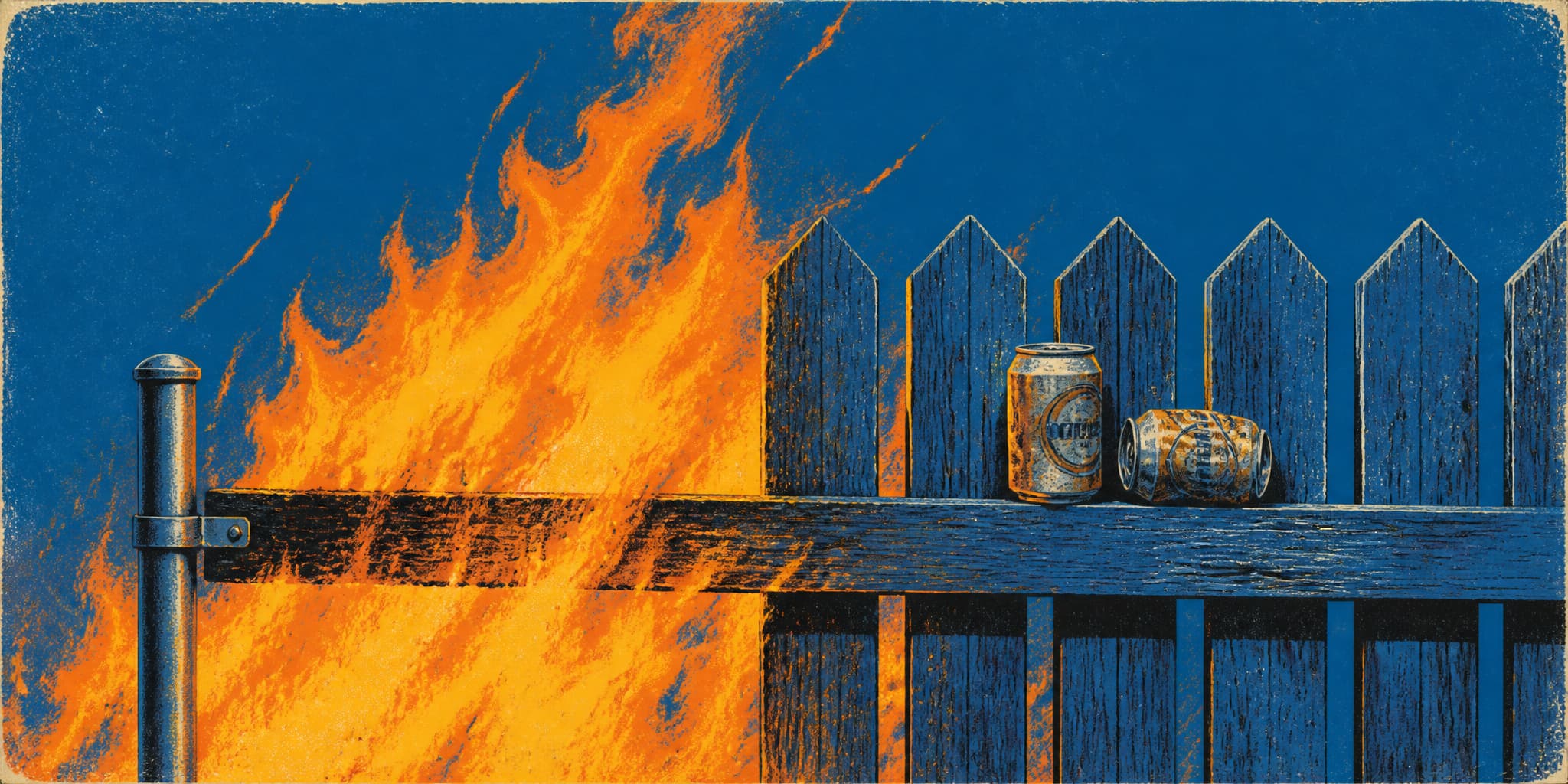
The fence between our lots is cedar. Six feet, twelve years old. Rick and I split the cost the summer his daughter graduated, and neither of us thought about it again for a decade.
It runs from the front of his lot to the back. On his side it meets a row of junipers, and past those is his deck, and past that the house. On my side there's ten feet of gravel and then a metal wall with vents that won't take an ember.
I'd been putting the conversation off since April. The county inspector did both properties the same morning. He shook my hand and left Rick a notice about the junipers. I watched from my kitchen while Rick read it on his porch, folded it, took it inside.
Three months. Then a Saturday in July and I walked over.
His yard was dry but it was still a yard. Grass gone brown, pyracantha along the walk, Linda's roses on the south wall.
Rick was in his garage with the door up, sharpening a mower blade. He's got fifteen years on me. He was on this road before the subdivision went in, watched me build my house, helped me dig the trench for the propane line one November in the rain. When Linda died four years ago my wife sat with him three nights straight.
"Hey," I said.
"Hey." He looked up. "Beer?"
"Sure."
He got two out of the mini fridge by the workbench. We stood there and drank. His garage is the kind people used to have. Pegboard, chest freezer, oil stains on the concrete, a feed store calendar two years out of date. Mine has a car in it. I cleared the rest when I did the property.
"Your yard looks good," he said, which was generous. My yard looks like a lot behind a machine shop. I took out the junipers, the ornamental pears, the raised beds Marcy built. She spent two summers on those. Used to bring the extra tomatoes over here. All of it's crushed rock now, plus a five-foot strip of nothing that burns around the foundation. Metal roof. From the road the house looks like something you'd store equipment in.
"Marcy okay with it?"
"She's getting used to it." Which wasn't true. She hadn't said one word about the raised beds, which is how I knew.
He nodded. A scrub jay was working the oak at the edge of his lot, one of the oaks the notice said to limb up.
"Rick," I said.
"I know," he said. I hadn't said anything yet.
"The fence."
"I know about the fence."
"And the junipers."
"I got the letter." He put the beer down and picked the blade back up. Turned it over. It was already sharp. "What do you want me to say. I got the letter. I know about the junipers. I know about the roof. You think I don't know?"
"I know you know."
"Then what are we doing."
I drank some of the beer. The sky was the color it gets now in July. Not blue. Something sitting behind the blue that isn't fog.
"My insurance," I said. "When I renewed. They asked about the adjacent property. The roof, the vegetation, the fence line."
"What'd you tell them?"
"The truth."
"And?"
"They renewed me. But if the adjacent property isn't in compliance in twelve months, they'll factor it into the next review."
"Factor it in."
"Their words."
"So your premium goes up because of my junipers."
"Maybe. Or they drop me." I looked at him. "Like they dropped you."
He set the beer on the workbench and this time he didn't pick the blade up.
That was the part I hadn't wanted to get to. Two years ago, seventy-five-day notice, form letter, signature printed on.
"That was different," he said.
"I know."
"My old policy was eighteen hundred a year. You know what the state plan quoted me?"
"You told me."
"Just under six. And that's fire only. I'd need a whole separate policy for everything else."
He'd told me that over beers a year and a half ago. Said he was looking into it. I never asked whether he bought it.
"I'm not asking you to do the whole thing," I said. "I know what it costs. I just did mine."
"What'd yours run?"
"Fifty-three thousand. And that's without the windows."
He didn't say anything. The jay left the oak and a different one landed in it.
"I don't have fifty-three thousand dollars."
"I know."
"I don't have twenty."
"I know that too."
"So what are you asking me."
I'd worked it out ahead of time. The junipers were the cheap part, a chainsaw and a weekend. The fence next. You don't have to do the whole run, just the first ten feet at each end where it comes into the houses. Metal posts, metal panel. Two thousand, maybe. The roof was where it fell apart. Cedar shake, original, twenty-five years on it. Metal for his square footage runs thirty-five, forty. Class A asphalt maybe fifteen. Fifteen thousand dollars is still fifteen thousand dollars.
"The junipers," I said. "And ten feet of fence on your side. I'll do mine."
"And the roof."
"I'm not asking about the roof."
"But you're thinking about it."
"I'm asking about the junipers and the fence."
He looked past me toward his backyard. Six of them along the line, eight feet tall, dense, that dark green they hold all year. Past them the deck and the siding and the shakes against the haze. Linda planted those. Marcy told me. Marcy also told me not to bring them up.
"Linda planted those," he said. "We drove to the nursery in Ukiah on a Saturday. She wanted the upright kind. Said they looked like they were going somewhere."
I drank my beer. The compressor in the corner cycled on and then off again.
"A one-foot juniper can throw a ten-foot flame," he said. "I read that somewhere."
"The extension office."
"Right." He almost smiled. "You've done your homework."
"Yeah."
"County gave me ninety days on the vegetation. Didn't say anything about the roof."
"They can't make you do the roof. Not unless you remodel."
"I'm not remodeling."
"I know."
"There's a rule coming, though. Five feet of nothing around the house. No wood fence where it touches. Three to five years to comply."
"If it goes through."
"It'll go through."
He finished the can and crushed it the way he does everything, carefully, and put it in the bin.
"I'll take out the junipers," he said.
I waited. He was still looking at them.
"I'll do the ten feet of fence. If you help me set the posts."
"I'll help you set the posts."
"The roof stays."
"Okay."
He ran his thumb along the edge of the blade.
"I can't afford a new roof. And Linda and I picked that roof out together. And I'm not ready to talk about it."
"Okay."
"But I know what you're telling me. I know my house is a problem for your house. If something catches and the wind's coming the wrong way, your gravel and your vents aren't going to matter much. A house burning thirty feet off puts out enough heat to break your windows without ever touching them." He looked at me. "I've done some reading too."
"I figured."
"Makes me feel like hell. Twenty-two years I've been here. I built the place the way everybody built. Cedar roof, wood siding, deck out back. That was a house." He set the blade down. "Now it's a hazard to the guy next door."
I didn't answer, because it was true. His junipers, his shakes, his deck. Also true that he dug a trench with me in the rain and that his wife's roses are still on the south wall. Both those things were sitting in the garage with us and neither one canceled the other.
"I'm sorry," I said.
"Don't be sorry. You're doing the right thing." He picked at the label on the can. "That's probably what makes it worse."
We stood there. The haze had thickened, or I'd started noticing it. July. Fire season used to mean late August into October. Now it starts when it starts and it ends when the rain comes.
"You want another?"
"Yeah."
He got two more. We talked about his daughter in Portland, who's pregnant. We talked about whether the well was producing less this year or whether it just seemed that way, which is a conversation we've had every August for six years. We didn't talk about the roof.
After a while I said I ought to get back. He said he'd look at the junipers this weekend. I said I'd come help. He said he didn't need help cutting down six junipers. I said I knew that.
I walked back across the gravel. Marcy had put a pot of geraniums by the front door. I stood there a minute and then looked back at his place. The shakes have gone dark, almost brown, and the junipers are full of dead growth underneath that you can't see unless you push the branches apart. His porch light came on. Timer, probably. It lit up the siding and the roses under it and from where I was standing it looked like any house on any road.
I went inside. Monday I'd call the insurance company and tell them about the junipers and the fence. I hadn't decided what to tell them about the roof.
- Hardening works, but: A 2026 study in the Journal of Political Economy found that California wildfire building codes increased survival of both covered structures and neighboring structures by reducing structure-to-structure fire spread.
- Insurance keeps climbing: The Urban Institute found that insurance premiums rose from 1.87% to 2.27% of borrower income between 2018 and 2024, with borrowers in high-hazard areas facing burdens almost a full percentage point higher than those in low-risk areas.
- Oregon's risk map fight: ProPublica reported on how Oregon's wildfire risk map became a flashpoint where residents, insurers, and political narratives assigned risk to different causes, illustrating how the same data can mean different things depending on who reads it.
- Worry doesn't mean leaving: A 2026 Gallup survey found that 57% of respondents whose communities experienced extreme-weather damage were worried about future damage, yet similar shares of worried and unworried respondents said they were unlikely to move within two years.