

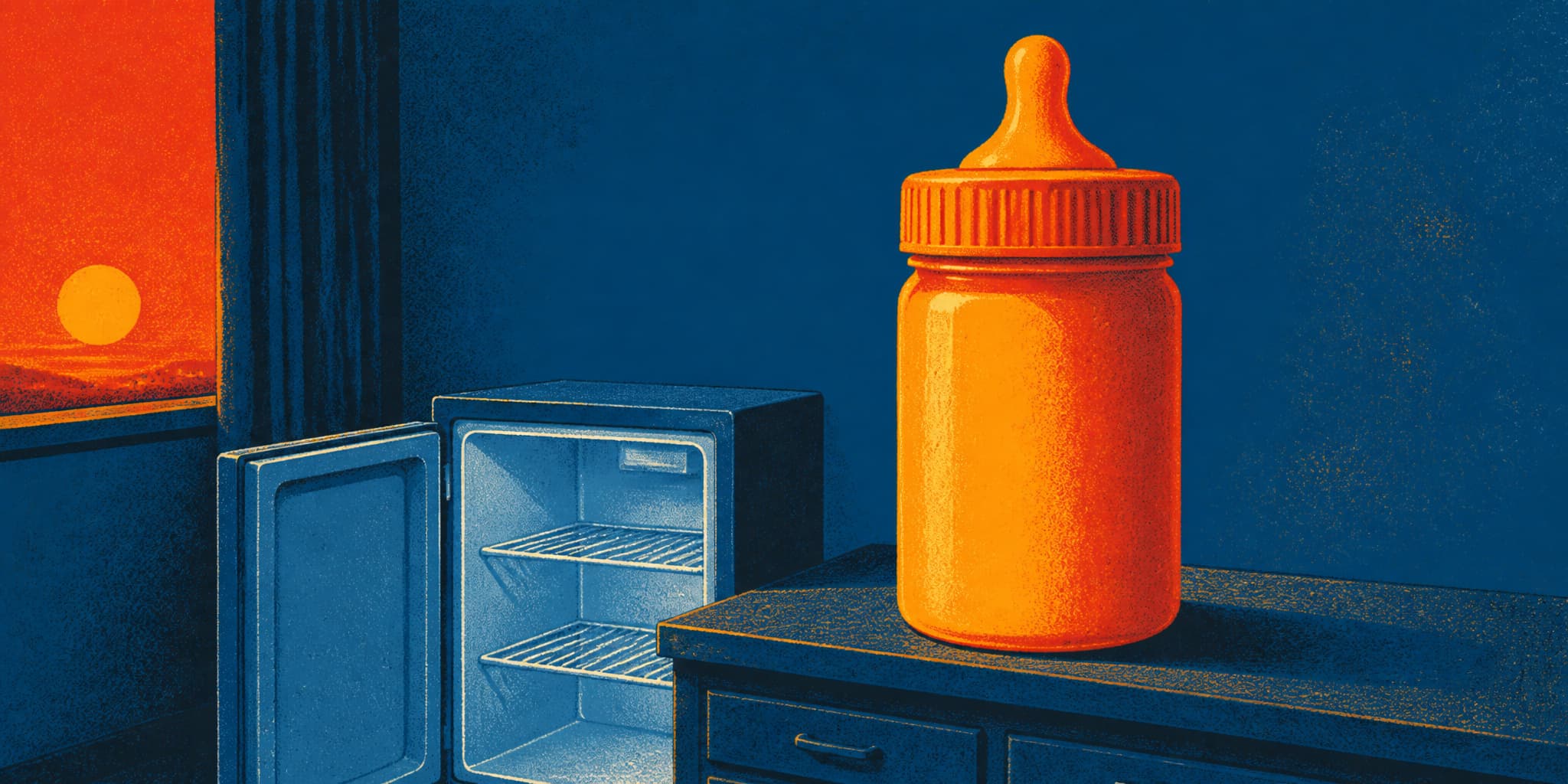
A health provider in North Carolina described to the Government Accountability Office what happened after Hurricane Helene: a mother staying in a hotel with three children, one of them two weeks old. She'd been given 32-ounce containers of ready-to-feed formula. The containers didn't fit in the mini-fridge. She didn't know they needed refrigeration once opened. She'd also been giving the infant water for hiccups, something a pediatrician or a home-visiting nurse would normally catch, except the appointments that fill a newborn's first weeks had disappeared along with everything else.
The provider wasn't describing a failure of the mother. She was describing what happens when the structure around a new baby — clinic visits, lactation support, someone to call at two in the morning — vanishes all at once, and what replaces it is a hotel room and a container with instructions on the side.
I keep coming back to the container that didn't fit. The right supply reached the right person and still didn't work, because whatever counted as success on the delivery end was measured in ounces sent.
This piece is about what people already depend on. Not what they should buy in advance. What's already in the refrigerator, the medicine cabinet, the filing cabinet, the week's routine, and what emergency systems quietly assume a household can do without.
What the guidance assigns to your household
FEMA's disability preparedness guide tells people to "plan how they will function without their usual tools and aids." Keep medication on hand, discuss emergency prescription quantities with your clinician, obtain backup power, teach other people how to operate your equipment. Sheltering in place, the guide warns, may mean days without electricity, telephone service, or passable roads.
For someone insulin-dependent, that instruction means: plan how you will function without refrigeration. For someone on home oxygen, it means plan how you will function without electricity. Written down, it reads as sensible advice. What it hands the household is a job, and it lands heaviest on the people whose ordinary lives already require the most logistics — families already managing dose schedules, equipment maintenance, supply chains for specialized nutrition, and the appointments that hold a fragile routine together.
The clocks already running
A refrigerator without power keeps food safe for about four hours if the door stays shut. A full freezer, roughly 48. After that, what's inside is waste.
For households in the lowest income quintile, which spend about a third of their income on food, a full refrigerator is this week's budget, already spent. After Hurricane Irma, William and Streisand Feyos told a local station they'd lost around $800 of food to an outage. They unplugged the empty freezer because they couldn't afford to refill it or to run it.
FEMA's Individual Assistance program does not cover food spoilage. SNAP has a replacement process, but it covers only food bought with SNAP benefits, requires a signed statement within ten days, and caps the replacement at one month's allotment. After Helene, USDA approved mass replacement for North Carolina on October 4, for a disaster that started September 26. October 4 is when the authorization cleared, not when anyone ate.
Insulin runs on its own clock. The FDA notes that many insulin products hold up for as long as 28 days between 59 and 86 degrees Fahrenheit. Above that range, effectiveness degrades. After Hurricane Maria took down the power across Puerto Rico, a mother identified as Juliana in a peer-reviewed study described watching her son's blood sugar go uncontrolled while she tried to keep his insulin viable without refrigeration and fed him canned food poorly suited to his condition. Not being able to store the medicine, and not being able to reach emergency care, was part of what pushed her family off the island.
These dependencies are running right now in working kitchens, invisible because the power is on.
What can't fit in the car
FEMA's evacuation guidance tells households to decide how everyone will get to the destination and to use one vehicle per family where possible. The disability guide advises wheelchair users to know their chair's size and weight, whether it collapses, and to obtain a lightweight manual backup.
After Hurricane Michael, the National Council on Disability documented rescuers finding more than 70 disabled and older people at a Panama City hotel with no power, water, or food. A young man with quadriplegia was carried down from an upper floor with his family. His customized power wheelchair stayed behind. A chair built around one person's body doesn't fold into a trunk, and the evacuation had not been designed with one in it.
The same evaluation found that some people evacuated after Hurricane Harvey ended up in a nursing home hundreds of miles from home, and couldn't come back until money was found for accessible transportation. Emergency planning concentrates on the hours of leaving. The return has a longer timeline and far fewer people watching it.
The paper that proves who you are
After the Eaton Fire destroyed Pete and Angela Mitchell's house in Altadena, they applied for FEMA assistance and were denied. A 90-minute phone call and most of a day at a Disaster Recovery Center went to figuring out what the application was missing. The answer was insurance documentation. Their insurance agent's office had burned too. They tracked the records down eventually, but the delay stacked on top of a mortgage, rent on temporary housing, and costs for their animals, all running at once.
FEMA's Individual Assistance policy requires applicants to submit insurance settlement or benefit documents before the agency will consider help in any category insurance might cover. When automated identity verification fails, acceptable proof includes a Social Security card paired with government ID, military identification, a passport, or a birth certificate. The policy specifically excludes notarized statements and affidavits. You can swear you are who you say you are, and it won't count.
After the 2023 Maui fires, Hawai'i waived replacement fees for vital records and processed about 205 requests in a single week: 184 birth certificates, 19 marriage certificates, two death certificates. Each one is somebody whose proof of existence burned in the same fire as the house.
The papers in the filing cabinet are the keys to every system a person will need afterward, and they're kept inside the structure the disaster is coming for.
What shelters weren't built to hold
FEMA's Shelter Field Guide calls for intake screening that identifies medication needs, dietary restrictions, mobility limitations, and pregnancy. Needs beyond the shelter's capacity, it says, should be referred to a medical facility. The guide contains no mention of refrigeration. The word "formula" doesn't appear in it.
Florida's 2024 statewide emergency plan runs 232 pages, written for a state that took two major hurricanes that year. It describes special-needs shelters as a "last resort" and tells registrants to self-sustain for up to 72 hours. "Infant" and "refrigeration" do not appear.
So the screening happens and the need gets written down. Whether it gets met depends on whether somebody on site understands what the need actually requires, and whether the local emergency operations center can source it in time.
Providers told the GAO that during Helene, donated powdered formula went to areas without safe water or power. It couldn't be used. It was thrown away, at a moment when trash service was also down. In the same disaster, FEMA and USDA delivered roughly 440,000 ounces of ready-to-feed formula and 73,000 bottles with nipples to North Carolina. That happened because providers asked for it specifically. The shelter system wasn't already carrying it.
Questions worth sitting with
Checklists exist, and they have their uses. The questions below are a different kind of inventory, of what's already in the house.
What in your home needs electricity to keep somebody alive or stable? How long can it go without before the consequences start? Does anyone outside your household know that number?
If you had 20 minutes, what wouldn't fit in the car? What would you be choosing between?
Where is the proof of who you are? If that drawer burned or flooded, how would you establish your identity to an agency that won't take your word for it?
How many days of food are in the kitchen right now? If the power went tonight and stayed off a week, how much would you lose, and what would replacing it cost against what's in the account?
Who in the household depends on something that repeats — a medication schedule, a dialysis appointment, a home health visit, a school meal — that would simply stop? What fills that gap, and for how long can it?
For plenty of households the answer to some of these is that there's nothing. No backup, no workaround, nobody with a spare room. Emergency plans measure readiness in instructions issued: store this, arrange that, discuss the other with your doctor. They don't count what the instructions assume is already handled.
When the Oakland hills burned in 2003, I was thirteen, and what I remember from Fruitvale is that the people organizing on our block already knew things no agency had recorded. Which apartment had the oxygen concentrator. Which families had no car. Which households wouldn't call anyone in a uniform for any reason, and would need somebody to knock. That list wasn't written down. It lived in whoever had been paying attention long enough to build it. Most households' lists still do.
- Heat hiding in diagnoses: A peer-reviewed study of nearly 917,000 Chicago emergency visits found 33 diagnoses associated with extreme heat that don't mention heat at all — kidney trouble, skin conditions, injuries, even multiple sclerosis flares — raising the question of how many dependencies on cooling never get counted as heat problems.
- EPA's pre-failure checklist: New federal guidance lets drinking-water regulators document signs a water system may be approaching failure — aging pipes, deferred repairs, treatment malfunctions — without triggering a violation or attaching money to fix it, creating a category for danger that's been named but not yet owned.
- Houston's cooling ordinance, tested: Houston now requires working air conditioning in all rental units, but enforcement depends on tenants filing complaints, inspectors gaining access, and landlords completing repairs — a sequence that assigns the household most of the work of making the protection real.
- Insurance and who adapts: A Brookings working paper studying Florida homeowners found that rising premiums pushed wealthier households toward protective retrofits while lower-income households pulled back, suggesting the same price signal can function as an incentive or a burden depending on what a family already has in the bank.