

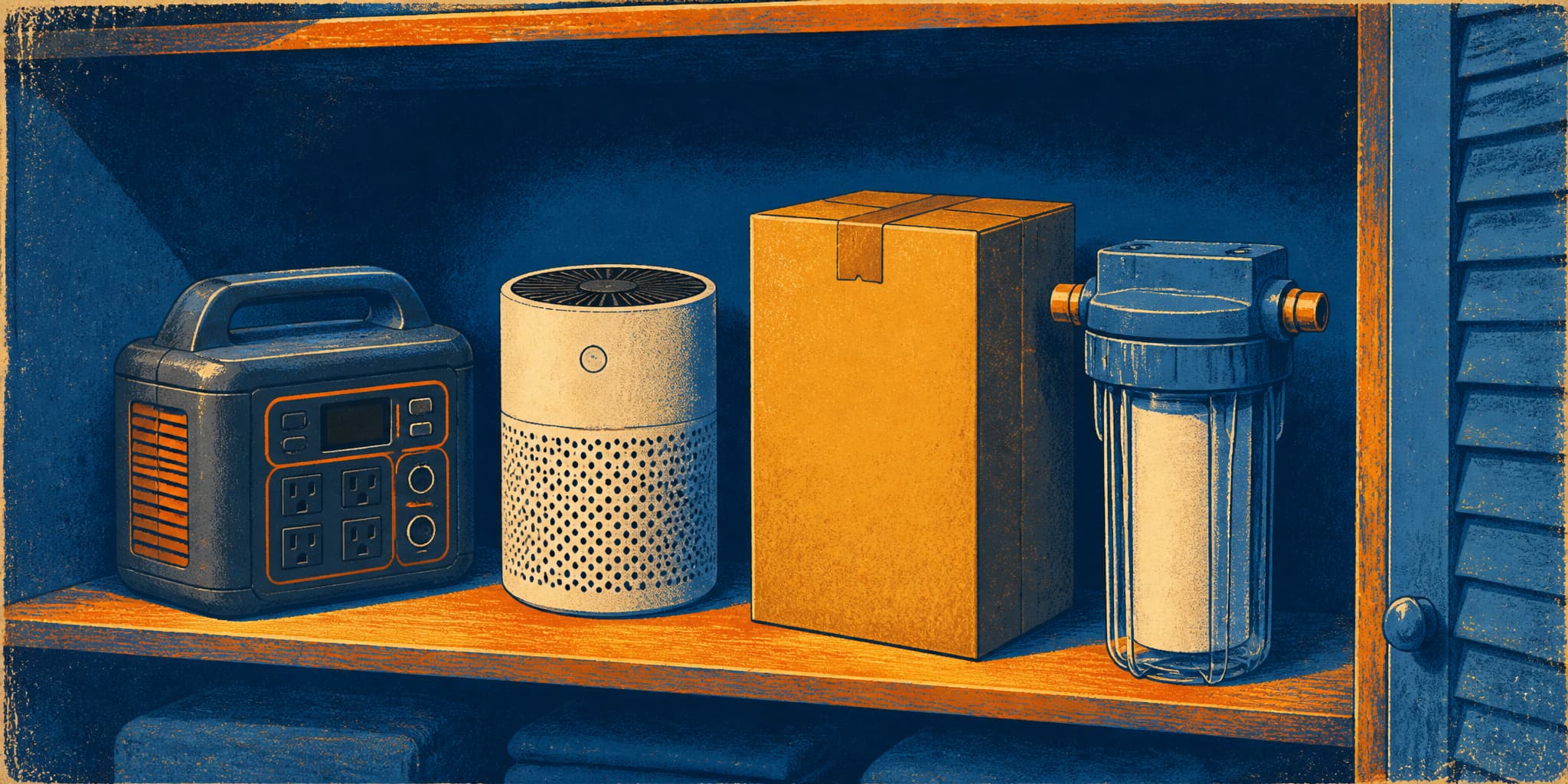
I've been staring at a shelf in my hall closet. It filled up over about three years without my noticing: a portable power station bought after a multi-day outage, a HEPA air purifier bought during a week when the air quality index on my phone went purple, a weather radio I still haven't programmed. Under the kitchen sink there's a water filter I installed after actually reading my city's annual water-quality report instead of recycling it.
Every one of those purchases solved a problem on a specific afternoon. None of them was part of a plan. But looking at the shelf now, I can see something I apparently built without deciding to build it: a small private utility system, assembled one credit card charge at a time.
Once I noticed mine I started noticing everyone else's. A friend in Houston had a whole-home generator wired in after the 2021 freeze. My sister keeps two window AC units in her Portland apartment closet, left over from the heat dome. A colleague has a go-bag by the door. The objects vary, but they're doing a similar job: standing in for something a public system used to handle, or still technically handles, just not reliably enough to count on when it matters.
I wanted to lay these out together and see what they look like as a collection rather than as a series of Tuesdays.
Portable power station
A 512-watt-hour battery with an AC outlet runs about $295. A 1,024Wh unit is around $499. A 2,048Wh bundle with two solar panels costs $1,400 at Costco.
That tells you what you can buy. What you can actually run with it takes different math, and the product page isn't in a hurry to walk you through it. Watt-hours measure stored energy; watts measure the load you can pull at any given moment. A 512Wh battery supplying its maximum 500-watt continuous load has a theoretical ceiling of about an hour. A 1,024Wh battery at its 1,800-watt max lasts roughly 34 minutes before you account for inverter losses. The manufacturer manual says this plainly enough if you read it closely. The listing emphasizes other things.
Recharging from a wall outlet takes about an hour for the smaller unit. Recharging from a solar panel takes three to six hours in favorable conditions: sun, correct angle, no clouds. The 220-watt folding panel that makes solar charging possible costs $326, slightly more than the battery. Which raises something I keep turning over. The scenario where you'd most need to recharge from the sun is a multi-day outage during a storm, which is also the scenario where a storm is sitting on top of your panel.
Owning one makes you the person who decides what gets power. Phone charges, refrigerator gets an hour, CPAP runs overnight, router stays dark. That job assumes you know the running wattage and the startup surge of every device you're trying to keep alive. In 2024, the average U.S. electricity customer went 11 hours without power over the course of the year, nearly double the annual average of the preceding decade, driven mostly by Hurricanes Beryl, Helene, and Milton. After Beryl came ashore near Houston, e-commerce analysts estimated that direct-website sales for portable battery brands jumped 24 to 71 percent within days.
Of everything on this list, the power station is the friendliest to renters. No exhaust, no permanent installation, fits on a shelf. Its limits are renter-shaped too. It can run what you plug into it and nothing that's wired into the building.
Whole-home standby generator
A standby generator addresses the same outage at a completely different scale, and it's the object on this list that most clearly assumes you own a house.
A 10-kilowatt Generac with a transfer switch costs $4,329 for the equipment. A 22-kilowatt unit costs $7,229. The equipment price is where the project starts. Installation, meaning a concrete pad, a gas line, electrical work, transfer switch wiring, permits, and inspection, adds $1,500 to $5,000 by Home Depot's own documentation, while the AP has reported total installed costs of $5,000 to $20,000 or more depending on the house. The spread comes from what the house needs, not from what the generator is.
Then it needs fuel, either natural gas from the utility line or propane from a tank on your property. It needs periodic testing whether or not the power ever goes out. It needs a licensed electrician and often a plumber, a permit, and a yard. A renter cannot independently produce any item on that list.
Generac has estimated that home standby generators reached roughly 6.75% penetration among single-family, detached, owner-occupied homes valued above $175,000, up from about 3.5% a decade earlier, though the company moved its home-value threshold between the two estimates, which makes the comparison rougher than it looks. Their 2015 filing attributed about $140 million in additional residential shipments to demand created by Superstorm Sandy. One storm, years of backlog.
The part I find hardest to file is that the generator doesn't make a household independent. It shifts the dependency. The household is off the electric grid but reliant on the gas utility to maintain pressure in the line. The utility's repair timeline gives way to a technician's availability. A monthly electric bill becomes a monthly gas bill plus an annual service contract. The gas line still needs the utility to maintain pressure. The propane tank still needs a truck that can reach the property. After a major storm, the same downed trees and flooded roads and overwhelmed crews that took out the grid can delay both. So what exactly has been bought? Something real, clearly, during the ordinary outage. During the disaster the object was purchased for, I'm less sure.
Air purifier
A room-sized HEPA purifier starts around $100 and climbs past $300. The purchase is straightforward. What follows is a schedule: prefilter cleaning every two weeks, carbon filter every three months, HEPA filter annually, about $60 per cycle for one representative model. Heavy smoke loads a filter faster than the calendar predicts.
Coverage matters more than the box suggests. The EPA's sizing guidance pairs a given clean-air delivery rate with a specific room size. A unit rated for 225 square feet doesn't stretch to a 900-square-foot apartment because you turned it up. The word "coverage" on packaging isn't standardized unless it's tied to a tested delivery rate, and plenty of advertised numbers aren't.
During wildfire smoke events, EPA research finds that a closed home without portable filtration typically sits at 55 to 60 percent of outdoor fine-particle concentrations, with individual homes ranging anywhere from 30 to 100 percent. A purifier brings that down meaningfully in one room, with the door closed and the windows shut.
Which is where I get stuck. EPA advises closing windows during smoke events. Closing the windows of an uncooled apartment during a heat wave can make the room dangerously hot. The purifier requires sealed windows to do its work; the person inside requires ventilation or cooling to be okay. Those two objects, purifier and air conditioner, turn out to need each other, and neither product listing mentions the other. Buying the answer to one problem quietly hands you the setup conditions for the next.
When Canadian wildfire smoke settled over the Northeast in June 2023, air purifier brands reported sales five to ten times normal daily volume. The Association of Home Appliance Manufacturers has cited research estimating that 36 percent of U.S. households owned or had access to a room air cleaner, with sales growing 6.6 percent annually, though COVID-era indoor air worry drove a good share of that alongside smoke. A 2023 CDC survey found that among adults who didn't use a portable air cleaner, 59 percent named cost. Among renters, 66 percent.
Water filter
The Water Quality Association's 2023 survey found that 45 percent of U.S. households had some water treatment beyond a refrigerator filter, up from 40 percent two years earlier. The WQA is the water treatment industry's trade group, so the number arrives from an organization with a stake in the category growing, but the direction matches other reporting.
What "filtered" means depends completely on which filter and which contaminant. The CDC is blunt: most pitcher and refrigerator filters aren't designed to remove germs, and many are mainly improving taste. A filter certified for lead reduction under one standard is not thereby certified for PFAS. And on PFAS, EPA notes that the certification standards in use as of 2024 didn't demonstrate reduction to the agency's newer drinking-water limits.
The prices track that specificity. A carbon-block faucet filter costs $43. A five-stage reverse-osmosis system runs $260 and wants cabinet space, a drain connection, a hole in the counter for a dedicated faucet, and replacement cartridges every six to twelve months at roughly $180 for a two-year set. Renters can use countertop or gravity-fed systems without touching the plumbing, at the cost of smaller volumes and counter space that's usually already spoken for.
During a boil-water advisory, the CDC says to boil tap water even if it's passed through a household filter. The filter treats one tap, for named contaminants, under normal operating conditions. It can't repair a main, restore pressure, or recognize an unknown chemical that entered the distribution system after a disaster.
EPA's new Systemic Issues Checklist, published this month, gives regulators a way to flag aging infrastructure, deferred repairs, and treatment problems before they become formal violations. The household filter sits downstream of all of that. I bought mine because my city's water report raised questions for me. It answered a couple of them. The rest were questions about a system, and a filter on a faucet isn't an answer to those.
Window AC unit
I spent an earlier piece on this object, working through a 5,000-BTU unit's installation manual to count the conditions hiding inside the sentence "the apartment has air conditioning": a machine, a circuit that holds, a compressor that runs, a bill someone can cover, and a person with the standing to say fix this. The price ladder runs from $169 for a small unit to $479 for a larger one, and the purchase assumes a compatible window, a grounded outlet, landlord permission, and a circuit that won't trip under load.
During the June 2021 Pacific Northwest heat dome, one Portland hardware store sold roughly 450 air conditioners in three days, about a month's business per day, before running out. Plenty of units in that surge arrived after the worst of the heat had passed.
Weather radio
A basic weather-band radio costs $18. A unit with location-specific alerting, meaning it sounds an alarm only for warnings in the area you've programmed rather than every warning on the frequency, costs $50. NOAA Weather Radio reaches more than 95 percent of the U.S. population through over 1,030 transmitters, generally about 40 miles from each tower, though terrain and buildings cut into that.
It works when the power is out and the cell towers are down, and the FCC has documented that disaster damage can disable wireless emergency alerts. It works, that is, if someone issued a message, the transmitter survived, the batteries are fresh, and the radio was programmed correctly.
Mine is still in the packaging. I suspect this is common.
What the shelf holds
Add it up. Power station, purifier, water filter, window AC unit, weather radio. At the cheapest options, roughly $625, before replacement filters, solar panels, electricity, or the hours spent learning how any of it works. At mid-range, over $1,300. The whole-home generator that would actually cover a household's electrical load stays out of reach for renters entirely and costs more to install than many households take home in a month.
Each object, considered by itself, is a reasonable purchase. I keep trying to see them that way, one at a time, because that's how they arrived. Together they describe a household that maintains its own backup electricity, its own air treatment, its own water filtration, its own cooling, and its own emergency warning system. Each one stands in for a public system that still exists but has been unreliable enough, often enough, in enough places, that a lot of people stopped waiting on it.
The filter schedules and fuel costs scattered through these sections belong to a pattern Maya Jimenez traced in a maintenance piece in this space: every installed object opens a recurring schedule that nobody budgets for and nobody tracks. We pay for the purchase and assume the protection follows on its own.
What stays with me is what these objects take for granted about whoever buys them: disposable income, somewhere to put them, technical knowledge or at least the patience to acquire it, time for maintenance. The more effective ones assume ownership of the property. They assume a person who can read a manual, calculate wattage, tell one filter certification from another, program a radio — a household with resources, and one that will absorb the work.
The households most exposed to grid failure, bad air, contaminated water, and extreme heat are frequently the ones least able to assemble any of this. I don't know what to do with that.
So I keep coming back to the shelf. Each thing on it arrived after a specific event, solved a specific afternoon, and stayed. Somewhere along the way the collection stopped registering as unusual. It's just what the closet looks like now. I'm still working out what to make of that.
- Houston's new cooling ordinance: The city council voted 12–2 on August 19 to require operable air conditioning in all rental properties, eliminating an old exemption that let screened windows substitute — but enforcement depends on tenant complaints, inspections, and landlord cure periods that haven't been tested yet.
- Florida's insurance-retrofit paradox: A Brookings working paper using 18 million Citizens Property Insurance observations found that rising premiums encouraged wealthier households to add resilience features while lower-income households reduced adaptation, suggesting the same price signal can push in opposite directions depending on who receives it.
- EPA's pre-failure water checklist: A new federal guidance document lets regulators flag aging infrastructure, deferred repairs, and treatment problems at water systems before those conditions become formal violations — creating a category for danger that's visible but doesn't yet have an owner or a budget.
- Heat hiding in other diagnoses: A peer-reviewed Chicago study of over 900,000 emergency visits found 33 diagnoses associated with extreme heat — including kidney disorders, skin conditions, injuries, and multiple sclerosis flares — that would never appear in a heat-death count.