

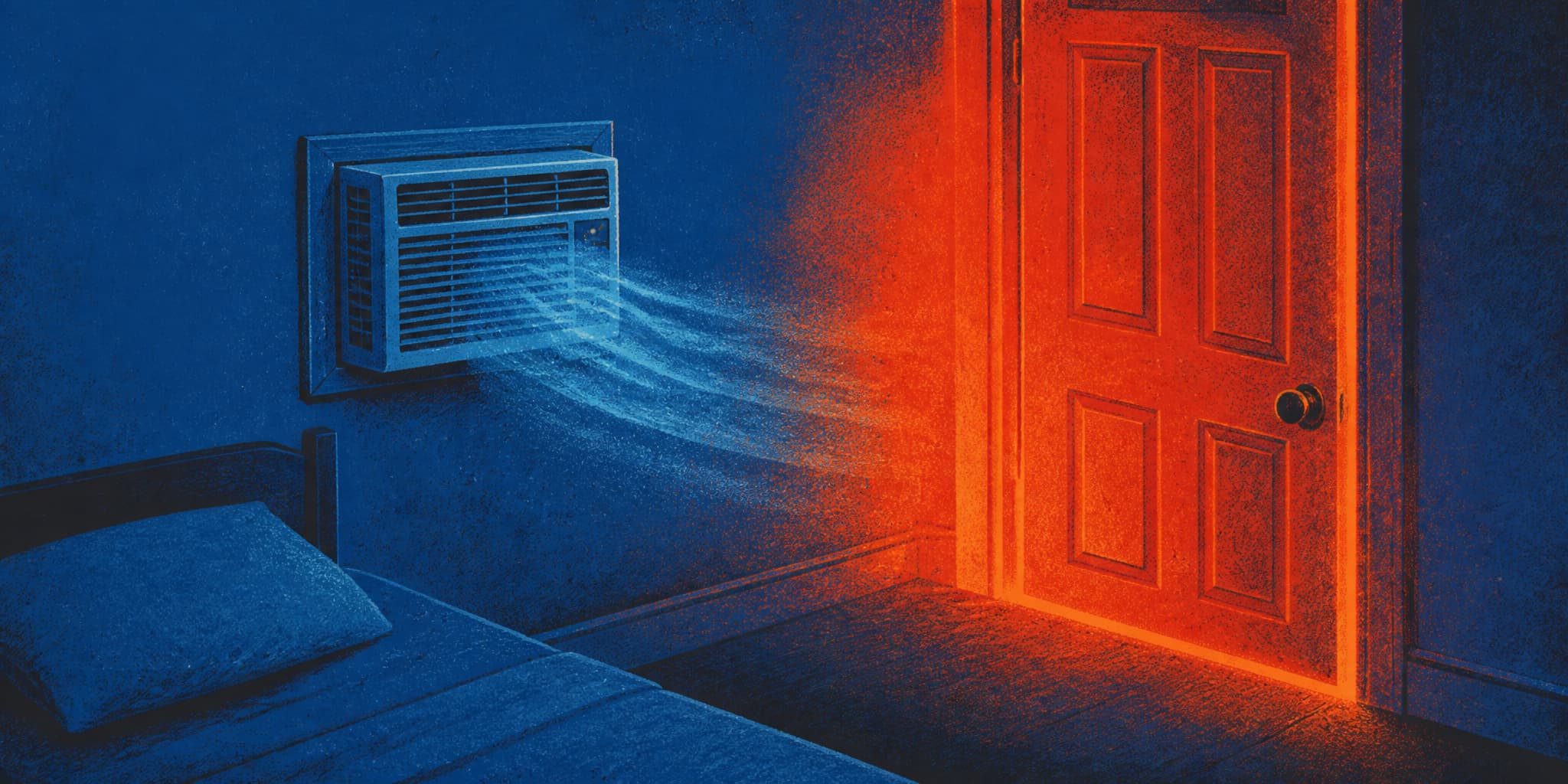
On May 9, 2026, a Red Cross canvassing team knocked on Joyce Craven's door at Friendly Village of Orangewood, a mobile home park in North Phoenix. It was past ten in the morning and already over ninety degrees. She told them her home was "like a tin can." Then she showed them the window air conditioner in her bedroom, which was the only one in the house. It could hold that room at something near livable. The rest of the place was whatever the outside was. Asked what she planned to do about summer, she said she'd stick back there in the one room with the window unit.
David Hondula, the city's chief heat officer, was along on the canvass. He told her to call Phoenix Neighborhood Services about emergency cooling assistance. A KJZZ reporter wrote it up.
That is the entire public record of Joyce Craven's summer. One morning, one quote. Nobody has published whether she made the call, whether she qualified for anything, or whether help arrived before the real heat did. What we have is the room.
I keep coming back to that room, because everything around it is functioning exactly as designed and the result is a woman living in her bedroom from May to October.
The Tin Can
Joyce owns her home. She does not own the ground underneath it. That's how manufactured-home parks work here and most everywhere else: you buy the structure, the park keeps the dirt, and you pay monthly for the privilege of leaving your house where it sits. At Friendly Village, advertised lot rents in 2026 run roughly $922 to $1,008 a month. That is ground rent alone — not the home, not the utilities, not the cooling.
Buyers there have to qualify with park management before they can close. The sale conveys the house and not the land. The listing calls it leasehold.
"Like a tin can" is a physical description before it's a complaint. A manufactured home is a thin-walled metal box with modest insulation, parked on a lot with little shade, taking Arizona sun on every surface it has. A 2022 investigation of manufactured housing in Tucson recorded indoor summer temperatures of 90 to 96 degrees in a poorly insulated 1982 unit. Residents in that reporting covered their windows with blankets and reflective foil. They left their homes for libraries and malls during the worst hours. Families spent the summer in the one room with a window unit, misting each other with spray bottles. One woman put her summer cooling bill at $350 a month for a house too drafty to cool.
The split ownership means Joyce is responsible for everything inside and attached to her home — walls, wiring, insulation, cooling equipment — while the park controls the land, the infrastructure feeding her lot, and the rules about what she's allowed to change. Arizona law lets parks maintain written rules covering safety and services. Parks are required to maintain the electrical facilities they supply and to disclose the type and power rating of each lot's connection.
Between Joyce's breaker panel and the park's transformers there's a chain of hardware: branch wiring inside the home, a feeder cable out to the lot pedestal, the pedestal itself, the underground lines running back to the park's equipment. Which pieces are hers and which are Friendly Village's is settled by the lease and the park rules. No current Friendly Village lease or rules document is publicly available.
The Right
In 2024, the Arizona legislature amended its manufactured-housing statute to bar park owners from prohibiting residents from installing "reasonably necessary commercial cooling methods." Before the amendment, a park could simply say no — no window unit, no mini-split, no swamp cooler, nothing that changed the exterior or pulled extra power.
That was a real legislative accomplishment, and it took people years. Joyce Craven now holds the legal right to install cooling equipment in her home.
The law says nothing about whether her electrical system can run it, whether the park's lot pedestal can supply it, whether the park's distribution wiring can carry the load if every resident on the block exercises the same right on the same 115-degree afternoon, or whether Joyce can pay the bill that comes after.
I wrote a version of this problem earlier for this publication — a Houston renter named Cheryl Henderson assembling something tolerable out of one portable unit, a few fans, and hourly decisions about what to run when. Henderson rented her space and had no authority over the building at all. Joyce owns her structure outright and has a statute on her side. The structure still may not be able to do what the statute permits, and the economics of a depreciating box on rented ground make it foolish to spend money finding out.
The Electrical Question
Nobody has published the age of Joyce's home, the amperage of her main breaker, the rating of her lot pedestal, the condition of her branch circuits, or whether her panel has room for another load. The distance between "you may install cooling" and "your house can run cooling" is an electrical question with a numerical answer, and the number has never been taken down.
You can sketch the range from comparable cases, with the understanding that none of it has been checked at her address. HUD's manufactured-housing code permitted some older homes to run on 40- or 50-amp power-supply cords, with 60-amp panelboards where the calculated load was small. Ordinary house service today is 100 or 200 amps. A 2025 Arizona Attorney General complaint against a Tucson mobile-home park included an electrical engineer's finding that the park's 30- and 50-amp pedestals were adequate only for a very small dwelling with minimal air conditioning and gas appliances. The same engineer noted that when several homes run their air conditioning at once for hours, the shared conductors can overload even where each individual panel looks fine on paper.
That was a different park in a different city. But the shape of the problem repeats wherever manufactured homes sit on leased lots with aging wire in the ground. Joyce's panel might handle a second window unit and the feeder to her pedestal might not. The pedestal might handle it and the park's distribution might not. The statute gives her the right. Whether the hardware gives her the watts is unknown, because nobody has walked the chain from the transformer to the bedroom.
The Arithmetic
A 1967 manufactured home at Friendly Village, 768 square feet, was listed for $35,000 this August. Another one there was offered at $75,000 in January 2024, dropped its price repeatedly through the year, and sold for $25,000 in March 2025.
Phoenix-area electricians publish 2026 estimates of $2,500 to $4,500 for a straightforward panel upgrade in a conventional house, and $4,200 to $6,500 if a new meter combination and mast are needed. Those are prices for ordinary houses on owned land. They cover no work on a park pedestal, a shared feeder, or a distribution transformer. Cooling equipment runs from about $6,000 for a basic package unit to north of $20,000 for a split system, going by recent Arizona permit valuations.
Put it together and a five-figure electrical and cooling retrofit — the kind that might make the whole house usable in July — can meet or exceed what the house is worth. The house sits on rented land, which puts conventional mortgage financing out of reach. The Consumer Financial Protection Bureau has documented that the loans available to people who own the home but not the lot, called chattel loans, get denied more often, carry higher interest, and are refinanced less than ordinary mortgages. Fannie Mae started a new program in 2025 aimed at manufactured homes in land-leased communities, though whether Friendly Village takes part, and whether improvement money is available through it, isn't on the public record.
I've spent a working life around people doing this arithmetic, and almost none of them do it on paper. They do it in their bodies, over a few summers. You learn which room goes first. You learn that the kitchen is a place you enter for water and leave. Eventually you know what the window unit can hold when it's 108 out and what it can't when it's 115. It stops being a decision at some point and becomes a fact about the house, the way the front step is a fact about the house. The bedroom works. The rest is square footage you pay rent under and can't use five months of the year.
Nobody with sense sinks $15,000 into a $25,000 home depreciating on ground that costs a thousand a month. Joyce did not need a financial planner to walk her through it. She pointed at the window unit and said she'd stick back there.
Who Dies Indoors
Maricopa County recorded 430 heat-related deaths in 2025. A hundred and eleven of them happened indoors. Mobile homes and RVs accounted for 25 of those 111 — roughly 23 percent of the indoor heat deaths in a county where they make up about 5 percent of the housing.
Mobile homes and RVs account for roughly 5 percent of Maricopa County's housing stock but 23 percent of its indoor heat deaths.
An air conditioner was present in 94 percent of the indoor deaths. In 72 percent of those, the unit was classified as not functioning — broken, unable to start, or not running properly even with power to the building.
What the county does not publish is those two facts laid against each other. We know mobile homes are wildly overrepresented among people who die indoors. We know most indoor deaths happen in homes that have an air conditioner that isn't working. We don't know whether the mobile-home deaths involved broken equipment, missing equipment, equipment running flat out against a structure it couldn't beat, or a house with the power shut off. The county tells researchers to file a data request for that.
Without the two together, you can't tell "no air conditioner" from "air conditioner running and the house too leaky to cool." Those call for entirely different remedies. You can hand out window units until the warehouse is empty and pass statutes protecting the right to install them, and neither one answers the question Joyce's bedroom asks, which is what to do when the machine is there and the building beats it.
The Phone Number
Hondula told her to call Phoenix Neighborhood Services. The likeliest thing on the other end of that number is the city's Weatherization Assistance Program — free, grant-funded, covering energy assessments, insulation, air sealing, and repair or replacement of heating and cooling equipment. Arizona's statewide rules explicitly include stationary mobile homes. The income limit for one person is $31,920 a year.
So the program exists, it covers her kind of housing, and it funds the work her house probably needs. What it doesn't publish is how many manufactured-home residents applied last year, how many got completed work, how long they waited, and how many were turned away because the house needed more than the program is allowed to do. The city's 2025 Energy Access Plan lists enrolled and weatherized households as metrics it intends to track, with no manufactured-home baseline to start from.
There's also a broader Housing Repairs Program for electrical and structural work, though the published language doesn't make clear whether a titled manufactured home on rented land qualifies. For the utility bill, Arizona's LIHEAP and Power AZ programs take manufactured-home residents and offer standard assistance of $160 to $640, which will cover a piece of one month's electricity in a leaky house running a window unit through a Phoenix summer. Earlier reporting described park residents on submeters as shut out of utility help; current state policy provides a route for households billed through a third party, with extra paperwork attached. Whether Joyce holds a direct account with the utility or buys her power from the park is one more thing nobody has published.
Count the things she'd need to know that aren't publicly available: whether weatherization can touch her electrical situation, whether housing repair covers a home like hers on land like hers, whether the park's wiring can carry another compressor, whether she's eligible for bill assistance given how she's billed. That's four questions routed through four agencies, and she got one phone number.
The Room
She had already done the work that the statutes and programs and mortality reports are all circling. She did it the way working people do it, without data requests, using her body and a couple of summers. She got her answer: the bedroom.
The legislature handed her a right. The county counts the bodies afterward and doesn't cross the columns. The city gave her a phone number, and the park cashes the lot rent on the first. Joyce is in the back bedroom with the window unit, in a house she owns on ground she rents, in a structure she can't afford to fix and can't afford to walk away from, exercising her legal right to cool one room out of a house full of rooms she pays for.
I've been listening for forty years to the news that the system is working on it, about one thing or another. Programs exist. Statutes get amended. Metrics are under development. Meanwhile the temperature in North Phoenix does what it now does every summer, which is climb past the point where the rest of the house is any use, and Joyce is in the one room that works, with the compressor running, waiting it out.
- Houston's 120-day clock: Landlords have until mid-December to comply with the city's new air-conditioning requirement, and Cheryl Henderson's Third Ward apartment will test whether an installed unit produces a tolerable room for a tenant with asthma and COPD.
- Spokane's standing-home gap: Bridget Perez got positive at-home lead tests from the window seal of her one-year-old's nursery in a home the fire never touched, but government hazardous-material removal covers only fire-damaged properties, leaving her family to decide whether the nursery is safe before any authority will.
- Alabama's dependency-rich success: The state's FORTIFIED roof program has documented 55 to 74 percent lower claim frequency after Hurricane Sally, but the result required grants, trained contractors, third-party inspections, and insurance discounts all working together — a counterexample worth watching for what happens when any link breaks.
- The missing county data: Maricopa County's heat reports show mobile homes wildly overrepresented in indoor deaths and most indoor deaths involving nonfunctioning AC, but the cross-tabulation of housing type against cooling status has never been published.