In 1998, Florida caught fire. A severe drought turned the spring burning season into a crisis, with wildfires and escaped prescribed burns running together across hundreds of thousands of acres. Fires closed interstates and forced evacuations from the Panhandle to the Atlantic coast. Smoke settled over Jacksonville, Daytona Beach, and Orlando thick enough to shut down stretches of I-95. Structurally, it was Florida's Yellowstone: a visible, politically charged fire emergency of the kind that, ten years earlier, had led the federal government to effectively suspend ecological fire management across the West.
Florida's legislators faced the same pressures that had driven the post-Yellowstone retreat. People were angry, property was damaged, and promising that the burning would stop was the obvious move. In 1999, lawmakers went the other way. They rewrote and strengthened the state's Prescribed Burning Act, raised the liability threshold for certified burns, and declared prescribed burning a property right. The law described it as essential to public safety, ecosystem maintenance, agriculture, forestry, and biodiversity.
So the crisis that could have ended prescribed fire in Florida got the state more of it. The reasons are mostly procedural.
The 1990 act and its 1999 revision
Florida's original Prescribed Burning Act took effect in 1990, two years after Yellowstone, while the federal system was still writing its suppression orders. Before anyone lit a match, the law required a written prescription, the landowner's consent, and state authorization. It also required adequate firebreaks, enough people and equipment on site, and direct supervision by a certified prescribed-burn manager. A burner who followed all of that was protected from liability unless someone proved negligence.
The 1999 revision kept every operational requirement and changed the legal standard. Under the current statute, a neighbor can still recover damages from an escaped prescribed burn. To do it, they have to prove gross negligence, meaning conduct so reckless it shows conscious disregard for the safety of the people exposed to the fire. Most states use ordinary negligence, which only requires showing the burner failed to take reasonable care.
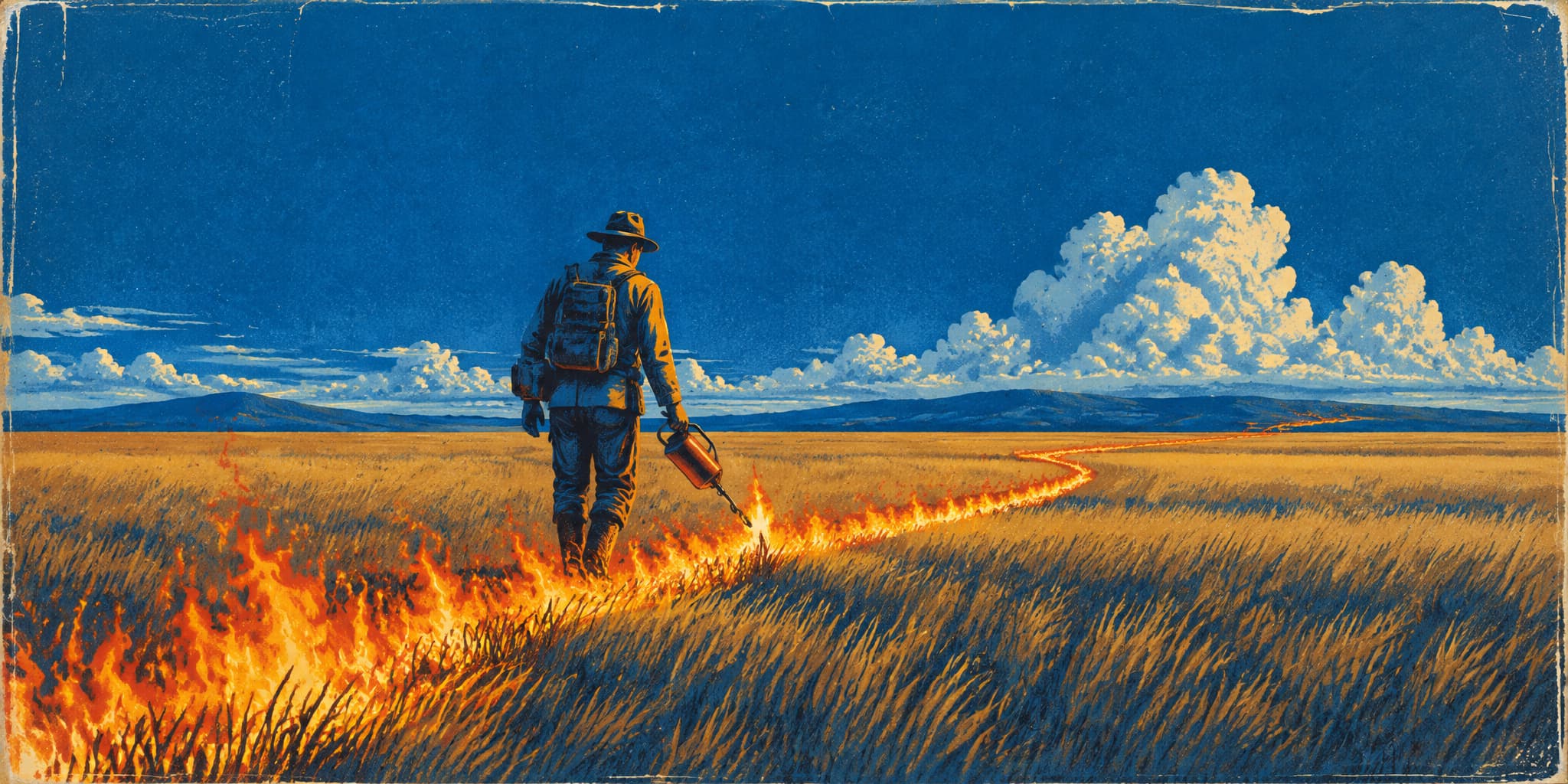
That difference changes the math for anyone deciding whether to put fire on the ground. Under ordinary negligence, if your burn escapes and damages a neighbor's property, you're liable if a jury decides you weren't careful enough, and a jury can apply that standard to any wind shift, any ember, any smoldering stump that flares back up a week later. Under gross negligence, the neighbor has to prove you knowingly ignored the risk. The person walking the line with a drip torch, the handheld canister that dribbles burning fuel onto the ground, isn't staking their livelihood on every gust.
The Florida Forest Service issues approximately 88,000 burn authorizations in an average year, covering more than 2.1 million acres — in a state with 23 million residents.
On state forest land alone, the agency treated a record 277,818 acres in fiscal 2023–24. Whether Florida burns more total acreage than any other state depends on which dataset you trust. A 2023 EPA inventory put Texas slightly ahead. Either way, Florida puts fire on millions of acres a year, across public and private land.
Tate's Hell, 2008
In April 2008, the Florida Division of Forestry ran a certified prescribed burn across 3,267 acres of Tate's Hell State Forest in the Panhandle. It was planned, authorized, and supervised by a certified manager, and it stayed inside its boundaries while crews were actively lighting it. Then it smoldered for six weeks. Spot fires jumped a highway twice and were contained on state property. On May 13, an ember crossed a firebreak somewhere between 800 and 1,300 feet wide and set a neighboring landowner's timber on fire. The fire burned 835 acres of private land.
The landowner sued. A jury found the state grossly negligent and awarded $741,496 in damages. An appellate court upheld the verdict. One judge dissented, arguing that disputed jury instructions had denied the state a fair trial. The instructions turned on questions that sound academic until you remember this burn smoldered for six weeks: when is a burn legally "completed"? Are visible flame and lingering smolder different operating states? Does the certified manager's required presence stretch to a reignition weeks after the crews have gone home?
Florida's liability shield is not immunity, and a burner who is grossly negligent pays. After Tate's Hell, though, there was no moratorium. The state paid the cost and kept burning.
Colorado in 2012 makes a useful comparison. A state-agency prescribed burn escaped in the foothills southwest of Denver. The Lower North Fork fire killed three people, destroyed or damaged 27 homes, and caused an estimated $11.3 million in property loss. Colorado immediately suspended prescribed burning by state agencies and reorganized its state fire functions. It also retroactively waived sovereign immunity, the legal doctrine that shields a state from being sued without its consent, so victims could bring claims.
Three people died in Colorado and nobody died at Tate's Hell, so the cases aren't equivalent. The responses still show different assumptions underneath. Florida's system was designed to absorb a failure and keep operating. Colorado's wasn't, and its failure produced the same kind of political retreat Yellowstone had produced at the federal level twenty-four years earlier.
Western adoption
What Colorado did after the moratorium complicates the picture. The legislature didn't settle back into suppression-only management. In 2013 it created a certification system and gross-negligence standard for private landowners who followed the rules, adopting part of the same architecture that let Florida keep burning. In 2025, Colorado added certification reciprocity and a $250,000 prescribed-fire claims fund, so burners certified elsewhere could work in the state and people harmed by an escape had a pot of money to draw on.
Other Western states have moved the same direction. Since 2021, California, Oregon, and New Mexico have each adopted some mix of certification, liability protection, claims funds, and right-to-burn language. Each picked different pieces, and none assembled the whole set. California's shield only covers the government's ability to recover firefighting costs from a burner. Oregon kept ordinary negligence and won't evaluate its own claims-fund pilot until 2028.
Why the gap persists
It would be tidy to find one reason Florida burns at scale and the West mostly doesn't. Liability is part of it. But Colorado has had a gross-negligence standard since 2013, and Colorado has not turned into Florida.
The ground itself is part of it too. Florida is flat, and its fire-adapted ecosystems (longleaf pine, wiregrass, palmetto) evolved with frequent, low-intensity fire every one to three years. What burns is grass and understory, not heavy timber. A prescribed burn in Florida flatwoods behaves differently from one on Colorado's Front Range or in Oregon's Cascades, and an escape means something different when the fire is moving through ankle-high wiregrass than when it's in sixty-year-old Douglas fir on a slope above a subdivision.
Florida's institutional continuity matters as much as its statutes. The state has been burning without interruption for decades. That has produced a deep bench of certified managers, an agency that thinks of fire as a tool, and a public that grew up seeing smoke on the horizon and mostly knowing what it meant. None of that moves through legislation. A law can pass in a single session, while the workforce, the agency habits, and the public tolerance take something closer to a generation to build.
The political economy of fire in the West also works against burning in ways Florida doesn't face. A Western wildfire is a national disaster, with emergency funding, cable coverage, and political attention attached. A prescribed burn is local smoke, with complaints, air-quality violations, and liability exposure attached. So the incentives point toward suppression. Fight the fire when it comes and the federal government will help pay for it. Burn ahead of time, and if anything goes wrong, it's yours.
That's the background to the federal spending ratio, better than six to one: more than six dollars in suppression capacity for every dollar spent treating hazardous fuels.
The system, not the statute
In Issue #52, this publication looked at how Florida built a statewide building code after Hurricane Andrew: standards, enforcement, training, and accountability that only worked as a set. The prescribed-fire architecture works the same way. Certification, prescriptions, state authorization, liability protection, staffing, smoke management, and enforcement each lean on the others. Lift one piece out and carry it to another state, and what arrives is a law on the books without the system it was written for.
Yellowstone and Florida usually get told as opposites, the place that tried fire and backed off versus the place that committed and kept going. That framing gets part of it. The federal review after Yellowstone never rejected ecological fire management; it called the policy sound and the execution inadequate. Florida, for its part, didn't just decide to be comfortable with fire. Over decades, through its own crises, with lawmakers returning to the statute again and again, it built a system that spread the risk of burning across certification, liability protection, and public money, instead of leaving it on the one person holding the match.
The Western states assembling pieces of that system are doing real work. Whether the pieces hold at scale, in landscapes and political conditions very different from Florida's, nobody can say yet. Oregon won't grade its own liability pilot until 2028. In the meantime the fuel in Western forests keeps building on its own schedule, and the rest of the system still has to be built around the laws already passed.
