The tile was cool under her feet at five-forty in the morning. Luz stood on it barefoot, the slab giving the night back through her soles, and drank sixteen ounces of water before anything else. Checked the color when she peed. Pale. Good. Drank eight more.
The precool cycle had pulled the house down to seventy-four overnight, banking cold against the day the way her father banked overtime against the months when shifts got cut. By afternoon the thermostat would let the rooms drift up to eighty-two, eighty-three. The system gave ground slowly through the day, a degree every hour or so, and took it back at night.
In the kitchen her mother had left a note beside a bowl of cut jicama: Library today? Text when you get there. Love you. The jicama was cold from the fridge. Luz ate it standing, the crunch loud in the empty kitchen. Her mother wouldn't come out of the back bedroom until eight or nine. Her father was already gone, four-to-noon at the distribution center, his coffee cup rinsed and upside down on the rack. Before he left he'd set two electrolyte tabs beside her water bottle on a folded paper towel, the way he always did.
Wednesday, July 16, 2045. High of 119. Current at 5:47: 97 degrees. Dew point 58. UV extreme by eight.
She had until about seven-fifteen to be outside comfortably. She knew this the way she knew which intersections had left-turn signals.
She dressed in the bathroom. Lightweight long sleeves, UPF rated, the fabric thin enough that her arm hair showed through. Leggings in the same material. The hat with the neck drape, which her father called her desert legionnaire look. She filled her bottle from the tap, and the water came out cool because the pipes ran through the slab. She dropped in one of his tabs. It fizzed pink.
Her pack was loaded from last night. Three books to return, her volunteer lanyard, and at the bottom, wrapped in a dish towel, a ceramic bowl she'd spent two weeks building. Hand-coiled at the rec center's Wednesday clay class, glazed the blue-green of a swimming pool in an old photograph. It was for Mrs. Reyes, who lived in the Garfield neighborhood, six blocks past the library. Mrs. Reyes had taught the clay class until her knee replacement in April. Luz had finished the bowl with what Mrs. Reyes had shown her: the coil method, scoring and slipping the joins so they hold.
The bowl meant going past the library. The library itself was twelve minutes on the cooled-pavement route, with shade structures at every bus stop and the covered walkway along Third Avenue. Mrs. Reyes's house was farther, past the light rail station, into older residential blocks where the sidewalks were original concrete. No shade canopy, no cooling stations. Six blocks of full exposure, maybe eight minutes at her pace.
Her parents would not consider eight minutes acceptable.
Outside, the air pressed warm and dry against her face. The sun was still low, coming in sideways through the mesquites, their shadows stretched long and thin across the gravel yards. There were no lawns on this block and hadn't been in her lifetime. Gravel, decomposed granite, palo verde, barrel cactus, here and there an agave sending up its once-in-a-lifetime stalk. A neighbor's desert willow was blooming, pale pink trumpets, and Luz kept to the shaded side underneath it.
Heat gathered on the triangle of skin at her throat. Warmth built in her shoes where the soles met the pavement. She drank without deciding to, the bottle at her lips every few minutes, the electrolyte taste sharp and familiar. A mockingbird sang from a rooftop. They sang early, before the heat pushed them into whatever shade they could find.
The walk to the library was easy. She passed a woman moving fast behind a stroller, the baby under a UV canopy, and an older man watering his container garden from a hose on a timer, the runoff draining into catch basins at the base of each pot. The pavement here was the treated kind, lighter in color, and she could feel it in her feet: it didn't push heat up through her soles the way the old dark asphalt did on the blocks that hadn't been redone.
The library opened at six-thirty in summer. Ramon, the security guard, unlocked the doors two minutes early. The cold came out of the doorway and onto her skin, and her forearms tightened, the fine hairs lifting.
She signed in at the volunteer desk and shelved returns for forty minutes. She helped a woman find a book on container gardening. She restocked the hydration station in the children's section: juice boxes, water pouches, the electrolyte popsicles the library had started carrying last summer. Kids came in from the day camp next door and went straight for the popsicles. Luz remembered doing the same. As long as she could remember, the library had been a cold room with free water and books, where nobody expected you to buy anything.
At seven-forty she told the desk supervisor she was leaving.
Outside, the morning had moved. The sun was higher, the shadows shorter, and the air sat on her forearms with a prickle that wasn't sweat yet. She walked the three blocks to the light rail station, which was covered and had misters that came on when the platform hit 105. They weren't on yet. She stood in the shade and checked her phone.
Her mother: At the library?
Just finished. Heading home soon.
Not a lie. She would head home. Soon had some room in it.
She turned south on Seventh Street instead of north. The first two blocks had the shade canopy, metal structures the city had put up along the commercial corridor with solar panels on top. Under them the direct sun was gone, and she felt its absence on the crown of her head, where the weight had been.
Then the canopy ended.
Garfield began where the commercial corridor stopped. The sidewalks were older and cracked, never given the cool-pavement treatment. The trees were mature, big mesquites and palo verdes that had been there for decades, and the shade they threw was real, in some ways better than the metal canopies. But it came in patches. Between trees there were stretches of full sun ten or fifteen feet long, and she crossed them quickly. The heat landed on her shoulders with weight. Her skin registered every change, shade, sun, shade, like stepping in and out of warm water.
She counted without meaning to. Ninety seconds of full sun, broken into five- and ten-second pieces between the patches. Her heart rate up a little. Her skin dry. The air was low enough in humidity that sweat left her before it could bead, which cooled her well but meant she couldn't use sweat to judge how she was doing. She drank. The water in her bottle had gone warm.
Mrs. Reyes's house was a small stucco bungalow with a ramada, a roof of weathered slats, over the front porch. A dead grapevine was draped across it; she kept saying she'd replace it with a native passionflower. Clay pots lined the porch railing, each one hand-thrown, each with a different herb: rosemary, oregano, epazote, a scraggly mint watered from the kitchen's gray-water line.
Luz rang the bell. Her pulse was in her throat, not from effort but from her body pushing blood out toward the skin to shed heat. The stucco behind her was still giving up the night's coolness. She leaned against it and felt the faint chill come through her shirt to the skin between her shoulder blades.
The door opened and the cold inside rolled out over her.
"Mija, what are you doing here?" Mrs. Reyes was in a housedress, her knee brace showing below the hem. She looked at Luz, then past her at the street, bright and empty and still. "Come in, come in."
Inside: seventy-six degrees, coffee, corn tortillas. Luz's skin tightened in the cold, and the sweat she hadn't felt outside showed up as a fine sheen on her forearms. Mrs. Reyes was already pouring ice water from a pitcher in the fridge. Luz drank it and felt the cold go down through her chest and into her stomach, a line she could trace.
"I brought you something."
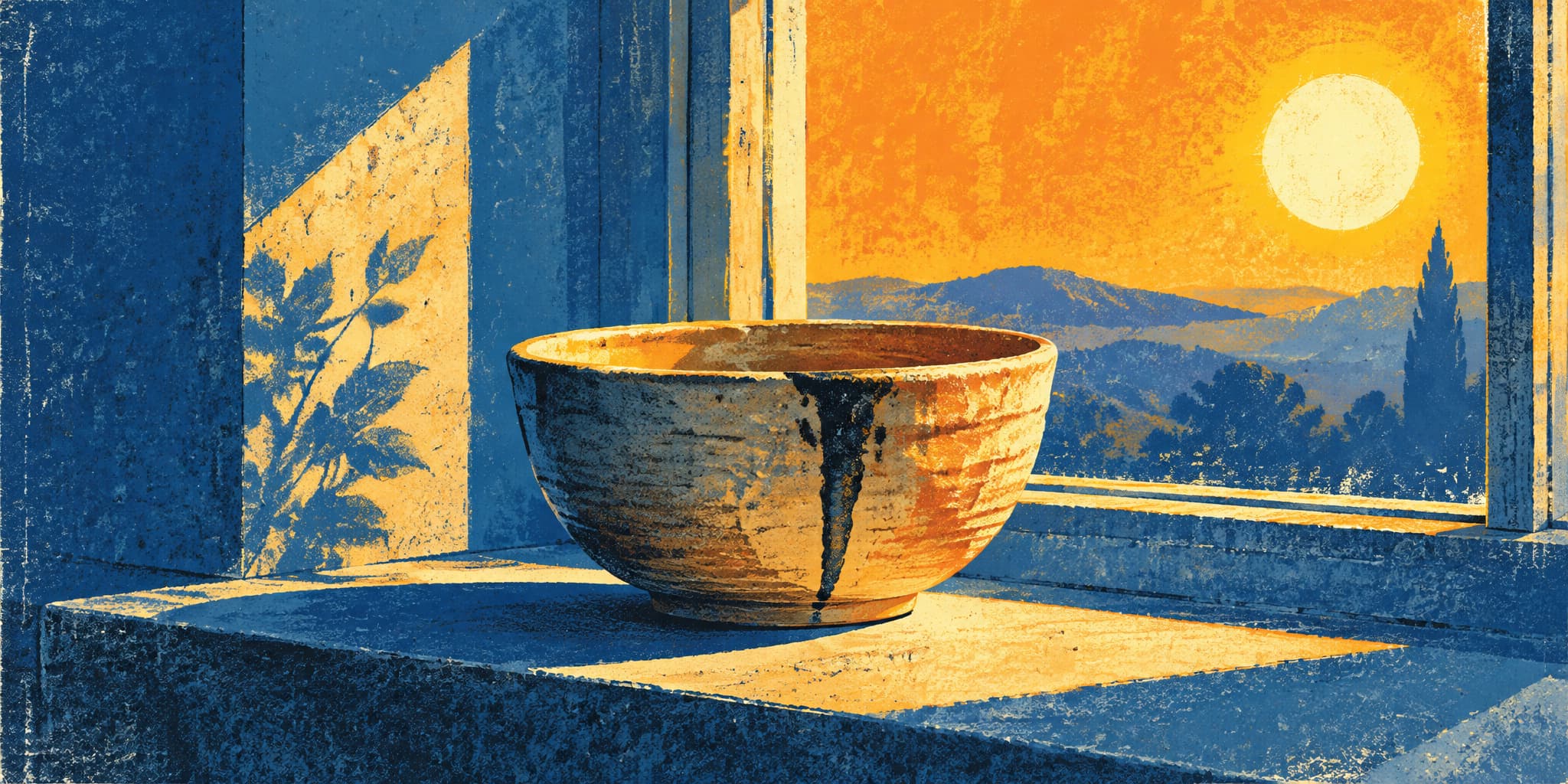
She unwrapped the bowl. The glaze had come out well, the blue-green deep and even, with a darker streak along one side where the kiln had heated unevenly. It looked intentional. It wasn't. Mrs. Reyes took the bowl in both hands and turned it slowly. Her fingers found the coil marks, the places where Luz had scored and slipped the joins, and her thumb ran along them without her looking down.
"You used the overlap join."
"You showed me."
"I showed you once."
"I practiced."
Mrs. Reyes set the bowl on the kitchen table. Her hands stayed close to it, not touching. Then she looked at Luz. "How did you get here?"
"Walked."
"From the library?"
"It's six blocks."
"In this."
"It's not bad yet. It's only eight."
Mrs. Reyes poured her more water and set out a plate of tortillas, still warm, with butter and salt. They talked about the clay class. Mrs. Reyes was hoping to come back in September, when the mornings cooled enough for her to walk to the rec center. Luz thought October was more realistic. The heat had been pushing later every year, or at least her father said so. Luz didn't have a comparison. Every year she'd been alive, October had been hot. She told Mrs. Reyes she wanted to try slab construction next and build something with flat walls and sharp angles. Coil work was all curves. She wanted to see what the clay did when she forced it into geometry.
"You'll need a different slip," Mrs. Reyes said. "Flat joins crack if you use the same ratio."
Luz filed that away to look up at the library.
Her phone buzzed. Her mother: Home soon?
On my way.
"You should go," Mrs. Reyes said. "Before it gets worse."
Luz refilled her bottle from the tap, and Mrs. Reyes added ice from a tray, the cubes cracking as they hit the warm water. At the door they stood a moment in the threshold, where the house's cool air met the porch's heat. Mrs. Reyes put her hand on Luz's shoulder, her palm dry and cool, the skin thin over the bones, and squeezed once.
"Thank you for the bowl."
"Thank you for teaching me."
Outside: 8:22, 106 degrees. The air sat closer against her than it had an hour ago, heavier, with heat coming up off the pavement through her shoes. A warmth that would turn to pain if she stood still in it. She didn't stand still.
The walk back went faster. The sun was higher but still east of her, and the west-facing walls threw shadows she could use. She reached the light rail canopy in four minutes. The misters were on now, a fine spray that was gone almost as soon as it left the nozzles but dropped the air a few degrees. She stood in it and felt it settle on her face, her neck, the insides of her wrists. A man in work clothes stood at the far end of the platform, drinking from a jug. They didn't speak. The mist was enough.
She took the cooled-pavement route home. The mockingbird was gone from its rooftop. The streets were emptying, the city pulling itself indoors the way it did every morning around this time. Adriana had texted the group chat about streaming a movie later. Someone named Kai had posted a clip of himself trying to cook an egg on his driveway. Luz smiled. The egg wasn't cooking. It never actually worked, but people tried it every summer.
She let herself into the house. Seventy-eight now, four degrees up since she'd left. She drank more water, ate a banana, kicked off her shoes. In an hour the house would be warm enough that she'd move to the back bedroom, which faced north and stayed cool longest.
Her mother came out of the office. "How was the library?"
"Good. I shelved. Restocked the hydration station."
"You were gone a while."
"I walked slow."
Her mother looked at her. The flush still on Luz's cheeks, the empty bottle on the counter, the hat thrown on the chair. Her mother's eyes went over these quickly, the way they always did, her face settling into the arrangement it took whenever Luz came in from outside. Luz had seen photographs of her mother as a teenager, standing outside in July in a tank top and shorts. No hat, no UV layer. Bare shoulders in the sun and a garden hose arcing water into the air. Her mother never talked about those photographs.
"Drink more water," her mother said.
"I know."
"I know you know."
Her mother went back to the office. The latch clicked, and then the house was quiet except for the hum of the cooling system and the small ticks of the building expanding in the heat.
Luz texted Mrs. Reyes: Got home safe. Thank you for the tortillas.
Mrs. Reyes replied with a photograph. The bowl on her kitchen windowsill, morning light coming through the glaze, the blue-green lit from behind. The dark streak ran down one side like a river seen from above.
Luz sent back a blue heart and switched to the group chat. Adriana's movie link was waiting. Kai had posted a second egg video, captioned almost. The egg was not almost. She settled into the couch and tucked her feet up off the tile, which had gone warm, the morning's cool all gone out of the slab. She pressed play. The north-facing bedroom would be cooler. She'd move back there soon.
-
Phoenix's cool pavement program: The city has now applied reflective pavement treatment to 200 street miles, with studies showing treated surfaces run 10–12°F cooler at midday but can increase reflected radiation exposure for people standing in direct sun.
-
How air conditioning saves lives: A 2026 county-level study using roughly 30 million U.S. death records estimated that household AC use averted more than 5,200 heat-related deaths annually while reducing heat-attributable mortality by more than half — though the protection still depends on equipment condition, electricity, and affordability at the household level.
-
Arizona's summer shutoff moratorium: The state's 2026 rule prevented most regulated utilities from disconnecting residential electricity for nonpayment from June through mid-October, keeping cooling running during dangerous heat while bills continued to accumulate underneath.
-
Phoenix's shrinking water margin: Following the Bureau of Reclamation's 2026 decision assigning Arizona a 760,000-acre-foot reduction in Colorado River supply, Phoenix emphasized that its stored underground reserves and diversified portfolio provide a bridge — while describing that bridge as temporary rather than permanent.
