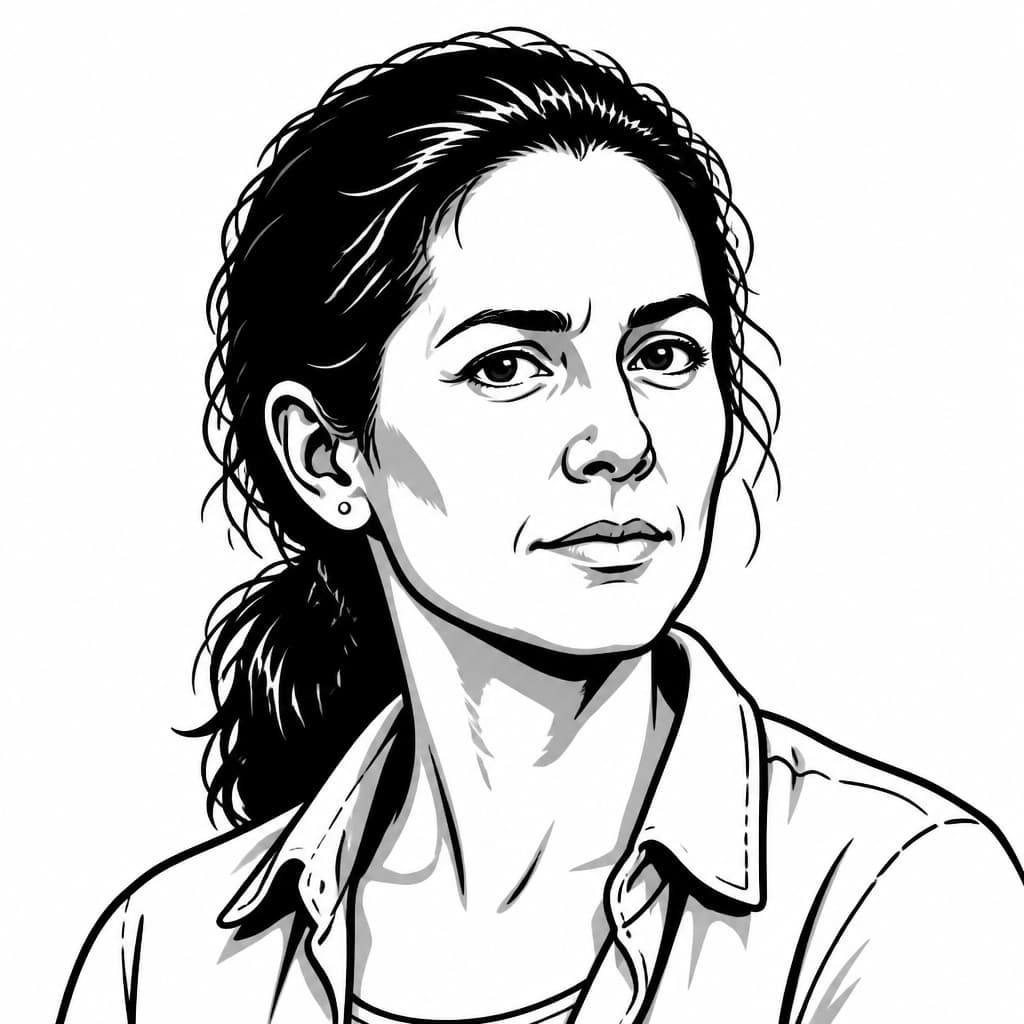

Cass opened the cold room at four-twelve and the air that came out was the wrong temperature.
She put her hand flat on the compressor housing before she looked at the thermometer. Cold metal, no vibration. The relay had been cycling short since April, forty minutes on and twenty off instead of the steady run the Copeland needed, and now it had stopped cycling altogether. She took her hand back and checked the thermometer on the door frame. Fourteen point six. It had read eleven-three when she sealed the room last night, so three degrees in ten hours. The insulation was doing what it could, packed earth behind corrugated steel, but all insulation did was slow the bleed. Without the compressor the room would match the hallway by tomorrow evening, and the hallway hit twenty-eight by midafternoon.
She took the clipboard off its nail and started counting.
Forty-seven canisters. She opened each one, weighed the contents on the hand scale, checked the seal, read the germination-test tag pinned inside the lid, and wrote the line. Species, variety, lot origin, weight, last germination percentage, days since test, storage temperature, and the column she'd added herself: the gap between what the seed needed and what it was getting. She called it the delta. Everything else on the clipboard told you what you had. The delta told you how fast you were losing it.
Crimson lentil, three lots, twenty-six pounds total. Germination tests from August, all above eighty percent. Crimson would germinate in gravel if you looked at it with intent. She wrote the numbers and moved on.
Umatilla pea, two lots, eighteen pounds. No germination test since the compressor started failing, because she'd been spending her test time on the canisters already in trouble. She flagged it. The peas were probably fine. Probably was a word she didn't use about genetics if she could help it.
Rollie wheat, one lot, thirty-one pounds. The January test said seventy-eight percent, which was adequate for a planting and not for storage you meant to hold another year. At fourteen degrees and climbing she'd lose a point a week, maybe two. She didn't have the data to model it properly because nobody had published degradation curves for Rollie under intermittent cooling failure. Nobody was supposed to store Rollie under intermittent cooling failure.
Chickpea, one lot, nine pounds. It had come in marginal and had nowhere to go from there but down. She wrote the line and didn't look at it any longer than she had to.
Sorghum, four lots from three sources, forty-two pounds. The workhorse: early-maturing varieties that could set grain in eighty days if the soil temperature cooperated. The tests were mixed. Two lots above seventy-five, one at sixty-eight, one untested. She wrote each line separately because the lots weren't interchangeable. The sixty-eight lot came from a source she couldn't re-contact, and below fifty it was gone.
She opened the last canister in the row and stopped writing.
Amaranth. Six pounds, all from Fern's place in the Grande Ronde, harvested last September and sent to Toppenish the month after because Fern's root cellar flooded and she needed somewhere dry. The germination tag said ninety-one percent, the best number in the room. The tag was dated five months ago. At four degrees the amaranth would hold that number for years. At fourteen and climbing, Cass was spending the margin Fern had built.
She sealed the canister, wrote the line (amaranth, Fern/GR, 6.0 lb, 91%, 147 days, 14.6C, DELTA 10.6) and carried the clipboard out. She pulled the door shut behind her and stood in the hallway doing the math she didn't want to do.
Two days. Three, maybe, if the overnight lows came down far enough to slow the room's climb. After that the chickpea and the amaranth would cross thresholds she couldn't walk back. The lentil and sorghum would hold longer, but longer didn't mean much when the numbers only moved one way. She was losing all of it. The only variable she controlled was the rate.
The operations room was a repurposed office in the old agency complex on Fort Road. Two desks, a radio, a charging station pulling off the rooftop solar, and a wall map Cass had drawn herself over the course of a year. It covered the interior basin from Bonneville to Lapwai, and every mark on it stood for something that existed somewhere: a generator, a pump, a cache of wire, a seed lot, a working well, a piece of salvageable equipment. She'd color-coded by status (operational, degraded, unknown, confirmed dead) and by jurisdiction, though she used that word loosely. Jurisdiction meant who you had to talk to before you could touch it.
There were marks in Della's territory and marks in Alahmoot's, marks at the church's scattered sites and in Boone's corridor, and marks in places that belonged to nobody because nobody wanted them. Cass had drawn the borders in pencil, because they moved. The marks she inked.
She sat down and unfolded Tam's report.
He'd sent it three days ago by relay: handwritten, photographed, pushed through in compressed bursts during a bandwidth window she'd negotiated off the church's uplink schedule. Tam at Lower Granite, doing what Tam did. Cass had asked him for a favor before he left, and it wasn't a political one. A list. What's still there. What condition. Be specific about the cooling infrastructure.
Tam had been specific. Four pages of his careful handwriting. She'd read it twice already and she read it again now, with the compressor's silence still in her ears.
She went through the first two pages fast. Generating units with visible runner damage and seized gates. The navigation lock stripped of its copper and silted nearly to the sill. The fish ladder still standing, one entrance blocked, its attraction pumps disconnected from any power source. All of it was useful to somebody. None of it was useful to her today. She filed it the way she filed everything, by location and condition and who would care, and turned to page three.
The line she'd been looking for:
Cooling system for fishway — deep-water intake pipe intact, pump housing present, two of three pump motors seized. Control panel in the cooling building is complete. Relay panel includes four 240V switching relays, Cutler-Hammer type, two appear functional based on visual inspection. I did not test them because I had no power source and did not want to damage them. The building is dry and the roof is holding.
Two relays, 240-volt, Cutler-Hammer. Her compressor ran on 208/230 single-phase. The relay that had failed was a 230-volt contactor, a different make, but the switching logic was the same, and contactors usually tolerated ten percent either way. A 240-volt relay on a 230-volt circuit would run hot. It would run.
She could make it work.
The problem was that the relay was at Lower Granite, which was Alahmoot's territory, which meant she needed either Alahmoot's permission or a way around Alahmoot's people, and she had neither. Della and Alahmoot hadn't spoken directly in four months, not since the spring record went public and turned Fern's cold-water site into exactly the argument Cass had told Della it would become. The argument itself had been running, in one form or another, since before Cass was born: open the dams or repair them. It had eaten every resource it got near, and right now it was sitting on top of a relay panel in a fishway cooling building that neither of them had thought about in years.
She folded Tam's report into her vest pocket and took out the other document she'd been carrying for two weeks.
It was a list, handwritten on the back of a feed-store receipt. Not Tam's handwriting. Someone at Lapwai Cass had been talking to since last winter, first through the church's message relay and then through a direct radio window on a frequency neither Della's people nor Alahmoot's monitored. The list was short:
Need: sorghum seed, early-maturing, minimum 20 lb. Need: amaranth seed if available, any quantity. Need: germination data for anything you send. Can trade: electrical components (specify), hand tools, 14-gauge copper wire (est. 200 ft), labor (2 people, 1 week, your site or ours).
She'd been sitting on it because the timing was wrong. The sorghum she could spare: forty-two pounds in the cold room, Toppenish's planting needs covered by thirty. The amaranth was harder. Six pounds, one source, no backup, and Fern's name on the tag.
But the cold room was dying. And the list said electrical components (specify).
She checked the radio battery. Sixty-two percent. Enough for a window if she kept it short.
Della was in the kitchen of the main house, writing. She was always writing. The record, the claim, the letters to the compact signatories documenting every allocation, every temperature reading, every decision that touched the senior water right. Della's position was that the record was the right. If she stopped documenting, the right wouldn't fall to a legal challenge; it would wear away through institutional forgetting, which was worse, because there was nobody to appeal it to.
Cass understood this. She didn't agree with it, but she understood it, and Della had never learned to hear the difference.
"The compressor's dead," Cass said from the doorway.
Della didn't look up. "Which compressor."
"The cold room. Relay failed overnight. Room's at fourteen and climbing."
Now Della looked up. Her pen stayed on the paper. "How long."
"Two days before I start losing the chickpea and the amaranth. Four or five before the sorghum and wheat get marginal. Lentil holds a week, maybe ten days."
"Can you fix the relay?"
"No. The contact points are welded shut. I need a replacement."
"From where."
Cass had rehearsed this on the walk over, the way she'd lay out a pump repair: parts in the order you'd reach for them. Della's political instincts came on about ninety seconds into any sentence with Alahmoot's territory in it, and Cass wanted the specs on the table before that happened.
"Tam's report from Lower Granite describes a cooling-system control panel with two compatible relays. Visual inspection only, he didn't have power to test them. But the building is dry and the components look intact."
Della set the pen down. "Lower Granite."
"Yes."
"Where Alahmoot's people have been running salvage for two years."
"Yes."
"And you want to go get a relay out of a dam Alahmoot considers part of his repair program, while I'm getting ready to argue at council that the dams should be opened and the river put back."
"I want to get a relay out of a cooling-system control panel in a fishway building. The cooling system isn't generation infrastructure. It's fish-passage support. Alahmoot's repair plan doesn't include it because it doesn't make power. It's sitting there doing nothing."
Della looked at her. Cass held the look. She knew what Della was seeing, the same hands and the wrong mouth. Della's gaze drifted to a point slightly above Cass's left ear, which was what she did when the resemblance got too loud.
"You've already figured out how to get it," Della said.
"I have a contact at Lapwai. Someone who works on Alahmoot's equipment inventory. We've been trading information for a few months."
"Trading information."
"What's where. What condition it's in. What's available and what's spoken for."
"And you didn't think to mention this."
"I'm mentioning it now."
Della picked the pen back up and turned it between her fingers. She held it the way some people hold a cigarette, something for her hands to do while the rest of her decided whether to be angry. "And what does your contact want for a relay out of a dam I've spent three decades arguing should come down?"
"Seed. Sorghum, mostly. They're short on early-maturing varieties. Their planting stock is down to what they saved from last season, and last season was bad."
"You want to send our seed stock to Alahmoot's people."
"I want to send twelve pounds of sorghum we can spare and two pounds of amaranth we can't afford to lose to a compressor failure. For a relay that saves the rest of the inventory."
"Two pounds of amaranth." Della's voice didn't change, but the pen stopped turning. "Fern's amaranth."
"Fern's amaranth is at fourteen degrees and climbing. In a week it'll be at twenty-five and the germination rate will be in the fifties. Below fifty you don't plant it, you throw it away. Fern sent it here because her cellar flooded. She needed somewhere dry."
"She sent it here because she trusted us."
"She sent it here because we had a working compressor. We don't anymore."
Della didn't answer. Outside, someone was running water at the standpipe in the yard, a thin metallic rattle that meant the pressure was low, which meant Well Four was cycling off-schedule, which meant the telemetry link between the well house and public works was probably dropping signal again. Cass put it on the list. She'd check it after.
"If I send two pounds to Lapwai and they grow it out," Cass said, "there's more amaranth in the world than there was before. If I keep it here and the compressor stays dead, there's less. That's a germination rate. It's not a position."
"Everything is a position once it crosses between Toppenish and Lapwai. You know that."
"I know that's what you believe."
Della set the pen down again. It made a small, precise sound on the table. "Your mother used to do this. Bring you the thing she'd already decided to do as if she were asking permission. Line the reasons up so clean that saying no looked irrational." She paused. "She was good at it."
"I'm not asking permission."
"I know you're not." Della picked the pen back up and went back to the page. "That's what I said. She was good at it. You're better."
Cass stayed a moment, watching Della's hand move across the paper. Thirty years of allocations and temperature readings and council minutes, kept against the day somebody claimed the right had lapsed through disuse. Della meant for the record to outlast the compacts and the dams and the argument and both of them. She might manage it.
Cass turned and walked back toward the operations room. Behind her the pen kept going.
The radio window was at six-fifteen, twenty minutes before the sun cleared Ahtanum Ridge and the heat started piling up. Cass sat at the desk with the radio, the clipboard, Tam's report, and the feed-store receipt.
The frequency was 151.625, a gap in the VHF band that neither the compact's official channels nor Boone's militia monitored. Cass had checked, over three months of listening, before she transmitted a single word on it. Her contact had found it the same way from the other end. They'd started with equipment lists, then parts availability, then the kind of information that made both of them useful to people who needed things moved across lines that weren't supposed to be crossable.
Her contact's name was Dez. Twenty-six, trained in the heavy-highway program out of Lapwai, currently keeping the electrical systems running in Alahmoot's administrative buildings and, on her own time, cataloging what was left at the Snake River dams. Dez kept the same kind of lists Cass kept. They'd recognized each other in the first week, when Dez sent over a parts list with the quantities right-aligned.
The radio clicked at six-fourteen. Early.
"Toppenish, go."
"Lapwai. I've got maybe eight minutes. What do you need?"
Cass read off the relay specifications from Tam's report. Cutler-Hammer, 240-volt switching contactor, in the cooling-system control panel at Lower Granite's fishway building. East side, wall-mounted, gray steel enclosure, third panel from the door.
"I know the building," Dez said. "I was in there in March. Panel's still there. I didn't pull anything because nobody asked, and I don't strip buildings on spec."
"I'm asking now. Two relays if both are good. One if you can only get one."
"What's your system?"
"Copeland semi-hermetic, 208/230 single-phase. Failed contactor is 230-volt, forty amp. The 240s should run within tolerance. Contact rating has to be at least thirty amps."
Silence. Cass could hear Dez writing. Dez always wrote things down before she answered, the same as Cass. It was one of the reasons they trusted each other. People who write it down first usually mean to do it.
"I can get into that building tomorrow. Maybe tonight if the road from Lewiston's clear. What are you offering?"
"Twelve pounds of sorghum, early-maturing, three varieties. Germination above seventy-five on two of the lots, sixty-eight on the third. And two pounds of amaranth, ninety-one percent as of five months ago. Single source. No other viable stock in the basin that I know of."
A longer silence.
"Amaranth," Dez said.
"Yes."
"From the Grande Ronde grower."
"Yes."
"Alahmoot's going to want to know where I got amaranth with a ninety-one germ rate."
"Tell him the truth. Toppenish traded it for a compressor part. If he wants to make it political, that's his business. The seed doesn't know whose dirt it's in."
"And your grandmother?"
"Didn't authorize it."
Dez laughed, short and compressed, more recognition than amusement. The laugh of someone else who made the decision and told her boss after. "Mine either. All right. Twelve sorghum, two amaranth, germination data on all of it. I'll pull the relays tomorrow and test them if I can rig a power source. If they're good, they can be moving by the day after. How are we routing this?"
This was the part Cass had thought about longest. The direct route from Toppenish to Lapwai ran through Walla Walla and up US 12, across ground Boone's people taxed and Della's people watched. Anything on that road with Toppenish markings would get logged, reported, and asked about. The southern route through Pendleton meant Boone's tollgate at Deadman Pass: a fee, a search, and a record.
"Reyes," Cass said.
"The router?"
"She's running the high Blues circuit this week. I can get the seed to her at Heppner by tomorrow night. She carries it to Anthony Lakes and hands it to your runner at the Elkhorn junction. Your runner takes it to Lapwai, and the relay comes back the same way. No main roads, no tollgates, no logs."
"That's four days minimum."
"I know. My cold room's at fourteen and climbing. I need the relay inside five days or I start losing stock I can't replace."
"I'll move fast."
"I know you will. One more thing." Cass checked the battery. Forty-four percent; she'd used more than she'd planned. "The germination data I'm sending is real data. Test dates, storage temperature history, lot origin, variety names. All of it, not just the percentages. If your people are going to plant this, they need to know what they're working with."
"Understood."
"And Dez. That amaranth is the only copy in the basin I'm sure of. Two pounds going to you, four staying in my cold room. If your people lose it, it isn't lost from Toppenish. It's lost from everywhere."
"I hear you."
"Toppenish out."
She set the radio in its cradle and plugged it in. Forty-four back up to sixty-two would take about three hours on the solar charger, depending on cloud. She wrote the charge time on the log sheet and got up to look at the wall map.
She found Lower Granite: red circle, Alahmoot's jurisdiction, a small blue square inside it for confirmed electrical components, placed off Tam's report. She added a notation underneath, 2x 240V relay, fishway cooling panel, status pending verification, and under that the date and the word committed.
Then she found Toppenish's cold room, green circle, her own jurisdiction, and updated the inventory. Minus twelve pounds of sorghum, minus two of amaranth. The new numbers were worse. The delta would come down if the relay worked, though, and the total across the basin would go up if the amaranth grew out at Lapwai. Two sites holding viable seed beat one site losing it.
She was working the numbers across a line nobody was supposed to work numbers across, and she knew it. The line was there because two people who shared a family and a water right had each picked an answer about the river, and every year since, the fight between those answers had cost seed and compressors and wells running off-schedule. Cass didn't think the argument was wrong. She thought it was expensive, and she was done paying for it in germination percentage.
She packed the seed after dark, when the hallway had cooled enough that opening the cold room wouldn't make things worse. The room read fifteen-eight. Another degree gone. The chickpea was past saving. She ran a quick estimate off the degradation rate and the starting percentage and came up with something in the low fifties, below where you'd risk a planting on it. She sealed the canister and wrote HOLD — do not plant without fresh germ test on the lid in marker. The chickpea had been marginal when it arrived. She'd known this would happen eventually. It had happened on a Tuesday.
She measured the sorghum out on the hand scale. Four pounds from each of the three viable lots, twelve total, packed into two cloth bags with silica packets she'd been saving for exactly this. She wrote the germination data on index cards, one card per lot: test date, storage temperature history, variety name, lot origin. Tam had said something once about data with the context stripped off it, how it looked complete and couldn't be checked. A germination percentage without a test date could mean anything. She wrote the dates.
She handled the amaranth last. She opened the canister and looked at the seed, small and dark and dense, every grain carrying a plant that could grow in heat that killed wheat and soil that starved chickpea. She weighed out two pounds into a separate bag with its own silica packet. Then she wrote the card: Amaranth, lot origin: church cache stock (Sparrow network) x wild population, south-facing slope, Grande Ronde basin. 2-season selection for drought tolerance and early maturation. Grower: Fern, upper GR. Germ 91%, tested 5 mo prior. Storage temp history: 4C stable through April, intermittent 4-11C April–Sept, 11-15C current. Single-source genetics — no other confirmed viable stock in basin. She pinned it inside the bag. The seed was Fern's work, and at fifteen degrees it was coming apart on the same schedule as everything else in the room.
She sealed the canister on the remaining four pounds and put it back on the shelf. Four pounds at fifteen-eight and climbing. If the relay came back in five days and she got the compressor running, the four pounds would hold. If the relay didn't come back, or didn't work, or the compressor had a second fault she hadn't found yet, the four pounds would end up like the chickpea, below fifty, where seed stopped being stock and became a bet you couldn't afford.
She carried the three bags to the staging area by the south gate, a covered loading dock where vehicles and runners left before dawn. The overnight runner to Heppner went at three-thirty. Cass had used the route before for small things: tools, medical supplies, messages too long or too sensitive for radio. The runner was a woman named Pia who worked for the compact's logistics office and didn't ask about sealed packages as long as the routing label was filled out right.
Cass filled out the routing label. Destination: Heppner relay, care of Reyes. Contents: agricultural seed stock, perishable, handle with care. Sender: C. Talbot, Toppenish operations. She didn't write Della's name. She didn't write the compact's authorization code. The label was accurate and incomplete, which was how she liked her paperwork. Everything on it was true, and nothing on it would catch the eye of anyone who wasn't already looking.
She set the bags on the staging shelf with the label tucked under the strap, walked back to the operations room, opened the clipboard to the inventory page, and drew a line under the day's entries. Below it she wrote:
Sorghum: -12.0 lb (3 lots, 4 lb ea, to Lapwai via Heppner-Elkhorn relay) Amaranth: -2.0 lb (Fern/GR lot, to Lapwai via same) Expected return: 2x 240V contactor relay, Lower Granite fishway cooling panel Authorization: operational discretion, C. Talbot Status: committed
Operational discretion was a phrase she'd made up for the decisions that fell through the compact's authorization structure: too small for council, too cross-jurisdictional for any one office, too urgent to wait the weeks it took to route through channels. She'd been using it for eight months. Nobody had challenged it because nobody had noticed, and nobody had noticed because what she did under it was practical and dull, seed transfers and equipment loans and bandwidth trades that never came up at council.
This one would come up. Fourteen pounds of seed stock leaving Toppenish for Alahmoot's territory, two of them the only amaranth in the basin, traded for a part pulled from a dam Della wanted opened and Alahmoot wanted repaired. By morning Della would see the gap in the inventory. By the day after, Alahmoot would be holding seed from Toppenish. Both of them would have questions, and neither of them had signed off on any of it.
She closed the clipboard. Checked the cold room thermometer one more time. Fifteen-nine. She turned off the light and set her alarm for three-fifteen.
The staging area was cold at three-fifteen, the slab still holding the night under the corrugated roof. Her three bags sat where she'd left them, label under the strap. She pressed the silica packets through the cloth. Dry, firm. She checked the index cards. She checked the seal on the amaranth bag a second time because she couldn't help it.
Pia came through the south gate at three twenty-two in the compact's small electric flatbed, headlights off. She pulled up to the dock and left it running, the low hum of the battery under load. Cass could guess the charge by the pitch. Seventy percent, maybe seventy-five. Enough to make Heppner with some margin if Pia kept the lights off on the grade up to Satus Pass.
"Three bags," Cass said. "Perishable. Keep them out of the sun if you stop."
Pia took the routing label, read it under her headlamp, and dropped it on the passenger seat. She lifted the first sorghum bag and set it behind the seat. Then the second. Then the amaranth. Twelve pounds, twelve pounds, two pounds, the same numbers Cass had subtracted on the clipboard, riding behind a seat now in somebody else's truck. In an hour they'd be past Satus Pass. By midmorning they'd be in the creek country south of Heppner, by tomorrow night Reyes would have them, and after that they'd go through the high Blues on a route Cass had drawn on the wall map and never walked.
"Anything else?" Pia said.
"No. Thanks."
Pia swung the flatbed around and went out the south gate without turning on her lights. The motor made almost no sound. Cass watched the shape of it go into the dark past the gate until there wasn't anything left to watch. Four hours until the sun cleared Ahtanum Ridge. Well Four first, then the telemetry, then the cold room. She went down the dock steps and headed for the well house.
- Dams are not monoliths: The four lower Snake River dams each contain separable subsystems — generators, spillway gates, navigation locks, fish ladders, cooling equipment — that can fail or be salvaged independently, as documented in the Corps of Engineers' component-level inventories and maintenance records.
- Seed storage versus seed availability: The USDA's Western Regional Plant Introduction Station at Pullman holds over 93,500 accessions in cold storage, but possession of an accession does not mean it has recent viability data or enough seed for field-scale planting.
- Wet surface, dry roots: A 2026 Nature Geoscience study found that among profile-average drought days that were not vertically compound, roughly 68% occurred when the surface was moist while deeper soil layers remained dry, meaning visible recovery can mask ongoing crop stress.
- River heat outlasts air heat: A 2026 study of compound atmospheric-riverine heatwaves found that river temperatures persisted beyond the atmospheric event in 99.6% of cases, by an average of 2.67 days and sometimes more than twelve.
