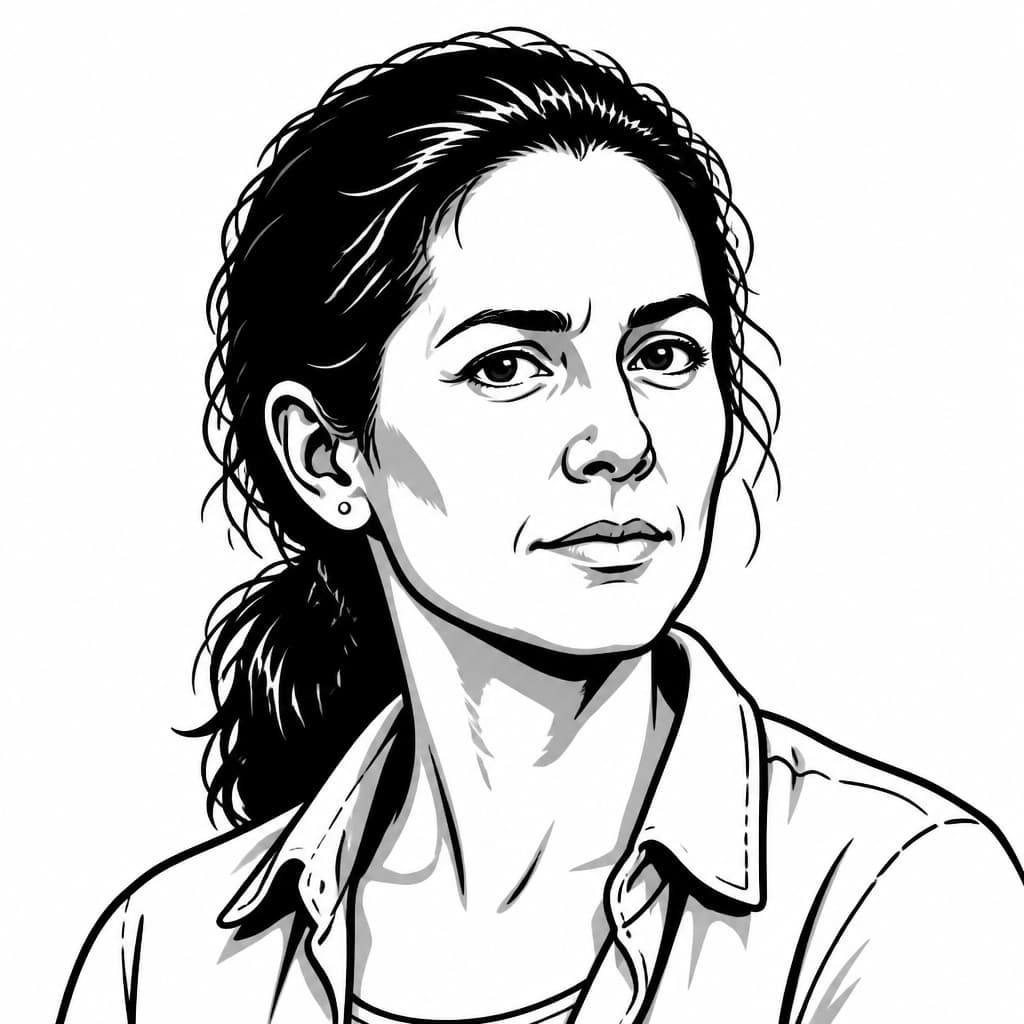
Kira found the first cross at twenty past one in the morning, under the sodium wash of the east bay lights. The amaranth head was wrong. It wasn't damaged. It was new. The Mayo Guegui was supposed to throw a dense, upright fuchsia head with tight architecture and red pith. This one had lateral branches she'd never seen on the variety and a looser seed set, and when she broke the stem the pith was pale green. Something had pollinated it that shouldn't have. Amaranth was wind-carried with open flowers, and Suki's ornamental border along the fence line was forty meters away, which Kira had said was probably fine for a low-wind site.
She photographed it, tagged it, kept moving down the row. By the end she had eleven out of sixty. Almost twenty percent of the seed crop they were bringing to the swap in four hours.
She found Tomás at the pump house, because that was where Tomás was. He was swapping a pressure regulator on the gray-water line, headlamp throwing white across the filter housing, and he didn't look up when she came in.
"We've got crosses in the Guegui block," she said.
"From what?"
"Suki's fence line."
He set the wrench down. "How many?"
"Eleven I can see. Probably more where the pollen took and the plant isn't showing it yet."
"So the whole block."
"The whole block."
He pulled the water bottle off the loop on his belt and drank. Eighty-four degrees at one-thirty in the morning, which counted as a good night. You could work in long sleeves and not soak through in twenty minutes. From the next bay she could hear the drip system cycling: the click of the solenoid, the pause while the line pressurized, the tick of water reaching the emitters.
"Dex is going to say this proves we need the Verdana deal," Tomás said.
"Yeah."
"Because we can't control our own genetics at this scale."
"Yeah."
Tomás had run the irrigation for the Guegui block. Kira had set the isolation distance. Suki had planted the ornamental border because it looked good in photos for the feed. Nobody had made any of those decisions in the same conversation as the others. Five people, no org chart, and every decision belonged to whoever happened to be standing closest to the problem at two in the morning.
The nursery took up a third of an acre on the south side of a decommissioned elementary school in Picture Rocks, thirteen miles northwest of Tucson. The district had consolidated in 2049: not enough kids, not enough water allocation to cover the cooling load. The collective leased the grounds from the county for less than any of them paid for their individual water shares. The building held storage and the seed-drying room, which ran a dehumidifier and a small AC unit and was both their only climate-controlled space and their biggest power draw. Everything else lived outside under shade cloth. Four propagation bays, a packing area, a compost operation that smelled like hot earth and rotting mesquite pods, and a social area consisting of two lawn chairs and a cable spool.
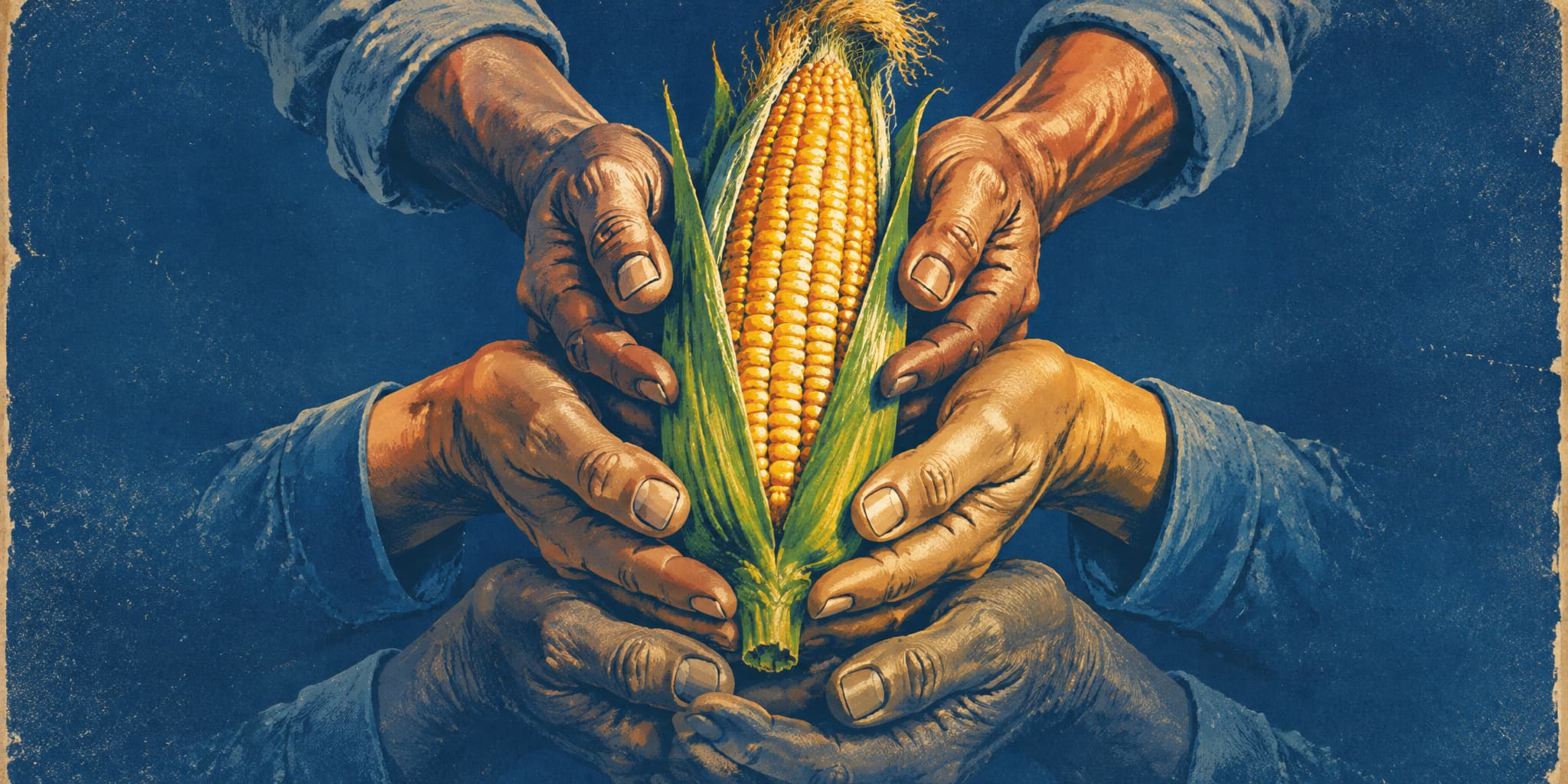
They were three years in. They grew tepary beans, grain amaranth, desert-adapted squash, sorghum for sweet cane and feed, and the thing Kira was proudest of, a corn they'd been selecting out of Desert White Sweet for four generations. They were pushing it toward fewer days to maturity and deeper roots, and it was starting to hold.
The corn was why Verdana Agricultural Systems had called. It was why the swap mattered. It was also what Lupe had been sending to Sonora for eight months without telling anyone.
Dex came out of the seed room at two-fifteen with his phone warm in his hand. He was twenty-six, the youngest of them, with the particular confidence of someone whose parents owned property in Scottsdale and had offered to co-sign the nursery's water-share purchase. The collective had voted to decline, three to two, with Dex abstaining because it was his parents' money and Lupe abstaining because she said the whole share system was a scam. They'd bought the shares anyway, on a payment plan that ate a third of their seed revenue.
"Verdana wants to send someone to the swap," he said to Kira, because she was closest. Suki was asleep in the building. Lupe was in the seed room.
"Send someone to do what?"
"Observe. Meet us. See the material."
"The material." Kira pulled a pollination bag off a tassel and folded it into her vest pocket. "You mean the corn."
"They're offering a licensing fee. It's not a buyout. We keep the seed, we keep growing it, they get propagation rights for their indoor systems."
"And the people at the swap? What do we tell them? The corn's open, except for the part that's licensed to a vertical-ag company in Houston?"
"The license doesn't restrict our distribution. Only theirs."
"Theirs being derived from ours."
"That's how licensing works."
"I know how licensing works, Dex. I also know what people at the swap are going to hear."
He had the grace to look uncomfortable, though not enough to back down. "The number covers our water-share payments for two years."
Kira hated that he'd said it out loud. Two years was the difference between this place existing and not existing, they both knew it, and now it was sitting in the air between them where someone would have to deal with it.
"We should talk about it when everyone's up."
"The swap's at six."
"Then I guess everyone's getting up."
They woke Suki at two-forty-five. She came out with her hair flattened on one side and a filter mask hanging off one ear. She slept in it because the seed-drying room shared a wall with her cot and the dehumidifier wrecked her sinuses. She sat down on the cable spool and said, "This better be about money."
"It's about money," Dex said.
"Good. Because we're three months behind on the water share."
"Two months behind and one month due," Tomás said.
"That's three months of not paying."
"That's two months behind. Words mean things."
"Tomás. I love you. Shut up about the words."
Lupe had come out of the seed room and was standing at the edge of the light with her arms crossed and a length of sorghum stalk in her teeth. She chewed the sweet pith the way other people chewed gum, something her jaw did on its own while the rest of her was thinking. She hadn't said anything yet. Kira had learned that a quiet Lupe usually meant the conversation was about to get rearranged.
Dex laid it out again for everyone. An annual licensing fee, scaled to propagation volume in Verdana's indoor facilities. The collective keeps the seed and the right to sell, trade, and grow it. Verdana builds its own production line from licensed parent material for its Gulf Coast vertical farms in Houston and Baton Rouge, where the corn's response to short days happened to fit their light cycles. Two years of water shares.
"So they'd grow it indoors," Tomás said. "In Houston. Under LEDs."
"People in Houston would eat corn. That's what would happen."
"I don't have a problem with people eating corn." Tomás was looking at the coil of drip line by his feet. "I have a problem with us standing behind our table tomorrow and not being able to say the corn is open-source. Anybody who gets seed from Verdana can't share it forward. That's the whole point of a license."
"That's Verdana's seed. Not ours."
"It's the same genetics, Dex."
"It's a derived line."
"It's the same corn."
Lupe took the sorghum out of her mouth. "It's already in Sonora."
The drip system cycled twice before anyone said anything. Somewhere south of the property a coyote started up, and nobody so much as turned their head.
"What do you mean it's in Sonora," Dex said.
"I've been sending seed to a network in Magdalena. Caborca. Small growers, ejido collectives. People doing what we do without the infrastructure. Since February."
"Eight months."
"Eight months."
"Our seed."
"Corn, tepary, some of the squash."
Kira watched Dex work through it. If the corn was out in open fields in Sonora, crossing with local varieties and getting selected by other people for other conditions, then the line Verdana wanted to license wasn't contained anymore. It was already turning into something else in somebody else's dirt.
"Did you send it under our name?" Suki asked. Kira wouldn't have thought to ask that, and it was the right question.
"I sent it as seed. Not as a brand."
"But they know where it came from."
"They know it came from me. Because I grew it. Because I pollinated it. Because I carried it across in my bag and handed it to people I've known since I was twelve."
"You carried it across the border," Tomás said. "Without a phyto cert." The phytosanitary certificate was the inspection paperwork that said your seed wasn't carrying pests or disease. Nobody at this table had ever gotten one.
"Without a phyto cert."
"Lupe."
"I know."
"If anyone traces that back to us—"
"I know what it means, Tomás."
Dex sat down in one of the lawn chairs, which creaked. He was doing math. Kira could practically see him setting the Verdana money against the Sonora distribution and the legal exposure and the water shares and getting nowhere.
"Nobody voted on this," he said.
"Nobody voted on your Verdana calls at midnight either."
"I've been talking to them. I haven't signed anything."
"And I've been sharing seed. I haven't signed anything either."
"Sharing is an action. Talking is—"
"Talking to Verdana for two months on a work phone is an action, Dex. You just don't want to call it one."
Suki pulled the mask off her other ear and set it on the cable spool. "The swap is in three hours. We have to pack the truck. Can we figure out what we're bringing?"
"That's the same question," Kira said. She hadn't planned to say it, but now she had to finish. "What we bring is what we're telling people this place is. If we bring the corn as open-source, that's one answer. If we bring it as a preview of a licensed product, that's another one. If we leave it home because it's loose in Sonora and we can't vouch for the line anymore—" She stopped. "And the amaranth's out."
"What?" Suki said.
"The Guegui block crossed with your fence-line planting. Twenty percent at least. I found it an hour ago."
Something went across Suki's face, fast. "You said forty meters was fine."
"I said probably fine. For a low-wind site. I didn't account for monsoon gusts pushing pollen that far. I should have said sixty meters. I didn't."
"So we've got no amaranth for the swap."
"We've got no Guegui for the swap. The crossed plants are interesting, actually. Different branching, the seed set looks heavy. But we can't sell something as Guegui that isn't Guegui."
Tomás got up off the pump house step. He was the tallest of them, and standing in front of the bay lights his shadow covered the cable spool and both lawn chairs and Dex in one of them.
"Before we start solving problems," he said, "can I say something? Because we're good at the problems."
They waited.
"I don't have parents in Scottsdale. I don't have family in Sonora. I don't have a plant science degree. I have this." He waved a hand at the pump house, the drip lines, the filter housings. "I keep the water running. If we license to Verdana, they don't need an irrigation tech, they've got engineers. If we turn into a stop on Lupe's network, fine, great, that doesn't pay my water share. And if we stay small and local and open, which is what I thought we were doing, somebody tell me how we do that and also don't lose the lease in March."
The drip system cycled. Nobody had an answer for him, and for once nobody tried to make one up.
"You're not an irrigation tech," Kira said eventually. "You're a founder."
"I'm a founder who fixes pumps. Dex is a founder who talks to corporations. Lupe's a founder who smuggles squash. Suki's a founder who plants ornamental amaranth next to the grain crop. Great. That doesn't answer my question."
It didn't, and Kira knew it. She also knew the corn in the block behind her wasn't hers, even after four summers of her hands in the silk every night, picking which ears set best in the heat, which stalks stayed up in the monsoon wind, which roots went deep enough to find water the drip couldn't reach. Tomás had run the water. Lupe had done half the hand-pollination last year. Suki had kept the records when Kira forgot to. And the original seed had come in a four-dollar packet from a nonprofit seed bank that had kept it going from a cross somebody made in the 1970s, out of somebody else's flour corn, from a community whose name Kira could say and whose history she had no business claiming.
It went back further than any of them could trace, and after today it would keep going: through the swap, through whatever Lupe's growers in Caborca did with it, through whatever Verdana's engineers did in Houston if they ever got their hands on the parent material. Her father used to say the same thing about the aquifer, that everybody pumping from it talked like it was theirs.
They packed the truck at four-thirty. The sky was still black, but the air had changed. It wasn't cooler, exactly. It had just backed off a little, the way the desert did right before dawn. Eighty-one degrees. Kira loaded flats of tepary bean starts, squash seedlings in four-inch pots, and the sorghum seed packets Lupe had weighed and labeled. No amaranth. The corn went in last, in paper sacks, each one hand-labeled: G4, short-season, deep-root, heat-set.
They hadn't decided about Verdana. They hadn't decided about Sonora. They hadn't figured out what to say if somebody at the swap asked whether the corn was open-source, because the honest answer was yes, or yes, but, or we're working on it, depending on who you asked, and those were three different answers.
What they had decided, without anybody calling a vote, was to bring the corn.
Suki drove, Dex up front with her. Kira, Tomás, and Lupe rode in the bed with the flats, feet braced against the wheel wells, warm air pulling at their clothes as the truck turned onto the road. The headlights picked out creosote and palo verde and saguaros. Kira had seen the photos from her father's time, when the saguaros grew lower on the slope and the creosote was thicker and the washes were narrower. The saguaros had been moving uphill her whole life, a few yards a decade, slow enough that you only noticed if somebody had kept the old pictures.
Lupe leaned over and said something Kira couldn't catch over the road noise. Tomás laughed, and it was the first laugh all night that wasn't covering for something.
The swap opened at six, which gave them ninety minutes. Then they'd be standing behind a table with their name on it, and people would start with the easy questions: how does it do in full sun, what's your water input, how many days to maturity. Those they could answer. They'd been out in the rows at two in the morning. They knew this corn.
Kira counted the paper sacks against the tailgate, twice, and started working out what she'd say when somebody asked about the rest.
- Open-source seed pledges: The Open Source Seed Initiative lets growers use, breed from, and sell pledged seed while prohibiting restrictions on anyone else's future access to it or its derivatives.
- Seed rematriation programs: Native Seeds/SEARCH has developed a rematriation policy that returns seed to tribes with direct cultural relationships to a collection, without requiring the recipient to share or return seed later.
- Night agricultural work: A 2026 study of California's Imperial and Coachella valleys found that most farm shifts still began between 5 and 6 a.m. despite the expected benefits of cooler nighttime hours, partly because visibility, ladder work, and crop-quality needs keep some tasks in daylight.
- Cooperative ownership gaps: USDA guidance on how to start a cooperative defines member-owned democratic structure but does not supply a standard rule for allocating breeder credit or intellectual-property rights in a cultivar developed informally by multiple members.
