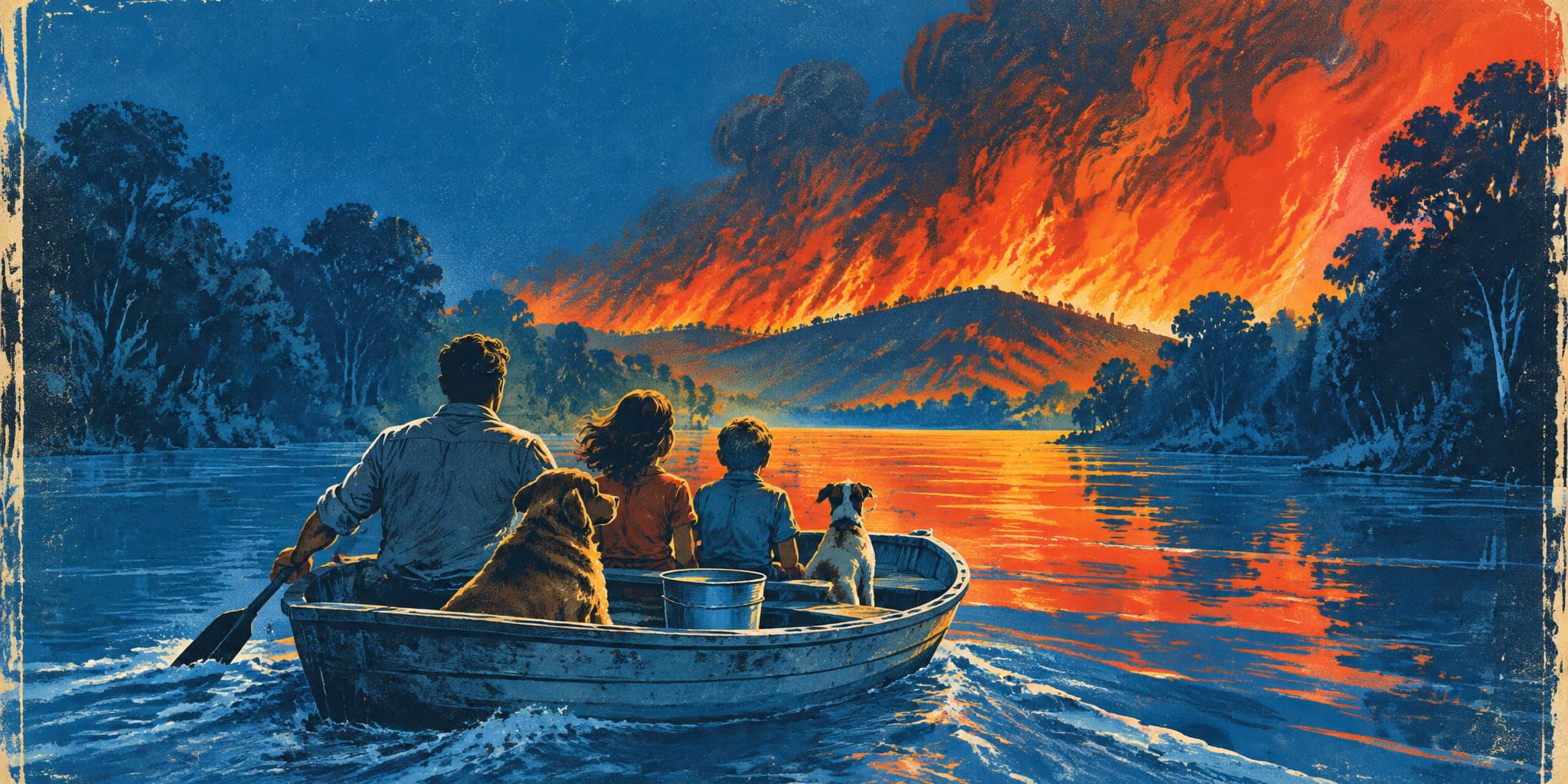
On August 12, Burt Paul loaded his dogs, Oreo and Koda, into a skiff and headed up the Kugkaktlik River. His daughter Caley, 24, came along, and so did their 12-year-old cousin, Preston Evan. The dogs rode between the buckets.
They stopped at grassy sloughs along the way and stepped out to fill metal pails with salmonberries, which the Pauls call naunraq in the coastal Yup'ik they speak. Burt knew where to look. He has been reading the tundra for color and ripeness his whole life. The berries are good for two or three weeks, he told KYUK, and then they drop back to the ground. In a normal year the family camps out for several days, picking and filling containers, and brings home 15 to 20 gallons. This year Burt was working on a village repair crew, so they fit in short trips around his shifts. They came back with one full five-gallon bucket. That was enough for Burt to make his naunraq pie.
"We always been going out as family. Never miss a year."
The family on the river that day was only part of the family that usually goes. Burt's wife and younger children were staying with relatives in Napaskiak, about 90 miles east. Caley had moved to Scammon Bay, 150 miles north on the coast. They had all come back to Kipnuk for the summer, to the tundra and the river and each other, and they would scatter again soon. The younger kids had to leave before school started. Burt would stay behind to keep repairing houses in a village that had voted to leave.
Caley told KYUK it was "heartwarming" to see the community again. Burt said his family's coming departure felt like losing them again.
A Year After the Surge
A year before that berry trip, ex-Typhoon Halong pushed a storm surge into Kipnuk, a Yup'ik village on Alaska's western coast about 500 miles from Anchorage. Before the storm, the population was estimated at 974. Most people evacuated. By late August 2026, tribal council president Daniel Paul counted about 190 people on the ground, some of them out hunting, fishing, and gathering (what Alaskans call subsistence) and some working on infrastructure. The school, Chief Paul Memorial, was closed for a second straight year, and the building had become a base for recovery crews. The Lower Kuskokwim School District announced in August that it would not reopen this year. About 145 students from Kipnuk and the neighboring village of Kwigillingok enrolled in Anchorage schools instead.
In March, the Kipnuk Tribal Council reached 662 of its 799 eligible adult members by phone and asked them something the community had been circling for years, and that the storm had made impossible to put off: should Kipnuk relocate? More than 92 percent said yes. They named two preferred areas near Cicing, a historical settlement about 13 miles northwest. One site is on land owned by a neighboring village corporation; the other belongs to the U.S. Fish and Wildlife Service. Two-thirds of voters chose the inland option, which tribal administrator Rayna Paul said ranges from 40 to 150 feet above sea level. Kipnuk sits at a little over 10.
The Vote and What Comes After
Rayna Paul laid out where that left the community in May, at a roundtable convened by Senator Lisa Murkowski. She told the officials that the state had hired contractors and sent them into Kipnuk for debris cleanup and recovery work "without consultation," which she said "violates our tribal sovereignty." Her larger point went past that dispute. There was no single agency responsible for relocating a community, she said, no current funding source, and no pathway for doing it.
The institutional record bears her out. The federal government does run a community relocation program through the Bureau of Indian Affairs, and it serves 11 demonstration communities. Kipnuk isn't one of them. The Denali Commission, which funds infrastructure in rural Alaska, lists one project for Kipnuk, a bulk-fuel upgrade. FEMA approved a tribal disaster declaration in late May, which makes money available for permanent repairs to damaged public infrastructure. That money is for restoring the village that exists. It doesn't build a new one.
Before the storm, in 2024, the BIA awarded Kipnuk $115,233 to hire a relocation coordinator. The community also had a $150,000 planning grant from 2011 that paid for an engineering study of the erosion, flooding, and thawing permafrost threatening the village. The study recommended stabilizing the riverbank and looked at relocation as a fallback. Neither grant paid for land, housing, a school, a clinic, water and sewer systems, an airport, or roads. So when Rayna Paul spoke to the senators, what Kipnuk had in hand was a 92 percent mandate, a coordinator position, and an engineering study that was 15 years old.
Newtok, the Alaska community furthest along in relocation, has been working on its move for more than 20 years. That's the timeline Kipnuk is looking at.
Keeping a Place Alive
Burt Paul was one of 19 people who stayed in Kipnuk right after the evacuation. He had taught Yup'ik language and culture at Chief Paul Memorial, and for roughly seven months he and Benjamin Kugtsun slept in his classroom while they worked with recovery contractors.
His reason for staying was practical. Everyone understood the move would take years, so the old village had to keep working as a place where people could live while they waited. What does that look like with 190 people in a place built for nearly a thousand?
A September 1 operations log from state contractors gives some idea. It lists 85 contractor and recovery-team members on site, running the power plant, delivering diesel, hauling water and septic waste, straightening power poles, drying out homes, collecting debris, and repairing foundations, porches, and boardwalks. Nearly every basic service depended on outside crews showing up to do it each day.
Other things are harder to pin down. The health corporation's directory lists a village clinic with normal hours but doesn't say whether it has been fully staffed since the storm. The post office was still standing as of June, though the Postal Service had told displaced residents the October before to collect their mail in Anchorage or file changes of address. The public record doesn't say whether the store is open, whether home internet works, or whether every occupied house has reliable heat. In the recoveries I've covered, the details nobody writes down — a working freezer, a stove you can count on, a way to buy groceries — are often what decide whether people can actually stay.
What Thins
David Martin of Kipnuk, in a cultural account written by community members, describes berry picking as one part of a seasonal round. After summer fishing and berry gathering, families historically moved to fall camps as freeze-up began. The berry trip belongs to that sequence, fishing into gathering into hunting into the freeze, each activity preparing for the next and each practiced on land that families have known for generations.
My grandmother farmed terraces in the Guatemalan highlands. What she knew went beyond which seeds went in when. She read soil and weather and season on one particular piece of ground, and she learned that the way she taught it, by working beside someone. You can't get it from a book. When Burt Paul reads the sloughs from his skiff for ripe naunraq, he is using knowledge his family has built in this one place over a very long time. Preston, at 12, was right there with him, filling buckets.
The limits on that trip show what scattering costs in practice. In a normal year the Pauls camp for days. This year Burt could only get away for short outings between repair shifts. Elsewhere in the village, Raymond Egoak had returned to his house but couldn't store much of his harvest because his chest freezer was still broken. Leona Paul came back planning to pick berries and spent her two weeks cooking for the rebuild crews. The subsistence season and the recovery work were pulling on the same hours, the same people, and the same short stretch of good weather.
In the Kuskokwim Delta, subsistence is how families feed themselves. It is also how knowledge moves from one generation to the next and how people stay connected to a place. When the people who practice it are spread across 500 miles, with kids in Anchorage, parents in Napaskiak, and elders in a village kept running by contractors, all of that wears thin, a little at a time, in ways that are hard to measure and easy for outsiders to dismiss.
Five Hundred Miles from the Berry Patch
In November 2025, a few weeks after the evacuation, the Associated Press found 10-year-old Ellyne Aliralria in Anchorage, where she had enrolled in a Yup'ik immersion program at a local school. She told the reporter the dialect there was somewhat different from the one she knew. Her family was living in a motel, nearly 500 miles from home.
"We're homesick."
How she is doing a year later hasn't been publicly reported, and the same is true for most of the displaced students. The Anchorage School District's back-to-school message in August said "many" displaced students were continuing in Anchorage schools, but it published no roster, no school-by-school count, and no breakdown by village. Anchorage staff described helping families with bus routines, registration at shelters, translation, and technology. That tells you something about the district's effort and not much about what any one child is going through.
For the Paul family's younger children, the record is spare: they stayed with relatives in Napaskiak and were among the kids expected to leave Kipnuk again before school started. Which schools they attend, how they're doing, what language they hear in the hallway — none of it is public. As this publication has noted before, when displaced families manage to improvise well, their competence can end up covering for the system. Quiet doesn't mean it isn't costing them anything.
A Place to Wait Together
At the Murkowski roundtable, Rayna Paul made a specific proposal: an interim village, coordinated by the tribes and backed by several agencies, where people from Kipnuk and Kwigillingok could live together while the long-term relocation moved forward. She wasn't asking for faster repairs to individual homes. She was asking for a shared place to wait, run by the communities themselves.
Anyone who has watched a neighborhood get displaced will recognize what she meant. Living close together is what makes so much of daily life work: trading off childcare, sharing meals, a school where your kids learn in your language, an elder who knows which slough has the best naunraq. When people get pulled apart, that knowledge stops passing between them. The seasonal round loses the people who carry it out, and the collective will that produced a 92 percent vote starts to wear down.
The public record doesn't show whether any agency has acted on her proposal. Kipnuk has articulated what it needs. The federal system has no existing program to provide it.
What Holds
Burt will stay through the winter to keep repairing houses. His wife and younger children will be in Napaskiak, and Caley in Scammon Bay. Preston will be in a school somewhere other than Chief Paul Memorial, a long way from the sloughs where he filled buckets this August.
The Pauls' berry trip leaves a question they can't answer on their own: will the community that voted to relocate still be a community by the time a new site exists? A decade is plenty of time for Preston to grow up somewhere else, for the elders who know this land best to age out of the seasonal round, and for kids raised in Anchorage to build lives that don't lead back to a village on the Kugkaktlik.
Kipnuk has a documented tribal decision, a preference between two sites on land that belongs to other owners, and a coordinator position. It does not yet have a lead agency, a land agreement, an environmental review, a construction budget, or a timeline. The people who voted to move are waiting for institutions to catch up with a decision they've already made, and the longer the wait runs, the further apart it pulls them.
If they can, they'll be back on the river next summer. Burt's family has never missed a year.
-
Schools reopen or don't: The Lower Kuskokwim School District said its next status update on Kipnuk and Kwigillingok schools is scheduled for November 1, which will determine whether families face a third year of dispersal for their children's education.
-
Land for the new site: The tribe's preferred relocation area sits on land owned by Chefornak's village corporation, and no public record yet confirms whether the corporation has agreed to convey it or what terms a transfer might involve.
-
Federal relocation pathways: The BIA's existing community-driven relocation program serves 11 demonstration communities and does not include Kipnuk, leaving open whether the program will expand or whether Kipnuk will need an entirely different institutional route.
-
Kwigillingok's parallel path: The neighboring village also voted to relocate after Halong, and KYUK has reported that repair work there is underway even as residents say the old site isn't the way forward, raising the same tension between restoring what exists and building what comes next.
