The Underline, Chapter 4
Dez heard the truck before he saw it. Pia's rig usually threw a belt squeal you could pick up at a quarter mile, and tonight it came in quiet. So either she'd fixed it or this was someone else's vehicle, and at eleven at night in Lapwai, Idaho, someone else's vehicle was a problem.
She'd fixed it.
She sat behind the wheel for a count of ten before she cut the engine. Dez had driven enough miles with her to know that pause. Tired, or putting together what she was about to say. With Pia it was usually both.
"Twelve pounds sorghum, two amaranth." She came around the tailgate with a canvas bag held in both arms and didn't bother with hello. "Cass weighed it before packing. I didn't open anything."
Eight hours of highway, the seed riding in the cab with her. She'd run the heater for part of the drive and then shut it off, because she wasn't sure what grain wanted.
Dez ran the numbers while she crossed the lot. The seed had been sitting in Cass's cold room in Toppenish, Washington, which wasn't cold anymore. Fifty-eight degrees, last Cass reported. Then a truck cab that went warm, then cool, then whatever eastern Oregon let in through the door seals. Now here, thirty-nine outside and dropping. Every one of those swings cost the seed a little. How much it could lose before it was just something to put in a jar on a windowsill, you couldn't tell by looking.
"Bring it in," he said.
The back room of the community building had a folding table, fluorescent tubes that buzzed at the exact frequency of a committee meeting, and a space heater doing what it could. Sixty degrees. Fine for people. For seed, nobody could say.
Inside the canvas bag were two sealed plastic bags, labeled in Cass's handwriting, which was so even it looked like she'd used a ruler for the baseline.
The sorghum label gave weight, source containers, and pack date. Twelve point three pounds.
Dez read the amaranth label twice. Two point one pounds, from the personal collection of a grower named Fern. Last germination test: 91%, May 2026.
So five months ago, in a real test, nine out of ten of these seeds had sprouted. That told him nothing about what they'd do now, after weeks in a room that kept getting warmer and a day in Pia's cab. A germination number goes stale, and this one had been going stale at fifty-eight degrees.
"Cass said you'd know what to do with it," Pia said.
"Cass is twenty-three."
Pia went back out for the contactors. Two electrical switching parts, each about the size of a deck of cards, wrapped in bubble wrap. They were the whole reason Dez had said yes. His walk-in cooler was the only cold storage he could get into without someone from the tribal council or the co-op standing at his elbow, and its compressor was dead because two contactors had burned out. With these he could bring it back. Right now the walk-in held donated produce and the clinic's backup insulin, coasting on residual cold and good insulation at thirty-eight degrees. Thirty-eight was also about right for keeping seed long-term.
The problem was obvious enough. Anybody who opened that cooler would see the bags, and Dez would need a story for them that left out Toppenish, Cass, and the fact that this seed had crossed a jurisdictional line it was never supposed to cross.
He turned the contactors over. Right voltage, right amperage rating. He could put them in Monday. Columbus Day, which nobody in Lapwai called Columbus Day, but the USDA field office down the road would be closed either way, and that meant no federal trucks doing their usual loop past the building. A holiday for the guy who started the whole trouble, buying him a quiet morning to wire a compressor. There was an irony in there somewhere. He didn't have time for it.
He smelled the sorghum first. It's the oldest diagnostic there is and the least precise, and it's the one Dez trusts most, because he has thirty years of calibration on it. Good dry grain smells flat and a little sweet, like dust that remembers sugar. Grain that's pulled in moisture smells sour. Moldy grain smells like a basement.
This smelled clean. The seeds were hard and smooth under his fingers and didn't clump. He saw no mold and no insect damage.
The amaranth was harder. Each seed is smaller than a pinhead. You could lose a hundred of them in a shirt pocket and never know. They smelled like nothing, which was what they should smell like, but they were too small to judge by touch or by eye.
"You have a magnifying glass?" Pia asked.
"I have reading glasses and a flashlight."
What he needed was a moisture meter, which reads how much water is inside the seed. Seed stored too wet will rot, or just quietly die, even in the cold. You can also get at moisture with a good scale and an oven, or by sealing seed in a jar with a humidity gauge and waiting overnight. Dez had none of that. He had his hands and his nose and three decades of growing food on ground that was working hard to stop being farmland.
"Feels dry. Smells dry." He set the bag down. "If it's dry enough, the cold will hold it. If it's not, I have to dry it first, and I don't have the equipment."
Pia suggested rice. He thought about it. Slow, uneven, and no way to check whether it had worked. The kind of fix that makes you feel useful and leaves you exactly as ignorant as before.
Silica gel would be better, the little desiccant packets that come in shoe boxes and electronics. He could get some from Marcie at the county extension office. Marcie ran a seed-sharing program through the university system, not the federal one, so she might be in Monday regardless of the holiday. Extension keeps its own calendar. She'd been at it six years, and she didn't ask questions she didn't want answered.
"And if she does ask?" Pia said.
"Then I'm a grower who got seed from a friend and wants to check it before spring. Which is true."
"It's true if you take Cass's name off the labels."
He looked at the bags. Cass's tidy handwriting. Container numbers from the Toppenish cold room. Fern's name on the amaranth. A chain of custody in ballpoint, tying this seed to one specific storage facility, one specific unauthorized trade, and one specific twenty-three-year-old who'd made the call without telling her boss.
He'd been moving too fast to see it.
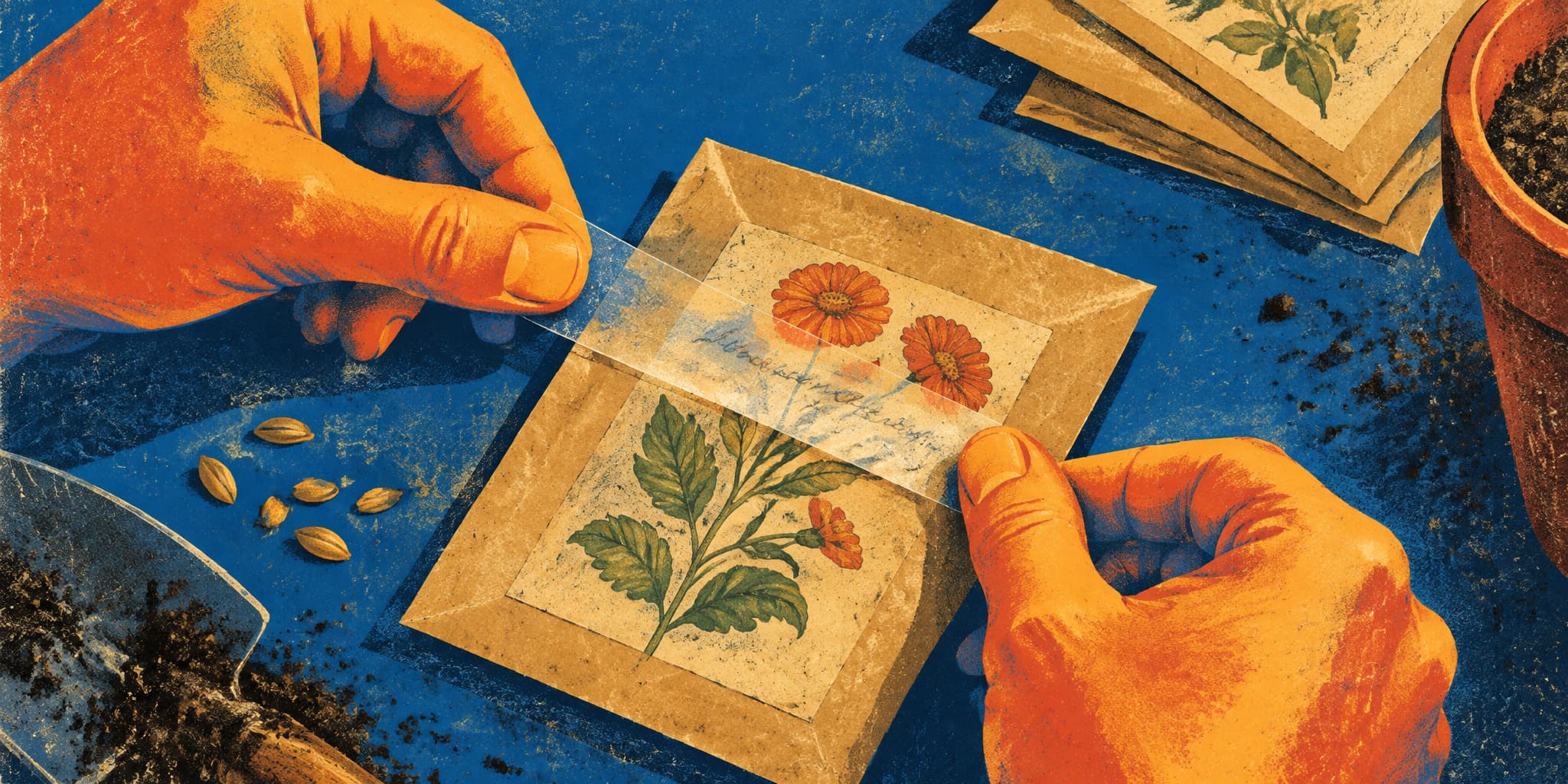
He found masking tape and a marker and wrote new labels: Sorghum, 12 lbs, received 10/11/26. Amaranth, 2 lbs, received 10/11/26. He pressed the tape down over Cass's labels. He didn't peel hers off. Anybody who lifted the tape would find the originals underneath, whole.
Pia watched him do it.
"That's not nothing," she said.
"No."
Pia left at 11:40. Dez counted out twenty sorghum seeds and ten amaranth and set them on the table and looked at them for a while.
Any seed he tested was a seed he'd never plant. If this was the last living stock of Fern's amaranth line, and he had no idea that it wasn't, then each of those ten was a piece of something nobody could make again. A germination test uses up what it tests. You find out the seed is alive by letting it sprout in a paper towel instead of in soil, and then it's done. It never becomes a plant, and it never makes more seed.
He wrapped them in damp paper towels, sealed the towels in plastic bags, and set them on top of the water heater in the hallway. Seventy-two degrees, give or take. Warm enough that the sorghum should do something in a few days. Amaranth wants seventy to seventy-five to germinate and can stall out below fifty, so if the building lost heat overnight the amaranth might just sit there, and he'd have no way of telling dead seed from cold seed.
He wrote in his notebook: Started 10/11, 11:40 pm. 20 sorghum, 10 amaranth. Damp paper towels, water heater surface, approx 72F. No control batch. No replicate. Not AOSA protocol. Indicative only.
A real germination test runs on calibrated equipment with controlled, alternating temperatures and enough seed to mean something statistically. Federal protocol is four replicates of fifty. This was a paper towel on a water heater. At best it would tell him whether any of the seed was still alive, and even that would come with an asterisk. Alive, able to sprout when you baby it, and able to make a crop in actual dirt are three separate questions, and tonight he could only start on the first.
Reyes used to say that a tool whose mistakes you understand beats an accurate instrument you haven't learned yet. Dez wasn't sure a paper towel counted as a tool. It was the only way he had to ask.
He put the seed bags on the top shelf of the walk-in, behind the insulin box. The compressor was still dead, but the walls would hold until around noon if nobody opened the door.
So that was four clocks. The cooler warming toward noon. The call about Marcie, due Monday. The germination results, Thursday or Friday at the soonest. And under all of them, the question of when somebody on either side of the line, Della in Toppenish or the council here, would notice that seed had gone one way and parts had gone the other and nobody with the standing to sign off on it had signed off on anything.
The cooler was the fastest. Dez picked up a screwdriver.
Cass couldn't sleep. She'd checked the cold room twice since midnight. Fourteen point eight Celsius, about fifty-nine Fahrenheit, up from two days ago. Forty-five containers on the shelves, down from forty-seven. She'd spread the rest out to close the gaps.
She hadn't told Della. Della ran the seed program, and Della would have said no. The logic of the trade was fine and Della would have seen that: seed you can't keep cold, traded for the parts that keep everything else cold, and now the same genetics live in two places instead of one, which is how you survive one place failing. Della would have said no because she'd want that seed as a bargaining chip in some negotiation Cass only half understood and didn't have time to wait out. Della was always thinking about where everybody stood. Cass was thinking about the thermometer.
Walking home she'd passed the community garden. Butternut squash still on the vines. Nobody had put together a harvest crew, and Cass had been too buried in container inventories to do it herself. It would freeze within the week. She'd looked at it for a second and kept going.
She thought about calling Dez and didn't. A phone call wasn't going to change the moisture in the grain or the temperature in his cooler. It would just let her feel like she was doing something, and lately she'd gotten better at telling that feeling apart from the real thing. Mixing them up was how she'd made most of her worst mistakes.
She set an alarm for six and lay down in her clothes.
Fern's amaranth. Fern had grown it out season after season, picked the plants worth keeping, saved the seed. Fern didn't know it had left the building. Cass had decided that by herself. She'd moved someone else's years of work across a line it wasn't meant to cross and taken on whatever she owed for that, without stopping to ask if she was the one who got to carry it.
That could wait until Thursday, when the seed answered, by way of damp paper towels on a stranger's water heater four hundred miles east.
She checked the alarm again. Then she got up, found her jacket, and walked back to the cold room to read the thermometer one more time.
- Seed storage under stress: USDA's National Laboratory for Genetic Resources Preservation documents the protocols for maintaining seed viability in cold storage, including the moisture-temperature relationship that makes a warming room dangerous even before mold appears.
- Arizona's water bank reversal: The Arizona Water Banking Authority spent decades storing unused Colorado River water underground and is now shifting toward recovery as the first major CAP shortage year approaches in 2027 — a transition where credits on a ledger must become water at a tap.
- Federal germination standards: The federal seed-testing rules under 7 CFR Part 201 specify that a sorghum germination test requires alternating temperatures and a ten-day final count, which is why a paper-towel screen on a water heater can suggest life but can't substitute for the real thing.
- Post-fire exposure persists: A 2026 peer-reviewed Maui cohort study found elevated urinary metals and associated lung-function changes six to eighteen months after the 2023 fires, evidence that a wildfire's visible ending and the body's exposure calendar don't match.
