
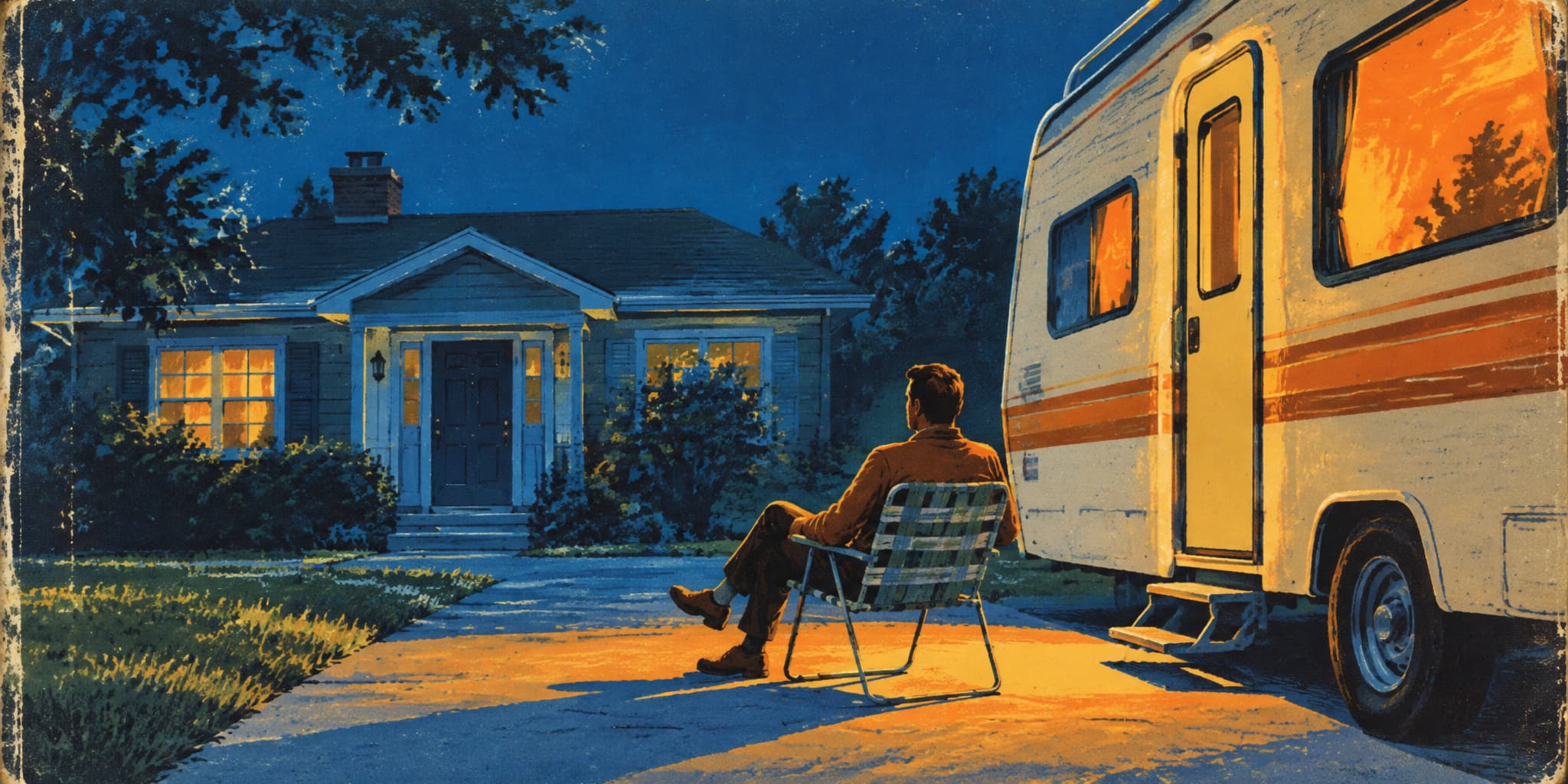
Most of the houses on Kareem Ali's cul-de-sac in Altadena are gone. What's left is foundations, cleared lots, the occasional chimney. His house is one of the few that made it through the Eaton Fire in January 2025. Last August, he and his wife moved into a donated RV parked on their property, twenty feet from the house they still can't live in.
Ali owns the home and holds the insurance policy. He has the legal authority to file the claim, hire contractors, and direct the work. What he doesn't have is the money to act on any of that while his insurer disputes how much work the house actually needs.
State Farm covered temporary housing from January 2025 through April 2026, fifteen months in all. Then the company declined to reimburse the $8,000 monthly rent on a one-bedroom apartment that, according to Ali, State Farm itself had recommended. He stopped paying. After three months of unpaid rent, he and his wife moved into the RV.
Paying to prove what happened to your own house
Ali asked State Farm to pay for environmental testing, the professional assessment that shows whether smoke, ash, and fire debris left behind contaminants like heavy metals, asbestos, or volatile chemicals. The company said no. He paid $3,000 out of pocket, which lines up with Pasadena Public Health's estimate of $3,000 to $5,000 for assessing an unoccupied home, depending on its size and how many rooms get sampled.
He says State Farm then refused to reimburse him and delayed or denied further cleanup work. The public record doesn't say what his test results showed or what his consultants recommended. That information is in a claim file that's still in dispute.
Ali and his wife took the money from their personal-property claim, meant to replace belongings lost in the fire, and hired contractors themselves to clean, pull out insulation, and replace carpet. The money ran out before the work was finished. The house now sits mid-remediation, partly stripped and partly cleaned, and not cleared for anyone to live in.
He told CalMatters his claim has gone through at least six or seven adjusters. With each handoff he walks the new person through the whole history, then waits while they catch up on a file that's been growing for almost two years.
A renter like Gil Barel can't act because she doesn't control the building. Ali's position is different. He controls his claim and his property, and he's used that control: he paid for testing, hired contractors, and is disputing his insurer's decisions. But he can't keep paying for all of it long enough to finish while the insurer holds the money.
What State Farm says, and what regulators found
State Farm has said it "strongly disagrees" with how Los Angeles County has characterized its wildfire claims response. The company says it has paid more than $6.2 billion on 2025 Los Angeles fire claims, about $1 billion of that for smoke damage, and has closed roughly 78 percent of claims. It says it evaluates each smoke claim on its own facts, professional assessments, and the policy's coverage.
The California Department of Insurance's own examination reached different conclusions. A regulatory review of 220 State Farm claim files found 398 alleged violations across 114 of them, including missed deadlines, repeated adjuster reassignment, failure to issue required written denials for environmental testing, and misclassifying testing costs. Smoke claims accounted for nearly half of the consumer complaints in the material examiners reviewed.
In August, Los Angeles County filed a civil complaint alleging that State Farm discouraged or denied environmental testing, refused to reimburse policyholders who paid for their own, and sent preferred vendors whose cleaning didn't deal with lead, asbestos, or other contaminants.
These are allegations in pending litigation and a regulatory action, not findings a court has ruled on. State Farm maintains that every remaining claim is being handled according to its facts and policy terms. The dispute is real and unresolved, and it bears directly on whether Ali's home gets remediated or whether he stays in the driveway.
Two laws, arriving in January
Two bills signed September 15 change the rules for smoke-damage claims. AB 1795, the Smoke Damage Recovery Act, presumes that contamination in a surviving home within the fire zone came from the wildfire, which puts the burden on the insurer to prove otherwise. It makes insurers responsible for the testing needed to restore a property and clear it for occupancy, subject to the policy's terms and provisions. It also bars insurers from cutting off temporary housing payments until the home is restored and cleared under applicable standards. That obligation still runs into the policy's coverage limit, though, so a household that has used up its temporary-housing cap isn't protected.
AB 1642 sets out what those clearance standards are. It begins with interim rules for lead and asbestos tied to existing federal thresholds. Standards for other contaminants, including heavy metals, dioxins, and volatile organic compounds, won't exist until state agencies write them, and some of those deadlines run to December 2029.
Both laws take effect January 1, 2027.
AB 1642 sets interim clearance thresholds for lead and asbestos in January 2027. Standards for other contaminants — heavy metals, dioxins, volatile organic compounds — await agency rulemaking with deadlines as late as December 2029.
The timing matters for Ali in two ways. First, the law's testing and payment requirements explicitly apply to claims "that occur on or after" the date it takes effect. His loss happened in January 2025. Legal-aid attorneys are still looking at whether the new rules will govern a claim like his that's still open, and the answer may depend on which section of the law someone invokes and how regulators read it.
Second, even if the law does cover his claim, the clearance standards it relies on are incomplete. Lead and asbestos get interim thresholds in January, and everything else waits on rulemaking that could take years. Ali has test results he paid for himself. Figuring out what they mean, what concentration counts as safe, how much remediation is enough, when the house is cleared to live in, depends on standards that mostly haven't been written.
Thirteen thousand claims, one driveway
Ali's six or seven adjusters aren't just bad luck. The California Department of Insurance estimates that more than 13,000 claims from the January 2025 fires involved standing homes with smoke damage. That volume helps explain why files get passed around, why each new adjuster starts over, and why a claim opened in January 2025 is still open in October 2026. The Docket has covered a similar case in Spokane, where a homeowner whose house survived fires in August 2026 couldn't confirm it was safe for her infant. The LA fires opened the same gap, on a scale nobody planned for.
Not all 13,000 homes are unlivable, and not all of them have been tested. But the number points to a kind of damage that emergency systems, insurers, and disaster law are all still catching up to: a home that survived the fire with contaminants from the burn — heavy metals, asbestos, volatile chemicals — embedded in its dust, insulation, and ductwork.
The law arrives in January. Nobody can say yet whether it reaches back to a loss from January 2025, or whether the standards it sets up will be far enough along to settle a claim like Ali's. During the legislative debate, some people testified that the future standards wouldn't come in time to help them. Ali has been out of his house for twenty-one months, and for the last two of them he's been sleeping in an RV twenty feet from his front door.
