
Two new studies suggest wildfire smoke strains the cardiovascular system over weeks and months, and medicine hasn't caught up to what that means for the people living through it.
In Medford, Oregon, wildfire smoke pushed the Air Quality Index past 101 on 27 days in 2021. That's the federal threshold for "Unhealthy for Sensitive Groups." Bend averaged about two weeks of those days per fire season from 2020 to 2024. The days rarely come in one block. They scatter across July, August, September, and more and more into October: a few bad days, a break, then the smoke settles back in.
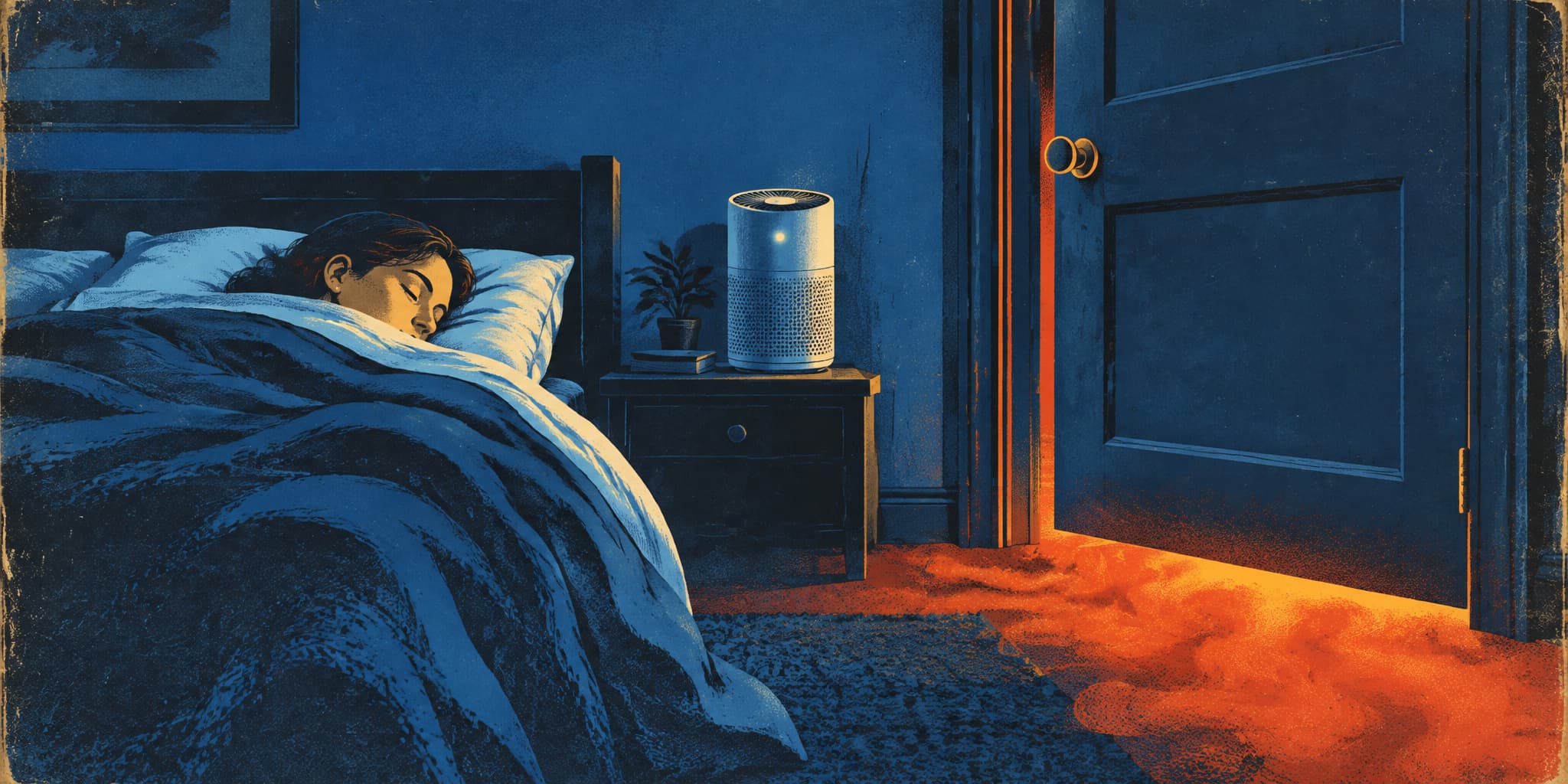
Picture that season for someone managing heart failure in a place like Medford. They rent an older unit with single-pane windows and no central air. There's a portable HEPA purifier in the bedroom, because the bedroom was the one room they could afford to protect. At a spring appointment, their cardiologist told them to stay inside on bad days and watch for symptoms. So every morning they check the AQI on their phone, the way someone with a basement that floods checks the forecast. But the number on the screen comes from a monitoring station across town. It says nothing about the bedroom where the purifier runs, or the kitchen where it doesn't, or the pharmacy parking lot where they pick up their diuretic. And "stay inside" assumes inside is safe: that closing the windows keeps smoke out without trapping heat in, that one purifier can cover more than one room, that the electric bill for running it all season is something they can absorb.
For this person, the season has no clean start or finish. It's weeks of decisions made with very little guidance, in air nobody is measuring where they actually breathe it.
Most people who think of wildfire smoke as a health problem think about lungs: coughing, asthma attacks, irritated airways. Two recent studies found the damage reaches the heart.
What the research found
A study in Nature Communications looked at hospitalizations across 20 U.S. states and compared them against two-year averages of wildfire-specific PM2.5. That's the fine particulate matter in smoke, particles small enough to pass from the lungs into the bloodstream. Higher smoke exposure tracked with more hospitalizations for asthma, which researchers expected. It also tracked with more hospitalizations for heart failure, ischemic heart disease (when narrowed arteries reduce blood flow to the heart), cerebrovascular disease (conditions affecting blood flow to the brain, including stroke), and irregular heartbeat.
A study in Scientific Reports followed 109,000 patients through the 2020 and 2021 fire seasons. Weeks with higher wildfire PM2.5 brought more medical encounters for heart attacks, cardiac arrest, heart failure, and flare-ups of COPD, or chronic obstructive pulmonary disease, a condition that makes breathing progressively harder.
Neither study can say smoke caused any one person's hospitalization. Both are observational, tracking patterns across large populations. Still, the patterns are consistent and they point the same way. Fire season may work as a sustained stress on the cardiovascular system, with effects that build over weeks instead of coming and going with a single plume.
A harder kind of particle
One finding from the Nature Communications study asks you to keep two facts in mind at the same time.
The first is that wildfire PM2.5 showed stronger associations with hospitalizations, particle for particle, than the everyday PM2.5 from traffic, industry, and power plants. Smoke is a different chemical mixture. It carries residue from burned vegetation, soil, and sometimes houses and other structures, and the data suggest it may be harder on the body per unit of exposure.
The second is that on an average day, non-wildfire PM2.5 ran roughly 20 to 27 times higher than wildfire PM2.5. Over a full year, the sheer volume of ordinary pollution still accounts for the larger share of harm across the population.
During fire season, that ratio flips. Smoke goes from a small fraction of what's in the air to the main source. For someone with heart disease in Bend or Medford or the Sacramento Valley, the smoky weeks are weeks when the air shifts toward something the research suggests does more damage per breath. There's more pollution overall, and it's a different kind.
The number on your phone describes air you're not breathing
Both studies relied on outdoor air quality measurements. The people whose hospital visits they counted spent most of their days breathing indoor air, in homes sealed and filtered and ventilated to very different degrees, moving between rooms, cars, pharmacies, and porches.
Most people spend smoke season somewhere between the measured air and the breathed air, and that distance is bigger than most of us assume.
EPA guidance estimates that with windows and doors closed and no purifier running, indoor particle levels usually sit around 55 to 60 percent of outdoor levels, though they can range from 30 percent to nearly 100 percent depending on the building. A study of seven Seattle homes during the 2020 smoke season found that without purifiers, the share of outdoor smoke getting in ranged from 33 to 76 percent between homes in the same city. With HEPA purifiers, machines that use dense filters to trap fine particles, the average dropped to 19 percent, and it still varied from house to house. A study of more than 1,400 California buildings found that on fire days, the share of outdoor smoke making it inside fell by about half compared with non-fire days, probably because people shut windows and ran filters. Indoor smoke levels nearly tripled anyway, because the air outside had gotten that much worse.
Back in Medford, this is what the arithmetic of a real day might look like. The AQI reads 160. In the bedroom, where the purifier ran all night, the air might be around 30. In the kitchen, out of its reach, maybe 80. In the car on the way to a cardiology appointment, 50. In the clinic parking lot, 120. Those numbers don't show up on any app, and no study has followed cardiac patients through exposures like these over an ordinary day.
A similar problem turned up in Maricopa County, Arizona. County-level air conditioning statistics looked fine, while people were dying in rooms where the unit was broken, cost too much to run, or wasn't in the room where they slept. The county figure described conditions that didn't exist where people actually were. Smoke works the same way. The AQI is accurate data about outdoor conditions. How far the air in a given room sits from that number depends on how old the building is, what equipment the household can afford, and whether they can pay to run it all season. In a rental with single-pane windows and no central HVAC, the indoor air may not be much better than what's outside.
When closing the windows becomes its own risk
During smoke, the instinct is to seal up: windows shut, doors closed, purifier on. But EPA guidance warns that in buildings without air conditioning, closing everything during a heat event "may be hazardous." A sealed home holds heat.
A 2026 study of 5.9 million cardiovascular deaths across six countries found that days combining heat waves with heavy wildfire smoke produced more heart-related deaths than days with only one condition — with the strongest effect for heart failure.
A 2026 study of 5.9 million cardiovascular deaths across six countries found that days with both a heat wave and heavy smoke brought more heart-related deaths than days with only one of the two. The effect was strongest for heart failure. The researchers used outdoor data and couldn't see what people did inside their homes. Even so, the study backs up what anyone who has lived through a hot, smoky day already suspects: each hazard makes the other worse.
For someone renting without air conditioning, that sets up tradeoffs no app or guideline sorts out. A purifier cleans the air but does nothing to cool it. Opening windows at night to cool off matters, because the body relies on nighttime cooling to recover from daytime heat stress, yet it lets smoke in during the very hours when the heart most needs to recover. Running a purifier and a window AC unit together takes electricity that may be unreliable during fires and expensive over a whole season. Every option trades one risk for another, and the person weighing them is usually doing it without clinical advice specific to their condition.
Schools built smoke protocols. Cardiology is still writing them.
Some institutions have already accepted that smoke season comes every year and needs standing preparation.
California's school air quality guidance, updated in October 2024, tells schools to move outdoor exercise indoors when the AQI reaches 101 to 150 and to cancel it above 150. It recommends upgrading building air filters to MERV-13, a rating that catches finer particles than standard filters, and putting HEPA purifiers in classrooms. Portland Public Schools formalized a smoke plan in August 2023, and had started placing purifiers in classrooms and upgrading filters two years before that. Whether those protocols are fully funded and carried out in every school building is a separate question. But the districts decided to treat smoke season as something that recurs, and they set thresholds, bought equipment, and wrote plans so staff wouldn't have to improvise each summer.
Cardiovascular medicine hasn't reached that point. The 2023 chronic coronary disease guideline from the American Heart Association and American College of Cardiology calls it "reasonable" for heart patients to limit their exposure to air pollution and says clinicians should consider a patient's environment. A January 2026 joint statement from major cardiovascular societies in the U.S., Europe, and around the world names wildfires as a danger to the heart and calls for new clinical guidelines. In July 2026, the American Heart Association put out an advisory on the combined risk of smoke and heat.
What's missing is the guidance a cardiologist could actually use: when to add check-ins during smoke season, whether to adjust diuretic doses, how to advise a patient on activity at specific AQI levels. None of that has been written. The AHA's own statement on PM2.5 protection says it doesn't suggest over-the-counter or prescription medications as protection against fine particle exposure. The professional societies have said publicly that this is a problem. Turning that into clinical practice is work that still hasn't been done.
So the burden lands on patients and their families. Someone managing heart failure in a place like Medford is told to stay inside on bad days and watch for symptoms. The advice is sound as far as it goes. It also leaves every specific call to the person least equipped to make it, often in a home whose construction they had no say in: which room to stay in, whether the purifier is doing enough, whether the pharmacy trip is worth the time in the parking lot, whether to open the window when the bedroom hits 85 degrees at midnight.
The research describes fire season as weeks of sustained strain on the heart. Clinically, it's still handled like bad weather, something to wait out indoors. In the meantime, a person in an older rental checks a number on their phone that describes the air outside, weighs it against the heat building up in the bedroom, and makes a decision that, if these two studies are right, matters more than anyone has told them.
- Heat plus power failure: A New York State study found that flooding and power outages together produced stronger cardiovascular hospitalization associations than either exposure alone, with effects concentrated among adults over 65, rural residents, and Medicaid-covered patients.
- Fire weather projections diverge: A September study found that observed atmospheric drying was largely absent from the downscaled climate models used to project future western U.S. fire weather, meaning near-term smoke-season forecasts may substantially underestimate what's coming.
- AC protects populations, not necessarily households: A county-level study estimated that current air conditioning use averts roughly 5,200 heat-related deaths annually in the contiguous U.S., but measured county averages rather than whether individual households could afford, maintain, or actually operate their equipment.
- Smoke and heat mortality interact: A six-country cardiovascular study found the strongest combined smoke-and-heat association for heart failure deaths, reinforcing that the two exposures need to be understood together rather than as separate seasonal risks.
